
MCAT-120 · Lesson 3 of 12 · 27 min
Intermolecular forces and phases
▶ Video coming soon A video version of this lesson is on the way.
Ezequiel opened the session with a story from his EMT years. On a winter call, a patient's skin had been wet from the snow, and his partner had insisted on drying the patient before anything else. 'Evaporation pulls heat,' his partner had said. Thandiwe liked the example so much that she wrote it at the top of the slide. 'Every phase change is a story about intermolecular forces and energy,' she said. 'Molecules stick together because of attractions between them. To pull them apart you pay energy, and that energy comes from somewhere, often from your patient.'
This lesson covers the intermolecular forces (London dispersion, dipole-dipole, hydrogen bonding and ion-dipole), how they set boiling and melting points, vapor pressure, viscosity and surface tension, the phases of matter, heating curves and heat calculations, and phase diagrams. On the AAMC outline these topics fall in content category 5B (nature of molecules and intermolecular interactions) and 5E (energy changes in phase transitions). Passages use them to explain protein folding, membrane behavior, anesthetic potency and the water in our bodies.
Intramolecular versus intermolecular forces
Intramolecular forces are the bonds within a molecule, covered in lesson 2. Intermolecular forces are attractions between separate molecules. They are much weaker, which is why boiling water breaks hydrogen bonds between water molecules but does not break the O–H bonds inside them. Boiling water produces water vapor, not hydrogen and oxygen gas. All intermolecular forces are electrostatic: partial or full charges on one molecule attract opposite charges on another.
The four main intermolecular forces
London dispersion forces exist between all molecules. Electrons move constantly, and at any instant a molecule may have a slightly uneven distribution, an instantaneous dipole, that induces a dipole in a neighbor. These forces are the only attraction between nonpolar molecules such as methane or the noble gases. Dispersion forces grow with the number of electrons, because larger electron clouds are more polarizable, and with surface area, because more contact means more attraction. That is why iodine is a solid at room temperature while fluorine is a gas, and why straight-chain pentane boils higher than its compact branched isomer neopentane.
Dipole-dipole forces act between polar molecules, which line up so that the positive end of one faces the negative end of the next. Acetone and hydrogen chloride are examples. For molecules of similar size, a polar compound usually boils higher than a nonpolar one.
Hydrogen bonds are especially strong dipole-dipole attractions that form when a hydrogen atom covalently bonded to nitrogen, oxygen or fluorine is attracted to a lone pair on another N, O or F. The highly electronegative atom pulls electron density away from the small hydrogen, leaving it nearly bare, and the lone pair of the neighbor fits close to it. Hydrogen bonds are perhaps a tenth as strong as a typical covalent bond, but they are among the strongest intermolecular forces and they shape biology: they hold the two strands of DNA together, stabilize alpha helices and beta sheets, and give water its unusual properties.
Ion-dipole forces act between an ion and a polar molecule, such as sodium ions surrounded by the partial negative oxygens of water. They are strong and explain why ionic compounds dissolve in water, the subject of lesson 10. Ion-induced dipole attractions also exist, and in biology the term "salt bridge" is used for the attraction between oppositely charged side chains in a protein.
| Force | Found between | Relative strength | Example |
|---|---|---|---|
| London dispersion | All molecules | Weakest per contact, but large for big molecules | Hexane, I₂, noble gases |
| Dipole-dipole | Polar molecules | Moderate | Acetone, HCl |
| Hydrogen bond | H on N, O or F, and a lone pair on N, O or F | Strong for an intermolecular force | Water, ammonia, alcohols, DNA base pairs |
| Ion-dipole | Ions and polar molecules | Strongest of these | Na⁺ in water |
A caution about strength rankings: the order "dispersion < dipole-dipole < hydrogen bond" holds for molecules of similar size. A large nonpolar molecule can have stronger total dispersion forces than a small polar one. Octane, a nonpolar molecule with a molar mass of 114 grams per mole, boils at about 126 °C, higher than water at 100 °C even though water forms hydrogen bonds. This is a real example of dispersion forces winning when the molecule is large. The MCAT likes this trap, because students who memorize the ranking overlook molecular size.
Properties that depend on intermolecular forces
Stronger intermolecular forces raise boiling and melting points, raise the heat needed to vaporize a liquid, raise viscosity and surface tension, and lower vapor pressure. Hydrogen fluoride, water and ammonia boil far higher than the hydrides of the elements below them, because hydrogen bonding is present only in the period 2 compounds. Water boils at 100 °C, while hydrogen sulfide, a heavier molecule, boils at about −60 °C.
Vapor pressure is the pressure exerted by a vapor in equilibrium with its liquid in a closed container. At any temperature some molecules have enough kinetic energy to escape the liquid, and some vapor molecules return. Weak intermolecular forces mean more escape and a higher vapor pressure, and such liquids are called volatile. Vapor pressure rises steeply with temperature. A liquid boils when its vapor pressure equals the external pressure, so the normal boiling point is the temperature at which vapor pressure reaches 1 atmosphere. At high altitude the external pressure is lower and water boils below 100 °C, which is why cooking times are longer in the mountains and why autoclaves and pressure cookers raise the pressure to reach higher temperatures.
Surface tension arises because molecules at a surface have fewer neighbors to attract them and are pulled inward. Water has a high surface tension because of hydrogen bonding, and pulmonary surfactant exists to reduce it in the alveoli so that the lungs can inflate. Viscosity, resistance to flow, rises with stronger intermolecular forces and with molecules that tangle, as in honey or glycerol. Capillary action results from the competition between cohesion (attraction among the liquid's own molecules) and adhesion (attraction to the walls). Water climbs up a glass capillary and forms a concave meniscus because its adhesion to glass is strong; mercury forms a convex meniscus because its cohesion dominates.
Water as a special case
Water is small, but each molecule can form up to four hydrogen bonds: two through its hydrogens and two through its lone pairs. This network gives water a high boiling point for its size, a high specific heat capacity (4.18 joules per gram per kelvin, which buffers body temperature), a high heat of vaporization (which makes sweating an effective way to cool), and a high surface tension. Ice is less dense than liquid water because the hydrogen bonds lock molecules into an open hexagonal lattice. As a result ice floats, lakes freeze from the top down and the solid-liquid line on water's phase diagram slopes to the left, as described below.
Phases and phase changes
Solids have fixed shape and volume, with particles vibrating in place. Crystalline solids have a regular repeating structure, and amorphous solids such as glass do not. Liquids have fixed volume but take the shape of their container. Gases fill their container completely. The six phase changes have names that the MCAT expects you to know: melting (fusion) and freezing, vaporization and condensation, and sublimation (solid to gas, as with dry ice) and deposition (gas to solid, as when frost forms).
Melting, vaporization and sublimation absorb energy (they are endothermic) because intermolecular attractions must be overcome. Freezing, condensation and deposition release energy (exothermic). Entropy increases from solid to liquid to gas. At a phase transition the two phases are in equilibrium, ΔG is zero, and the transition temperature equals ΔH divided by ΔS, a connection explored in lesson 6.
Heating curves and heat calculations
If heat is added at a steady rate to a sample of ice starting below 0 °C, the temperature rises until the ice reaches 0 °C, stays flat while the ice melts, rises again through the liquid range, stays flat at 100 °C while the water boils, and then rises as the steam is heated. During the flat segments all the added energy goes into breaking intermolecular attractions rather than increasing the kinetic energy of the molecules, so the temperature does not change.
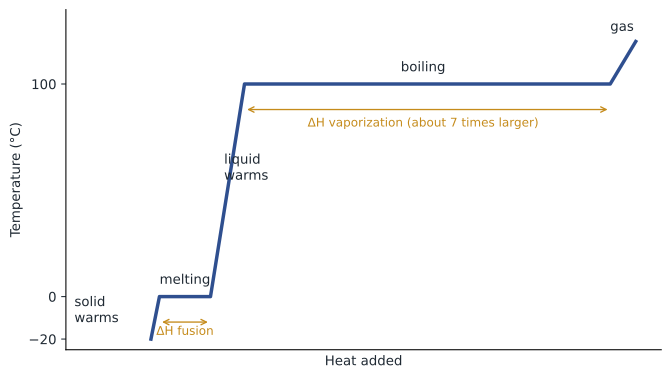
Two equations cover the calculations. Within a single phase, heat equals mass times specific heat times the temperature change. During a phase change, heat equals moles (or mass) times the enthalpy of the transition. For water, the heat of fusion is about 6 kilojoules per mole (334 joules per gram) and the heat of vaporization is about 41 kilojoules per mole (about 2,260 joules per gram). The specific heat of liquid water is about 4.2 joules per gram per kelvin; ice and steam each have about half that value.
Worked problem
Energy to melt and warm ice
How much heat is needed to turn 18 grams of ice at 0 °C into liquid water at 50 °C? Use ΔH_fus = 6.0 kJ/mol and c = 4.2 J/(g·K).
Show solution
- 18 grams of water is 1.0 mole, so melting needs 1.0 × 6.0 = 6.0 kilojoules.
- Warming the liquid: q = 18 × 4.2 × 50. Estimate 18 × 4.2 ≈ 75.6, and 75.6 × 50 ≈ 3,780 joules, about 3.8 kilojoules.
- Total: 6.0 + 3.8 ≈ 9.8 kilojoules.
Answer: About 9.8 kilojoules; melting alone takes more energy than warming the water by 50 degrees.
Calorimetry questions apply the same equations to heat flowing between objects. In an insulated container, heat lost by the hot object equals heat gained by the cold one. A coffee-cup calorimeter works at constant pressure and measures enthalpy changes; a bomb calorimeter works at constant volume and is used for combustion. Lesson 6 returns to these devices.
Phase diagrams
A phase diagram shows which phase is stable at each combination of temperature and pressure. The lines are phase boundaries, where two phases coexist in equilibrium. The triple point is the single temperature and pressure where solid, liquid and gas coexist. The critical point ends the liquid-gas boundary: above the critical temperature and pressure, liquid and gas can no longer be told apart, and the substance is a supercritical fluid. Supercritical carbon dioxide is used to remove caffeine from coffee beans.
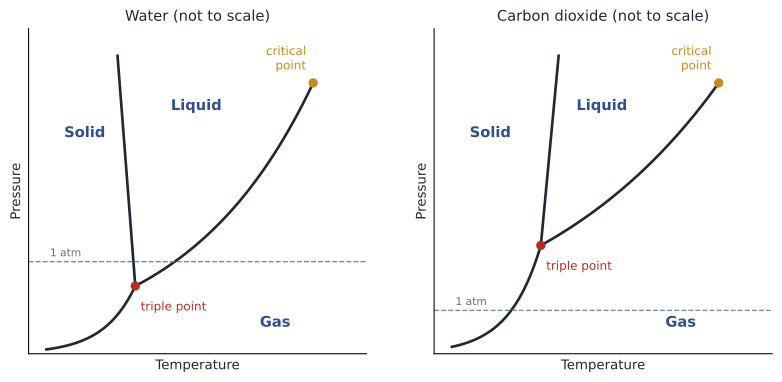
For most substances the solid-liquid line slopes to the right: raising the pressure favors the denser phase, which is normally the solid. Water is the exception. Because ice is less dense than liquid water, raising the pressure on ice at a temperature just below 0 °C can melt it, and the line slopes slightly to the left. Carbon dioxide's triple point lies at about 5 atmospheres, so at ordinary atmospheric pressure solid carbon dioxide sublimes directly to gas rather than melting, which is why it is called dry ice.
To read a phase diagram, move horizontally for a change in temperature at constant pressure and vertically for a change in pressure at constant temperature. Each line crossed is a phase change. A typical MCAT question asks what happens to a substance as pressure is lowered at constant temperature (it moves down the diagram, toward the gas phase) or which phase exists at a given point.
Passage-style practice
Passage. Researchers compared four general anesthetic candidates, all small organic molecules, by measuring their boiling points and the concentration in inhaled air needed to prevent movement in half of tested animals (a lower value means a more potent drug). They proposed that potency depends on how readily each molecule dissolves in the lipid regions of nerve cell membranes. Data invented for this course.
| Compound | Molar mass (g/mol) | Polar? | Can donate hydrogen bonds? | Boiling point (°C) | Concentration needed (percent of inhaled air) |
|---|---|---|---|---|---|
| A | 72 | No | No | 36 | 4.0 |
| B | 74 | Yes | No | 35 | 1.9 |
| C | 74 | Yes | Yes | 117 | Not volatile enough to test |
| D | 184 | Yes | No | 57 | 1.2 |
Practice problems
Work each problem on paper first, then reveal the answer to check.
Compounds B and C have the same molar mass. Why does C boil about 80 degrees higher? (Skill 2: scientific reasoning)
Show answer
C can donate hydrogen bonds, so its molecules attract each other much more strongly than B's molecules do.
Why is compound C unsuitable as an inhaled anesthetic? (Skill 2)
Show answer
Its strong intermolecular forces give it a low vapor pressure at body and room temperature, so too little enters the gas phase to be inhaled.
Compound D has the highest molar mass. Which intermolecular force most likely explains its higher boiling point compared with B? (Skill 1)
Show answer
Stronger London dispersion forces, because D has more electrons and a larger surface area.
Which compound is the most potent anesthetic in the table? (Skill 4: data-based reasoning)
Show answer
D, because the smallest concentration (1.2 percent of inhaled air) is needed to produce the effect.
What additional measurement would most directly test the researchers' proposal? (Skill 3: research design)
Show answer
Measure each compound's solubility in a lipid-like solvent such as olive oil or octanol and test whether higher solubility correlates with lower required concentration.
Common mistakes
MistakeBoiling water breaks O–H bonds.
InsteadBoiling overcomes intermolecular hydrogen bonds; the water molecules stay intact.
MistakeHydrogen bonds form whenever a molecule contains hydrogen.
InsteadA hydrogen bond needs hydrogen bonded to N, O or F and a lone pair on another N, O or F.
MistakeTemperature rises while a substance melts if heat keeps flowing in.
InsteadDuring a phase change the temperature stays constant; the energy breaks intermolecular attractions.
MistakeA polar molecule always boils higher than a nonpolar one.
InsteadMolecular size matters; large nonpolar molecules can have stronger dispersion forces than small polar ones.
MistakeRaising the pressure always turns a liquid into a solid.
InsteadFor water, pressure favors the denser liquid, so the solid-liquid line slopes to the left.
Summary and key terms
- Intermolecular forces are weaker than covalent bonds; boiling and melting overcome them without breaking molecules apart.
- Dispersion forces act between all molecules and grow with size; dipole-dipole forces act between polar molecules; hydrogen bonds need H on N, O or F.
- Stronger intermolecular forces mean higher boiling points, viscosity and surface tension and lower vapor pressure.
- A liquid boils when its vapor pressure equals the external pressure.
- Heating curves are flat during phase changes; use q = mcΔT within a phase and q = nΔH for a transition.
- Phase diagrams show stable phases by temperature and pressure; water's backward-sloping solid-liquid line reflects ice's low density.
- London dispersion force
- An attraction caused by temporary dipoles, present between all molecules.
- Hydrogen bond
- An attraction between H bonded to N, O or F and a lone pair on another N, O or F.
- Vapor pressure
- The pressure of a vapor in equilibrium with its liquid at a given temperature.
- Normal boiling point
- The temperature at which vapor pressure equals 1 atmosphere.
- Heat of vaporization
- The energy needed to vaporize one mole of a liquid at constant pressure.
- Specific heat capacity
- The heat needed to raise one gram of a substance by one kelvin.
- Triple point
- The temperature and pressure at which solid, liquid and gas coexist.
- Critical point
- The end of the liquid-gas boundary, beyond which a supercritical fluid exists.
- Sublimation
- A direct phase change from solid to gas.
Practice problems
Work each problem on paper first, then reveal the answer to check.
Which has the higher boiling point, ethanol or dimethyl ether (same formula, C₂H₆O)?
Show answer
Ethanol, because its O–H group lets it donate hydrogen bonds; the ether cannot.
Why does sweating cool the body?
Show answer
Evaporation is endothermic, so the water absorbs heat from the skin as it vaporizes.
Which noble gas has the highest boiling point: helium, argon or xenon?
Show answer
Xenon, because it has the most electrons and the strongest dispersion forces.
What happens to the boiling point of water in a pressure cooker?
Show answer
It rises, because the liquid must reach a higher vapor pressure to equal the raised external pressure.
How much heat is needed to vaporize 36 grams of water at 100 °C (ΔH_vap = 41 kJ/mol)?
Show answer
36 grams is 2 moles, so 2 × 41 = 82 kilojoules.
Lesson quiz · 5 questions
Score 60% or more to complete this lesson.
Create a free account to save your progress, take quizzes and earn a certificate.