
MCAT-120 · Lesson 5 of 12 · 32 min
Gases
▶ Video coming soon A video version of this lesson is on the way.
Ezequiel had spent five years carrying oxygen cylinders up apartment stairs, and he knew the rule of thumb crews used to estimate how long a tank would last. He had never thought of it as chemistry. Thandiwe asked him to explain it. 'The pressure gauge tells you how much is left,' he said, 'because at the same temperature the pressure is proportional to how much gas is in there.' 'That is Avogadro's law and Boyle's law working together,' Thandiwe said. 'You already use the ideal gas law. Today we just write it down.'
This lesson covers pressure and its units, the ideal gas law and the simple gas laws it contains, standard conditions and molar volume, gas stoichiometry, Dalton's law of partial pressures, the kinetic molecular theory, Graham's law of effusion and real-gas behavior. On the AAMC outline these topics appear in content category 4B (fluids and gas exchange), with links to 5E. Physiology passages about breathing, oxygen therapy, diving and altitude depend on them.
Pressure and its units
Pressure is force per unit area. Gas pressure results from molecules colliding with the walls of their container. The SI unit is the pascal (newton per square meter), but several units appear on the MCAT, and you should be able to convert between them.
| Unit | Equivalent to 1 atmosphere | Where you will see it |
|---|---|---|
| Atmosphere (atm) | 1 atm | General chemistry problems |
| Millimeters of mercury (mmHg) or torr | 760 mmHg | Blood pressure and blood gases |
| Kilopascal (kPa) | About 101.3 kPa | SI and Canadian clinical reports |
| Pascal (Pa) | About 1.013 × 10⁵ Pa | Physics calculations |
A barometer measures atmospheric pressure from the height of a mercury column it supports: 760 millimeters at sea level. A manometer compares the pressure of a gas sample with the atmosphere or with a vacuum. Pressure from a column of fluid is covered in MCAT-121.
The ideal gas law
An ideal gas is a model in which molecules have no volume and no attractions for each other. Real gases approach this behavior at low pressure and high temperature. The ideal gas law relates pressure, volume, moles and temperature:
R is the gas constant: 0.0821 liter-atmospheres per mole-kelvin, or 8.314 joules per mole-kelvin. Temperature must be in kelvins (add 273 to the Celsius value). Pick the value of R whose units match the pressure and volume in the problem, and make sure the units cancel.
At standard temperature and pressure (STP), defined for MCAT purposes as 0 °C (273 K) and 1 atm, one mole of an ideal gas occupies about 22.4 liters. This molar volume is a useful shortcut. Note that STP for gases is not the same as the standard state used in thermodynamics (lesson 6), which is 25 °C and 1 atm (or 1 bar) with 1 M solutions.
Worked problem
Using the ideal gas law
An oxygen cylinder of 10 liters contains gas at 150 atm and 27 °C. Roughly how many moles of oxygen does it contain?
Show solution
- Convert temperature: 27 + 273 = 300 K.
- n = PV ÷ RT = (150 × 10) ÷ (0.0821 × 300).
- Estimate the denominator: 0.0821 × 300 ≈ 24.6. The numerator is 1,500.
- 1,500 ÷ 24.6 ≈ 61.
Answer: About 61 moles of O₂, roughly 2 kilograms. Real gases at 150 atm deviate somewhat from ideal behavior, but the estimate is close.
The simple gas laws
Each named gas law is the ideal gas law with two of the four variables held constant. Rather than memorizing four laws, you can derive each one by asking which variables change. The combined gas law handles a fixed amount of gas whose pressure, volume and temperature all change.
| Law | Held constant | Relationship | Example |
|---|---|---|---|
| Boyle's law | n and T | P₁V₁ = P₂V₂ (P and V inversely proportional) | Expanding the chest lowers lung pressure so air flows in |
| Charles's law | n and P | V₁/T₁ = V₂/T₂ (V proportional to T) | A balloon shrinks in the cold |
| Gay-Lussac's law | n and V | P₁/T₁ = P₂/T₂ (P proportional to T) | Pressure rises in a heated sealed can |
| Avogadro's law | P and T | V₁/n₁ = V₂/n₂ (V proportional to n) | Equal volumes of gases at the same conditions contain equal moles |
| Combined gas law | n | P₁V₁/T₁ = P₂V₂/T₂ | Weather balloon rising through the atmosphere |
Worked problem
Boyle's law in breathing
Before inspiration, the air in a person's lungs is at 760 mmHg in a volume of 2.40 liters. The diaphragm contracts and the lung volume increases to 2.43 liters before any air flows in. What is the new pressure, assuming constant temperature?
Show solution
- P₂ = P₁V₁ ÷ V₂ = 760 × 2.40 ÷ 2.43.
- 2.40 ÷ 2.43 is about 0.988.
- 760 × 0.988 ≈ 751 mmHg.
Answer: About 751 mmHg, roughly 9 mmHg below atmospheric pressure, so air flows into the lungs down the pressure gradient.
A common trap is to use Celsius in Charles's or Gay-Lussac's law. Doubling the temperature from 20 °C to 40 °C does not double the volume; on the kelvin scale the change is from 293 to 313 K, only about 7 percent.
Gas density and molar mass
Rearranging the ideal gas law gives the density of a gas, ρ = PM/RT, where M is the molar mass. At the same temperature and pressure, denser gases have higher molar masses. Carbon dioxide (44 grams per mole) is denser than air (average about 29 grams per mole), which is why it collects in low places such as cellars and mine shafts, and why it is hazardous in confined spaces. Helium (4 grams per mole) is far less dense than air.
Dalton's law of partial pressures
In a mixture of gases that do not react, each gas exerts a partial pressure as if it alone filled the container, and the total pressure is the sum of the partial pressures. The partial pressure of each gas equals its mole fraction times the total pressure.
Dry air is about 21 percent oxygen, 78 percent nitrogen and 1 percent argon by moles. At sea level the partial pressure of oxygen is about 0.21 × 760 ≈ 160 mmHg. At an altitude where the total pressure is 500 mmHg, the fraction of oxygen is still 21 percent, but its partial pressure falls to about 105 mmHg, and that is why altitude causes hypoxia. Inhaled air is also humidified in the airways: water vapor contributes about 47 mmHg at body temperature, which must be subtracted before oxygen's share is calculated.
Worked problem
Inspired oxygen partial pressure
What is the partial pressure of oxygen in humidified inspired air at sea level (total 760 mmHg; water vapor 47 mmHg at 37 °C; oxygen 21 percent of the dry gas)?
Show solution
- Pressure of the dry gas: 760 − 47 = 713 mmHg.
- Oxygen: 0.21 × 713. Estimate 0.2 × 713 = 142.6, plus 0.01 × 713 = 7.1, total about 150 mmHg.
Answer: About 150 mmHg. Alveolar oxygen is lower still, near 100 mmHg, because oxygen is constantly absorbed and carbon dioxide added.
Gases collected over water in the laboratory follow the same logic: the gas in the collection tube is mixed with water vapor, so the pressure of the collected gas is the total pressure minus the vapor pressure of water at that temperature.
The amount of a gas that dissolves in a liquid is proportional to its partial pressure above the liquid, Henry's law, covered with other solubility rules in lesson 10. Henry's law explains why divers who surface too quickly develop decompression sickness, as nitrogen dissolved under high pressure comes out of solution as bubbles, and why hyperbaric oxygen therapy raises the oxygen dissolved in plasma.
The kinetic molecular theory
The kinetic molecular theory explains the gas laws from a model of molecular motion. Its assumptions are that gas particles have negligible volume compared with the container, that they move randomly in straight lines between collisions, that collisions are perfectly elastic (no kinetic energy is lost), that there are no attractive or repulsive forces between particles, and that the average kinetic energy of the particles is directly proportional to the absolute temperature.
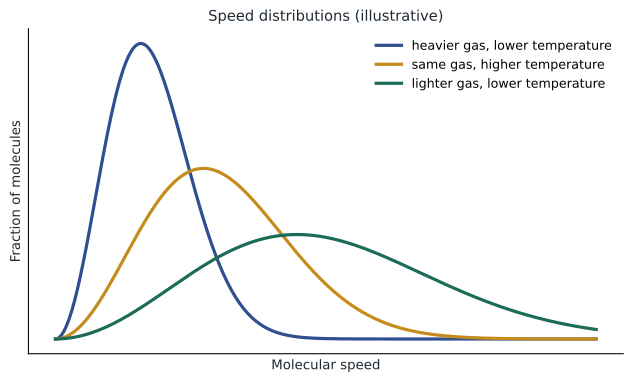
The last assumption is the most tested. At a given temperature all gases have the same average kinetic energy, but lighter molecules move faster. At room temperature, hydrogen molecules average a speed several times that of oxygen molecules. Speeds within a sample vary widely and follow the Maxwell-Boltzmann distribution. Raising the temperature shifts the peak to higher speed and broadens the curve; a heavier gas at the same temperature has a narrower distribution with a lower peak speed.
Diffusion, effusion and Graham's law
Diffusion is the spreading of one gas through another; effusion is the escape of gas through a tiny hole into a vacuum. Both happen faster for lighter gases. Graham's law states that the rate of effusion is inversely proportional to the square root of the molar mass.
Worked problem
Comparing effusion rates
How much faster does helium (4 grams per mole) effuse than methane (16 grams per mole) at the same temperature?
Show solution
- rate(He) ÷ rate(CH₄) = square root of (16 ÷ 4).
- The square root of 4 is 2.
Answer: Helium effuses twice as fast. The same principle was used historically to separate uranium isotopes as gaseous UF₆.
In physiology the rate of gas transfer across the alveolar membrane depends on more than molar mass. Fick's law of diffusion includes the partial pressure difference, the area and thickness of the membrane and the gas's solubility. Carbon dioxide is heavier than oxygen, yet it crosses the membrane about twenty times as readily because it is far more soluble in water. A passage may test whether you overapply Graham's law.
Real gases
Real gases deviate from ideal behavior when molecules are close together (high pressure) or moving slowly (low temperature). Two effects compete. Real molecules occupy volume, so at very high pressure the volume available to them is less than the container volume and the measured volume is larger than ideal. Real molecules attract each other, so at moderate pressure and low temperature they hit the walls less forcefully and the measured pressure is lower than ideal. The van der Waals equation corrects for both, with a constant a for attractions and b for molecular volume.
You will not need to calculate with the van der Waals equation on the MCAT, but you should predict direction. Gases with strong intermolecular forces (large a), such as ammonia or water vapor, deviate more than noble gases. Large molecules (large b) deviate more at high pressure. The most ideal conditions are high temperature and low pressure, and the most ideal common gases are small, nonpolar ones such as helium and hydrogen. Strong deviation near the boiling point is a sign that the gas is about to condense.
Passage-style practice
Passage. A respiratory therapist compared two methods of supplying oxygen to a patient. In method 1, the patient breathed 40 percent oxygen at sea level (total pressure 760 mmHg). In method 2, the patient breathed 100 percent oxygen in a hyperbaric chamber pressurized to 2.0 atm. Arterial oxygen partial pressures and dissolved oxygen in plasma were measured. Data invented for this course.
| Condition | Inspired oxygen partial pressure (mmHg, dry gas) | Arterial oxygen partial pressure (mmHg) | Dissolved oxygen (mL per 100 mL of plasma) |
|---|---|---|---|
| Room air, sea level | 160 | 95 | 0.29 |
| Method 1 | 304 | 220 | 0.66 |
| Method 2 | 1,520 | 1,250 | 3.75 |
Practice problems
Work each problem on paper first, then reveal the answer to check.
Show how the inspired oxygen partial pressure for method 1 was calculated. (Skill 1: knowledge of scientific concepts)
Show answer
By Dalton's law, 0.40 × 760 mmHg = 304 mmHg.
Verify the value for method 2. (Skill 4: data-based reasoning)
Show answer
2.0 atm is 1,520 mmHg, and the gas is 100 percent oxygen, so its partial pressure is 1,520 mmHg.
What relationship between arterial oxygen and dissolved oxygen does the table show, and which law does it reflect? (Skill 4)
Show answer
Dissolved oxygen is roughly proportional to arterial partial pressure (about 0.003 mL per 100 mL per mmHg), which reflects Henry's law.
Why might method 2 help a patient whose hemoglobin is blocked by carbon monoxide? (Skill 2: scientific reasoning)
Show answer
At high partial pressure, enough oxygen dissolves directly in plasma to supply tissues without hemoglobin, and the high oxygen pressure also speeds the release of carbon monoxide from hemoglobin.
The chamber is quickly depressurized at the end of a session. Which gas law predicts the risk to air trapped in a blocked middle ear, and what happens? (Skill 2)
Show answer
Boyle's law: as pressure falls, trapped gas expands, which can stretch or damage the ear structures if it cannot escape.
Common mistakes
MistakeUse degrees Celsius in gas law calculations.
InsteadGas laws require absolute temperature in kelvins.
MistakeHeavier gas molecules have more kinetic energy at the same temperature.
InsteadAll gases at the same temperature have the same average kinetic energy; heavier molecules move more slowly.
MistakeChanging altitude changes the fraction of oxygen in air.
InsteadThe mole fraction stays about 21 percent; the total and partial pressures fall.
MistakeReal gases always have higher pressures than ideal gases.
InsteadAttractions lower the pressure at moderate conditions; molecular volume raises the apparent volume at very high pressure.
MistakeSTP and thermodynamic standard state are the same.
InsteadGas STP is 0 °C and 1 atm; the thermodynamic standard state uses 25 °C.
Summary and key terms
- PV = nRT relates pressure, volume, moles and kelvin temperature; at STP one mole of ideal gas occupies about 22.4 liters.
- Boyle's, Charles's, Gay-Lussac's and Avogadro's laws are special cases of the ideal gas law.
- Dalton's law: total pressure is the sum of partial pressures, and each partial pressure equals mole fraction times total pressure.
- The kinetic molecular theory links average kinetic energy to absolute temperature; lighter molecules move faster.
- Graham's law: effusion rate is inversely proportional to the square root of molar mass.
- Real gases deviate from ideal behavior at high pressure and low temperature because of molecular volume and attractions.
- Ideal gas
- A model gas whose particles have no volume and no attractions.
- Partial pressure
- The pressure a gas in a mixture would exert if it occupied the container alone.
- Mole fraction
- The moles of one component divided by the total moles of a mixture.
- Standard temperature and pressure
- For gases, 0 °C (273 K) and 1 atm.
- Kinetic molecular theory
- A model explaining gas behavior from the motion of particles.
- Effusion
- Escape of gas particles through a tiny opening into a vacuum.
- Graham's law
- Effusion rate is inversely proportional to the square root of molar mass.
- Van der Waals equation
- A modified gas law that corrects for molecular volume and attractions.
Practice problems
Work each problem on paper first, then reveal the answer to check.
What volume does 2.0 moles of an ideal gas occupy at STP?
Show answer
2.0 × 22.4 = 44.8 liters.
A gas occupies 3.0 liters at 300 K. What is its volume at 450 K and the same pressure?
Show answer
V₂ = 3.0 × 450 ÷ 300 = 4.5 liters.
A mixture contains 2 moles of N₂ and 1 mole of O₂ at a total pressure of 3.0 atm. What is the partial pressure of O₂?
Show answer
Mole fraction 1/3, so 1.0 atm.
Which gas effuses fastest: Cl₂, CO₂ or H₂?
Show answer
H₂, which has the lowest molar mass.
Under which conditions does a real gas behave most ideally?
Show answer
High temperature and low pressure.
Lesson quiz · 5 questions
Score 60% or more to complete this lesson.
Create a free account to save your progress, take quizzes and earn a certificate.