
MCAT-120 · Lesson 8 of 12 · 30 min
Kinetics and equilibrium: chemical equilibrium
▶ Video coming soon A video version of this lesson is on the way.
Elliot said he had always pictured equilibrium as the moment a reaction stops. Thandiwe asked him to picture instead a busy clinic waiting room where the number of people stays at twelve all afternoon. 'Nobody thinks the room has stopped,' she said. 'People walk in and people walk out at the same rate. Equilibrium is that: two reactions running at equal speeds. The amounts stay constant, but the molecules never stop moving.' Ezequiel added that his ambulance station had worked the same way on a good night, and the group agreed to call it the waiting-room model.
This lesson covers dynamic equilibrium, the equilibrium constant and how to write it, the reaction quotient, calculations with ICE tables, Le Chatelier's principle, and the effect of temperature on K. On the AAMC outline it belongs to content category 5E (principles of chemical thermodynamics and kinetics). Acid-base equilibria in lesson 9 and solubility equilibria in lesson 10 apply exactly the same ideas, and so does oxygen binding to hemoglobin in MCAT-110.
Dynamic equilibrium
Many reactions are reversible. As a reaction proceeds, the forward rate falls because reactants are consumed and the reverse rate rises because products accumulate. Eventually the two rates become equal. From then on, the concentrations of reactants and products stay constant, though not necessarily equal, and the system is at equilibrium. Experiments with isotopic labels show that molecules keep reacting in both directions at equilibrium: if some product is made with a heavy isotope, the label soon appears in the reactants as well.
Equilibrium can be approached from either direction. Starting with only reactants or only products, the system reaches the same equilibrium composition at a given temperature, provided the total amounts of each element are the same. Equilibrium is also the state of minimum free energy for the system, where ΔG = 0, which connects it directly to lesson 6.
The equilibrium constant
For a reaction aA + bB ⇌ cC + dD, the law of mass action defines the equilibrium constant as the ratio of product concentrations to reactant concentrations, each raised to its stoichiometric coefficient. For gases, partial pressures can be used instead to give Kp.
Unlike rate laws, equilibrium expressions do use the coefficients of the balanced equation, because the equilibrium constant is a thermodynamic quantity tied to the overall reaction, not to its mechanism. Pure solids and pure liquids are left out of the expression, because their concentrations do not change; water is left out when it is the solvent. K has no units in rigorous thermodynamics, though textbooks sometimes attach them.
| Size of K | Meaning | Example |
|---|---|---|
| K much greater than 1 (for example 10¹⁰) | Products strongly favored; reaction goes nearly to completion | Strong acid ionizing in water |
| K about 1 | Comparable amounts of reactants and products | Some isomerizations |
| K much less than 1 (for example 10⁻¹⁰) | Reactants strongly favored; little product forms | Ionization of water, Kw = 10⁻¹⁴ |
K depends only on temperature. It does not change when concentrations, pressures or volumes change, or when a catalyst is added. If you reverse a reaction, the new K is the reciprocal of the old one; if you multiply a reaction by a factor, K is raised to that power; if you add reactions, their K values multiply. These rules parallel the rules for ΔH in Hess's law, with addition replaced by multiplication.
Worked problem
Writing equilibrium expressions
Write K for (a) N₂(g) + 3 H₂(g) ⇌ 2 NH₃(g); (b) CaCO₃(s) ⇌ CaO(s) + CO₂(g); (c) CH₃COOH(aq) + H₂O(l) ⇌ CH₃COO⁻(aq) + H₃O⁺(aq).
Show solution
- (a) K = [NH₃]² ÷ ([N₂][H₂]³).
- (b) Solids are omitted, so K = [CO₂], or Kp = P(CO₂).
- (c) Water is the solvent and is omitted: K = [CH₃COO⁻][H₃O⁺] ÷ [CH₃COOH], which is Ka for acetic acid.
Answer: As above. In (b) the equilibrium carbon dioxide pressure at a given temperature is fixed no matter how much solid is present.
The reaction quotient
The reaction quotient Q has the same form as K but uses the concentrations at any moment, not only at equilibrium. Comparing Q with K tells you which way the reaction will go. If Q is less than K, there are too few products relative to equilibrium, and the reaction proceeds forward. If Q is greater than K, there are too many products and the reaction proceeds in reverse. If Q equals K, the system is at equilibrium. The same comparison underlies ΔG = ΔG° + RT ln Q: when Q is less than K, ΔG is negative and the forward reaction is spontaneous.
Worked problem
Using Q to predict direction
For H₂ + I₂ ⇌ 2 HI, K = 50 at a certain temperature. A flask contains 0.10 M H₂, 0.10 M I₂ and 0.50 M HI. In which direction will the reaction proceed?
Show solution
- Q = [HI]² ÷ ([H₂][I₂]) = 0.25 ÷ 0.010 = 25.
- Q (25) is less than K (50).
Answer: The reaction proceeds forward, forming more HI until Q reaches 50.
ICE tables
An ICE table organizes equilibrium calculations: Initial concentrations, the Change in each (written in terms of x using the coefficients), and the Equilibrium concentrations. Substitute the equilibrium row into the K expression and solve for x. When K is very small, x is small compared with the initial concentration, and you can drop it from subtractions, which avoids the quadratic formula. Check afterward that x is less than about 5 percent of the initial value. The MCAT almost always arranges the numbers so this approximation works.
Worked problem
An ICE table with the small-x approximation
For A ⇌ B + C, K = 1.0 × 10⁻⁶. If [A]₀ = 1.0 M and no B or C is present initially, what are the equilibrium concentrations?
Show solution
- Initial: A 1.0, B 0, C 0. Change: A −x, B +x, C +x. Equilibrium: A 1.0 − x, B x, C x.
- K = x² ÷ (1.0 − x) = 1.0 × 10⁻⁶. Since K is small, 1.0 − x ≈ 1.0.
- x² = 1.0 × 10⁻⁶, so x = 1.0 × 10⁻³ M.
- Check: 0.001 is 0.1 percent of 1.0, so the approximation is valid.
Answer: [B] = [C] = 1.0 × 10⁻³ M and [A] ≈ 1.0 M. Lesson 9 uses exactly this method to find the pH of a weak acid.
Le Chatelier's principle
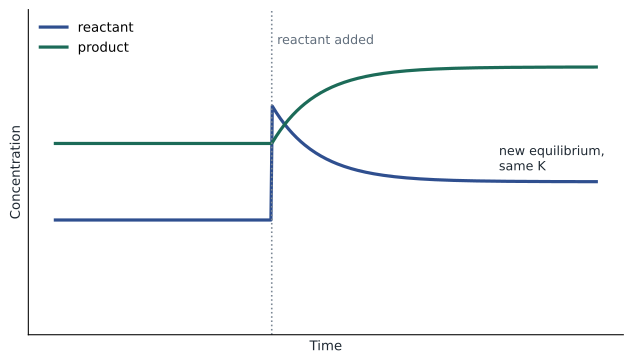
Le Chatelier's principle states that when a system at equilibrium is disturbed, it shifts in the direction that partly counteracts the disturbance. It is a qualitative shortcut for the Q-versus-K comparison. Adding a reactant raises the denominator of Q, makes Q less than K, and drives the reaction forward. Removing a product does the same. Adding a product or removing a reactant drives the reaction in reverse. None of these changes K.
Pressure changes affect gas-phase equilibria only when the moles of gas differ on the two sides. Decreasing the volume (raising the pressure) shifts the equilibrium toward the side with fewer moles of gas; increasing the volume shifts it toward more moles. In the Haber process, N₂ + 3 H₂ ⇌ 2 NH₃, four moles of gas become two, so high pressure favors ammonia. Adding an inert gas such as argon at constant volume raises the total pressure but does not change any partial pressures, so it has no effect on the equilibrium.
Temperature is different, because it changes K itself. Treat heat as a reactant in an endothermic reaction and as a product in an exothermic one. Raising the temperature shifts an endothermic reaction forward and increases its K; it shifts an exothermic reaction backward and decreases its K. The Haber process is exothermic, so lower temperatures give more ammonia at equilibrium. Industry nonetheless runs it at around 400 to 450 °C, because at lower temperatures the reaction is too slow even with a catalyst. That compromise between yield and rate is a favorite MCAT theme.
| Disturbance | Direction of shift | Does K change? |
|---|---|---|
| Add reactant or remove product | Forward | No |
| Add product or remove reactant | Reverse | No |
| Decrease volume (gases) | Toward fewer moles of gas | No |
| Add inert gas at constant volume | No shift | No |
| Raise temperature, endothermic reaction | Forward | Yes, K increases |
| Raise temperature, exothermic reaction | Reverse | Yes, K decreases |
| Add a catalyst | No shift; equilibrium reached faster | No |
Equilibrium in the body
Physiology passages use Le Chatelier's principle constantly. Carbon dioxide and water form carbonic acid, which dissociates to bicarbonate and a proton: CO₂ + H₂O ⇌ H₂CO₃ ⇌ HCO₃⁻ + H⁺. When a person hyperventilates, carbon dioxide is exhaled faster, the equilibrium shifts to the left, protons are consumed and blood pH rises (respiratory alkalosis). When ventilation is inadequate, carbon dioxide accumulates and pH falls (respiratory acidosis). Hemoglobin's binding of oxygen is another equilibrium: high oxygen partial pressure in the lungs drives binding, and low partial pressure in tissues drives release. Lesson 9 returns to the bicarbonate system as a buffer.
Heterogeneous equilibria deserve one more note. Because pure solids drop out of the expression, the equilibrium pressure of carbon dioxide above heated calcium carbonate is fixed at a given temperature, whether the container holds one gram of limestone or one kilogram. The same logic explains why a saturated solution has a fixed concentration of dissolved ions no matter how much undissolved solid sits at the bottom, the basis of the solubility product in lesson 10. Adding more solid changes neither K nor the position of the equilibrium; it only changes how long the equilibrium can be maintained as the reaction proceeds.
Coupled equilibria and the common-ion effect
When two equilibria share a species, a change in one affects the other. If a reaction has an unfavorable K but its product is consumed by a second reaction with a large K, the first reaction is pulled forward, the same principle that drives coupled reactions in metabolism. Adding an ion that is already part of an equilibrium shifts it away from that ion. This common-ion effect suppresses the ionization of a weak acid when its conjugate base is added (lesson 9) and lowers the solubility of a salt in a solution that already contains one of its ions (lesson 10).
Equilibrium versus kinetics
Keep the two ideas apart. K tells you the composition at equilibrium; it says nothing about how fast equilibrium is reached. A reaction with an enormous K may take years to reach equilibrium if its activation energy is high, while a reaction with a small K may reach its modest equilibrium in microseconds. A catalyst changes the time to reach equilibrium but not the composition. Temperature changes both: it speeds every reaction, and it shifts K in a direction determined by the sign of ΔH.
Passage-style practice
Passage. A student studied the equilibrium between two forms of a cobalt complex in solution. The pink form, Co(H₂O)₆²⁺, reacts with chloride to form the blue form, CoCl₄²⁻: Co(H₂O)₆²⁺ + 4 Cl⁻ ⇌ CoCl₄²⁻ + 6 H₂O. She recorded the color of the solution after each change. Results invented for this course, though they follow the real behavior of this system.
| Change | Observed color |
|---|---|
| Starting solution at room temperature | Purple (both forms present) |
| Concentrated HCl added | Blue |
| Water added | Pink |
| Silver nitrate added (precipitates AgCl) | Pink |
| Heated in a hot water bath | Blue |
| Cooled in an ice bath | Pink |
Practice problems
Work each problem on paper first, then reveal the answer to check.
Explain why adding concentrated HCl turns the solution blue. (Skill 1: knowledge of scientific concepts)
Show answer
It adds chloride, a reactant, so the equilibrium shifts forward toward blue CoCl₄²⁻.
Why does adding silver nitrate turn the solution pink? (Skill 2: scientific reasoning)
Show answer
Silver removes chloride as AgCl, so the system shifts in reverse to replace it, forming pink Co(H₂O)₆²⁺.
Is the forward reaction endothermic or exothermic? (Skill 4: data-based reasoning)
Show answer
Endothermic: heating shifts it forward (blue), so heat acts like a reactant.
Does K change when water is added? When the solution is heated? (Skill 2)
Show answer
Adding water does not change K; it changes Q by diluting chloride. Heating changes K, which increases for this endothermic reaction.
A student wants to show that the color changes are reversible. Which sequence of steps would best show this? (Skill 3: research design)
Show answer
Heat a sample until it is blue, then cool it until it is pink, and repeat several times; the color should switch back and forth each time.
Common mistakes
MistakeAt equilibrium the concentrations of reactants and products are equal.
InsteadAt equilibrium the rates are equal; concentrations are constant but usually different.
MistakeAdding reactant increases K.
InsteadOnly temperature changes K; adding reactant changes Q and shifts the position.
MistakeInclude solids and pure liquids in the K expression.
InsteadOmit pure solids, pure liquids and solvent water.
MistakeAdding an inert gas at constant volume shifts a gas equilibrium.
InsteadPartial pressures are unchanged, so the equilibrium does not shift.
MistakeA large K means a fast reaction.
InsteadK describes position; rate depends on activation energy.
Summary and key terms
- Equilibrium is dynamic: forward and reverse rates are equal and concentrations are constant.
- K is products over reactants, each raised to its coefficient; omit pure solids, liquids and solvent; K depends only on temperature.
- Compare Q with K: Q < K proceeds forward; Q > K proceeds in reverse.
- ICE tables organize equilibrium calculations; for small K, drop x in subtractions and check the 5 percent rule.
- Le Chatelier's principle predicts shifts from changes in concentration, pressure and temperature; only temperature changes K.
- Catalysts change how fast equilibrium is reached, not where it lies.
- Dynamic equilibrium
- A state in which forward and reverse reactions proceed at equal rates.
- Equilibrium constant
- The ratio of product to reactant concentrations at equilibrium, each raised to its coefficient.
- Law of mass action
- The rule that defines the form of the equilibrium constant.
- Reaction quotient
- The same ratio as K, calculated with concentrations at any moment.
- Le Chatelier's principle
- A system at equilibrium shifts to partly counteract a disturbance.
- ICE table
- A table of initial, change and equilibrium concentrations used to solve equilibrium problems.
- Common-ion effect
- Suppression of an equilibrium by adding an ion it already contains.
Practice problems
Work each problem on paper first, then reveal the answer to check.
For a reaction with K = 4, what is K for the reverse reaction?
Show answer
1/4 = 0.25.
For 2 SO₂ + O₂ ⇌ 2 SO₃ (exothermic), name two changes that increase the yield of SO₃.
Show answer
Lowering the temperature and raising the pressure (decreasing volume); adding O₂ or removing SO₃ also works.
A reaction mixture has Q = 10 and K = 1. Which way does it shift?
Show answer
In reverse, because Q > K.
Why is solid carbon omitted from K for C(s) + O₂(g) ⇌ CO₂(g)?
Show answer
Its concentration is effectively constant, so it is folded into K.
Hyperventilation raises blood pH. Explain using Le Chatelier's principle.
Show answer
Exhaling CO₂ removes a reactant, so the carbonic acid equilibrium shifts left, consuming H⁺.
Lesson quiz · 5 questions
Score 60% or more to complete this lesson.
Create a free account to save your progress, take quizzes and earn a certificate.