
MCAT-120 · Lesson 11 of 12 · 34 min
Electrochemistry: redox and electrochemical cells
▶ Video coming soon A video version of this lesson is on the way.
Ezequiel had used an automated external defibrillator dozens of times, and he wanted to know how the battery inside could deliver so much energy from such a small box. Thandiwe said the answer started with a piece of zinc in a solution of copper sulfate. 'Drop the zinc in, and copper metal plates out on it while the blue color fades. Electrons are moving from zinc to copper. A battery is the same reaction with the electrons sent through a wire, so you can make them do work on the way.' She added that electrochemistry is where three earlier lessons meet: redox from lesson 4, free energy from lesson 6 and equilibrium from lesson 8.
This lesson covers balancing redox reactions, galvanic and electrolytic cells, cell notation, standard reduction potentials and cell potential, the relationship between cell potential, free energy and the equilibrium constant, the Nernst equation and concentration cells, electrolysis and Faraday's law, and batteries. On the AAMC outline this material belongs to content category 4C (electrochemistry and electrical circuits and their elements). It links to nerve membrane potentials in MCAT-111 and MCAT-112 and to the electron transport chain in MCAT-110.
Balancing redox reactions
Redox reactions transfer electrons from a reducing agent to an oxidizing agent. Simple redox equations can be balanced by inspection, but those in acidic or basic solution are best balanced by the half-reaction method. Split the reaction into an oxidation half-reaction and a reduction half-reaction. For each, balance atoms other than O and H, then balance O by adding water, then balance H by adding H⁺, then balance charge by adding electrons. Multiply the half-reactions so that the electrons lost equal the electrons gained, add them, and cancel species that appear on both sides. In basic solution, finish by adding OH⁻ to both sides to neutralize each H⁺ and canceling water.
Worked problem
Balancing permanganate and iron(II) in acid
Balance the reaction MnO₄⁻ + Fe²⁺ → Mn²⁺ + Fe³⁺ in acidic solution.
Show solution
- Oxidation: Fe²⁺ → Fe³⁺ + e⁻.
- Reduction: MnO₄⁻ → Mn²⁺. Add 4 H₂O on the right to balance oxygen, then 8 H⁺ on the left to balance hydrogen: MnO₄⁻ + 8 H⁺ → Mn²⁺ + 4 H₂O. Charge on the left is +7 and on the right +2, so add 5 e⁻ on the left.
- Multiply the oxidation by 5 so that five electrons are transferred in each half.
- Add: MnO₄⁻ + 8 H⁺ + 5 Fe²⁺ → Mn²⁺ + 4 H₂O + 5 Fe³⁺.
Answer: MnO₄⁻ + 8 H⁺ + 5 Fe²⁺ → Mn²⁺ + 5 Fe³⁺ + 4 H₂O. Charges: +17 on the left (−1 + 8 + 10), +17 on the right (+2 + 15).
Galvanic and electrolytic cells
An electrochemical cell has two electrodes, each dipping into an electrolyte, connected by an external wire and, usually, a salt bridge. Oxidation always occurs at the anode, and reduction always occurs at the cathode ("an ox, red cat"). Electrons always flow through the wire from anode to cathode. These rules hold for every kind of cell.
A galvanic (voltaic) cell uses a spontaneous redox reaction to produce electric current. Its cell potential is positive and ΔG is negative. In a galvanic cell the anode is the negative electrode, because oxidation there releases electrons into the wire, and the cathode is positive. An electrolytic cell uses an external power source to drive a nonspontaneous reaction. Its cell potential is negative (the source must supply at least that voltage) and ΔG is positive. In an electrolytic cell the anode is connected to the positive terminal of the source and is the positive electrode, and the cathode is negative. Only the signs of the electrodes swap between the two kinds of cell; where oxidation and reduction happen does not.
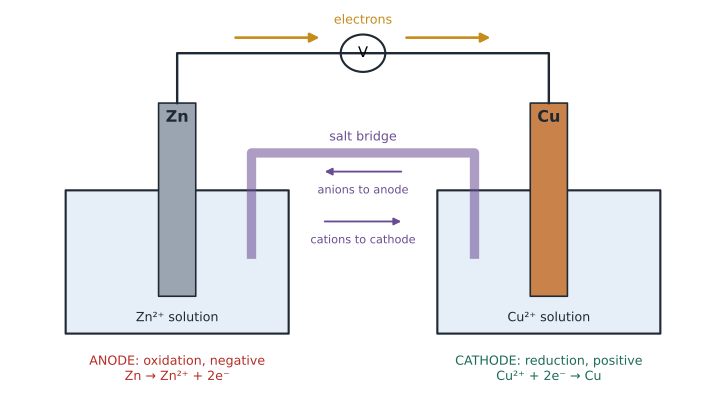
The salt bridge, a tube of an inert electrolyte such as potassium nitrate, completes the circuit and keeps the solutions neutral. As zinc dissolves, the anode solution gains positive ions, and anions from the salt bridge flow toward it; as copper ions plate out, the cathode solution loses positive ions, and cations from the bridge flow toward it. Without the salt bridge, charge would build up and current would stop almost at once. In the zinc-copper cell, the zinc electrode loses mass and the copper electrode gains mass.
| Feature | Galvanic cell | Electrolytic cell |
|---|---|---|
| Reaction | Spontaneous | Nonspontaneous, driven by an external source |
| E°cell | Positive | Negative |
| ΔG | Negative | Positive |
| Anode | Oxidation; negative | Oxidation; positive |
| Cathode | Reduction; positive | Reduction; negative |
| Electron flow | Anode to cathode | Anode to cathode |
| Example | Battery discharging | Electroplating; recharging a battery |
Cell notation summarizes a cell in one line, with the anode on the left and the cathode on the right. A single vertical line marks a phase boundary, and a double line marks the salt bridge: Zn(s) | Zn²⁺(aq) ‖ Cu²⁺(aq) | Cu(s). When the half-reaction involves no solid metal, an inert electrode such as platinum is written at the end, as in Pt(s) | Fe²⁺, Fe³⁺.
Standard reduction potentials
Each half-reaction has a standard reduction potential, E°, measured against the standard hydrogen electrode (SHE), which is assigned 0.00 volts. Standard conditions are 1 M solutions, 1 atm gases and 25 °C. A more positive E° means a greater tendency to be reduced, so the species on the left of that half-reaction is a stronger oxidizing agent. A more negative E° means the reduced form, on the right, is a stronger reducing agent.
| Half-reaction (reduction) | E° (V) |
|---|---|
| F₂ + 2 e⁻ → 2 F⁻ | +2.87 |
| MnO₄⁻ + 8 H⁺ + 5 e⁻ → Mn²⁺ + 4 H₂O | +1.51 |
| O₂ + 4 H⁺ + 4 e⁻ → 2 H₂O | +1.23 |
| Ag⁺ + e⁻ → Ag | +0.80 |
| Cu²⁺ + 2 e⁻ → Cu | +0.34 |
| 2 H⁺ + 2 e⁻ → H₂ | 0.00 |
| Fe²⁺ + 2 e⁻ → Fe | −0.44 |
| Zn²⁺ + 2 e⁻ → Zn | −0.76 |
| Na⁺ + e⁻ → Na | −2.71 |
| Li⁺ + e⁻ → Li | −3.04 |
To find the standard cell potential, identify which half-reaction is the reduction (the one with the more positive E°, for a galvanic cell) and which is the oxidation. Then subtract.
Both values in this subtraction are standard reduction potentials, as tabulated; do not flip the sign of the anode value before subtracting, or you will count the change twice. Potentials are intensive properties, so they are never multiplied by the coefficients used to balance the electrons, even though ΔG is.
Worked problem
Cell potential of the zinc-copper cell
Find E°cell for Zn(s) | Zn²⁺ ‖ Cu²⁺ | Cu(s), and decide whether the reaction is spontaneous.
Show solution
- Cathode (reduction): Cu²⁺ + 2 e⁻ → Cu, E° = +0.34 V.
- Anode (oxidation): Zn → Zn²⁺ + 2 e⁻; its reduction potential is −0.76 V.
- E°cell = +0.34 − (−0.76) = +1.10 V.
Answer: +1.10 V. The potential is positive, so the cell is galvanic and the reaction Zn + Cu²⁺ → Zn²⁺ + Cu is spontaneous.
Cell potential, free energy and the equilibrium constant
The electrical work a cell can do equals the charge transferred times the potential, and that work comes from the free energy of the reaction. For n moles of electrons transferred, ΔG° = −nFE°, where F is Faraday's constant, about 96,500 coulombs per mole of electrons. Combining this with ΔG° = −RT ln K from lesson 6 links all three quantities.
| E°cell | ΔG° | K | At standard conditions |
|---|---|---|---|
| Positive | Negative | Greater than 1 | Spontaneous (galvanic) |
| Zero | Zero | Equal to 1 | At equilibrium |
| Negative | Positive | Less than 1 | Nonspontaneous (electrolytic) |
Worked problem
Free energy from cell potential
Calculate ΔG° for the zinc-copper cell (E° = 1.10 V, n = 2).
Show solution
- ΔG° = −nFE° = −2 × 96,500 × 1.10.
- 2 × 96,500 = 193,000; × 1.10 ≈ 212,000 joules.
- ΔG° ≈ −212 kJ per mole of reaction.
Answer: About −212 kJ/mol, a large negative value consistent with a very large K.
The Nernst equation and concentration cells
Under nonstandard conditions, the cell potential depends on concentrations through the Nernst equation, which is the electrochemical form of ΔG = ΔG° + RT ln Q. At 25 °C, using base-10 logarithms, it simplifies to the second form below.
As a galvanic cell runs, products accumulate and reactants are used up, so Q rises and E falls. When Q reaches K, E becomes zero and the battery is dead: the reaction has reached equilibrium. Raising the concentration of reactants or lowering that of products raises E above E°.
A concentration cell has the same half-reaction on both sides but different concentrations. Its E° is zero, so its potential comes entirely from the concentration difference, and the cell runs in the direction that equalizes the two concentrations. The electrode in the dilute solution is the anode (metal dissolves, raising the concentration), and the electrode in the concentrated solution is the cathode (ions plate out, lowering it).
Worked problem
A concentration cell
A cell has two copper electrodes, one in 0.010 M Cu²⁺ and one in 1.0 M Cu²⁺. What is its potential at 25 °C?
Show solution
- E° = 0 and n = 2.
- The reaction moves Cu²⁺ from the concentrated side to the dilute side, so Q = [dilute] ÷ [concentrated] = 0.010 ÷ 1.0 = 10⁻².
- E = 0 − (0.0592 ÷ 2) × log(10⁻²) = −0.0296 × (−2) ≈ +0.059 V.
Answer: About 0.059 V, with the anode in the dilute solution.
Nerve and muscle cells use the same principle. The membrane potential arises because ion concentrations differ across the membrane and the membrane is selectively permeable. The Nernst equation, written for a single ion, gives that ion's equilibrium potential; for potassium, with about 140 mM inside and 5 mM outside a typical cell, it is roughly −90 millivolts. MCAT-112 builds the action potential on this foundation.
Electrolysis and Faraday's law
In an electrolytic cell, an external voltage drives a nonspontaneous reaction. Electrolysis of molten sodium chloride produces sodium metal at the cathode and chlorine gas at the anode. Electrolysis of water produces hydrogen at the cathode and oxygen at the anode, in a 2 to 1 ratio by volume. Electroplating deposits a thin metal layer on an object made the cathode.
Faraday's law relates the amount of substance produced or consumed at an electrode to the charge passed. Charge equals current times time (Q = It, in coulombs when current is in amperes and time in seconds). Dividing the charge by Faraday's constant gives moles of electrons, and the half-reaction converts moles of electrons to moles of substance.
Worked problem
Electroplating silver
A current of 9.65 amperes is passed through a silver nitrate solution for 1,000 seconds. What mass of silver plates out? (Ag⁺ + e⁻ → Ag; Ag is 108 grams per mole.)
Show solution
- Charge = 9.65 × 1,000 = 9,650 coulombs.
- Moles of electrons = 9,650 ÷ 96,500 = 0.100 mole.
- One electron per silver atom, so 0.100 mole of Ag, which is 0.100 × 108 = 10.8 grams.
Answer: 10.8 grams of silver. For copper (two electrons per atom), the same charge would deposit only 0.050 mole.
Batteries and corrosion
Batteries are galvanic cells built for convenience. In a lead-acid car battery, lead is oxidized at the anode and lead dioxide is reduced at the cathode, both forming lead sulfate in sulfuric acid. Recharging runs the reaction in reverse as an electrolytic cell. Nickel-cadmium and nickel-metal hydride cells are older rechargeable types. Lithium-ion batteries, used in phones and in defibrillators, move lithium ions between a graphite anode and a metal oxide cathode during discharge and recharge; lithium's very negative reduction potential and low mass give them a high energy density.
Corrosion is an unwanted galvanic process. When iron rusts, iron is oxidized at one region of the surface and oxygen is reduced at another, with water as the electrolyte. Galvanizing coats iron with zinc, which has a more negative reduction potential and is oxidized in preference; it acts as a sacrificial anode. The same principle protects ship hulls and buried pipelines with blocks of magnesium or zinc.
Passage-style practice
Passage. Engineers designing an implantable glucose fuel cell measured the potentials of several electrode pairings under standard conditions. In the best design, glucose was oxidized at one electrode and oxygen was reduced to water at the other. The overall cell potential under body conditions was lower than the standard value. Data invented for this course, using the standard potentials in the table above.
| Pairing | Cathode half-reaction | Anode half-reaction | Measured E°cell (V) |
|---|---|---|---|
| 1 | Cu²⁺/Cu | Zn²⁺/Zn | 1.10 |
| 2 | Ag⁺/Ag | Cu²⁺/Cu | 0.46 |
| 3 | O₂/H₂O | Glucose oxidation (E° about −0.0 V at pH 0) | About 1.2 |
Practice problems
Work each problem on paper first, then reveal the answer to check.
Confirm the value for pairing 2 from the table of reduction potentials. (Skill 4: data-based reasoning)
Show answer
+0.80 − (+0.34) = +0.46 V, with silver as the cathode and copper as the anode.
In pairing 2, which electrode gains mass? (Skill 1: knowledge of scientific concepts)
Show answer
The silver cathode, because silver ions are reduced and deposited as silver metal.
In the glucose fuel cell, at which electrode does oxygen react, and what is that electrode's sign? (Skill 1)
Show answer
At the cathode, where oxygen is reduced; in a galvanic cell the cathode is positive.
Why might the cell potential in the body be lower than the standard value? (Skill 2: scientific reasoning)
Show answer
Body conditions are not standard: oxygen's partial pressure is far below 1 atm and the pH is near 7, not 0, so the Nernst equation predicts a lower potential.
If the device delivers 0.10 milliampere for one day (about 86,400 seconds), how many moles of electrons pass through it? (Skill 4)
Show answer
Charge = 1.0 × 10⁻⁴ × 86,400 ≈ 8.6 coulombs; 8.6 ÷ 96,500 ≈ 9 × 10⁻⁵ mole of electrons.
Common mistakes
MistakeThe anode is always negative.
InsteadThe anode is negative in a galvanic cell but positive in an electrolytic cell; it is always where oxidation occurs.
MistakeMultiply E° by the coefficients used to balance electrons.
InsteadPotentials are intensive and are never multiplied; ΔG° = −nFE° accounts for the number of electrons.
MistakeFlip the sign of the anode potential and then subtract it.
InsteadUse E°cathode − E°anode with both as tabulated reduction potentials.
MistakeElectrons travel through the salt bridge.
InsteadElectrons move through the wire; ions move through the salt bridge.
MistakeA dead battery has used up all its reactants.
InsteadA dead battery has reached equilibrium, where E = 0 and Q = K.
Summary and key terms
- Balance redox reactions with half-reactions, adding H₂O, H⁺ and electrons, then matching electrons lost and gained.
- Oxidation at the anode, reduction at the cathode, electrons from anode to cathode in every cell.
- Galvanic cells are spontaneous (E° positive, anode negative); electrolytic cells are driven (E° negative, anode positive).
- E°cell = E°cathode − E°anode using reduction potentials; potentials are not multiplied by coefficients.
- ΔG° = −nFE°, and E°, ΔG° and K always have consistent signs; the Nernst equation adjusts E for concentrations.
- Faraday's law: moles of electrons = It ÷ F, which links current and time to the amount of product.
- Anode
- The electrode at which oxidation occurs.
- Cathode
- The electrode at which reduction occurs.
- Galvanic cell
- An electrochemical cell that produces electricity from a spontaneous reaction.
- Electrolytic cell
- An electrochemical cell that uses an external source to drive a nonspontaneous reaction.
- Salt bridge
- A connector of inert electrolyte that lets ions flow between half-cells.
- Standard reduction potential
- The potential of a half-reaction under standard conditions relative to the standard hydrogen electrode.
- Faraday constant
- The charge on one mole of electrons, about 96,500 coulombs.
- Nernst equation
- An equation relating cell potential to concentrations through the reaction quotient.
- Concentration cell
- A cell with identical half-reactions at different concentrations.
Practice problems
Work each problem on paper first, then reveal the answer to check.
Which is the strongest oxidizing agent in the table of reduction potentials?
Show answer
F₂, with the most positive E°.
Which is the strongest reducing agent in the table?
Show answer
Li metal, whose reduction potential is the most negative.
Will Ag⁺ oxidize Cu metal spontaneously?
Show answer
Yes: E° = 0.80 − 0.34 = +0.46 V.
How many coulombs are needed to deposit 1 mole of copper from Cu²⁺?
Show answer
2 × 96,500 = 193,000 coulombs.
In electrolysis of molten NaCl, what forms at the cathode?
Show answer
Sodium metal, from reduction of Na⁺.
Lesson quiz · 5 questions
Score 60% or more to complete this lesson.
Create a free account to save your progress, take quizzes and earn a certificate.