
MCAT-120 · Lesson 1 of 12 · 36 min
Atoms and bonding: atomic structure, electron configuration and periodic trends
▶ Video coming soon A video version of this lesson is on the way.
The general chemistry block of the Sunday Session began with a confession. Devika said that chemistry calculations were the part of the test she feared most, and that her diagnostic misses in Chem/Phys clustered in exactly this material. Thandiwe nodded and put a single line on the screen: "An atom is a nucleus that holds electrons with a strength you can predict." 'Almost every general chemistry question on the MCAT comes back to that sentence,' she said. 'How many protons, how far away the electrons sit, and how much the inner electrons get in the way. If you can reason about those three things, you can predict ionization energy, radius, acidity and a good part of bonding without memorizing a table.'
This lesson covers the structure of the atom, isotopes and atomic mass, nuclear decay, the quantum numbers and electron configurations, the Bohr model and atomic spectra, and the periodic trends that follow from electron structure. On the AAMC outline this material belongs to content category 4E (atoms, nuclear decay, electronic structure and atomic chemical behavior) in the Chemical and Physical Foundations of Biological Systems section. It is tested both as quick recall and inside passages about radioactive tracers, spectroscopy and metal ions in biology.
The parts of an atom
An atom has a small, dense nucleus containing protons and neutrons, surrounded by electrons. The proton carries a charge of +1 elementary charge, the electron carries −1, and the neutron is neutral. Protons and neutrons each have a mass of about 1 atomic mass unit (amu); the electron is roughly 1/1,836 as heavy, so electrons contribute almost nothing to an atom's mass. The nucleus holds nearly all the mass in a volume about one hundred-thousandth of the atom's diameter.
| Particle | Charge | Approximate mass | Location |
|---|---|---|---|
| Proton | +1 | 1 amu | Nucleus |
| Neutron | 0 | 1 amu | Nucleus |
| Electron | −1 | About 0.0005 amu | Orbitals around the nucleus |
The atomic number, Z, is the number of protons and defines the element. The mass number, A, is the number of protons plus neutrons. A neutral atom has as many electrons as protons; an ion has gained or lost electrons. In isotope notation the mass number is written as a superscript and the atomic number as a subscript before the symbol, so carbon-14 has 6 protons and 8 neutrons. Isotopes of an element have the same Z but different numbers of neutrons, and they have nearly identical chemistry because chemistry depends on electrons.
The atomic mass printed on the periodic table is a weighted average of the masses of an element's naturally occurring isotopes. Chlorine is listed at about 35.45 amu because roughly three quarters of chlorine atoms are chlorine-35 and one quarter are chlorine-37. One mole of atoms of an element has a mass in grams equal to its atomic mass, which is the bridge between the atomic scale and the laboratory scale used in lesson 4.
Worked problem
Weighted average atomic mass
An element has two isotopes: one of mass 10.0 amu with 20 percent abundance and one of mass 11.0 amu with 80 percent abundance. What is its average atomic mass?
Show solution
- Multiply each mass by its fractional abundance: 10.0 × 0.20 = 2.0 and 11.0 × 0.80 = 8.8.
- Add the contributions: 2.0 + 8.8 = 10.8 amu.
- Check that the answer lies closer to the more abundant isotope, as it should.
Answer: About 10.8 amu, which matches boron.
Nuclear stability and radioactive decay
Nuclei are held together by the strong nuclear force, which acts between nucleons over very short distances and overcomes the electrostatic repulsion between protons. The mass of a nucleus is slightly less than the total mass of its separate protons and neutrons. This mass defect corresponds to the nuclear binding energy through E = mc², and binding energy per nucleon peaks near iron. Unstable nuclei decay toward more stable arrangements, and the MCAT expects you to balance decay equations by conserving both mass number and atomic number.
| Decay type | Particle emitted | Change in A | Change in Z | Typical cause |
|---|---|---|---|---|
| Alpha (α) | Helium-4 nucleus | −4 | −2 | Very heavy nucleus |
| Beta-minus (β⁻) | Electron (and an antineutrino) | 0 | +1 | Too many neutrons: a neutron becomes a proton |
| Beta-plus (β⁺, positron emission) | Positron (and a neutrino) | 0 | −1 | Too few neutrons: a proton becomes a neutron |
| Electron capture | None; an inner electron is absorbed | 0 | −1 | Too few neutrons |
| Gamma (γ) | High-energy photon | 0 | 0 | Excited nucleus relaxes |
Decay follows first-order kinetics, the same mathematics you will meet in lesson 7. The half-life is the time for half of the radioactive nuclei in a sample to decay, and it does not depend on how much material is present, on temperature or on chemical form. After n half-lives the fraction remaining is one half raised to the nth power. The MCAT favors whole numbers of half-lives, so the arithmetic is halving, not logarithms.
Worked problem
A tracer in a clinical passage
A diagnostic tracer has a half-life of 6 hours. A dose contains 80 units of activity at 8 a.m. How much activity remains at 2 a.m. the next day?
Show solution
- From 8 a.m. to 2 a.m. is 18 hours.
- 18 hours divided by 6 hours per half-life is 3 half-lives.
- 80 → 40 → 20 → 10.
Answer: 10 units, one eighth of the original activity.
Positron emitters such as fluorine-18 are used in positron emission tomography. When a positron meets an electron, the two annihilate and produce two gamma photons traveling in opposite directions, which the scanner detects. A passage on imaging might ask you to identify the decay product, to balance the equation, or to say why a short half-life is useful (the patient's exposure falls quickly) and inconvenient (the tracer must be made close to where it is used).
Quantum numbers and orbitals
Electrons in atoms occupy orbitals, regions of space where an electron with a given energy is likely to be found. Each electron in an atom is described by four quantum numbers, and no two electrons in the same atom can share all four. That rule is the Pauli exclusion principle, and it is why each orbital holds at most two electrons with opposite spins.
| Quantum number | Symbol | Allowed values | What it describes |
|---|---|---|---|
| Principal | n | 1, 2, 3, … | Shell; size and most of the energy |
| Azimuthal (angular momentum) | l | 0 to n − 1 | Subshell shape: 0 = s, 1 = p, 2 = d, 3 = f |
| Magnetic | m_l | −l to +l | Orientation of the orbital; number of orbitals in the subshell |
| Spin | m_s | +1/2 or −1/2 | Spin of the electron |
Counting rules follow directly. A subshell with quantum number l has 2l + 1 orbitals, so s has 1, p has 3, d has 5 and f has 7. Each orbital holds two electrons, so the subshells hold 2, 6, 10 and 14 electrons. A shell with principal quantum number n has n² orbitals and holds 2n² electrons: 2 in the first shell, 8 in the second, 18 in the third. These counts are reliable quick points on test day.
Electron configurations
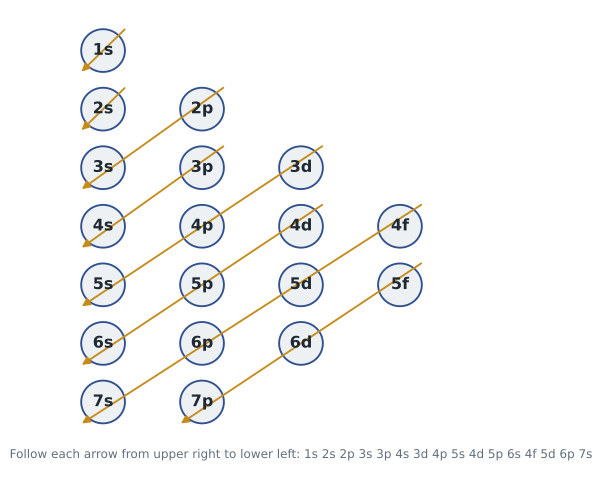
Electrons fill orbitals from lowest to highest energy (the Aufbau principle). Because of shielding and penetration, subshells within a shell are not equal in energy, and the 4s subshell fills before 3d. The filling order follows the n + l rule: lower n + l fills first, and for a tie, lower n fills first. The diagonal diagram below is a quick way to generate the order. Within a subshell, electrons occupy separate orbitals with parallel spins before pairing (Hund's rule), which minimizes electron-electron repulsion.
A configuration lists each occupied subshell with its electron count as a superscript: oxygen is 1s² 2s² 2p⁴. Noble gas shorthand replaces the core with the preceding noble gas in brackets, so iron is [Ar] 4s² 3d⁶. Valence electrons are those in the outermost shell (for main-group elements, the s and p electrons of the highest n), and they control bonding.
Two exceptions appear often: chromium is [Ar] 4s¹ 3d⁵ and copper is [Ar] 4s¹ 3d¹⁰. A half-filled or filled d subshell is especially stable, so one 4s electron moves into 3d. The same pattern holds for molybdenum, silver and gold in the rows below. Expect a question that offers the "expected" configuration as a distractor.
Ions follow two rules. Anions add electrons to the next available orbital, so chloride is [Ar], the same configuration as argon (they are isoelectronic). Cations lose electrons from the highest n first, which for transition metals means the 4s electrons leave before 3d. So Fe²⁺ is [Ar] 3d⁶, not [Ar] 4s² 3d⁴, and Fe³⁺ is [Ar] 3d⁵. This rule matters in biochemistry passages about iron in heme groups and the iron-sulfur clusters of the electron transport chain.
Unpaired electrons make a species paramagnetic, weakly attracted to a magnetic field. When all electrons are paired the species is diamagnetic and weakly repelled. Counting unpaired electrons requires drawing the orbital boxes and applying Hund's rule: nitrogen (2p³) has three unpaired electrons, oxygen (2p⁴) has two, and neon has none.
Worked problem
Configuration of a transition metal ion
Write the electron configuration of Mn²⁺ (manganese, Z = 25) and state how many unpaired electrons it has.
Show solution
- Neutral manganese has 25 electrons: [Ar] 4s² 3d⁵.
- Form the cation by removing the two 4s electrons first: [Ar] 3d⁵.
- Five d orbitals each take one electron with parallel spins, by Hund's rule.
Answer: [Ar] 3d⁵, with five unpaired electrons, so Mn²⁺ is strongly paramagnetic.
The Bohr model and atomic spectra
Niels Bohr's 1913 model of hydrogen treated the electron as moving in fixed circular orbits with quantized energies. The model is wrong in its picture of orbits, but it correctly predicts hydrogen's energy levels, and the MCAT uses it for questions about absorption and emission. The energy of level n is proportional to −1/n². The negative sign means the electron is bound; zero energy corresponds to a free electron at infinite distance.
Here R_H is about 2.18 × 10⁻¹⁸ joules (13.6 electronvolts), h is Planck's constant (about 6.6 × 10⁻³⁴ joule-seconds) and c is the speed of light (3.0 × 10⁸ meters per second). When an electron absorbs a photon whose energy exactly matches the gap between two levels, it jumps up. When it falls back, it emits a photon of the same energy. Larger energy gaps mean higher frequency and shorter wavelength.
Because only certain gaps exist, each element produces a line spectrum, a fingerprint used in flame tests and astronomy. In hydrogen, transitions that end at n = 1 lie in the ultraviolet (the Lyman series), and those that end at n = 2 include the visible Balmer lines. The energy gaps between successive levels shrink as n rises, so emission from n = 2 to n = 1 releases more energy than any transition that ends at n = 2. The heuristic to remember is that falling into a low level releases a lot of energy.
Two related ideas complete the picture. The Heisenberg uncertainty principle says that the position and momentum of an electron cannot both be known precisely, which is why orbitals are probability clouds rather than tracks. The photoelectric effect shows that light comes in packets: electrons are ejected from a metal only when each photon carries more energy than the metal's work function, regardless of the light's intensity. Intensity changes how many electrons are ejected, not how fast they move. Both ideas come back in MCAT-121.
Shielding and effective nuclear charge
An outer electron does not feel the full charge of the nucleus, because inner electrons shield it. The net pull it feels is the effective nuclear charge, Z_eff, roughly the number of protons minus the number of core electrons. For sodium, Z_eff on the 3s electron is about 11 − 10 = 1; for chlorine in the same row, it is about 17 − 10 = 7. Electrons in the same shell shield each other only weakly. Across a period, protons are added while the core stays the same, so Z_eff rises. Down a group, Z_eff for valence electrons stays roughly constant, but the valence shell is farther away.
Those two facts explain nearly every periodic trend. Thandiwe asked the group to say them aloud before each trend question: "Across a row, more pull on the same shell. Down a column, the same pull on a more distant shell."
Periodic trends
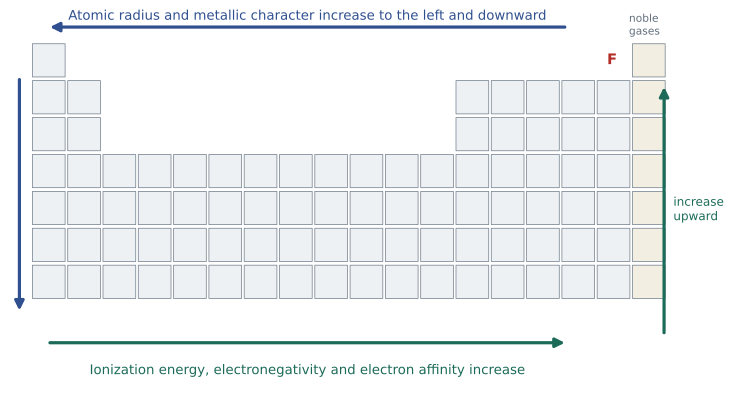
Atomic radius decreases across a period, because rising Z_eff pulls the same shell inward, and increases down a group, because each new shell is farther out. Cations are smaller than their parent atoms (they lose a shell or reduce repulsion), and anions are larger. In an isoelectronic series such as O²⁻, F⁻, Na⁺ and Mg²⁺, all with ten electrons, the radius falls as the nuclear charge rises, so O²⁻ is the largest and Mg²⁺ the smallest.
Ionization energy is the energy needed to remove an electron from a gaseous atom. It rises across a period and falls down a group, the reverse of radius. Successive ionization energies always increase, and a very large jump appears when the next electron must come from a noble gas core. Magnesium's third ionization energy is several times its second, because the third electron would come from a filled n = 2 shell. A passage that gives a sequence of ionization energies is asking you to locate that jump and so identify the group.
There are two small exceptions across period 2 and 3. Boron has a lower first ionization energy than beryllium, because boron's electron comes from a 2p orbital, which is higher in energy and slightly shielded by 2s. Oxygen has a lower first ionization energy than nitrogen, because oxygen's fourth p electron is paired and repelled by its partner, whereas nitrogen's half-filled p subshell is especially stable.
Electron affinity is the energy change when a gaseous atom gains an electron. Halogens release the most energy, because the added electron completes an octet. Noble gases and alkaline earth metals have little or no tendency to gain electrons. Electronegativity, introduced by Linus Pauling, is an atom's ability to attract shared electrons in a bond. It rises toward the upper right of the table, with fluorine highest at about 4.0, followed by oxygen (3.4), nitrogen and chlorine (each about 3.0). Noble gases are usually left out because they rarely form bonds.
Metallic character follows the opposite direction: metals lie on the left and toward the bottom, lose electrons easily, conduct electricity and form basic oxides. Nonmetals lie to the upper right and form acidic oxides. Metalloids, such as silicon and arsenic, lie along the staircase between them and have intermediate properties.
| Trend | Across a period (left to right) | Down a group | Main reason |
|---|---|---|---|
| Atomic radius | Decreases | Increases | Z_eff rises across; new shells added down |
| First ionization energy | Increases | Decreases | Stronger hold across; electron farther away down |
| Electronegativity | Increases | Decreases | Same as ionization energy |
| Electron affinity (energy released) | Generally increases | Generally decreases | Added electron feels more pull across |
| Metallic character | Decreases | Increases | Ease of losing electrons |
The groups you should know
The alkali metals of group 1 have one valence s electron, lose it easily to form +1 ions, and react vigorously with water to give hydroxides and hydrogen gas. The alkaline earth metals of group 2 form +2 ions. The halogens of group 17 have seven valence electrons, exist as diatomic molecules and form −1 ions; their reactivity as oxidizing agents falls down the group, so fluorine is the strongest. The noble gases of group 18 have filled valence shells and are very unreactive. Transition metals in the d block form ions with several possible charges, and many form colored complexes because their partly filled d orbitals absorb visible light. That property is why copper sulfate solutions look blue and why hemoglobin changes color when it binds oxygen.
Biology passages lean on these groups. Sodium and potassium (group 1) carry membrane potentials; calcium and magnesium (group 2) act in signaling and as enzyme cofactors; iron, copper and zinc (transition metals) appear in heme, cytochrome oxidase and zinc fingers. The chemistry is the same as in the lab: charge and radius decide how tightly an ion binds water or a protein.
Passage-style practice
Passage. A research group compared the first three ionization energies of two unknown main-group elements, X and Y, both in period 3, and measured the wavelength of a strong emission line from each element in a flame. Data invented for this course.
| Element | First ionization energy (kJ/mol) | Second (kJ/mol) | Third (kJ/mol) | Strong emission line (nm) |
|---|---|---|---|---|
| X | 500 | 4,560 | 6,910 | 589 |
| Y | 740 | 1,450 | 7,730 | 285 |
Practice problems
Work each problem on paper first, then reveal the answer to check.
Which group does element X belong to, and why? (Skill 4: data-based reasoning)
Show answer
Group 1. The jump from about 500 to about 4,560 kilojoules per mole occurs after the first electron, so X has one valence electron; in period 3 that is sodium.
Which group does element Y belong to? (Skill 4)
Show answer
Group 2. The large jump comes after the second electron (1,450 to 7,730), so Y has two valence electrons, which fits magnesium.
Which element has the smaller atomic radius, and why? (Skill 1: knowledge of scientific concepts)
Show answer
Y. It lies to the right of X in the same period, so it has a higher effective nuclear charge pulling on the same shell.
Which emission line corresponds to the larger energy gap between electron levels? (Skill 2: scientific reasoning)
Show answer
Y's line at 285 nanometers. Photon energy is inversely proportional to wavelength, so the shorter wavelength means the larger energy gap.
A student says the second ionization energy of X is high because X becomes more negative after the first electron leaves. What is wrong with this explanation? (Skill 2)
Show answer
X becomes a positive ion, not a negative one. The second electron is hard to remove because it must come from the filled n = 2 core, which is closer to the nucleus and less shielded.
Common mistakes
MistakeTransition metals lose their d electrons first when they form cations.
InsteadThey lose the highest-n electrons first, which are the 4s electrons for the first row of transition metals.
MistakeIsotopes have different chemical properties because they have different masses.
InsteadIsotopes have nearly identical chemistry, because chemistry depends on electrons, which are the same.
MistakeA larger atom has a higher ionization energy because it has more electrons.
InsteadLarger atoms hold their valence electrons less tightly, so ionization energy falls as radius grows.
MistakeHalf-life depends on how much radioactive material is present.
InsteadHalf-life is constant for a given nuclide, as for any first-order process.
MistakeBeta-minus decay lowers the atomic number.
InsteadIn beta-minus decay a neutron becomes a proton, so Z rises by one while A stays the same.
Summary and key terms
- Z is the number of protons and defines the element; A is protons plus neutrons; isotopes differ only in neutrons.
- Nuclear decay conserves mass number and atomic number; half-life is constant and follows first-order kinetics.
- Four quantum numbers describe each electron; the Pauli principle limits each orbital to two electrons of opposite spin.
- Electrons fill by the Aufbau principle and Hund's rule; chromium and copper are the main exceptions; cations lose highest-n electrons first.
- Bohr energy levels and photon energy (E = hf = hc/λ) explain line spectra; shorter wavelength means larger energy.
- Effective nuclear charge rises across a period and outer shells grow down a group, which explains radius, ionization energy and electronegativity trends.
- Atomic number
- The number of protons in the nucleus, which identifies the element.
- Isotope
- An atom of an element with a particular number of neutrons.
- Half-life
- The time for half of the radioactive nuclei in a sample to decay.
- Pauli exclusion principle
- No two electrons in an atom can have the same four quantum numbers.
- Hund's rule
- Electrons occupy separate orbitals of a subshell with parallel spins before pairing.
- Effective nuclear charge
- The net positive charge felt by an electron after shielding by other electrons.
- Ionization energy
- The energy needed to remove an electron from a gaseous atom or ion.
- Electronegativity
- The ability of an atom to attract shared electrons in a bond.
- Paramagnetic
- Having unpaired electrons and so being attracted to a magnetic field.
Practice problems
Work each problem on paper first, then reveal the answer to check.
How many neutrons are in an atom of iodine-131 (Z = 53)?
Show answer
131 − 53 = 78 neutrons.
Thorium-230 (Z = 90) undergoes alpha decay. What is the product?
Show answer
Radium-226 (Z = 88): the mass number falls by 4 and the atomic number by 2.
How many electrons can the n = 3 shell hold?
Show answer
2n² = 18 electrons (3s, 3p and 3d).
Write the configuration of Cu⁺.
Show answer
Copper is [Ar] 4s¹ 3d¹⁰; removing the 4s electron gives [Ar] 3d¹⁰.
Arrange S²⁻, Cl⁻, K⁺ and Ca²⁺ from largest to smallest radius.
Show answer
S²⁻ > Cl⁻ > K⁺ > Ca²⁺: all have 18 electrons, and radius falls as nuclear charge rises.
Why is the first ionization energy of oxygen lower than that of nitrogen?
Show answer
Oxygen's fourth 2p electron is paired in one orbital, and repulsion from its partner makes it easier to remove.
Lesson quiz · 5 questions
Score 60% or more to complete this lesson.
Create a free account to save your progress, take quizzes and earn a certificate.