
MCAT-120 · Lesson 7 of 12 · 30 min
Kinetics and equilibrium: reaction rates and rate laws
▶ Video coming soon A video version of this lesson is on the way.
Thandiwe started with the diamond on her ring. 'Last week we said this is thermodynamically unstable at room temperature. Graphite is lower in free energy. So why is it still a diamond?' Ezequiel answered that the reaction must be very slow. 'Exactly. Thermodynamics tells you where a reaction is going. Kinetics tells you how fast it gets there, and the MCAT will try to make you confuse the two.' Devika added that the Michaelis-Menten material from the biochemistry block had made her nervous about rate equations. Thandiwe promised that enzyme kinetics would look simpler after this lesson, not harder.
This lesson covers reaction rates, rate laws and reaction order, how to find a rate law from experimental data, integrated rate laws and half-lives, reaction mechanisms and the rate-determining step, collision theory, activation energy and the Arrhenius equation, transition states, and catalysis. On the AAMC outline this belongs to content category 5E (principles of chemical thermodynamics and kinetics). Enzyme kinetics in MCAT-110 rests on the same foundations.
Reaction rate
The rate of a reaction is the change in concentration of a reactant or product per unit time, usually in molar per second (M/s). Reactant concentrations fall, so their rates of change are negative; by convention the reaction rate is reported as a positive number. The rate is related to the coefficients of the balanced equation. For 2 N₂O₅ → 4 NO₂ + O₂, nitrogen dioxide appears four times as fast as oxygen and twice as fast as N₂O₅ disappears. Dividing each rate of change by its coefficient gives a single rate for the reaction.
Rates are usually highest at the start of a reaction and fall as reactants are used up. The initial rate, measured before concentrations change much, is what most rate experiments report. Factors that affect rate include reactant concentrations, temperature, the physical state and surface area of reactants (a powder reacts faster than a lump), the solvent, and the presence of a catalyst.
Rate laws and reaction order
A rate law expresses the rate as a function of reactant concentrations. For a reaction A + B → products, the general form is:
k is the rate constant, which depends on temperature and the presence of a catalyst but not on concentration. The exponents x and y are the orders with respect to each reactant, and their sum is the overall order. Orders must be determined experimentally. They are not, in general, the coefficients of the balanced equation, because the balanced equation shows only the overall change, not the steps by which it happens. The one exception is an elementary step, a single molecular event, whose rate law does follow from its molecularity.
| Overall order | Rate law example | Units of k | Effect of doubling [A] |
|---|---|---|---|
| Zero | rate = k | M/s | No change in rate |
| First | rate = k[A] | 1/s | Rate doubles |
| Second | rate = k[A]² or k[A][B] | 1/(M·s) | Rate quadruples (for k[A]²) |
| Third | rate = k[A]²[B] | 1/(M²·s) | Rate quadruples (for [A]) |
Finding a rate law from initial rates
The method of initial rates compares experiments in which one reactant's concentration changes while the others stay fixed. If doubling a concentration doubles the rate, the order in that reactant is 1; if it quadruples the rate, the order is 2; if the rate does not change, the order is 0. If tripling a concentration multiplies the rate by 9, the order is 2. In general, the factor by which the rate changes equals the factor by which concentration changes, raised to the order.
Worked problem
Method of initial rates
For 2 NO + O₂ → 2 NO₂, a chemist measures initial rates: Experiment 1: [NO] = 0.010 M, [O₂] = 0.010 M, rate 2.5 × 10⁻⁵ M/s. Experiment 2: [NO] = 0.020 M, [O₂] = 0.010 M, rate 1.0 × 10⁻⁴ M/s. Experiment 3: [NO] = 0.010 M, [O₂] = 0.020 M, rate 5.0 × 10⁻⁵ M/s. Find the rate law and k.
Show solution
- Experiments 1 and 2: [NO] doubles, [O₂] constant, rate goes from 2.5 × 10⁻⁵ to 1.0 × 10⁻⁴, a factor of 4. Order in NO is 2.
- Experiments 1 and 3: [O₂] doubles, [NO] constant, rate doubles. Order in O₂ is 1.
- Rate law: rate = k[NO]²[O₂], third order overall.
- k = rate ÷ ([NO]²[O₂]) = 2.5 × 10⁻⁵ ÷ (1.0 × 10⁻⁴ × 1.0 × 10⁻²) = 2.5 × 10⁻⁵ ÷ 1.0 × 10⁻⁶ = 25.
Answer: rate = k[NO]²[O₂] with k = 25 M⁻² s⁻¹. Here the orders happen to match the coefficients, but that must be shown by experiment.
Integrated rate laws and half-life
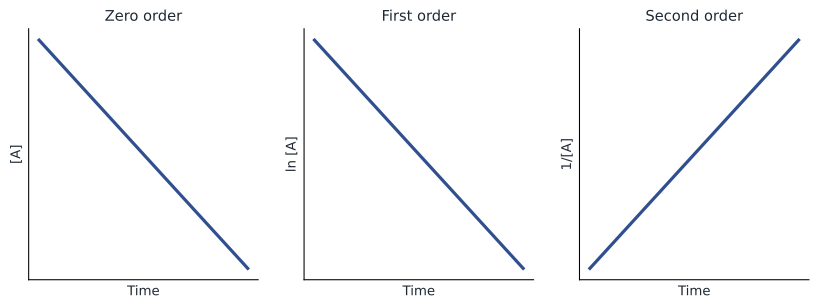
Integrated rate laws describe how concentration changes over time, and each order gives a characteristic straight-line plot. For a zero-order reaction, concentration falls linearly with time. For a first-order reaction, the natural logarithm of concentration falls linearly. For a second-order reaction, the reciprocal of concentration rises linearly. Identifying which plot is straight is a common way to determine order from a single experiment, and passages often show one of these plots.
The half-life is the time for a reactant's concentration to fall by half. Only for first-order reactions is the half-life constant, independent of starting concentration; it equals 0.693 divided by k. Radioactive decay (lesson 1), many drug elimination processes and the decomposition of hydrogen peroxide are first order. For a zero-order reaction the half-life shortens as the reaction proceeds; for a second-order reaction it lengthens.
Worked problem
Drug elimination as a first-order process
A drug is eliminated by first-order kinetics with a half-life of 4 hours. A patient's plasma concentration is 80 milligrams per liter at noon. What is it at 8 p.m., and what is the rate constant?
Show solution
- Noon to 8 p.m. is 8 hours, two half-lives: 80 → 40 → 20 milligrams per liter.
- k = 0.693 ÷ 4 hours ≈ 0.17 per hour.
Answer: 20 milligrams per liter; k is about 0.17 h⁻¹. Ethanol, by contrast, is eliminated at a nearly constant rate at typical concentrations, because its enzyme is saturated, so its elimination is close to zero order.
The ethanol example connects to Michaelis-Menten kinetics. At substrate concentrations far below Km, an enzyme-catalyzed rate is roughly proportional to substrate concentration (first order). At concentrations far above Km, the enzyme is saturated and the rate approaches Vmax regardless of substrate (zero order). The Michaelis-Menten curve bridges the two regimes.
Reaction mechanisms
Most reactions occur in several elementary steps, collectively the mechanism. Each elementary step has a molecularity: unimolecular (one particle rearranges or breaks apart), bimolecular (two particles collide) or, rarely, termolecular. Species formed in one step and consumed in a later one are intermediates; they do not appear in the overall equation. A catalyst, by contrast, is consumed in an early step and regenerated in a later one.
The slowest step, the rate-determining step, controls the overall rate, like the narrowest part of a funnel. The rate law of the overall reaction is the rate law of that step, provided it involves only reactants. If the slow step involves an intermediate formed in a fast earlier equilibrium, the intermediate's concentration must be expressed in terms of reactants, which can lead to unexpected orders.
Worked problem
Deducing a rate law from a mechanism
The reaction NO₂ + CO → NO + CO₂ is proposed to occur in two steps. Step 1 (slow): NO₂ + NO₂ → NO₃ + NO. Step 2 (fast): NO₃ + CO → NO₂ + CO₂. What rate law does the mechanism predict, and what is the intermediate?
Show solution
- Add the steps: 2 NO₂ + NO₃ + CO → NO₃ + NO + NO₂ + CO₂. Cancel NO₃ and one NO₂: NO₂ + CO → NO + CO₂. The mechanism gives the correct overall reaction.
- NO₃ is formed in step 1 and consumed in step 2, so it is the intermediate.
- Step 1 is slow and bimolecular in NO₂, so rate = k[NO₂]².
Answer: rate = k[NO₂]², zero order in CO. That matches experiment, which shows that carbon monoxide does not take part in the rate-determining step.
A proposed mechanism must satisfy two conditions: its steps must add up to the overall equation, and it must predict the experimentally observed rate law. Agreement with experiment does not prove a mechanism; it shows only that the mechanism is consistent with the data.
Collision theory and activation energy
For molecules to react, they must collide with enough energy and with the right orientation. Collision theory explains why concentration matters (more molecules mean more collisions), why temperature matters (faster molecules collide more often and, more importantly, with more energy) and why orientation matters (a collision on the wrong part of a molecule does nothing). The minimum energy needed is the activation energy, Ea.
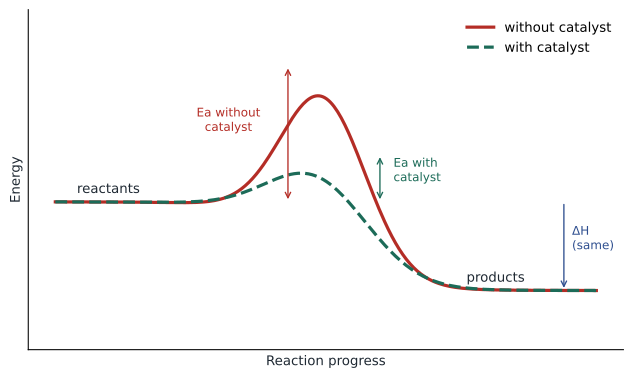
Transition state theory pictures the reaction passing through a high-energy arrangement, the transition state or activated complex, at the top of the energy barrier. The transition state exists only fleetingly and cannot be isolated, unlike an intermediate, which sits in a shallow valley between two humps in a multi-step energy diagram. On a reaction coordinate diagram, the number of humps equals the number of elementary steps, and the tallest hump measured from the starting point usually marks the rate-determining step.
The Arrhenius equation and temperature
The Arrhenius equation describes how the rate constant depends on temperature and activation energy.
A is the frequency factor, which reflects how often molecules collide with the correct orientation. The exponential term is the fraction of collisions with energy at least Ea. Raising the temperature or lowering the activation energy increases k, and the effect is large because it is exponential. A rough rule for many reactions near room temperature is that a 10 °C increase roughly doubles the rate. That rule is an approximation, not a law, and passages sometimes test whether you treat it as exact.
Temperature affects rate through k; it does not change the reaction's order. It also shifts the equilibrium position of a reaction, but by a different mechanism (lesson 8).
Catalysts
A catalyst increases the rate of a reaction by providing an alternative pathway with a lower activation energy. It is not consumed overall. Crucially, a catalyst lowers the activation energy of the forward and reverse reactions by the same amount, so it speeds up both directions equally. It therefore does not change ΔH, ΔG, ΔS or the equilibrium constant. It only helps the system reach equilibrium faster.
Homogeneous catalysts are in the same phase as the reactants, such as acid speeding up the hydrolysis of an ester in solution. Heterogeneous catalysts are in a different phase, usually a solid surface on which gas or liquid molecules adsorb, as in a car's catalytic converter or the iron catalyst of the Haber process. Enzymes are biological catalysts that bind substrates in an active site, stabilize the transition state, orient reactants and sometimes provide acid-base or covalent catalysis. They can speed reactions by factors of a million or more.
| Change | Effect on rate | Effect on k | Effect on Ea | Effect on K (equilibrium) |
|---|---|---|---|---|
| Increase reactant concentration | Increases (unless zero order) | None | None | None |
| Increase temperature | Increases | Increases | None | Changes (depends on ΔH) |
| Add a catalyst | Increases | Increases | Lowers | None |
| Increase surface area of a solid | Increases | Effectively increases | None | None |
Passage-style practice
Passage. Hydrogen peroxide decomposes slowly to water and oxygen: 2 H₂O₂ → 2 H₂O + O₂. A student measured the concentration of H₂O₂ over time at 25 °C, with and without a small amount of iodide ion added. She also repeated the uncatalyzed reaction at 35 °C. Data invented for this course.
| Time (min) | [H₂O₂] uncatalyzed, 25 °C (M) | [H₂O₂] with iodide, 25 °C (M) | [H₂O₂] uncatalyzed, 35 °C (M) |
|---|---|---|---|
| 0 | 0.80 | 0.80 | 0.80 |
| 10 | 0.40 | 0.10 | 0.20 |
| 20 | 0.20 | 0.0125 | 0.05 |
| 30 | 0.10 | Below detection | 0.0125 |
Practice problems
Work each problem on paper first, then reveal the answer to check.
What is the order of the uncatalyzed reaction at 25 °C, and how do you know? (Skill 4: data-based reasoning)
Show answer
First order: the concentration halves every 10 minutes regardless of its starting value, so the half-life is constant.
What is the half-life of the iodide-catalyzed reaction? (Skill 4)
Show answer
The concentration falls by a factor of 8 every 10 minutes, which is three half-lives, so the half-life is about 3.3 minutes.
Does iodide change the final amount of oxygen produced from the same starting H₂O₂? (Skill 2: scientific reasoning)
Show answer
No. A catalyst changes the rate, not the equilibrium position or the stoichiometry; all the H₂O₂ still yields the same oxygen.
By what factor did the rate constant increase between 25 °C and 35 °C for the uncatalyzed reaction? (Skill 4)
Show answer
The half-life fell from 10 minutes to 5 minutes, so k doubled, consistent with the rough rule of a doubling per 10 °C.
A classmate proposes that the reaction is second order because the balanced equation has a coefficient of 2 for H₂O₂. What is wrong with this argument? (Skill 2)
Show answer
Orders come from experiment, not from coefficients of the overall equation; the constant half-life shows the reaction is first order.
Common mistakes
MistakeReaction orders equal the coefficients of the balanced equation.
InsteadOrders come from experiments; only elementary steps have orders equal to their coefficients.
MistakeA catalyst shifts equilibrium toward products.
InsteadA catalyst speeds forward and reverse reactions equally and leaves K unchanged.
MistakeThe rate constant changes when concentration changes.
Insteadk depends on temperature and catalysts, not on concentration.
MistakeAn intermediate and a transition state are the same thing.
InsteadAn intermediate sits in an energy valley and can sometimes be detected; a transition state is a fleeting energy maximum.
MistakeA large negative ΔG means a fast reaction.
InsteadSpeed depends on activation energy, not on ΔG.
Summary and key terms
- Rate is the change in concentration per unit time; dividing by coefficients gives a single reaction rate.
- Rate laws (rate = k[A]^x[B]^y) are found experimentally, often by the method of initial rates.
- Zero-, first- and second-order reactions give straight lines for [A], ln [A] and 1/[A] against time; only first-order half-lives are constant.
- Mechanisms are sequences of elementary steps; the slow step sets the rate law; intermediates are formed and consumed.
- Collision theory and the Arrhenius equation explain why higher temperature and lower activation energy speed reactions.
- Catalysts lower Ea for both directions; they do not change ΔH, ΔG or K.
- Rate law
- An equation relating reaction rate to reactant concentrations.
- Rate constant
- The proportionality constant k in a rate law; it depends on temperature.
- Reaction order
- The exponent of a concentration in a rate law.
- Half-life
- The time for a reactant concentration to fall to half its value.
- Elementary step
- A single molecular event in a reaction mechanism.
- Rate-determining step
- The slowest step of a mechanism, which controls the overall rate.
- Activation energy
- The minimum energy needed for a reaction to occur.
- Transition state
- The highest-energy arrangement along the reaction pathway.
- Catalyst
- A substance that speeds a reaction by lowering its activation energy without being consumed.
Practice problems
Work each problem on paper first, then reveal the answer to check.
A reaction is second order in A. If [A] triples, what happens to the rate?
Show answer
It increases ninefold.
What are the units of k for a first-order reaction?
Show answer
Inverse seconds (s⁻¹).
A first-order reaction has k = 0.0693 per minute. What is its half-life?
Show answer
0.693 ÷ 0.0693 = 10 minutes.
Which plot is linear for a second-order reaction?
Show answer
1/[A] against time.
Does a catalyst change the enthalpy of reaction?
Show answer
No; ΔH is a state function, and the catalyst changes only the pathway.
Lesson quiz · 5 questions
Score 60% or more to complete this lesson.
Create a free account to save your progress, take quizzes and earn a certificate.