
LSAT-140 · Lesson 7 of 12 · 19 min
Managing anxiety
▶ Video coming soon A video version of this lesson is on the way.
The session on Friday, October 30, the night before Halloween, began with Harriet asking each member to describe, in one sentence, how they felt in the first five minutes of their last full practice test. Dani said her hands were cold and she read the first stimulus three times. Thomas said he felt fine, then realized halfway through section 1 that he had been rushing because he wanted it to be over. Élodie said she felt calm until she looked at the clock. Marcus, two weeks from his test, said he felt the way he had in April 2025, which he described as "a low hum of dread".
Ji-won said she felt mostly excited, which made the others laugh. Harriet said that was a useful starting point, because excitement and anxiety feel physically similar, and the difference between them is partly a matter of interpretation.
Why nerves matter
Some nervousness before a high-stakes test is normal and can even help: it raises alertness. Too much, or the wrong kind, interferes with performance. The research literature on test anxiety and on "choking under pressure" suggests one common mechanism: worry uses some of the same limited mental capacity, often called working memory, that complex reasoning needs. A candidate who is thinking "I am going to fail this section" has less capacity left for following a conditional chain.
That mechanism explains why anxious candidates often make errors on exactly the kind of questions that demand holding several pieces of information at once, such as sufficient assumption, parallel reasoning and inference questions with multiple conditions. It also suggests the remedies: reduce the worry, or reduce how much capacity it takes.
Harriet was careful about what the course would and would not do. 'This is test preparation, not therapy,' she said. 'Everything I will show you is a simple technique with some research behind it, which ordinary candidates use. If anxiety is affecting your life beyond the test, sleep, eating, work, that is something to talk about with a doctor or counselor. A diagnosed condition can also support an accommodation request to LSAC, which Lesson 10 covers.'
Preparation itself reduces anxiety
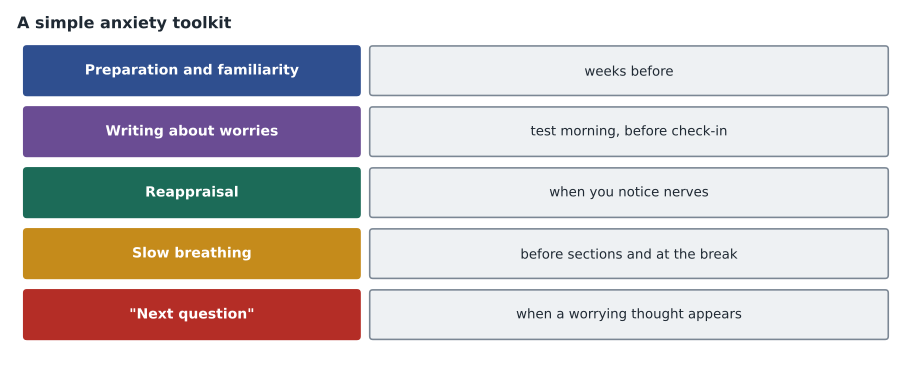
The most reliable remedy for test anxiety is familiarity. A candidate who has taken several full-length practice tests in the official interface, at the real time of day, with the intermission routine practiced, has fewer unknowns on test day. Unknowns feed worry. Harriet said that much of the course so far, checkpoints, the skip rule, stamina work, was also anxiety management, because it replaced "what if" with "I have done this".
She asked each member to list the three things about test day they were most uncertain about. Élodie listed the drive to Ottawa, finding the center and the check-in process. Dani listed whether her ID would be accepted and what she could bring. Thomas listed whether he would rush. Harriet said each item had an answer: a trial drive, LSAC's ID rules and checklist, and the checkpoints. Lessons 9 and 11 would deal with the logistics.
Reappraising arousal
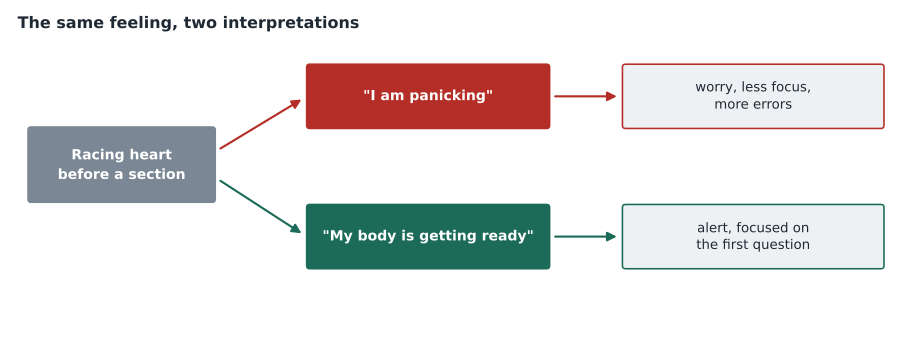
One technique with experimental support is called arousal reappraisal. In a study published in 2010, researchers led by Jeremy Jamieson told some students preparing for a practice graduate admissions test that physical signs of nervousness, such as a racing heart, can help performance by supplying energy. Those students scored higher on the math section than students who received no such message. Later studies have found similar effects in some settings, although results vary.
The technique is simple. When you notice a fast heartbeat or tense stomach before or during the test, tell yourself something like "this is my body getting ready" rather than "this means I am panicking". The goal is not to stop feeling nervous, which rarely works, but to interpret the feeling as useful energy. Ji-won's instinct to call the feeling excitement was a natural version of the same idea.
Writing about worries
A second technique comes from research by Gerardo Ramirez and Sian Beilock, published in 2011. Students who spent about ten minutes writing about their worries immediately before a high-stakes exam performed better than students who did not, with the effect largest among students who were most anxious. The researchers suggested that writing the worries down frees up working memory that would otherwise be used for worrying.
Test-center rules do not allow you to write anything once you are checked in, so this technique belongs before you leave home or in the car or waiting area before check-in, using your own paper, which you then leave behind. Harriet suggested ten minutes of writing on the morning of the test, describing honestly what you are worried about. The page does not need to be read by anyone, including you.
Dani tried it before a practice test and said it felt strange at first. By the third practice test she said it had become part of her routine, and that she started section 1 feeling, in her words, "less crowded".
Breathing
Slow breathing is a widely used way to reduce physical tension. Breathing slowly, with the out-breath a little longer than the in-breath, for a minute or two, tends to slow the heart rate and settle the body. It can be done anywhere, including at your seat before a section begins and during the intermission, without any equipment or anything that might break test rules.
Harriet's version was four counts in and six counts out, repeated six times, which takes about a minute. She asked the group to practice it during the breaks of their practice tests so that it would feel familiar on test day. Marcus, who said he had never tried anything like it, reported after a week that it helped most at the start of section 3, after the intermission.
Thoughts during the test
Anxious thoughts during a section usually take a few forms: predictions ("I am going to run out of time"), judgments ("I should know this"), and catastrophes ("If this section goes badly, I will not get into law school"). Harriet's advice was not to argue with these thoughts, which takes more capacity, but to notice them briefly and return to a concrete task: read the stem, find the conclusion, check the checkpoint.
She gave the group a single phrase for this: "next question". When a worrying thought appears, say "next question" to yourself and do the first step of the question in front of you. The phrase redirects attention to something small and controllable.
She also reminded the group of three facts that put any single section in perspective. A section that feels hard may be the unscored section. Feelings about how a section went are poor predictors of results. And the LSAT can be retaken, scores can be canceled under LSAC's rules, and Score Preview lets candidates see a score before deciding whether to keep it. No single section, and no single test, is the end of the road.
Recovering from a bad moment
Even well-prepared candidates have bad moments: a question that makes no sense, a passage that seems impossible, a glance at the clock that shows you are behind. Harriet's recovery routine had three steps. Choose an answer and flag the question; take one slow breath; read the next question's stem. The routine takes about ten seconds and stops one bad question from becoming a bad section.
Thomas asked what to do if the bad moment was larger, such as realizing halfway through a section that he had misread an entire passage. Harriet said the same principle applies: make the best decisions you can with the time left, use the last-passage strategy from Lesson 3, guess the rest, and start the next section at zero. A single damaged section rarely sinks a test if the other sections are protected.
Keeping perspective
Harriet closed with a point she said she made to every group. The LSAT matters, but it is one part of a law school application, and it measures a narrow set of skills on a single day. Candidates who see it as a measure of their worth tend to be more anxious and perform worse. Candidates who see it as a skills test they have trained for, and can retake, tend to perform closer to their ability.
Marcus said that was easier to believe the second time. Harriet said that was one reason so many candidates do better on a retake: not only more practice, but less fear of the unknown. She asked each member to write one sentence describing what the test was, and was not, and to keep it with their test-day materials.
Practicing calm under realistic conditions
Familiarity works best when practice conditions resemble the real test. Harriet suggested that each member take at least one or two practice sections in a setting less comfortable than home: a public library, a coffee shop with ambient noise, or a shared room, at the time of day of the real appointment. The point is not to make practice harder for its own sake, but to rehearse staying calm and focused when conditions are not ideal, as they may not be at a busy test center.
Élodie did a practice section in the reading room of her university library on a Saturday morning, with other students around her. She said the first ten minutes felt strange and the rest felt normal. Harriet said that was exactly the effect she hoped for: the strange feeling happened during practice, not on test day.
Talking about the test
Some candidates find that talking about the test with friends, family or other candidates increases anxiety, especially when others share their own scores or stories. Harriet suggested setting limits in the final weeks: tell people the date, ask them not to ask about scores until after, and avoid online forums where candidates speculate about the test. Others find talking helpful. The point is to notice which helps you and choose accordingly.
Dani said her family asked about the test constantly because they were proud of her, which she appreciated but found stressful. She decided to tell them that she would share her plans after the January test and that, until then, the best way to support her was to ask about anything else. She said the conversations became easier immediately.
When the stakes feel too high
Ji-won asked how to handle the feeling that everything depended on one morning. Harriet said the feeling is understandable, and also not accurate. Law school admissions consider many parts of an application. The LSAT can be retaken within LSAC's limits. Score Preview and cancellation give candidates some control after the test. Writing those facts down, and rereading them on test morning, helps put the day in proportion.
Building a personal routine
Harriet asked each member to combine the tools into a short personal routine and write it on a card for test day. Dani's card read: "Morning: write for ten minutes. Car: slow breathing. Seat: one breath, read the first stem. Bad question: choose, flag, breathe, next question. Break: walk, water, breathe." Élodie's card was shorter: "Energy, not panic. Flag sooner, never read faster." Thomas wrote only: "Hold the checkpoints. Next question." Harriet said the best routine was the one each person would actually use, and that a card with three lines was better than a page nobody would read on test morning.
She asked them to use the routine on every remaining practice test, so that on test day it would feel automatic rather than like something new to remember.
Marcus said the most useful idea for him was the simplest: that a section feeling bad told him almost nothing. In April 2025 he had been sure his second section went badly and spent the rest of the test trying to make up for it. His final score, 158, turned out close to his practice average, which suggested the section had not gone nearly as badly as it felt. This time he planned to let each section go as soon as it ended.
Common mistakes
MistakeTrying to stop feeling nervous.
InsteadReinterpret physical arousal as energy getting ready.
MistakeArguing with worrying thoughts during a section.
InsteadAcknowledge them briefly, say "next question" and do the first step of the question in front of you.
MistakeTrying a new calming technique for the first time on test day.
InsteadPractice breathing and routines during practice tests so they are familiar.
MistakeJudging the whole test by one bad section.
InsteadUse the recovery routine and start the next section at zero.
MistakeTreating anxiety that affects daily life as only a test problem.
InsteadTalk to a doctor or counselor; a diagnosed condition can support an accommodation request.
Summary and key terms
- Worry uses working memory that complex reasoning needs, so anxiety hurts most on multi-step questions.
- Familiarity is the most reliable remedy: practice under realistic conditions and resolve logistics in advance.
- Arousal reappraisal (Jamieson and colleagues, 2010) and writing about worries before the exam (Ramirez and Beilock, 2011) have research support.
- Slow breathing and the phrase "next question" help during the test; a ten-second recovery routine stops a bad question from spreading.
- The LSAT can be retaken and scores can be previewed or canceled under LSAC rules; no single section decides everything.
- Working memory
- The limited mental capacity used to hold and manipulate information while reasoning.
- Arousal reappraisal
- Interpreting physical signs of nervousness as helpful energy rather than danger.
- Expressive writing
- Writing briefly and honestly about worries before an exam.
- Recovery routine
- Choose and flag, take one slow breath, read the next stem.
- Choking under pressure
- Performing below one's ability because of stress in a high-stakes situation.
Practice problems
Work each problem on paper first, then reveal the answer to check.
How does worry interfere with LSAT performance, according to the research described?
Show answer
It uses working memory that complex reasoning needs.
When can the writing-about-worries technique be used on test day?
Show answer
Before check-in, such as at home or in the car, on your own paper left behind.
What is Harriet's breathing pattern?
Show answer
Four counts in, six counts out, repeated six times.
What are the three steps of the recovery routine?
Show answer
Choose and flag the question, take one slow breath, read the next stem.
Why should you not judge a section by how it felt?
Show answer
It may be the unscored section, and feelings are poor predictors of results.
Lesson quiz · 5 questions
Score 60% or more to complete this lesson.
Create a free account to save your progress, take quizzes and earn a certificate.