
LSAT-140 · Lesson 12 of 12 · 44 min
Capstone: a test-week plan and a timed mini-section
▶ Video coming soon A video version of this lesson is on the way.
At the end of the November 13 session, Harriet set the capstone for the Friday lab in two parts. First, each member would write a one-page test-week plan, covering the final seven days before their own test, and send it to her by Wednesday, November 18. Second, each would take a timed mini-section of ten Logical Reasoning questions she had written, at home, between Saturday, November 14 and Tuesday, November 17, using every technique from the course: checkpoints, the two-minute ceiling, choosing before flagging, a flag log, the second pass and the last-minute sweep. Her debrief notes would go out by email on the evening of Sunday, November 22.
This lesson gives you the same capstone. Write your own test-week plan using the template below. Then set a timer for 14 minutes, or 21 minutes if you have 50 percent extra time, and take the mini-section before reading the answers.
Part 1: the test-week plan
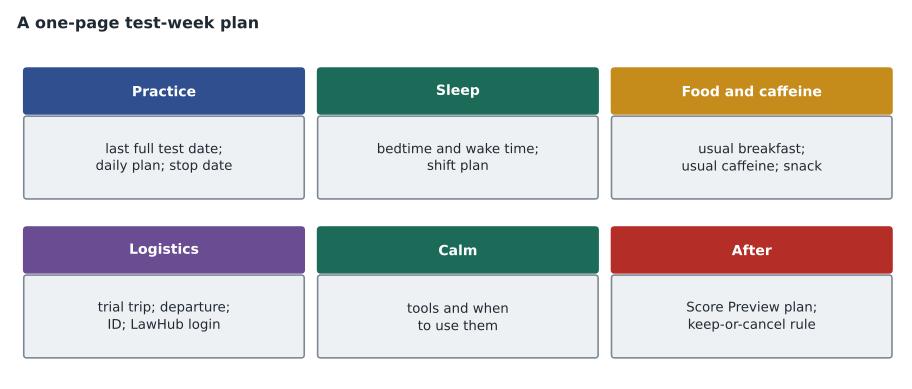
A test-week plan is a one-page document that answers, in advance, every question you might otherwise have to decide in the last seven days. Harriet's template had six headings.
- Practice: the date of the last full practice test (five to seven days before), what you will do on each following day, and the day you stop doing new questions.
- Sleep: your target bedtime and wake time each day, and how you will shift them if your appointment is early.
- Food and caffeine: your usual breakfast, your usual caffeine, and the snack and drink you will leave in your locker.
- Logistics: the trial trip date, departure time on test day, ID to bring, and your LawHub credentials memorized.
- Calm: which anxiety tools you will use and when, such as writing about worries on test morning and slow breathing at the intermission.
- After: your Score Preview or cancellation plan and your keep-or-cancel rule, written before you see a score.
Recalculating checkpoints for any section
Lesson 1 promised a way to recalculate checkpoints for any section length, including the August 2027 format. Harriet's standard checkpoints, question 10 by minute 11 and question 18 by minute 22 in a 35-minute section of about 25 questions, place you about 40 percent of the way through the questions at about 31 percent of the time, and about 72 percent of the way through the questions at about 63 percent of the time. Those proportions bank time early for the harder questions late.
To apply them to another section, multiply. For a 45-minute Logical Reasoning section with 32 questions in the August 2027 format, the first checkpoint is about question 13 by minute 14 and the second about question 23 by minute 28. For this capstone's 10 questions in 14 minutes, the checkpoints are question 4 by about minute 4 and a half and question 7 by about minute 9, with the sweep at about minute 13. With 50 percent extra time, multiply every minute by one and a half: question 4 by about minute 7 and question 7 by about minute 13 and a half, with the sweep at about minute 20.
For Reading Comprehension, divide the section time evenly by the number of passage sets. In the August 2027 format, a 52-minute section with five passage sets would give about ten and a half minutes per set; a 52-minute section with four sets would give thirteen minutes per set. Check LSAC's published structure when the new format arrives, then do the division.
Part 2: the timed mini-section
Set a timer for 14 minutes (21 with 50 percent extra time). Keep a flag log on blank paper. Answer every question. Do not read past the last question until the timer ends.
Worked problem
Drill question 1
City planner: Replacing the old sodium streetlights with LED fixtures will cost the city a large sum this year. But the LED fixtures use far less electricity and last several times longer, so within a decade the savings on power and replacement will exceed the cost. The city should therefore begin the replacement now. Which one of the following most accurately expresses the main conclusion of the planner's argument? (A) LED fixtures last several times longer than sodium streetlights. (B) The city should begin replacing its sodium streetlights with LED fixtures now. (C) The replacement will cost the city a large sum this year. (D) Within a decade the savings will exceed the cost of the replacement. (E) LED fixtures use far less electricity than sodium streetlights.
Show solution
- (B) is correct. "Therefore" introduces the recommendation that everything else supports.
- (A) is a premise supporting the prediction of savings.
- (C) is a concession the planner acknowledges before arguing against delay.
- (D) is an intermediate conclusion that supports the recommendation; it is not the main point.
- (E) is a premise, like (A).
Answer: (B).
Worked problem
Drill question 2
A survey of visitors to a downtown farmers market found that nine in ten of them would support a new tax to expand the city's bicycle lanes. The organizers concluded that most city residents would support the tax. The reasoning in the organizers' conclusion is most vulnerable to criticism on the grounds that it (A) confuses support for a tax with support for bicycle lanes. (B) assumes that people who support a tax will vote for it. (C) fails to state how many visitors were surveyed. (D) draws a conclusion about a population from a sample that may not be representative of it. (E) treats a result about one city as if it applied to all cities.
Show solution
- (D) is correct. Visitors to a downtown market may differ from residents generally, for example in how often they cycle or where they live.
- (A) is wrong: the survey asked about the tax for bicycle lanes, and the conclusion is about the same tax.
- (B) is wrong: the conclusion concerns support, not voting.
- (C) points to missing information but is not the central flaw; even a large sample of market visitors could be unrepresentative.
- (E) is wrong: the conclusion is about one city's residents.
Answer: (D).
Worked problem
Drill question 3
Bakery owner: Our sales of whole-grain bread rose sharply after we moved the whole-grain loaves to the shelf beside the entrance. So placing a product near the entrance is an effective way to increase its sales in our shop. The bakery owner's argument depends on assuming which one of the following? (A) The rise in whole-grain sales was not caused mainly by some other change that occurred at about the same time as the move. (B) Customers in the shop prefer whole-grain bread to white bread. (C) Products near the entrance are always the shop's best sellers. (D) The bakery sells more bread than any other shop in the area. (E) Moving other products to the entrance would not reduce whole-grain sales.
Show solution
- (A) is correct. If another change, such as a price cut or a health campaign, mainly caused the rise, the move does not show that placement works. The argument needs this to be true.
- (B) is not needed; preference for whole grain over white bread is irrelevant to whether placement affected sales.
- (C) is too strong; the argument needs placement to help, not that entrance products always lead.
- (D) is irrelevant to the causal claim.
- (E) concerns future moves, not whether the past move caused the rise.
Answer: (A).
Worked problem
Drill question 4
Researchers found that employees at a company who took a short walk at lunchtime reported less afternoon fatigue than employees who did not. The researchers concluded that a lunchtime walk reduces afternoon fatigue. Which one of the following, if true, most strengthens the researchers' conclusion? (A) Many employees who did not walk ate lunch at their desks. (B) Some employees who walked also drank coffee after lunch. (C) The employees who walked were, on average, younger than those who did not. (D) Afternoon fatigue is common in many workplaces. (E) When employees who had not been walking were assigned to walk at lunch for a month, their reported afternoon fatigue declined.
Show solution
- (E) is correct. It shows the same people becoming less tired after starting to walk, which supports walking as the cause rather than a difference between groups.
- (A) suggests a possible alternative cause, eating at a desk, which does not strengthen the walking claim.
- (B) introduces coffee as an alternative explanation, which weakens rather than strengthens.
- (C) suggests age as an alternative cause, which weakens.
- (D) is general background that does not bear on the cause.
Answer: (E).
Worked problem
Drill question 5
Every member of the hiking club who has completed the advanced navigation course may lead a winter hike. No one may lead a winter hike without a current first-aid certificate. Priya has completed the advanced navigation course. If the statements above are true, which one of the following must also be true? (A) Priya may lead a winter hike. (B) Priya is a member of the hiking club. (C) If Priya is a member of the hiking club, she has a current first-aid certificate. (D) Anyone with a current first-aid certificate may lead a winter hike. (E) Priya does not have a current first-aid certificate.
Show solution
- (C) is correct. If Priya is a member, completing the course means she may lead a winter hike, and anyone who may lead one must have a current first-aid certificate.
- (A) is not guaranteed, because the stimulus does not say Priya is a member of the club.
- (B) is not stated; she may have taken the course without being a member.
- (D) reverses a necessary condition into a sufficient one.
- (E) is not supported; nothing says she lacks a certificate.
Answer: (C).
Worked problem
Drill question 6
A town reduced the speed limit on its main street and, in the following year, recorded fewer collisions there than in the year before. A council member argues that the lower speed limit caused the decline. Which one of the following, if true, most seriously weakens the council member's argument? (A) Most drivers on the main street are local residents. (B) During the following year, a long road closure diverted most traffic away from the main street. (C) Lower speed limits have reduced collisions in some other towns. (D) The town also repainted the crosswalks on the main street. (E) Collisions on the main street had been rising for several years before the change.
Show solution
- (B) is correct. Much less traffic would reduce collisions whatever the speed limit, offering a strong alternative explanation.
- (A) is irrelevant to whether the limit caused the decline.
- (C) supports the council member by showing the effect elsewhere.
- (D) offers a possible second cause, but repainted crosswalks would explain only part of the change; it weakens less than a large drop in traffic.
- (E) makes the decline more notable, if anything, and does not suggest another cause.
Answer: (B).
Worked problem
Drill question 7
Principle: A public library should lend an item only if doing so does not prevent other patrons from reasonable access to it. Which one of the following judgments most closely conforms to the principle above? (A) The library should lend its new laptops, because patrons have asked for them. (B) The library should not lend its newspapers, because they are expensive. (C) The library should lend reference books for a month, because some patrons need them for long projects. (D) The library should not lend children's books to adults, because they are meant for children. (E) The library should not lend its only copy of the local phone directory, because patrons regularly consult it in the building.
Show solution
- (E) is correct. Lending the only copy would prevent other patrons from reasonable access, so the principle forbids it.
- (A) relies on demand, which the principle does not address.
- (B) relies on cost, which the principle does not address.
- (C) would likely prevent others from reasonable access for a month, so it conflicts with the principle.
- (D) relies on intended audience, not on access.
Answer: (E).
Worked problem
Drill question 8
Mayor: Critics say the new transit plan is too expensive. Yet the same critics supported last year's highway expansion, which cost more per resident served. If cost per resident served was acceptable then, it should be acceptable now. The mayor responds to the critics by (A) pointing out an inconsistency between the critics' current objection and a position they took earlier. (B) showing that the transit plan costs less in total than the highway expansion. (C) questioning the critics' motives for opposing the plan. (D) providing evidence that the transit plan will serve more residents than the critics expect. (E) arguing that cost should never be a reason to reject a public project.
Show solution
- (A) is correct. The mayor says the critics accepted a higher cost per resident before, so their objection now is inconsistent.
- (B) is wrong; the mayor compares cost per resident served, not total cost.
- (C) is wrong; the mayor does not discuss motives.
- (D) is wrong; no evidence about ridership is given.
- (E) is too broad; the mayor argues only that this cost should be acceptable given the earlier position.
Answer: (A).
Worked problem
Drill question 9
A regional orchestra lowered its ticket prices by a third last season, yet its total ticket revenue rose. Which one of the following, if true, most helps to explain how revenue could rise despite the lower prices? (A) The orchestra performed the same number of concerts as the season before. (B) Other orchestras in the region did not lower their prices. (C) The orchestra's costs for musicians rose last season. (D) The number of tickets sold last season more than doubled. (E) Many longtime subscribers said they preferred the old prices.
Show solution
- (D) is correct. If attendance more than doubled while prices fell by a third, total revenue would rise.
- (A) holds the number of concerts constant and explains nothing about revenue.
- (B) might help explain higher sales, but it does not show that sales rose enough to raise revenue.
- (C) concerns costs, not revenue.
- (E) concerns preferences, not sales.
Answer: (D).
Worked problem
Drill question 10
Any proposal that would raise property taxes requires a public hearing before the council may vote on it. The proposal to build a new community center will be funded entirely by raising property taxes. Therefore, the council may not vote on the community center proposal until a public hearing is held. The conclusion follows logically if which one of the following is assumed? (A) Public hearings are held on all major council proposals. (B) Most residents support building a new community center. (C) A proposal funded entirely by raising property taxes is a proposal that would raise property taxes. (D) The council has never voted on a proposal without a public hearing. (E) Property taxes in the town are already high.
Show solution
- (C) is correct. It links "funded entirely by raising property taxes" to "would raise property taxes", so the rule about hearings applies and the conclusion follows.
- (A) is not needed and does not connect this proposal to the rule.
- (B) is irrelevant to the procedural requirement.
- (D) describes past practice, which does not guarantee the conclusion.
- (E) is irrelevant.
Answer: (C).
Answer key
Credited answers: 1 (B), 2 (D), 3 (A), 4 (E), 5 (C), 6 (B), 7 (E), 8 (A), 9 (D), 10 (C). Each letter is credited twice, which is a feature of this drill, not a pattern to expect on the real test.
Debriefing your mini-section
Score your drill, then answer five questions about how you took it, using your flag log.
- Where were you at the checkpoints, question 4 at about minute 4 and a half and question 7 at about minute 9?
- Did any question go past the two-minute ceiling? If so, did you choose, flag and move on?
- How many flags did you use, and of which kind?
- Did you change any answers on the second pass, and could you state the reason for each change?
- Did every question have an answer when the timer ended?
Then redo any missed or flagged questions in blind review, without a time limit, before checking the explanations. As Lesson 2 explained, a question you get right untimed points to a pace problem; a question you still miss points to a method problem.
The group's results
Harriet's email on the evening of November 22 reported each member's timed score and blind review score out of 10, along with what each person's flag log showed.
- Thomas: 9 timed, 10 in blind review. He reached question 4 at minute 4:40 and question 7 at minute 9:10, almost exactly on the checkpoints, and used his spare time for two flags. Harriet wrote that it was the first timed set on which he had held the checkpoints instead of beating them.
- Élodie: 9 timed, 10 in blind review. One flag, a two-finalist flag on question 6, which she changed correctly on the second pass after noticing that a repainted crosswalk explains only part of a large decline.
- Dani: 7 timed, 9 in blind review. She skipped question 5 at the door with an answer selected, came back with a minute and a half left and got it right, and missed questions 3 and 10 under time. Harriet noted that both were assumption questions she answered correctly untimed, which pointed to pace, not method.
- Ji-won: 10 timed under her 21-minute timing, 10 in blind review, with two flags revisited before the sweep.
- Marcus: 9 timed, 9 in blind review, a week after his November test. He said it was strange to take a timed set with nothing at stake, and that he had used the two-minute ceiling once, on question 10, without hesitation.
All five finished with every question answered. Harriet said that was the most important result of the whole lab.
The test-week plans
The plans Harriet received varied with each member's situation. Élodie's included a December Saturday trial trip across the bridge to Ottawa, a two-week sleep shift, her passport and driver's license and a 7:15 departure. Dani's included her corrected LSAC name, a Tucson trial trip and two remaining full practice tests in the final three weeks. Ji-won's included her scaled checkpoints and confirmation of her accommodation on her appointment notice. Thomas's plan, for April, was a draft he would revise in March. Marcus's "after" section held his rule: keep the November score only if it was above 158, decided between December 2 and December 8.
Harriet ended her email with a summary of the lab in seven lines: know the shape of the day; plan your pace with checkpoints; skip by choosing and flagging; guess every blank; build stamina gradually; manage nerves with practiced tools; and make test day boring with a checklist. Then she added one more line: "You have done the work. Let it show."
Common mistakes
MistakeReading the answers before taking the mini-section.
InsteadTake it timed first, then debrief and review.
MistakeWriting a test-week plan in the last few days.
InsteadWrite it at least a week ahead so every decision is made in advance.
MistakeUsing the same checkpoints for a section of a different length.
InsteadRecalculate checkpoints by proportion for any section length.
MistakeJudging the drill only by the score.
InsteadDebrief checkpoints, flags, changes and blanks using the flag log.
MistakeLeaving the "after" section of the plan blank.
InsteadWrite your keep-or-cancel rule before seeing a score.
Summary and key terms
- A one-page test-week plan covers practice, sleep, food and caffeine, logistics, calm and what happens after the test.
- Checkpoints can be recalculated for any section: about 40 percent of the questions by 31 percent of the time and 72 percent by 63 percent.
- For the August 2027 format, a 45-minute, 32-question Logical Reasoning section gives checkpoints of about question 13 by minute 14 and question 23 by minute 28.
- Debrief a timed drill by checkpoints, ceiling use, flags, reasoned changes and blanks, then blind review.
- The lab's goal: every question answered, every decision made in advance.
- Test-week plan
- A one-page document setting out every decision for the final seven days before the test.
- Mini-section
- A short timed set used to practice every timing technique at once.
- Proportional checkpoints
- Checkpoints recalculated for a new section length by keeping the same fractions of questions and time.
- Debrief
- A structured review of how a timed set was taken, not only what was scored.
- Keep-or-cancel rule
- A decision rule for a score, written before the score is seen.
Practice problems
Work each problem on paper first, then reveal the answer to check.
What are the six headings of Harriet's test-week plan?
Show answer
Practice, sleep, food and caffeine, logistics, calm, and after.
What are the checkpoints for 10 questions in 14 minutes?
Show answer
Question 4 by about minute 4 and a half and question 7 by about minute 9, with the sweep at about minute 13.
What are the proportional checkpoints for a 45-minute, 32-question Logical Reasoning section?
Show answer
About question 13 by minute 14 and question 23 by minute 28.
What did Dani's blind review show about her two misses?
Show answer
She answered both correctly untimed, which pointed to pace, not method.
What result did Harriet call the most important?
Show answer
All five finished with every question answered.
Lesson quiz · 5 questions
Score 60% or more to complete this lesson.
Create a free account to save your progress, take quizzes and earn a certificate.