
LSAT-140 · Lesson 1 of 12 · 19 min
How timing works on the LSAT
▶ Video coming soon A video version of this lesson is on the way.
On Friday, October 2, at seven in the evening Eastern time, Harriet Nakamura-Fox opened a series the Thursday Circle had been asking for since September: a Friday test-day lab. The weekday sessions taught the question types. The Friday lab would teach something the members kept saying they lacked, which was control over the clock and over the day itself.
'Most of you already know more Logical Reasoning than your scores show,' Harriet said. 'What you lose, you lose in three places: you spend too long on a few questions, you run out of attention late in a section, or the day itself rattles you. None of those is a knowledge problem, and all of them can be trained.'
Thomas said that was exactly his experience. On the September diagnostic he had finished every section early and still made careless errors, because he rushed. Élodie said she had the opposite problem in Reading Comprehension: she read carefully and ran out of time on the last passage. Harriet said the course would treat both problems as two sides of the same skill, which is spending time where it earns points.
The current format
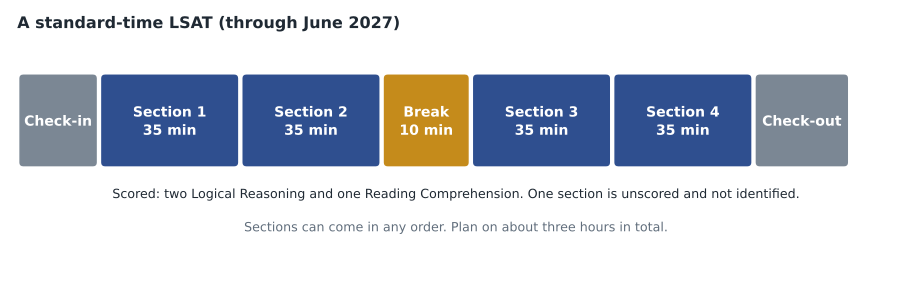
As LSAC describes the test through the June 2027 administration, the multiple-choice LSAT has four sections of 35 minutes each. Two sections are scored Logical Reasoning, one is scored Reading Comprehension, and one is an unscored section of either type that LSAC uses to try out new questions. The unscored section is not labeled, so you cannot tell which section it is while you are testing. The sections can come in any order.
There is a 10-minute intermission between the second and third sections. With check-in and the time it takes to read instructions, LSAC tells candidates to expect about three hours in total for a standard-time test. LSAT Argumentative Writing is separate: it is completed remotely on a different day, within a window that opens eight days before the administration.
Harriet put the day on the screen as a timeline: check-in, section 1, section 2, the intermission, section 3, section 4, check-out. 'Two blocks of seventy minutes with a ten-minute pause between them,' she said. 'That is the shape you will train for. Not one section at a time. Two in a row, a short break, two more.'
How the score is built
Your score is based on the number of questions you answer correctly. LSAC states that all questions are weighted exactly the same and that there is no deduction for incorrect answers. The number correct across the three scored sections, the raw score, is converted to the 120 to 180 scale so that scores from different administrations can be compared.
Those two facts, equal weight and no deduction, drive almost every timing decision in this course. Because a hard question is worth no more than an easy one, spending four minutes to win one hard question at the cost of two easy ones is a bad trade. Because a wrong answer costs nothing, an unanswered question is always a wasted chance. Harriet wrote them at the top of the shared notes: "Every question is worth one point. Blanks are free points thrown away."
Marcus, who tested in April 2025 and was registered for November, said he had read those rules before and still left two questions blank last time. 'The timer hit zero while I was rereading choice (D),' he said. 'I knew the rule. I did not have a habit.' Harriet said that was the point of the lab: turning rules you know into habits you do not have to think about.
Average time per question
A simple calculation sets expectations. A Logical Reasoning section usually has about 25 or 26 questions, so 35 minutes gives you roughly 80 to 84 seconds per question on average. A Reading Comprehension section usually has four passages, or three single passages and one comparative pair, with about 26 to 28 questions in total, so each passage set gets a little under nine minutes on average, reading included.
Averages mislead if you treat them as targets for every question. Questions vary in length and difficulty, and difficulty tends to rise through a Logical Reasoning section, although not in a strict line. A sensible pace is faster than average early, where questions are usually shorter and more direct, so that time is banked for the harder questions later. Lessons 2 and 3 turn this into checkpoints.
Dani asked whether the counts were always the same. Harriet said no: section lengths vary slightly from test to test, which is why she taught checkpoints by question number and minute rather than a fixed number of seconds per question. A checkpoint that says "question 10 by minute 11" still works whether the section has 25 questions or 26.
The August 2027 format
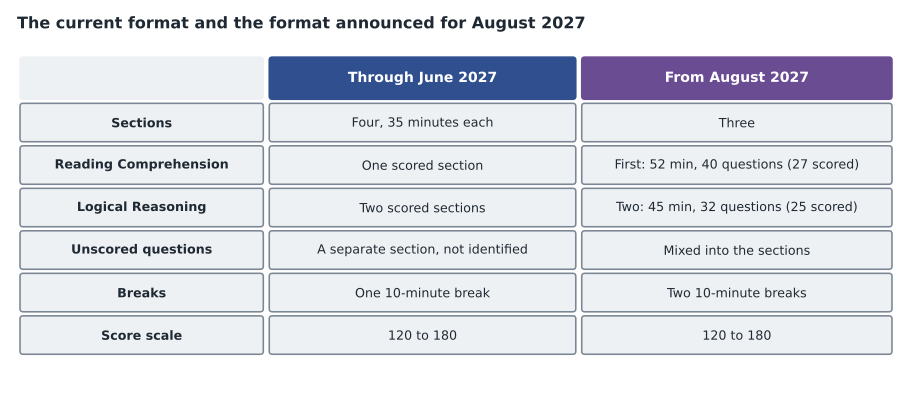
LSAC has announced a new format starting with the August 2027 administration. It has three sections instead of four. Reading Comprehension comes first and lasts 52 minutes, with 40 questions, 27 of them scored and 13 unscored. Two Logical Reasoning sections follow, each 45 minutes with 32 questions, 25 scored and 7 unscored. Unscored questions are mixed into the sections rather than gathered into a separate section, and there are two 10-minute breaks. The 120 to 180 scale stays the same.
The per-question arithmetic changes only a little: about 78 seconds per Reading Comprehension question and about 84 seconds per Logical Reasoning question. What changes more is the shape of the day. A 52-minute reading block demands more sustained concentration than a 35-minute one, and because unscored questions are mixed in, you cannot hope to coast through a section that turns out not to count.
Everyone in the Thursday Circle planned to test before August 2027, so the course trains for the current format. Harriet said the skills carry over unchanged: checkpoints, skipping and returning, guessing every blank, stamina and a calm routine. Only the numbers on the checkpoints would need to be recalculated, and Lesson 12 shows how to do that for any section length.
Where the clock is on the screen
The LSAT is taken on a computer, whether at a test center or remotely, and the test interface shows a section timer. Practice tests in LawHub use the same interface. Harriet asked everyone to take their remaining practice tests only in the official interface, because a paper test or a different program trains different habits: how you flag questions, how you move between them and how often you glance at the clock.
She also recommended deciding in advance how often to look at the timer. Checking after every question wastes attention; never checking leads to surprises. Her rule was to look at the timer only at the checkpoints, and to keep a rough sense of pace in between by counting questions rather than minutes.
Ji-won, who is approved for 50 percent extra time, asked how the arithmetic worked for her. Harriet said that with 50 percent extra time each 35-minute section becomes 52 minutes and 30 seconds, so every checkpoint is multiplied by one and a half. Ji-won's Logical Reasoning checkpoints, already set in the arguments block, were question 10 by minute 16 and question 18 by minute 33. Lesson 10 covers accommodations in more detail.
What the course will do
Harriet set out the plan for the series. The first sessions would build pacing for each section type and a method for skipping, flagging and guessing. The middle sessions would build stamina and address nerves, sleep and the final week. The last sessions would cover the test-day experience itself, at a test center or remotely, the decisions that follow the test, and a checklist. The capstone would ask each member to build a written plan for test week and to take a timed mini-section using every technique from the course.
Thomas asked whether all of this was really worth seven Fridays. Harriet said a candidate who loses three questions to pacing, two to fatigue and one to a blank has lost six raw points, which on a typical conversion is several scaled points. 'Nothing in the weekday sessions will be worth more than getting those back,' she said.
A first timing diagnostic
Before the next session, each member would take one timed Logical Reasoning section and one timed Reading Comprehension section from LawHub and, for each, record three numbers: the question they were on at minute 11 and at minute 22 for Logical Reasoning (or at minutes 9, 18 and 27 for Reading Comprehension), how many questions they answered in the last three minutes, and how many they left blank or guessed at random.
Those numbers, Harriet said, would show each person's timing profile. Some candidates start too slowly and panic at the end. Some start too fast and make careless errors early. Some are steady but stall on two or three questions. Each profile needs a different fix, and you cannot choose the fix until you know which profile is yours.
Reading your own timing data
Harriet showed the group how to turn a practice section into timing data without a stopwatch. The LawHub interface records how long a candidate spends on each question, and its review screens show those times after a section. Harriet asked each member to sort the questions from a recent section by time spent and look at the five longest. For most people, two patterns appear. Some of the longest questions were answered correctly but could have been answered faster with a cleaner method. Others were answered incorrectly after a long struggle, which means the time was spent and the point was lost anyway.
The second group is where timing work pays off first. A question that took four minutes and was still missed cost the candidate the four minutes plus whatever those minutes would have earned later in the section. Thomas found that his longest questions were mostly correct, which fit his profile: he was not stalling, he was finishing early and then not using the spare time. Marcus found three questions over three minutes each, two of them missed. That was the pattern the two-minute ceiling would address.
Why timing is a separate skill
Dani asked whether timing would simply improve on its own as her accuracy improved. Harriet said accuracy helps, because a candidate who understands a question type answers it faster. But timing also needs its own practice, for two reasons. First, the habits that produce good timing, such as checking the clock only at checkpoints, choosing before flagging and doing a sweep, are behaviors that have to be rehearsed until they happen automatically. Second, pressure changes how people read. A candidate who reads well untimed may read differently when the clock is visible, and only timed practice reveals and trains that.
She compared it to learning to drive. Knowing the rules of the road does not make someone a good driver in traffic; hours of driving in traffic do. Knowing the LSAT question types does not make someone good at the clock; timed sections with deliberate review do.
A note on practice materials
Harriet asked the group to use official LSAT practice material from LSAC's LawHub for timed work, because only official questions reproduce the exact difficulty, length and wording of the real test. Commercial prep questions can be useful for learning a method, but their timing can mislead: a set of questions that is easier or harder than the real test produces a false sense of pace. Questions written for this course, including the drills in Lesson 12, are designed to practice technique, not to predict a score.
Élodie said the timing data changed how she thought about her own sections. She had assumed her problem was slow reading. The data showed she read at a normal pace but spent almost a minute too long on the last two questions of each passage set, rechecking answers she had already chosen correctly. That was a habit, not a reading problem, and habits can be changed in a few weeks.
Common mistakes
MistakeSpending several minutes to win one hard question.
InsteadEvery question is worth one point; protect the easier questions first.
MistakeLeaving questions blank when time runs out.
InsteadThere is no deduction for wrong answers, so answer every question.
MistakeTreating the average time per question as a target for each question.
InsteadGo faster than average early and bank time for harder questions later.
MistakePracticing only single sections.
InsteadTrain for the real shape of the day: two sections, a 10-minute break, two more.
MistakeChecking the timer after every question.
InsteadLook at the timer at planned checkpoints and count questions in between.
Summary and key terms
- Through June 2027 the LSAT has four 35-minute sections: two scored Logical Reasoning, one scored Reading Comprehension and one unlabeled unscored section, with a 10-minute intermission after section 2.
- The score is the number of questions answered correctly; every question has equal weight and there is no deduction for wrong answers.
- Logical Reasoning averages about 80 to 84 seconds per question; Reading Comprehension a little under nine minutes per passage set.
- From August 2027 the test has three sections: Reading Comprehension first (52 minutes, 40 questions) and two Logical Reasoning sections (45 minutes, 32 questions), with unscored questions mixed in and two breaks.
- Timing skills are trained with checkpoints, a skip-and-guess method, stamina work and a test-day routine.
- Raw score
- The number of questions answered correctly in the scored sections, before conversion to the 120 to 180 scale.
- Unscored section
- A section used to try out new questions; through June 2027 it is unlabeled and may appear in any position.
- Intermission
- The 10-minute break between the second and third sections.
- Checkpoint
- A planned point in a section, such as "question 10 by minute 11", where you check your pace.
- Timing profile
- The pattern in how a candidate uses time, such as a slow start, a rushed start or stalling on a few questions.
Practice problems
Work each problem on paper first, then reveal the answer to check.
How many scored sections does the current LSAT have, and of what types?
Show answer
Three: two Logical Reasoning and one Reading Comprehension.
Why should you never leave a question blank?
Show answer
There is no deduction for wrong answers, so a guess can only add a point.
About how much time per question does a 26-question Logical Reasoning section allow?
Show answer
About 80 seconds on average.
How long is a Reading Comprehension section from August 2027?
Show answer
52 minutes, with 40 questions, 27 scored.
With 50 percent extra time, how long is a 35-minute section?
Show answer
52 minutes and 30 seconds.
Lesson quiz · 5 questions
Score 60% or more to complete this lesson.
Create a free account to save your progress, take quizzes and earn a certificate.