
LSAT-140 · Lesson 4 of 12 · 21 min
When to skip and guess
▶ Video coming soon A video version of this lesson is on the way.
On Friday, October 16, Harriet opened with a question she said would sound too obvious to ask. 'How many of you have ever left a question blank on a timed section?' Every hand went up. 'And how many of you knew, at that moment, that blanks are never worth anything?' Every hand stayed up. The session, she said, was about closing the gap between those two facts.
The arithmetic of guessing
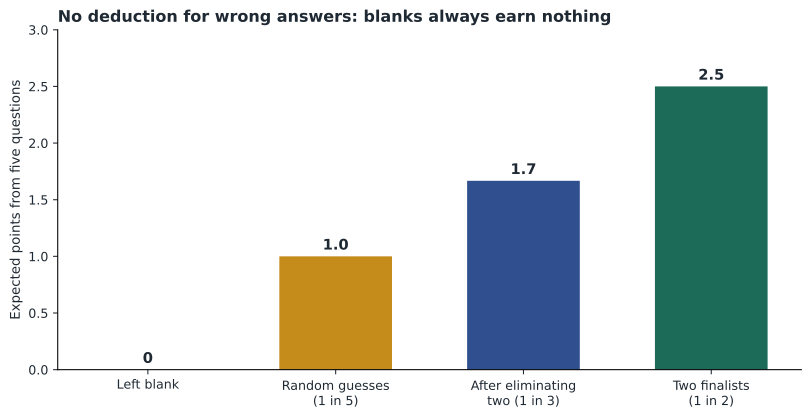
Because the LSAT has no deduction for wrong answers, a guess can only help. A random guess among five choices has a one-in-five chance of being right. Over many guesses, that is about one point for every five questions guessed. A blank has no chance at all.
Elimination improves the odds. If you can rule out two choices with confidence, a guess among the remaining three has a one-in-three chance. If you can rule out three, it is a coin flip. That is why Harriet's skip rule never means skipping without choosing. Every skipped question gets the best guess available from the elimination already done, and a flag so you can return if time allows.
Harriet put the numbers in a small table. Five unanswered questions at the end of a section are worth zero points. Five random guesses are worth about one point on average. Five guesses after eliminating two choices each are worth about one and two-thirds points. Five educated guesses after reducing each question to two finalists are worth about two and a half points. 'Over three scored sections,' she said, 'the difference between blanks and educated guesses is easily three or four raw points.'
When to skip
Skipping in this course means choosing a provisional answer, flagging the question and moving on, not leaving it blank. Harriet gave four signals that a Logical Reasoning question should be skipped on the first pass.
- The two-minute ceiling: you have spent about two minutes without a clear answer.
- A long, dense stimulus paired with a question type you find slow, such as parallel reasoning or parallel flaw, when you are behind your checkpoint.
- You do not understand the stimulus after one careful reading. Rereading under pressure rarely helps; a fresh look later often does.
- You are down to two choices and the thirty-second rule has not settled it.
The first three signals can be recognized early. A candidate who notices, within the first thirty seconds, that a stimulus is long, abstract and attached to a question type she finds slow can make a quick elimination pass, choose, flag and move on before investing two minutes. Harriet called this "skipping at the door". It is the most efficient kind of skip, because it costs almost nothing.
Marcus asked whether skipping at the door meant some questions would never get a real attempt. Harriet said yes, for a candidate who is behind. That is the trade. A question skipped at the door and guessed has a one-in-five to one-in-three chance; the three minutes it would have taken are worth more than that on the questions that follow. A candidate on pace will usually have time to come back.
What not to skip
Some questions look intimidating and are not. A long stimulus with a main point question attached is usually quick, because the task is simple. A question with unfamiliar subject matter, such as an argument about marine chemistry or medieval tax records, is no harder than one about everyday life if its structure is simple. Harriet warned against skipping by topic. The LSAT supplies everything needed to answer each question; unfamiliar vocabulary is often a distraction rather than a difficulty.
Dani said she had tended to skip any question with formal-sounding conditional language. Harriet asked her to look at her error log. Her accuracy on conditional questions had risen from about half in September to above three-quarters by late October. Her instinct to skip them was out of date. Skip decisions should be based on current evidence from your own practice, not on how a question type felt months ago.
Guessing well
A guess made at the end of a section with no time to read is a random guess. Harriet recommended choosing one letter in advance and using it for every such guess. No answer letter is known to be favored, so the choice of letter does not matter; what matters is that choosing in advance saves the seconds you would otherwise spend picking a letter for each question.
A guess made during the section is different, because you have usually eliminated something. The rule is simple: never leave a flagged question with no answer selected. Before moving on, select the choice you would pick if you had no more time. If you come back later, you can change it. If you do not, at least that question carries your best estimate rather than a blank.
Élodie said she had once flagged several questions without selecting answers, intending to return, and run out of time. Harriet said that was the most common way good candidates leave blanks: not by giving up, but by planning to come back. Selecting an answer before flagging removes the risk completely.
The last minute
Every section should end with every question answered. Harriet asked each member to practice a "last-minute sweep": at about one minute remaining, stop working on whatever question you are on, choose an answer, and use the remaining seconds to select your guessing letter on any question still unanswered. The test interface makes unanswered questions easy to see. The sweep takes about twenty or thirty seconds for a handful of questions.
Thomas asked whether a minute was too early. Harriet said it might feel early, but candidates almost always underestimate how long the sweep takes when they are anxious. Starting at one minute, and finishing with seconds to spare, is safer than starting at twenty seconds and leaving two blanks. With practice, some candidates move the sweep to forty-five seconds.
Skipping in Reading Comprehension
Lesson 3 explained why skipping works differently in Reading Comprehension: returning to a passage means rereading part of it. Within a set, the same rules apply. Choose and flag a question that runs long, and move to the next question in the set. Between sets, finish every question before moving on, so that the passage does not need to be reread later.
The exception is a candidate who chooses to work passages out of order. Harriet's view was that reordering is a decision made at the start of the section, not a way of skipping a hard passage halfway through. A candidate who abandons a passage after reading it has paid for the reading and earned nothing.
How many questions to skip
The right number of skips depends on the candidate. A candidate scoring in the low 150s who tries to answer every question carefully will usually run out of time and guess randomly on several at the end. That candidate does better by skipping three or four of the hardest questions deliberately, with elimination, and spending the saved time getting the rest right. A candidate scoring in the high 160s may skip only one or two, and come back to them.
Dani's practice average was about 153 in early November, and her target was 156. Harriet's advice to her was to aim to work carefully through about 21 or 22 questions per Logical Reasoning section and to guess with elimination on the rest. On her next two practice sections, Dani answered fewer questions with full effort and got more right overall. Her raw score rose by two points on each.
Ji-won, scoring in the low to mid 160s with her extended time, needed almost no deliberate skips. Her goal was to skip at the door only when a question was clearly going to take longer than its share, and to come back to every flagged question before the section ended.
Worked problem
Sample question (written for this course)
With 50 seconds left in a section, a candidate has three unanswered questions she has not read. What should she do? (A) Read the first of the three quickly and answer it. (B) Leave all three blank to avoid a wrong answer. (C) Select her pre-chosen guessing letter on all three at once. (D) Change earlier answers she is unsure about. (E) Read the question stems and guess based on question type.
Show solution
- (C) is correct. With under a minute and three unread questions, the sweep secures a one-in-five chance on each.
- (A) is wrong because reading one question risks leaving the other two blank when time expires.
- (B) is wrong because there is no deduction for wrong answers; blanks earn nothing.
- (D) is wrong because changing uncertain answers without new reasoning is unlikely to help and leaves blanks.
- (E) is wrong because question type does not tell you which letter is correct, and reading stems costs time.
Answer: (C). The last-minute sweep: every question gets an answer.
Guessing during practice
Harriet asked the group to treat guessing as something to practice, not something that just happens. On each timed section, mark which answers were guesses, either random or educated, on your scratch paper. After scoring, count how many guesses were right. Over several sections, educated guesses should be right noticeably more often than one time in five, because elimination improves the odds. If they are not, the eliminations themselves may be unreliable, which is a method problem worth reviewing.
Thomas found that his educated guesses were right about half the time, which suggested his eliminations were sound. Dani found hers were right only a little more often than random guesses would be, and in review discovered she was sometimes eliminating the correct answer because it used words she found awkward. That became a new item in her error log: "Don't eliminate an answer for its wording; eliminate it for what it says."
The cost of perfectionism
Some candidates find skipping and guessing emotionally difficult. They want to answer every question properly, and a guess feels like a failure. Harriet addressed this directly. Almost every candidate faces questions they cannot fully solve in the time available. The difference between strong and weak timing is not whether candidates guess, but whether they choose which questions to guess on deliberately or have the choice made for them when the clock runs out.
Élodie said that reframing helped her. A guess made at minute 19 because a question would take too long was a decision; a guess made at minute 35 because time ran out was an accident. She preferred decisions. Harriet said that was the whole philosophy of the course in one sentence.
Guessing in the unscored section
Marcus asked whether it was worth guessing carefully in the unscored section. Harriet reminded the group that the unscored section is unlabeled, so a candidate cannot know which section it is. Every section should be treated as scored, with the same pacing and the same sweep at the end. Trying to identify the unscored section during the test wastes attention and risks treating a scored section carelessly.
A worked example of the trade-off
Harriet showed the trade-off with numbers from Dani's practice. On one section, Dani spent about four minutes each on two hard questions near the end, getting one right, and then had no time for the last four questions, which she guessed randomly. On average, four random guesses earn less than one point. On the next section, she skipped those two hard questions at the door with educated guesses between two finalists, used the eight minutes on the last four questions and got three of them right. Her expected score on the six questions rose from about two points to about four.
Dani said the numbers made the decision feel less like giving up and more like arithmetic. Harriet said that was the right way to see it. A test that weights every question equally rewards candidates who treat their time as a budget, spent where it buys the most points.
Marcus asked whether there was ever a case for leaving a question blank on purpose. Harriet said no, not on the LSAT as it is scored today. Some other tests have penalized wrong answers in the past, and candidates who took those tests sometimes carry the habit of leaving blanks. LSAC states plainly that there is no deduction for incorrect answers, so the habit has no place here.
Common mistakes
MistakeLeaving questions blank at the end of a section.
InsteadDo a last-minute sweep at about one minute remaining and answer everything.
MistakeFlagging a question without selecting an answer.
InsteadAlways select your best current choice before flagging.
MistakeSkipping by topic or by how a question type felt months ago.
InsteadBase skip decisions on structure, timing and current accuracy data.
MistakePicking a different guess letter for each random guess.
InsteadChoose one letter in advance to save seconds.
MistakeAbandoning a Reading Comprehension passage after reading it.
InsteadFinish every question in a set before moving on.
Summary and key terms
- There is no deduction for wrong answers, so guesses can only help; blanks always earn nothing.
- A random guess is right one time in five; eliminating choices raises the odds to one in three or one in two.
- Skipping means choosing an answer, flagging and moving on; "skipping at the door" costs almost no time.
- Choose a guessing letter in advance and do a last-minute sweep at about one minute remaining.
- The right number of deliberate skips depends on a candidate's level and current accuracy data.
- Skip
- Choosing a provisional answer, flagging the question and moving on.
- Skipping at the door
- Recognizing early that a question will run long, eliminating quickly, choosing, flagging and moving on.
- Educated guess
- A guess made after eliminating one or more choices.
- Guessing letter
- A letter chosen before the test for every random guess, to save time.
- Last-minute sweep
- Stopping at about one minute remaining to answer every unanswered question.
Practice problems
Work each problem on paper first, then reveal the answer to check.
What is the chance a random guess among five choices is correct?
Show answer
One in five.
What must you always do before flagging a question?
Show answer
Select your best current answer.
What does "skipping at the door" mean?
Show answer
Recognizing early that a question will take too long, choosing quickly, flagging and moving on.
When should the last-minute sweep start?
Show answer
At about one minute remaining, or a little later with practice.
Why should skip decisions not be based on topic?
Show answer
The test supplies everything needed; unfamiliar topics are often no harder in structure.
Lesson quiz · 5 questions
Score 60% or more to complete this lesson.
Create a free account to save your progress, take quizzes and earn a certificate.