
LSAT-140 · Lesson 5 of 12 · 21 min
Flagging and the second pass
▶ Video coming soon A video version of this lesson is on the way.
The second half of the October 16 session turned to what happens after the skip. A flag, Harriet said, is a promise to your future self. If you make too many promises, you cannot keep any of them. If you make them carelessly, you waste the time you saved.
What the flag is for
The test interface lets you mark questions to come back to. Used well, flagging turns the end of a section into a short, targeted review of the questions most likely to change with a second look. Used badly, it produces a long list of questions you cannot possibly revisit, and the anxiety of seeing that list.
Harriet asked the group to treat flags as a scarce resource. Her guideline was no more than about four flags in a Logical Reasoning section and no more than one or two per Reading Comprehension passage set. A candidate who flags eight questions has told herself nothing useful about which ones to revisit first.
Two kinds of flags
Harriet distinguished two reasons for flagging, and asked the group to treat them differently.
- A "two finalists" flag: you narrowed the question to two choices and chose one, but could not find a decisive reason. These are the best questions to revisit, because a fresh look often reveals the deciding word.
- A "time" flag: you skipped the question early, at the door or at the two-minute ceiling, with less work done. These are worth revisiting only if enough time remains to work them properly, about a minute and a half each.
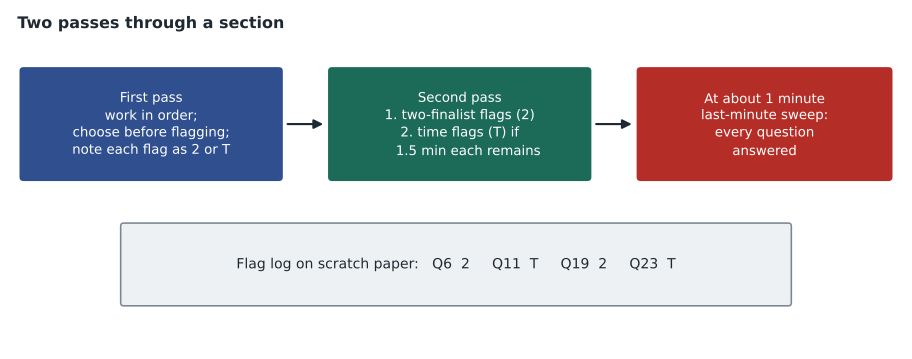
Some candidates mark the difference by remembering the question number; others use a quick mental tag. Ji-won kept a tiny note on her scratch paper for each flag: the question number and either "2" for two finalists or "T" for time. Harriet said that habit was worth adopting, because it turns the end-of-section review into a plan instead of a scramble.
The order of the second pass
When you reach the end of a section with time left, revisit flags in this order: first the two-finalist questions, starting with the earliest, then the time flags, if at least a minute and a half remains for each. Stop at about one minute remaining for the last-minute sweep, even if flags remain. Every flagged question already has an answer selected, so stopping costs nothing.
The reason for starting with two-finalist flags is simple: they offer the best return per second. You already understand the stimulus and have done most of the work. A thirty-second look with a fresh mind often settles them. A time-flag question requires reading the stimulus again from scratch, which costs more and succeeds less often.
Marcus asked whether it ever made sense to revisit an unflagged question. Harriet said only if something specific nags at you, such as realizing that a word in an earlier question meant something different from what you assumed. Revisiting unflagged questions at random rarely helps and sometimes hurts.
Should you change answers?
A long-standing belief among test takers is that your first instinct is usually right and that changing answers is risky. Research on multiple-choice tests generally does not support that belief. Studies over several decades have found that when test takers change answers, the change more often goes from wrong to right than from right to wrong. The usual explanation is that changes tend to happen when a second look reveals something the first look missed.
That research has a condition attached. It concerns changes made for a reason: noticing a misread word, a scope shift or a better match to the stimulus. It does not support changing an answer because of a vague feeling, or because you have chosen the same letter several times in a row. Harriet's rule was to change an answer only if she could state, in a short sentence, what she had missed the first time.
Élodie said she had always been told to trust her gut. Harriet said the research suggests the gut is right more often on questions where you felt confident and less often on questions you flagged as uncertain. A flagged question is, by definition, one where the first answer was a provisional choice. Changing it for a stated reason is exactly what the flag is for.
How to look again
A second look should not repeat the first. Harriet recommended a short routine for each flagged question.
- Reread the question stem first, and say the task in a few words. Many second-look corrections come from noticing that the stem asked for something slightly different, such as the choice that weakens "EXCEPT" or the assumption that is necessary rather than sufficient.
- Reread the stimulus once, paying attention to qualifiers: "some", "most", "only", "probably", "all".
- Compare only the finalists, or the two or three remaining choices, against your restated task. Look for the specific words that make one choice go further than the stimulus supports.
- Decide within about thirty to sixty seconds and move on.
Thomas tried the routine on his flagged questions from a recent practice section. Of four flags, he changed two answers, each for a stated reason: one because he had missed "EXCEPT" in the stem and one because his chosen answer said "most" where the stimulus supported only "some". Both changes were correct. He left the other two as they were, because a second reading confirmed his first choice.
Flagging in Reading Comprehension
In Reading Comprehension, the second pass is harder, because the passage is no longer fresh. Harriet's advice was to keep Reading Comprehension flags within the set: if time remains after the last question of a set, revisit that set's flags immediately while the passage is still in mind, then move on. Returning to an earlier set at the end of the section is worth it only for a two-finalist flag on a question tied to specific lines, which can be checked quickly.
Élodie's pacing card had a line for this: "flags stay home". She revisited flags within the set or not at all, except for a line-reference question with two finalists. Since adopting the rule in late October, she had finished every practice Reading Comprehension section without guessing.
Scratch paper and the second pass
Scratch paper helps the second pass if it records the right things. Writing out every argument in full is too slow for a timed section. Short notes are enough: the flag log, a conditional chain for a question you might revisit, or a two-word prediction. At a test center, LSAC provides scratch paper booklets; remote test takers may use a small number of blank sheets. Lesson 9 covers the rules.
Ji-won said her flag log had another benefit: at the end of a section she could see at a glance how many flags she had and decide how much time each could get. Harriet said that was the point. The second pass is a budget, and you cannot budget what you have not counted.
Practicing the second pass
Harriet asked the group to practice the second pass deliberately for two weeks. On each timed section, note the number of flags, the type of each, the time left when the first pass ended, how many flags were revisited and how many answers changed, with whether each change was right or wrong.
After two weeks, the logs would show whether each member flagged too much or too little, whether the second pass was producing gains, and whether changes were helping. Most candidates who keep such a log find that two-finalist flags produce most of the gains and time flags produce few. That pattern supports spending the first pass more carefully and the second pass on the narrow questions it is good at.
Worked problem
Sample question (written for this course)
A candidate finishes the first pass of a Logical Reasoning section with three minutes left and four flags: two marked as two finalists and two marked as time skips. What is the best plan? (A) Revisit the two time-skip questions first, since they had the least work done. (B) Revisit all four questions for about forty-five seconds each and ignore the sweep. (C) Recheck every unflagged question from the start. (D) Change all four flagged answers, since first answers on flagged questions are usually wrong. (E) Revisit the two-finalist questions first, then a time-skip question if enough time remains, stopping for the sweep at one minute.
Show solution
- (E) is correct. Two-finalist flags offer the best return per second; time flags need about a minute and a half each.
- (A) is wrong because time-skip questions require rereading from scratch and succeed less often in a short window.
- (B) is wrong because forty-five seconds is too little for time-skip questions and the sweep still matters if any question is unanswered.
- (C) is wrong because rechecking unflagged questions at random rarely helps.
- (D) is wrong because answers should change only for a stated reason, not as a rule.
Answer: (E). Two-finalist flags first, time flags if time allows, sweep at one minute.
Using the review screen
The test interface makes it easy to see which questions are answered, unanswered and flagged, which makes the second pass faster. Harriet suggested checking it at the end of the first pass to count flags and confirm that every question has an answer. If any question is unanswered at that point, select an answer immediately before doing anything else. Then plan the second pass from the flag log and the time remaining.
Ji-won said seeing every flag at the end was the reason she trusted herself to flag. Harriet said that was the right relationship with the tool, as long as the interface is used to confirm the flag log, not to replace it. The flag log tells you which flags are two-finalist flags; the interface does not.
When the second pass reveals a pattern
Sometimes the second pass shows the same mistake twice. Thomas noticed on one practice section that two of his flagged questions had an "EXCEPT" in the stem that he had overlooked on the first pass. He added a step to his routine: when reading any stem, look for capitalized words such as EXCEPT or NOT before reading the stimulus. On later sections, that type of error disappeared from his first pass, and his second pass became shorter.
Harriet said that is the deeper purpose of tracking flags and changes. A second pass catches errors on one test; a pattern in the second pass prevents them on the next. The flag log, kept over weeks, becomes a list of the habits most worth fixing.
How many flags is too few?
A candidate who never flags is not necessarily efficient. She may be stalling on every hard question until she reaches an answer, which uses time a flag would have saved. Marcus admitted that before the course he almost never flagged, because he did not trust himself to come back. Once he adopted the choose-and-flag rule, he flagged two or three questions per section and returned to most of them. His accuracy rose and his stalls disappeared. Harriet said a candidate who uses no flags at all on a hard section should ask whether she spent more than two minutes on any question; if so, a flag would have helped.
Flagging under extended time
Ji-won's flag habits showed how extended time changes the second pass without changing its logic. With longer sections, she usually finished her first pass with four to six minutes left, more than most standard-time candidates. She still revisited two-finalist flags first, then time flags, and still stopped at about a minute and a half for her sweep, scaled from the standard minute. The extra time meant more of her flags got a real second look, which is why her blind review and timed scores were so close.
Élodie said the routine made the end of a section feel calmer. Before, she had looked at a screen of flags and felt that everything was unfinished. With the flag log, she saw two questions marked "2" and one marked "T", knew exactly what to do with three minutes, and did it. The section ended with a plan carried out rather than a scramble.
Common mistakes
MistakeFlagging so many questions that the list is useless.
InsteadKeep to about four flags in Logical Reasoning and one or two per passage set.
MistakeRevisiting flags in question order regardless of type.
InsteadRevisit two-finalist flags first, then time flags if enough time remains.
MistakeChanging answers on a vague feeling.
InsteadChange only when you can state what you missed the first time.
MistakeRepeating the first look on a flagged question.
InsteadRestate the stem, reread qualifiers and compare only the finalists.
MistakeReturning to earlier Reading Comprehension sets at the end.
InsteadRevisit Reading Comprehension flags within the set while the passage is fresh.
Summary and key terms
- Flags are a scarce resource: about four in Logical Reasoning and one or two per passage set.
- Two-finalist flags offer the best return on a second look; time flags need about a minute and a half each.
- Research generally finds that reasoned answer changes go from wrong to right more often than the reverse.
- A second look should restate the stem, reread qualifiers and compare only the finalists.
- In Reading Comprehension, revisit flags within the set; a flag log on scratch paper turns the second pass into a budget.
- Flag
- A mark in the test interface on a question you may revisit.
- Two-finalist flag
- A flag on a question narrowed to two choices without a decisive reason.
- Time flag
- A flag on a question skipped early with little work done.
- Second pass
- Revisiting flagged questions in priority order with the time left after the first pass.
- Flag log
- A short note of each flagged question and its type, kept on scratch paper.
Practice problems
Work each problem on paper first, then reveal the answer to check.
Which flagged questions should you revisit first?
Show answer
Two-finalist flags, starting with the earliest.
When should you change an answer on the second pass?
Show answer
Only when you can state what you missed the first time.
What does Élodie's rule "flags stay home" mean?
Show answer
Revisit Reading Comprehension flags within the set, not at the end of the section.
What should a flag log record?
Show answer
The question number and whether the flag is for two finalists or for time.
When does the second pass end, even if flags remain?
Show answer
At about one minute remaining, for the last-minute sweep.
Lesson quiz · 5 questions
Score 60% or more to complete this lesson.
Create a free account to save your progress, take quizzes and earn a certificate.