
LSAT-140 · Lesson 3 of 12 · 21 min
Pacing in Reading Comprehension
▶ Video coming soon A video version of this lesson is on the way.
The second Friday session fell on October 9, the start of the Canadian Thanksgiving weekend. Thomas joined from his parents' house in Halifax with a pie cooling somewhere behind him, and Élodie from Gatineau. Harriet said the topic suited a holiday weekend, because Reading Comprehension pacing is mostly about not doing extra work.
Élodie had the clearest Reading Comprehension timing problem in the group. On the September diagnostic she ran out of time and guessed on five questions. In the Wednesday reading lab she had begun to fix it with checkpoints, and her capstone results there would later show the change. Harriet used her plan as the model for the session, with her permission.
Why Reading Comprehension pacing is different
In Logical Reasoning, each question is a separate unit with its own stimulus. In Reading Comprehension, the reading is shared: you read a passage once and answer five to eight questions about it. That changes the arithmetic. Time spent understanding the passage is an investment that pays off across every question in the set. Time spent rereading the passage for each question is a cost paid again and again.
It also changes where time goes wrong. Candidates who run out of time in Reading Comprehension rarely do so because one question stalled them. They do so because they read too slowly the first time, or too quickly to understand, and then reread for each question. Either way the fix is the same: read once, well, with a purpose.
The basic budget
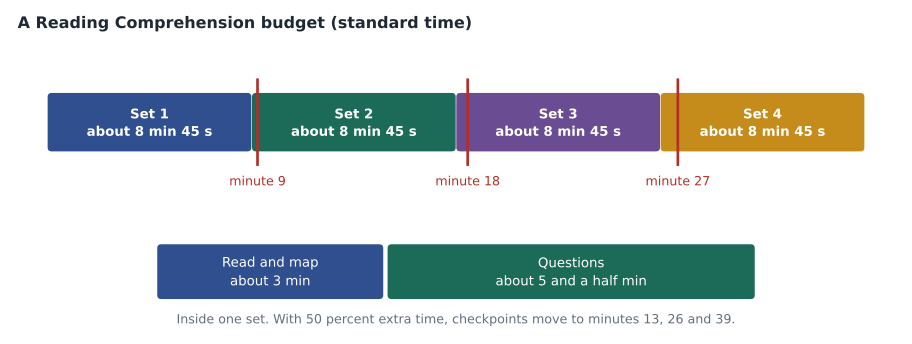
A standard section of about 27 questions over four passage sets gives each set a little under nine minutes, reading included. Élodie's checkpoints, which she set in the reading lab, were nine, eighteen and twenty-seven minutes: the end of the first set by minute 9, the second by minute 18 and the third by minute 27, leaving about eight minutes for the last set. Ji-won's scaled checkpoints were 13, 26 and 39 minutes.
Within a set, a common split is about three to three and a half minutes to read and map the passage and about five to five and a half minutes for the questions. A passage with eight questions deserves a little more time than one with five, and a comparative pair, which is two shorter passages, usually takes about the same total reading time as one longer passage.
Read for structure, not detail
The single biggest saving in Reading Comprehension comes from reading for structure on the first pass. The reading lab covered this in depth: identify the main point, the author's view and the role of each paragraph, and mark where details are, without trying to memorize them. Detail questions can then be answered by going back to the right paragraph, which takes seconds when you know where to look.
Candidates who try to absorb every detail on the first reading spend five or six minutes on the passage and still have to look back for most detail questions. Candidates who skim without understanding the structure save time on the reading but then cannot answer main point, purpose or attitude questions without reading again. The goal is the middle path: a first reading that is complete enough to answer the big-picture questions without looking back and organized enough to find any detail quickly.
Dani said her problem was the opposite of Élodie's. She read each paragraph twice because she worried she had missed something. Harriet suggested a rule from the reading lab: read each paragraph once, then write a three-to-five-word note of its role before moving on. The note forces understanding and removes the urge to reread.
Order of passages
You may work the passages in any order within the section. Some candidates benefit from starting with the passage type they find easiest, which banks time and confidence. Marcus, for example, does the science passage first and the humanities passage third. Others, including Élodie, do better working in order, because choosing costs time and attention.
Harriet's advice was to decide this before the test, based on practice, and not to deliberate during the section. If you choose to reorder, take no more than a few seconds to glance at the first lines of each passage and pick. A candidate who reads the opening paragraphs of all four passages before choosing has spent a minute and a half on nothing.
Moving through the questions
Within a set, answer the questions in order unless one is clearly going to take long. Main point and primary purpose questions can usually be answered from your structural notes without looking back. Detail and inference questions require going back to the relevant lines, briefly. Questions that ask you to apply the passage to a new situation, or to find what would strengthen or weaken a claim, tend to take longest.
The skip rule from Logical Reasoning applies in a modified form. Because the passage is fresh in your mind only while you are working on the set, it is usually better to make a decision on every question in the set before moving to the next passage, even if some decisions are guesses you flag. Coming back to a passage set later means rereading at least part of the passage, which costs more time than it would in Logical Reasoning.
Élodie's rule, which she wrote on her pacing card in the reading lab, was "flag sooner, never read faster". When a question in a set ran long, she chose the best answer, flagged it and moved to the next question in the same set. When she reached a checkpoint behind, she did not speed up her reading; she gave the remaining sets slightly less question time and accepted a flagged guess or two.
The last passage
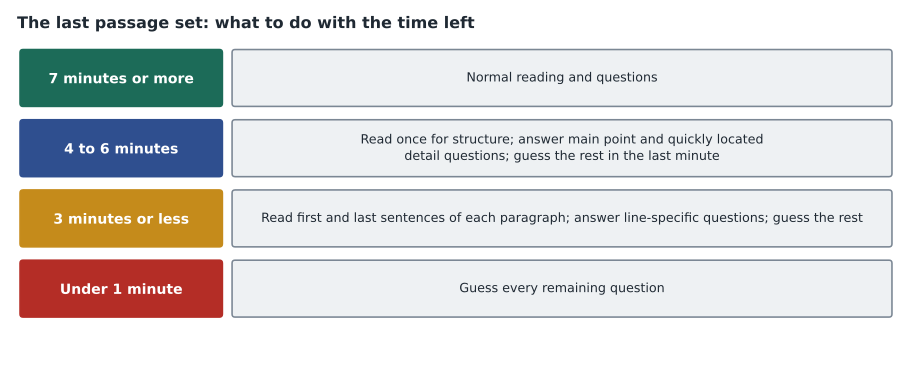
Most Reading Comprehension timing problems show up on the last passage set. A candidate who is two minutes behind at minute 27 has six minutes for a full set. Harriet's guidance for that situation was specific. Read the passage for structure, faster than usual but still once; answer the main point and the detail questions you can locate quickly; then guess the rest in the final minute rather than leaving any blank.
If the time remaining at the start of the last set is very short, say three minutes or less, a different approach works better: read the first and last sentences of each paragraph, answer the questions that refer to specific lines or paragraphs, and guess the rest. This sacrifices some accuracy for coverage, but on a test with no deduction for wrong answers, coverage matters.
Thomas asked whether it was ever better to skip a passage entirely and guess every question in it. Harriet said almost never. Even a hurried reading usually produces a better result than random guessing, because main point questions and questions tied to specific lines can often be answered quickly. The exception is a candidate with less than a minute left, who should simply guess.
Comparative passages
A comparative pair has two shorter passages and questions that ask about one passage, the other or the relationship between them. The pacing principles are the same, with one addition from the advanced reading series: make a brief comparison map after reading both passages, noting where the authors agree, disagree or discuss different things. Relationship questions then go quickly, because the map holds the answer.
Élodie's comparative-set average had fallen from about eleven minutes in September to just under nine. She credited the comparison map. Without it, she said, she had reread both passages for every relationship question.
Accuracy and pace together
Harriet ended the session by showing how the pace changes had affected accuracy for Élodie. Her Reading Comprehension accuracy had risen from 18 of 27 in September to about 23 of 27 on recent practice sections, and she had not guessed on a section since late October. Her reading speed had barely changed. What changed was how much rereading she did and when she made decisions.
'Speed in Reading Comprehension is mostly an illusion,' Harriet said. 'Nobody learns to read twice as fast in two months. What you learn is to read once instead of twice.'
Worked problem
Sample question (written for this course)
A candidate reaches the start of the fourth passage set with five minutes left in a Reading Comprehension section. What is the best approach under this lesson's method? (A) Read the passage once for structure, answer the main point and quickly located detail questions, and guess the rest in the final minute. (B) Skip the passage and guess every question immediately. (C) Read the passage slowly and carefully, then answer as many questions as time allows, leaving the rest blank. (D) Go back to flagged questions in the first three sets. (E) Read only the questions and answer from memory of similar passages.
Show solution
- (A) is correct. With four to six minutes, a single structural reading plus the quickest questions, then guessing the rest, maximizes expected points.
- (B) is wrong because even a hurried reading usually beats random guessing on main point and line-specific questions.
- (C) is wrong because leaving blanks throws away free chances; there is no deduction for wrong answers.
- (D) is wrong because returning to earlier sets requires rereading and leaves an entire set unattempted.
- (E) is wrong because answers must come from the passage on the screen, not from other passages.
Answer: (A). Read once, take the quick points, guess the rest.
A practice routine for Reading Comprehension timing
Harriet suggested a routine for the weeks before the test. Take one timed Reading Comprehension section a week, recording the time at the end of each passage set. Between those sections, do two or three single passage sets a week with a strict nine-minute limit, and practice the last-set strategies deliberately: some sets with seven minutes, some with five, some with three. The aim is not to get every question right in three minutes, which is impossible, but to make the decisions automatic so that a short last set on test day does not cause panic.
Dani tried the three-minute version first and found it eye-opening. Reading first and last sentences of each paragraph, then answering the questions tied to specific lines, she got three of six questions right, better than random guessing would have given her. On a five-minute version she got four. She said knowing that a hurried set still earned points made her less afraid of falling behind.
What to do with time left over
Occasionally a candidate finishes a Reading Comprehension section with time to spare. Harriet's advice was to use it on flagged questions within the most recent set first, while the passage is freshest, and then on two-finalist flags in earlier sets tied to specific lines. Rereading an entire earlier passage to check a main point question rarely pays, because a first impression of the main point is usually reliable if the first reading was structural.
Thomas asked whether finishing early in Reading Comprehension meant he was reading too fast. Harriet said it might, and that he should check his accuracy on main point and attitude questions, which suffer most from skimming. If those were strong, finishing early simply meant he read efficiently. If they were weak, he should spend another thirty seconds per passage on the first reading.
Passage length and difficulty
Passages vary in length and difficulty, and a hard passage early in a section can throw off a candidate's budget. Harriet's rule was to give each set roughly its share of time regardless of difficulty, which means accepting more flagged guesses on a hard set rather than borrowing time from later sets. A hard passage is hard for everyone, and the conversion to the 120 to 180 scale allows for differences in difficulty between test forms; a candidate who protects the easier sets usually comes out ahead.
Ji-won added that the same budget logic applied to her extended timing. With thirteen minutes per set rather than nine, she had more room for a careful first reading, but the temptation to reread was greater too. She kept her role notes to the same three to five words as everyone else.
Common mistakes
MistakeTrying to absorb every detail on the first reading.
InsteadRead for structure and mark where details are; go back for details when asked.
MistakeRereading the passage for each question.
InsteadWrite a short note of each paragraph's role so big-picture questions need no rereading.
MistakeDeliberating over passage order during the section.
InsteadDecide your approach to order before the test, based on practice.
MistakeLeaving a set and planning to return to it.
InsteadDecide every question in a set before moving on, flagging guesses if needed.
MistakeLeaving the last passage's questions blank when time runs out.
InsteadGuess every remaining question in the final minute.
Summary and key terms
- In Reading Comprehension the reading is shared across the set, so reading once well saves time on every question.
- A standard section gives each passage set a little under nine minutes; checkpoints at 9, 18 and 27 minutes (13, 26 and 39 with 50 percent extra time).
- Read for structure on the first pass and go back for details; a short role note per paragraph prevents rereading.
- Decide every question in a set before moving on; flag sooner rather than read faster.
- On the last set, adjust to the time left: a structural reading and quick questions, then guess the rest.
- Passage set
- A passage, or a comparative pair, and the questions that go with it.
- Structural reading
- A first reading aimed at the main point, the author's view and the role of each paragraph.
- Role note
- A three-to-five-word note of what a paragraph does in the passage.
- Comparison map
- A brief note of where two comparative passages agree, disagree or discuss different things.
- Coverage
- Answering every question, including by guessing, so that no question is left blank.
Practice problems
Work each problem on paper first, then reveal the answer to check.
What are Élodie's standard-time Reading Comprehension checkpoints?
Show answer
Minutes 9, 18 and 27, the end of the first three passage sets.
Why is it usually better to finish every question in a set before moving on?
Show answer
Returning to a set later means rereading at least part of the passage.
What does "flag sooner, never read faster" mean?
Show answer
When behind, choose and flag rather than speeding up your reading.
What should you do with three minutes left at the start of the last set?
Show answer
Read first and last sentences of paragraphs, answer line-specific questions and guess the rest.
What mainly changed in Élodie's Reading Comprehension timing?
Show answer
She reread less and made decisions sooner; her reading speed barely changed.
Lesson quiz · 5 questions
Score 60% or more to complete this lesson.
Create a free account to save your progress, take quizzes and earn a certificate.