
LSAT-140 · Lesson 2 of 12 · 21 min
Pacing strategies
▶ Video coming soon A video version of this lesson is on the way.
The timing diagnostics came back before the second half of the October 2 session, and Harriet put the numbers on the screen without names. Five Logical Reasoning sections, five different shapes. One candidate had reached question 14 by minute 11 and finished with six minutes to spare, with four careless errors in the first ten questions. Another had been on question 8 at minute 11 and answered the last five questions in under three minutes, mostly by guessing. A third had been on schedule until minute 20 and then spent almost five minutes on a single parallel reasoning question.
Thomas recognized the first profile as his own. Dani recognized the second. Marcus admitted to the third. Harriet said all three had the same underlying problem: the time each of them spent on a question was set by how the question felt, not by a plan.
Why pacing needs a plan
Under time pressure, people tend to spend time in proportion to how confusing a question feels. That instinct is backwards on a test where every question is worth one point. The most confusing questions are often the least likely to be answered correctly even with extra time, while the questions that feel easy are the ones where a few extra seconds of care prevent a careless miss.
A pacing plan replaces feeling with a small number of decisions made in advance. It tells you roughly where you should be at certain moments, what to do when a question runs long, and how to use whatever time is left at the end. The plan does not make you faster at reading or reasoning. It makes sure your reading and reasoning are spent where they earn the most.
Checkpoints for Logical Reasoning
Harriet's Logical Reasoning checkpoints, which the group had used since the arguments block in October, were question 10 by minute 11 and question 18 by minute 22. A candidate on that pace reaches the last questions with about 13 minutes left for seven or eight questions, which is roughly the extra time the harder late questions need.
The checkpoints reflect two features of most Logical Reasoning sections. Early questions tend to be shorter and more direct, so they can be answered a little faster than average without losing accuracy. Later questions tend to be longer and more abstract, with more parallel reasoning, principle and sufficient assumption questions, so they need more than average. The pattern is a tendency, not a rule. A hard question can appear at number 6 and an easy one at number 24.
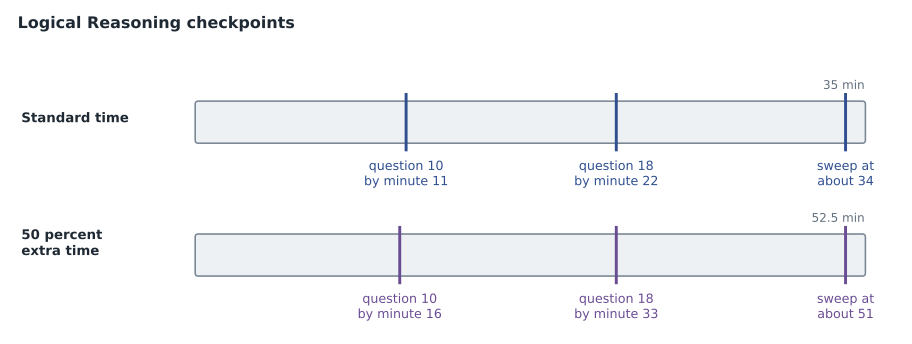
Ji-won's scaled checkpoints, set for her 50 percent extra time, were question 10 by minute 16 and question 18 by minute 33. Harriet reminded the group that checkpoints should be adjusted after practice. If your accuracy holds when you are a little ahead, you can tighten them. If you make careless errors when you hit them, loosen them and accept a few more guesses at the end.
Reading the checkpoints correctly
A checkpoint is information, not a verdict. If you reach minute 11 on question 8, you are about two questions behind. That is not a reason to panic or to start reading carelessly. It is a reason to apply the skip rule more firmly for the next stretch, which Lesson 4 explains, and to accept that one or two late questions will be guessed.
If you reach minute 11 on question 13, you are ahead. That is not automatically good news. Harriet asked Thomas to look back at his first ten answers whenever he arrived early, not to rework them, but to ask whether he had read every stem and every choice. On his diagnostic, three of his four careless errors were questions where he had chosen an answer before reading all five choices.
The two-minute ceiling
Marcus's profile needed a different tool: a ceiling. Harriet's rule was that no Logical Reasoning question gets more than about two minutes on the first pass. If you notice that you have been on a question for two minutes and are still not close to an answer, choose the best remaining choice, flag the question and move on. You may come back if time allows.
The ceiling works because of how stalls happen. A candidate who has spent ninety seconds on a question feels invested in it and keeps going, rereading the stimulus and comparing two choices again and again. The extra time rarely produces a better answer. Choosing, flagging and moving on turns a five-minute stall into a two-minute question and three minutes for later questions.
Marcus asked how he would know two minutes had passed without checking the timer. Harriet said most candidates develop a sense of it with practice, and a simple cue helps: if you have read the stimulus twice and eliminated choices without a clear winner, you are almost certainly near two minutes. That is the moment to choose and flag.
The order of work within a question
Pacing also depends on doing each question in an efficient order. Harriet reviewed the sequence the group had practiced in the weekday sessions: read the question stem first, so you know what task you are reading for; read the stimulus once with that task in mind; predict, in a few words, what the credited answer must do; then read all five choices, eliminating clearly wrong ones before comparing the finalists.
Each step saves time somewhere. Reading the stem first prevents a second reading of the stimulus. Predicting gives you a test to apply to each choice instead of weighing each choice against all the others. Eliminating clearly wrong choices quickly leaves the hard comparison to two choices rather than five. Skipping steps, particularly prediction, usually costs more time than it saves.
Dani said she often skipped the prediction because it felt slow. Harriet asked her to time ten questions both ways. On the questions where Dani predicted, her average time was about the same, and she got eight right instead of six. The prediction did not slow her down; it moved her time from rereading choices to thinking about the stimulus.
Two finalists
Many slow questions come down to two attractive choices. Harriet's thirty-second rule, introduced in the reading series, applies here too: once you are down to two, give yourself about thirty seconds to find a specific reason to reject one. Go back to the stimulus for the exact words that matter, and ask which choice depends on something the stimulus does not say.
If thirty seconds does not settle it, choose the one that better matches your prediction, flag it and move on. A flagged question with two finalists is the best kind to return to later, because a fresh look often makes the difference obvious.
Pacing for each timing profile
Harriet gave each profile a specific prescription.
- Rushed start (Thomas): hold the checkpoints, not beat them. Read all five choices on every question. Use any time saved at the end to revisit flagged questions, not to finish early.
- Slow start (Dani): use the checkpoints firmly. If behind at minute 11, apply the two-minute ceiling strictly until question 18. Aim to reach the last question with at least a minute to guess any remaining blanks.
- Stalls (Marcus): apply the two-minute ceiling on every question. Choose, flag and move on without debate. Return to flagged questions only after finishing the section.
- Steady but late (Élodie in Logical Reasoning, Ji-won): small adjustments only. Keep the checkpoints and practice identifying the one or two questions per section that should be skipped early.
Practicing pace without losing accuracy
Harriet warned against a common mistake: practicing speed by doing timed sections and nothing else. A candidate who only drills under the clock learns to hurry, and hurrying produces errors. Accuracy has to come first. The group's weekly routine kept untimed or loosely timed review, blind review, alongside timed sections, so that each member could see whether misses came from not knowing or from not having time.
The comparison is easy to make. Take a section timed, then redo the questions you missed or guessed without a time limit before checking the answers. If you get most of them right untimed, your problem is pace. If you still get them wrong, your problem is method, and speeding up will not help.
Worked problem
Sample question (written for this course)
A candidate reaches minute 11 of a Logical Reasoning section while still on question 8. Which response best fits the pacing method in this lesson? (A) Read faster until the checkpoint is recovered. (B) Skip all remaining parallel reasoning questions without guessing. (C) Return to question 1 and check earlier answers. (D) Apply the two-minute ceiling firmly until question 18 and accept a few guesses at the end. (E) Stop using checkpoints for the rest of the section.
Show solution
- (D) is correct. Being behind is information: tighten the ceiling, keep reading carefully and plan to guess any late blanks.
- (A) is wrong because reading faster produces careless errors; the method changes how time is allocated, not reading speed.
- (B) is wrong because skipping without guessing leaves blanks, which throw away free chances.
- (C) is wrong because checking earlier answers costs more time when already behind.
- (E) is wrong because the checkpoints are what reveal the problem and guide the correction.
Answer: (D). A checkpoint is information, not a verdict.
Building the checkpoint habit
Harriet suggested a two-week routine for making checkpoints automatic. In the first week, write the two checkpoint numbers at the top of your scratch paper before every timed section, and say them to yourself before you start. After each section, write down where you actually were at each checkpoint. In the second week, stop writing the numbers down but keep recording where you were. By the end of two weeks, most candidates check the timer at the right moments without thinking about it.
The record also shows whether the checkpoints suit you. If you are consistently a question or two ahead with no loss of accuracy, you can tighten them. If you hit them but make more errors in the first ten questions, loosen them. Harriet said the checkpoints were a starting point, not a law, and that several of her past students had ended up with slightly different numbers.
Pacing in a section with an unusual start
Occasionally a section begins with one or two unusually long or hard questions. A candidate who spends three minutes on question 2 starts the section behind and under pressure. Harriet's advice was to apply the skip rule early in exactly that situation: if question 1 or 2 is clearly going to take long, choose, flag and move on. Starting the section with a few quick questions builds momentum and leaves more time to return. The same applies to a section whose first questions feel unfamiliar: the feeling usually fades as the section goes on.
Élodie asked whether the checkpoints still worked when that happened. Harriet said yes, because the checkpoints count questions, not difficulty. A candidate who skips question 2 and returns to it later will still be close to question 10 at minute 11 if she keeps the ceiling elsewhere.
When the timer becomes a distraction
For some candidates, the visible timer itself causes anxiety. Every glance becomes a calculation, and every calculation becomes a worry. Candidates who find the clock distracting should practice with whatever display options the official interface offers, as described in LSAC's materials, so that test day feels the same as practice. The bigger fix, Harriet said, is the checkpoint habit itself: once you know you will look only at minute 11 and minute 22, the rest of the time you can stop thinking about the clock.
Marcus summed up the session in a sentence he wrote at the top of his pacing card: "A hard question is still one point." Harriet said that if he remembered nothing else, that sentence alone would save him time on test day.
Common mistakes
MistakeLetting how confusing a question feels decide how long you spend on it.
InsteadUse checkpoints and a two-minute ceiling decided in advance.
MistakePanicking when behind at a checkpoint and reading faster.
InsteadApply the skip rule more firmly and plan to guess a few late questions.
MistakeFinishing early and treating it as success.
InsteadUse spare time to revisit flagged questions, and check whether early answers were rushed.
MistakeSkipping the prediction to save time.
InsteadPredict; it moves time from rereading choices to thinking about the stimulus.
MistakePracticing only timed sections.
InsteadPair timed work with blind review to tell pace problems from method problems.
Summary and key terms
- Under pressure, people spend time in proportion to confusion; a pacing plan replaces that instinct with decisions made in advance.
- Harriet's Logical Reasoning checkpoints are question 10 by minute 11 and question 18 by minute 22, scaled by one and a half for 50 percent extra time.
- A checkpoint is information: behind means tighten the ceiling and plan to guess; ahead means check for rushed reading.
- The two-minute ceiling: choose the best remaining answer, flag and move on; the thirty-second rule settles two finalists.
- Different timing profiles need different fixes, and blind review shows whether misses come from pace or method.
- Pacing plan
- Decisions made before the test about where to be at certain times and what to do when a question runs long.
- Two-minute ceiling
- A first-pass limit of about two minutes per Logical Reasoning question, after which you choose, flag and move on.
- Thirty-second rule
- Once down to two finalists, spend about thirty seconds looking for a specific reason to reject one.
- Stall
- Spending far more time than planned on one question while rereading without progress.
- Blind review
- Redoing missed or uncertain questions without a time limit before checking answers.
Practice problems
Work each problem on paper first, then reveal the answer to check.
What are Harriet's standard Logical Reasoning checkpoints?
Show answer
Question 10 by minute 11 and question 18 by minute 22.
What should you do after about two minutes on one question with no clear answer?
Show answer
Choose the best remaining choice, flag it and move on.
What should a candidate who is ahead at a checkpoint check?
Show answer
Whether earlier questions were read fully, especially all five choices.
How can you tell whether a miss came from pace or from method?
Show answer
Redo it untimed in blind review; if you get it right untimed, pace was the problem.
Why do early Logical Reasoning questions usually allow a faster pace?
Show answer
They tend to be shorter and more direct, though this is a tendency, not a rule.
Lesson quiz · 5 questions
Score 60% or more to complete this lesson.
Create a free account to save your progress, take quizzes and earn a certificate.