
LSAT-140 · Lesson 6 of 12 · 21 min
Building stamina with timed sections
▶ Video coming soon A video version of this lesson is on the way.
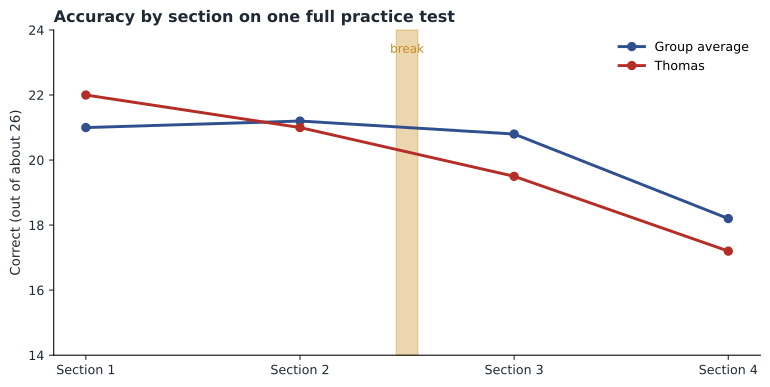
On Friday, October 23, Harriet began with a chart that surprised the group. It showed each member's accuracy, section by section, on the last full practice test they had taken. For four of the five, accuracy dropped in the last section, by two to four questions compared with their average. For Thomas, the drop was almost five. 'Nothing about the fourth section was harder,' Harriet said. 'You were tired. That is a separate skill, and it trains like any other.'
What stamina means on the LSAT
Stamina on the LSAT is the ability to read and reason as carefully in the last section as in the first. It is partly mental endurance: holding attention on dense text for over two hours. It is partly emotional: not letting a hard section, or the feeling that a section went badly, carry over into the next. And it is partly practical: knowing how your body and mind react after two hours of concentration, and having a routine for the intermission.
Signs of fatigue on a practice test are easy to see in a review. Careless errors cluster late: misread qualifiers, missed "EXCEPT" stems, answers chosen before reading all five choices. Reading Comprehension passages in the last section take longer to read and produce more errors on main point questions. Timing drifts, either slower because concentration lapses or faster because the candidate wants to be done.
Building up gradually
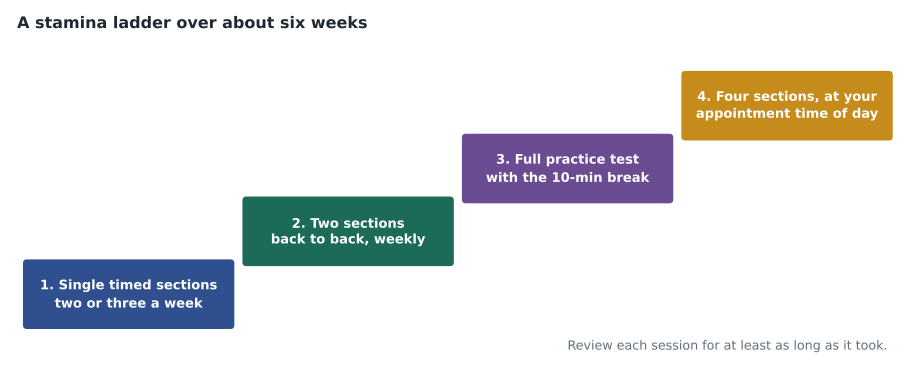
Harriet's stamina plan built up over about six weeks, adjusted for each member's test date. The idea is to lengthen continuous testing time step by step, the way a runner lengthens a long run, while keeping review time in proportion.
- Stage 1: single timed sections, two or three times a week, each fully reviewed. This builds accuracy and pacing in short blocks.
- Stage 2: two sections back to back with no break, once a week. This trains the first half of the test day, seventy minutes of continuous work.
- Stage 3: a full practice test in the official interface, three scored sections, with a 10-minute break after the second section, once every week or two.
- Stage 4: a full test with an added fourth section, to match the real day's four sections, taken at the same time of day as the real appointment.
The fourth stage matters because official practice tests in LawHub usually contain only the three scored sections. On test day there is a fourth, unscored section, so the real test is about thirty-five minutes longer than a three-section practice test. Adding an extra section, such as a timed section from another practice test, makes the practice day match the real one. Harriet suggested placing the extra section in a different position each time, since the real unscored section can appear anywhere.
How often to take full tests
Full practice tests are valuable, but taking too many without review produces diminishing returns. Harriet's view was that a full test is useful only if it is reviewed properly afterwards, which takes at least as long as the test itself. A candidate who takes four full tests a week and reviews none of them learns very little.
The group's plan, set out in the advanced reading series, was a weekly full practice test from early December for the three members testing in January, with review on the following day. Thomas, testing in April, would start full tests in January and move to weekly tests in March. Marcus, who had just tested in November, would wait for his score before deciding.
Harriet added a guideline for the final two weeks: no more than two full tests in the last ten days, and none in the last two days. A full test two days before the real one leaves a candidate tired and, if it goes badly, discouraged. Lesson 8 returns to the final week.
Matching the time of day
People concentrate differently at different times of day. A candidate who always practices at nine in the evening and tests at eight-thirty in the morning has never trained her mind to do this work at that hour. Harriet asked each January tester to take at least the last three practice tests at the same time of day as the real appointment.
Élodie's appointment is at 8:30 a.m. on a Saturday in Ottawa. That meant waking up earlier than she usually did on weekends and taking practice tests starting at 8:30 a.m. on Saturdays in December and early January. She said it would be the hardest part of her plan. Harriet said that was exactly why it mattered.
Practicing the intermission
The 10-minute intermission is short, and on test day it comes with rules: at a test center, you must not use electronic devices, discuss the test or work on scratch paper, and you must complete a recheck-in with staff before the break ends. Lesson 9 covers the details. For stamina purposes, the point is to practice using ten minutes well.
Harriet recommended a simple routine: stand up and move; drink water and eat a small snack if you have one available at the locker or permitted area; use the washroom early in the break, not at the end; and spend the last minute or two settling, not reviewing the first half in your head. The first half is over. Thinking about it costs attention you need for the second half.
Marcus said that at his first LSAT, in April 2025, he spent the whole intermission replaying a Reading Comprehension passage he thought he had misread. He started section 3 distracted and missed the first two questions. For his November test, he planned to walk, drink water and rehearse the first-question routine instead.
The carry-over problem
One of the hardest stamina skills is not letting a hard section affect the next one. A section that feels bad may be the unscored section, may be a hard section on which everyone struggled, or may simply feel worse than it was. Candidates are poor judges of how a section went while they are taking it.
Harriet's rule was that each section starts at zero. Between sections, take a breath, set aside the last section and begin the next with the same routine as the first: read the first stem, settle into the checkpoints. She asked the group to practice this deliberately on full tests by noting, after each section, one word for how it felt, and then comparing that word with the actual result after scoring. Most members found their feelings were a poor guide. Thomas rated his best section of the month "awful".
Physical stamina
Sitting still and concentrating for three hours is physically tiring. Harriet listed small habits that help: practicing in a chair and at a desk similar to a test-center setup, not on a couch; keeping water available during practice breaks; and taking practice tests without frequent snacks or phone checks, since those will not be available during sections on test day.
She also noted that general health habits help concentration over a test-preparation period: regular sleep, physical activity and meals. These are not tricks. They support the attention that every other technique in the course depends on.
Reviewing a full test
Review after a full test should look at more than individual misses. Harriet asked the group to record, for each section, the number correct, the question reached at each checkpoint, the number of flags and changes, and the one-word feeling. Patterns across sections show where stamina is failing. A candidate whose accuracy is steady but whose timing drifts late needs more continuous practice. A candidate whose timing is steady but whose accuracy drops late may need better intermission habits or more sleep.
Dani found her pattern quickly. Her timing was steady across all four sections, but her accuracy dropped in whichever section came after the intermission. She realized she was spending the break checking her phone in the practice room, a habit that would not be allowed on test day, and that it scattered her attention. She replaced it with a short walk and a glass of water, and her post-break accuracy recovered within two weeks.
Worked problem
Sample question (written for this course)
A candidate's full practice tests show steady accuracy in sections 1 to 3 and a drop of four questions in section 4, with no change in timing. Which change is most likely to help? (A) Take four full tests a week without review. (B) Add a fourth section to practice tests and build up continuous testing gradually. (C) Stop taking timed sections and study untimed only. (D) Spend the intermission reviewing questions from the first half. (E) Take a full practice test the day before the real test.
Show solution
- (B) is correct. A late accuracy drop with steady timing points to fatigue; practicing the full four-section length builds stamina.
- (A) is wrong because volume without review produces little learning and adds fatigue.
- (C) is wrong because stamina is trained by continuous timed work, not by removing it.
- (D) is wrong because reviewing the first half during the break costs attention needed for the second half.
- (E) is wrong because a full test just before the real one leaves the candidate tired.
Answer: (B). Train for the real length of the day.
Reviewing in proportion
Harriet repeated a ratio she used with all her students: for every hour of timed practice, at least an hour of review. Review is where learning happens. A timed section shows what went wrong; review shows why, and what to do differently. Candidates who cut review to fit in more timed practice usually plateau, because they repeat the same errors at higher volume.
Review after a full test can be spread over two days if needed. Harriet suggested reviewing the sections in a different order from the one in which they were taken, starting with the section that felt worst, while the experience was still fresh. She also asked each member to note any timing pattern before looking at individual questions, since timing patterns are easier to see from the overall record than from question-by-question review.
Rest days
Stamina training needs recovery. Harriet asked each member to take at least one full day a week with no LSAT work at all. Rest and sleep help the brain consolidate what was learned, and a candidate who studies every day without a break is more likely to burn out in the final weeks. Rest days also make the test feel less all-consuming, which helps with anxiety.
Thomas, who tended to over-study, found the rest day hardest to keep. Harriet suggested scheduling it in advance and planning something specific for it, such as a hike or time with friends, so that the day had its own purpose rather than feeling like time taken away from preparation.
Signs of overtraining
Harriet listed signs that a candidate may be doing too much: practice scores that fall for no clear reason over two or three weeks; trouble concentrating on short sets that used to feel easy; dreading every session; and poor sleep. The remedy is usually a few days of lighter practice and more rest, followed by a return to a more moderate schedule. More practice, at that point, makes things worse.
Stamina for extended time
Ji-won's ladder ran longer at every step, because her sections were longer. Two sections back to back took her about an hour and forty-five minutes, and a full four-section test took close to four hours with the intermission. Harriet built her plan to reach a full four-section practice test, at her real timing and real time of day, at least twice before her January test, with the same rest day each week as everyone else.
Élodie added her own measure of stamina: on full practice tests, she wrote down her one-word feeling after each section and her accuracy on main point questions in the last Reading Comprehension section she saw. Over three weeks of four-section practice at 8:30 a.m. on Saturdays, the main point accuracy in her last section rose to match her first. She said that was the clearest sign that the early mornings were working.
Common mistakes
MistakePracticing only three-section tests.
InsteadAdd a fourth section so practice matches the real day's length.
MistakeTaking many full tests without reviewing them.
InsteadReview each full test for at least as long as it took.
MistakePracticing at a different time of day from the real appointment.
InsteadTake the last several tests at the same time of day as your appointment.
MistakeReplaying the first half during the intermission.
InsteadMove, drink water, settle, and start the next section at zero.
MistakeJudging a section by how it felt.
InsteadTreat each section as a fresh start; feelings are a poor guide to results.
Summary and key terms
- Stamina is the ability to read and reason as carefully late in the test as early; fatigue shows as late careless errors.
- Build up gradually: single sections, two back to back, full three-section tests, then four-section tests at the real time of day.
- Official practice tests usually have three scored sections; add a fourth to match test day.
- Use the intermission to move, drink water and settle, not to replay the first half.
- Review full tests for patterns across sections, not just individual misses.
- Stamina
- The ability to maintain careful reading and reasoning through all sections of the test.
- Stamina ladder
- A plan that lengthens continuous timed practice step by step.
- Fourth section
- An extra timed section added to a three-section practice test to match the real test's length.
- Carry-over
- Letting a hard section affect performance on the next one.
- Intermission routine
- A planned way of using the 10-minute break to recover and refocus.
Practice problems
Work each problem on paper first, then reveal the answer to check.
Why add a fourth section to official practice tests?
Show answer
They usually contain three scored sections, while test day has four.
How long should review of a full practice test take?
Show answer
At least as long as the test itself.
What should the January testers do with the time of day of their practice tests?
Show answer
Take the last several at the same time as their real appointments.
What did Dani change about her intermission?
Show answer
She replaced phone checking with a short walk and water.
What does "each section starts at zero" mean?
Show answer
Set aside how the last section felt and begin the next with the same routine.
Lesson quiz · 5 questions
Score 60% or more to complete this lesson.
Create a free account to save your progress, take quizzes and earn a certificate.