
LSAT-140 · Lesson 11 of 12 · 20 min
Test-day checklist
▶ Video coming soon A video version of this lesson is on the way.
Harriet ended the November 13 session by handing out a document she had been revising for eleven years: her test-day checklist. She said it was boring on purpose. 'A good checklist removes every decision that does not need to be made on test day,' she said. 'You will have enough decisions to make in the sections.'
The checklist below follows hers, organized by time, and adjusted to LSAC's rules as of late 2026. LSAC publishes its own in-person and remote checklists, and candidates should read the current versions in the weeks before their test, since rules change. Where the course and LSAC differ, LSAC's rules govern.
Two to four weeks before
- Confirm your registration, test date and appointment time and location in your LSAC account.
- Check that the legal name on your LSAC account exactly matches the name on your ID. LSAC requires a match and does not accept digital images or photocopies of ID.
- Confirm that your ID will still be valid on test day. LSAC accepts a valid physical passport or a valid government-issued photo ID from the United States, its territories or Canada, as described in its ID rules.
- If you are approved for accommodations, confirm how they will be delivered in your setting.
- If you qualify for remote testing, run LSAC's system check and fix any problems.
- Schedule your LSAT Argumentative Writing within its window, if you need to complete it for this administration.
- Plan your last full practice test for five to seven days before the test and your tapering schedule after it.
- Start shifting your sleep schedule if your appointment is earlier than you usually wake.
The week before
- Do a trial trip to the test center at the same time of day as your appointment. Note the parking or transit stop and the building entrance.
- Memorize your LawHub username and password. LSAC warns that candidates who do not know them will have a delayed start.
- Plan what you will wear: comfortable layers you can wear in the testing room, since you may not be able to bring a jacket or sweater into the room if it must be stored.
- Plan breakfast and an intermission snack and drink to leave in your locker, if your center allows food at the locker during the break.
- Review your error log, pacing card and flag rules. Do short sets of familiar questions. No new strategies.
The day before
- No practice tests. A few familiar questions at most, or none.
- Lay out your ID, car keys or transit pass, and anything you plan to leave in the locker.
- Check the weather and traffic forecast and adjust your departure time.
- Set two alarms.
- Do something relaxing in the evening and go to bed at your usual time.
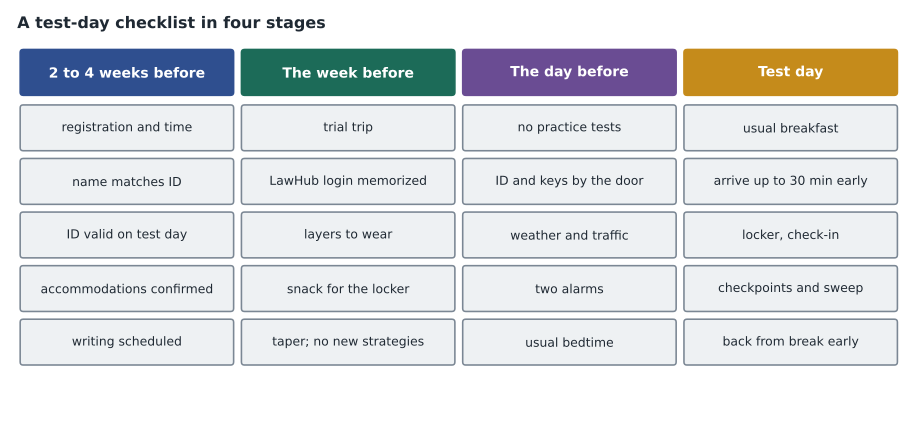
Test morning
- Wake at the planned time. Eat your usual breakfast and have your usual caffeine.
- Optional: ten minutes of writing about worries, on your own paper, at home. Leave the paper behind.
- Optional: two or three familiar questions read slowly as a warm-up, at home.
- Leave with a margin for traffic, parking and finding the room. LSAC tells in-person candidates to arrive up to 30 minutes before the scheduled time.
- Bring only what you need: ID, keys, and items for the locker such as a snack, water and your phone, which must be stored.
At the center
- Check in with your ID and follow the center's procedures. Store your phone, food and drinks in the locker.
- Do not bring paper or pencils into the room. The center provides scratch paper booklets.
- At your computer, log in with your LawHub credentials, read and agree to the certifying statement, and begin when ready.
- Before section 1, take one slow breath and read the first stem.
During the sections
- Follow your checkpoints. Look at the timer only at the checkpoints.
- Apply the two-minute ceiling. Choose and flag; never flag without an answer.
- At about one minute left, do the last-minute sweep.
- Start each section at zero, whatever the last one felt like.
At the intermission
- Go to your locker if you need your snack or water. Do not use any electronic device, do not discuss the test and do not work on scratch paper.
- Move, drink water, use the washroom early in the break.
- Start back with about three minutes left and complete the recheck-in with center staff before the ten minutes end.
- Before section 3, one slow breath and read the first stem.
After the test
- Follow the check-out procedures and collect your belongings.
- Do not discuss the questions. LSAC's rules prohibit sharing test content.
- Note in a sentence or two how the day went, for your own reference, without trying to reconstruct questions.
- If you have Score Preview, mark the release date and the end of your six-day decision window. If you do not, decide within six calendar days of the test date whether to cancel, under LSAC's rules, and decide in light of your rule set in advance, not your feelings.
- Rest. Do something unrelated to the LSAT for at least a day.
Remote candidates
Candidates who qualify for remote testing need a different version of the middle of the list. Harriet's remote additions: run the system check again the day before; clear the desk and room, since a room scan will check them; set up the second camera required since August 2026; keep up to six blank sheets of scratch paper ready, as LSAC allows remote candidates; use a wired connection if possible; tell the household the exact times; and have LSAC's contact information ready in case of a technical problem. The intermission recheck-in happens with the remote proctor.
Personalizing the checklist
Harriet asked each member to adapt the checklist to their own situation and bring it to the capstone. Each member's additions showed what worried them.
Élodie added the bridge crossing from Gatineau to Ottawa, a winter-weather margin and a reminder that her appointment was at 8:30 a.m., so she would leave at about 7:15. She also added a line to bring her passport as well as her driver's license, in case of any problem with one of them, after checking that her legal name matched both.
Dani added a line to confirm that the name on her Arizona driver's license matched her LSAC account exactly, since she uses a hyphenated surname on some documents. She found a mismatch in her account, a missing hyphen, and in November asked LSAC to correct it, weeks before her January test.
Ji-won added a line confirming that her accommodation was listed on her appointment confirmation, and a reminder that her checkpoints were scaled.
Thomas, whose test was in April, added a line at the top in capital letters: "HOLD THE CHECKPOINTS". He said it was the one thing he needed to remember above everything else.
Marcus added a line at the bottom, written after the fact: "Start back from the intermission at three minutes."
Why a checklist works
Harriet ended by explaining why she cared so much about a boring list. Checklists are used in aviation, surgery and other fields not because experts forget what to do, but because stress and fatigue make anyone more likely to skip a step. The LSAT is a long, stressful morning. A written list means the important steps happen whether or not you are thinking clearly at seven in the morning.
She also said a checklist is a source of calm. A candidate who has checked every item knows that the logistics are handled, and that the only thing left is the test itself, which she has trained for.
Worked problem
Sample question (written for this course)
A week before her test, a candidate notices that her LSAC account lists her name without the hyphen that appears on her driver's license. What should she do? (A) Nothing, because small differences are always accepted. (B) Bring a photocopy of her birth certificate on test day. (C) Show a photo of her passport on her phone at check-in. (D) Contact LSAC to correct the account name to match her ID well before test day. (E) Plan to explain the difference to center staff on test day.
Show solution
- (D) is correct. LSAC requires the account name to match the ID; correcting it in advance avoids a problem at check-in.
- (A) is wrong because the course and LSAC stress an exact match; the candidate should not assume a difference will be accepted.
- (B) is wrong because photocopies are not accepted as ID.
- (C) is wrong because digital images of ID are not accepted, and phones are stored in lockers.
- (E) is wrong because test day is too late to resolve an identity mismatch.
Answer: (D). Fix name mismatches with LSAC well before test day.
Rehearsing the checklist
Harriet suggested running the checklist once as a full rehearsal, about a week or two before the test, on a practice test day. Set the alarm for the real wake time, eat the planned breakfast, leave the house at the planned departure time and drive or ride to the test center, then come home and take the practice test at the real appointment time. Candidates who rehearse this way often find one or two items that need changing, such as a breakfast that leaves them hungry by the intermission or a departure time that turns out too tight.
Dani scheduled her rehearsal for a weekday in December. While planning it, she looked up the parking near her Tucson center and found it was a paid lot that took payment only through a phone app. She added a line to her checklist to set up the app in advance and to pay for parking before going inside, since her phone would be in the locker during the test.
A copy for someone else
Harriet also suggested giving a copy of the checklist, or at least the key times, to someone at home: a partner, parent or friend. If something goes wrong on test morning, such as a car that will not start, that person can help without needing to be told every detail. It also helps the household plan around the test, so that nobody schedules something noisy or needs the car that morning.
The checklist after test day
The checklist does not end when the test ends. Harriet asked each member to keep their checklist after the test and add notes about what worked and what did not. If they retake, the annotated checklist becomes the starting point for the next attempt. Marcus's note about returning from the intermission at three minutes was exactly that kind of annotation: a lesson learned on one test day, recorded for the next.
What not to bring
Harriet's checklist also had a short list of things to leave at home or in the car: practice materials and notes, which cannot be reviewed after check-in anyway; valuables that will not fit in a locker; and anything that might cause a delay at security. A candidate who arrives with only an ID, keys and a few items for the locker gets through check-in faster and has less to think about.
Thomas asked whether a watch was allowed. Harriet said candidates should follow LSAC's current rules on watches and other personal items, which are set out in its checklists and candidate agreement, and that in practice the on-screen timer makes a watch unnecessary. If in doubt, leave it in the locker.
Élodie said writing the checklist made her realize how many small decisions she had been carrying around in her head without noticing. Once they were written down, she stopped thinking about them. Harriet said that was the most common reaction, and the reason she had kept revising the list for eleven years.
Common mistakes
MistakeDiscovering an ID name mismatch on test day.
InsteadCheck that your LSAC account name matches your ID weeks in advance.
MistakeRelying on memory for test-day steps.
InsteadUse a written checklist adapted to your situation.
MistakeBringing items into the testing room that must be stored.
InsteadStore phone, food and drinks in the locker; bring no paper or pencils.
MistakeDiscussing questions after the test.
InsteadDo not share test content; note only how the day went.
MistakeAssuming the course checklist replaces LSAC's.
InsteadRead LSAC's current checklists; its rules govern.
Summary and key terms
- A checklist removes unnecessary decisions from test day and protects against skipped steps under stress.
- Weeks before: confirm registration, name match and ID validity, accommodations, the writing and the taper.
- The week and day before: trial trip, memorized LawHub credentials, clothes and snack plan, no new strategies, early bed.
- On the day: arrive up to 30 minutes early, store items in the locker, follow checkpoints and the intermission routine, and complete the recheck-in.
- After the test: do not share content, apply your Score Preview or cancellation plan, and rest.
- Name match
- LSAC's requirement that the legal name on the account match the ID presented.
- Acceptable ID
- A valid physical passport or government-issued photo ID from the United States, its territories or Canada, under LSAC's rules.
- Certifying statement
- The statement a candidate reads and agrees to before starting the test.
- Check-out
- The center's procedure at the end of the test.
- Personalized checklist
- A candidate's own version of the checklist, with additions for their situation.
Practice problems
Work each problem on paper first, then reveal the answer to check.
Which forms of ID does LSAC not accept?
Show answer
Digital images and photocopies.
What should you do about your LawHub credentials before test day?
Show answer
Memorize your username and password.
What three things are prohibited during the intermission at a center?
Show answer
Using electronic devices, discussing the test and working on scratch paper.
What did Dani find when she checked her name?
Show answer
Her LSAC account was missing a hyphen in her surname; she corrected it weeks before.
Why do checklists help on test day?
Show answer
Stress and fatigue make anyone more likely to skip steps; a list ensures they happen.
Lesson quiz · 5 questions
Score 60% or more to complete this lesson.
Create a free account to save your progress, take quizzes and earn a certificate.