
LES-113 · Lesson 7 of 12 · 19 min
Policing with American Indian and Alaska Native communities
▶ Video coming soon A video version of this lesson is on the way.
For the seventh class, Jesse Morningstar has invited an Elder from his community, Marion Shawanda, and Sergeant Paul Keeshig of his tribe's police department. Elder Shawanda opens with a teaching and then tells the class about her father, who was taken to a boarding school far from home with a federal agent beside him. 'When I was a girl,' she says, 'a government car on the reservation road meant someone was being taken away. Paul's job is to make it mean someone is coming to help. That takes a long time.'
This lesson is about policing with Indigenous peoples. It covers history, because that history shapes relationships today; the legal framework, which is different from the framework that governs other communities; the current state of Indigenous policing; and the practical skills officers need to work respectfully and effectively with Indigenous people, in their own communities and in cities. Indigenous peoples in the United States include members of more than 570 federally recognized tribes, as well as Alaska Native villages and corporations and members of tribes recognized only by states or not at all. Most American Indian and Alaska Native people now live outside reservations, many in cities.
History that shapes the present
Policing in the United States was part of the removal and control of Native nations. Federal troops and agents enforced removals such as the Trail of Tears in the 1830s. From the 1870s, the federal government created Indian police forces on reservations under the control of federal Indian agents, partly to suppress traditional governance and religious practices. Federal agents and police enforced attendance at boarding schools, where children were separated from their families and punished for speaking their languages. A Department of the Interior investigation released in 2022 and 2024 documented the federal Indian boarding school system and identified deaths and burial sites at many schools.
More recent events also shape trust. The occupation at Wounded Knee in 1973 ended in a long armed standoff with federal agents. High rates of violence against Native women, and inadequate responses to reports of missing and murdered Indigenous people, have led to federal laws such as Savanna's Act and the Not Invisible Act, both signed in 2020, which require better data, guidelines and coordination for missing and murdered Indigenous persons cases. Many Native people today report that their concerns are not taken seriously when they call for help, and that jurisdictional confusion delays the response.
Desjardins says that officers who did not take part in this history sometimes feel it is unfair to be judged by it. Sergeant Keeshig answers that no one expects them to apologize for the past; they are expected to understand why people are wary, to listen, and to make sure their own conduct does not repeat it. He adds that Indigenous communities also want effective policing. They suffer high rates of victimization and want offenders held accountable, missing people found and their children safe. Trust and effectiveness go together.
The legal framework
In the United States, policing in Indian country depends on a complex division of jurisdiction. Tribes are sovereign nations with their own police and courts. Federal law gives federal agencies, mainly the FBI and the Bureau of Indian Affairs Office of Justice Services, jurisdiction over major crimes committed by Indians in Indian country under the Major Crimes Act of 1885. In Oliphant v. Suquamish Indian Tribe (1978), the Supreme Court held that tribes have no inherent criminal jurisdiction over non-Indians, though the Violence Against Women Act reauthorizations of 2013 and 2022 restored tribal jurisdiction over non-Indians for certain crimes, including domestic violence and sexual violence. Public Law 280, passed in 1953, transferred much criminal jurisdiction in Indian country to six states, including Minnesota and Wisconsin, and allowed others to assume it. In McGirt v. Oklahoma (2020), the Court held that much of eastern Oklahoma remains Indian country, and in Oklahoma v. Castro-Huerta (2022) it held that states have concurrent jurisdiction over crimes by non-Indians against Indians in Indian country.
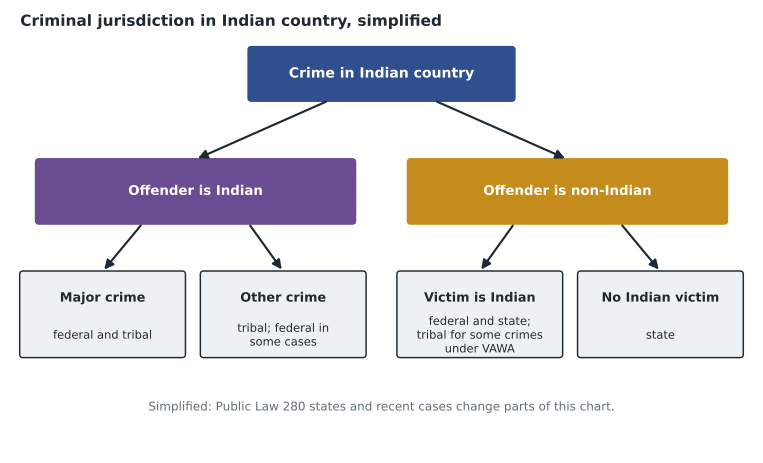
Treaty rights also affect how officers act. Many tribes reserved hunting, fishing and gathering rights in treaties, including in ceded territory outside reservation boundaries, and the courts have upheld those rights, as in Minnesota v. Mille Lacs Band of Chippewa Indians (1999) and Herrera v. Wyoming (2019). The Indian Child Welfare Act of 1978, upheld by the Supreme Court in Haaland v. Brackeen (2023), sets standards for removing Native children from their families, and officers involved in child protection must know when it applies. Cross-deputization agreements, under which tribal, county and state officers can enforce each other's laws, are common and reduce gaps.
Working across jurisdictions
Port Ardent is several hours' drive south of Jesse's reservation, but Sergeant Keeshig describes the arrangements his department has with the county sheriff, the state police and the FBI. A cross-deputization agreement lets tribal officers enforce state law on the reservation and lets county deputies respond on the reservation when tribal officers are not available. A memorandum of understanding with the FBI sets out who investigates major crimes. He says the agreements work when officers on all sides know each other, and fail when a new deputy treats the reservation as a place to drive through rather than a nation with its own police and its own law.
Jesse asks what the biggest practical problem is. Keeshig says it is missing persons. When an Indigenous person is reported missing, families often report that police elsewhere delayed or dismissed the report, assuming the person had run away or was drinking. Clear policies requiring immediate investigation, regardless of the person's background, and good communication between services are essential.
# Missing person reports in the region around Port Ardent, 2025
reports = 310
indigenous_reports = 41
indigenous_population_share = 0.04
share = indigenous_reports / reports
print("share of reports involving Indigenous people:", round(share, 3))
print("compared with population share:", indigenous_population_share,
"ratio:", round(share / indigenous_population_share, 1))share of reports involving Indigenous people: 0.132 compared with population share: 0.04 ratio: 3.3
Indigenous people were the subject of about 0.132 of missing person reports, compared with about 0.04 of the regional population, a ratio of 3.3. Desjardins says the numbers matter for two reasons. They show that the region's missing persons work is, to a large extent, work with Indigenous families, so officers must be ready to do it well. And they are probably an undercount, because research has found that some missing Indigenous people are never reported to police at all, often because families do not expect a useful response.
Practical skills
Elder Shawanda and Sergeant Keeshig give the class practical advice.
- Learn about the specific community. Indigenous nations differ in language, culture, governance and history. Ask, and do not assume that what you know about one applies to another.
- Know who to contact. Many communities have Elders, band or tribal council members, health and social services staff, and community safety workers who can help officers understand a situation and reach people.
- Take reports seriously. Treat every report of a missing or harmed Indigenous person as urgent and investigate it fully from the start.
- Respect ceremony and sacred items. Items such as medicine bundles, eagle feathers and pipes are sacred; when a search is necessary, ask the person how they would like the item handled or allow them or an Elder to handle it.
- Communicate patiently. Some people take time before answering and may avoid direct eye contact as a sign of respect. Silence is not evasion.
- Remember trauma. Many Indigenous people have personal and family experience of trauma connected to state institutions. A calm, explained approach reduces fear.
Many agencies now provide training on tribal sovereignty, culture and jurisdiction, developed with tribes, and the federal Not Invisible Act Commission recommended better training and coordination. Officers can also learn from tribal justice approaches, such as tribal wellness courts and peacemaking courts, which several tribes use and which police can refer cases to.
Urban Indigenous communities
Most Indigenous people live in cities, not in their home communities, and urban officers will work with Indigenous people far more often than they may realize. Port Ardent has an urban Indian center that provides health, employment and cultural services, and Officer Ferreira meets its staff regularly. Desjardins says that many urban Indigenous people have complex connections to home communities, may have moved for school, work or services, and may face the same barriers as other marginalized groups, as well as racism specific to them. He says officers should know the local organizations, learn whether a person wants their home community or family contacted, and never assume that an Indigenous person in a city is in trouble because they are Indigenous.
Restorative approaches and community justice
Elder Shawanda tells the class that many Indigenous traditions understand harm as damage to relationships, and justice as the work of repairing them. That understanding has influenced restorative justice, which brings together the person who caused harm, the person harmed and the community to talk about what happened, its effects and what should be done. Police can play a role by referring suitable cases, with the consent of the people involved, to restorative programs instead of, or alongside, the court process. Several tribes run peacemaking and wellness courts, and many states allow police and prosecutors to refer cases to restorative or diversion programs, including programs run by tribes or urban Indian organizations.
Sergeant Keeshig says that such programs are not a soft option. Facing the people you harmed, in front of Elders and family, is often harder than facing a judge. But they are more likely to change behavior and to repair relationships, and they give communities a role in justice that colonial systems took away. He asks the students, when they become officers, to learn which programs exist in their area and to use them. He also asks them to remember that victims must be safe and must consent, and that restorative approaches are not suitable for every case, particularly some cases of intimate partner violence, where the power imbalance between the parties can make a face-to-face process dangerous.
Worked problem
A missing person report
At 21:00 on a Friday, a woman calls Port Ardent police to report that her 17-year-old niece, who is a member of her tribe and living with her in Port Ardent to attend high school, did not come home after school and is not answering her phone. The niece has stayed out late twice before without telling anyone. The call-taker asks whether the report can wait until morning. What should happen?
Show solution
- Treat the report as urgent: she is a youth, and policy and the lessons of past failures require immediate action regardless of past behavior.
- Take a full report now, including recent photos, friends, social media, places she goes and any concerns about exploitation or harm.
- Notify her tribal police department in case she has gone home or contacted family there.
- Begin checks: phone location through the proper legal process, friends, school contacts and the places she visits.
- Keep the aunt informed of what is being done, and record every step and its timing.
Answer: Take the report immediately and investigate it as urgent, involve her home community's police and family, use proper legal processes for location data, and keep the aunt informed.
Common mistakes
MistakeIndigenous peoples are one group with one culture.
InsteadNations differ in language, culture, governance and history.
MistakeHistory is irrelevant to an officer who did not take part in it.
InsteadHistory shapes how people perceive police today; understanding it improves encounters.
MistakeA missing Indigenous youth who has stayed out before can wait until morning.
InsteadMissing person reports must be investigated promptly regardless of the person's background.
MistakeSacred items are just personal property to be searched like any other.
InsteadAsk the person how they wish the item handled, or allow them or an Elder to handle it, when a search is necessary.
Summary and key terms
- Federal agents and Indian police helped enforce removal and boarding school policies.
- Savanna's Act and the Not Invisible Act (2020) address missing and murdered Indigenous persons.
- Criminal jurisdiction in Indian country is divided among tribal, federal and state governments.
- In Port Ardent's region, Indigenous people were the subject of about 0.132 of missing person reports, about 3.3 times their population share.
- Learn the specific community, take reports seriously, respect sacred items and communicate patiently.
- Most Indigenous people live in cities; urban officers need local relationships too.
- Indian country
- Reservations, dependent Indian communities and Indian allotments, as defined in federal law.
- Major Crimes Act
- The 1885 law giving federal courts jurisdiction over serious crimes by Indians in Indian country.
- Public Law 280
- The 1953 law that transferred much criminal jurisdiction in Indian country to certain states.
- Cross-deputization
- An agreement allowing tribal, county and state officers to enforce each other's laws.
- Savanna's Act
- A 2020 law requiring guidelines and data for missing and murdered Native American cases.
- Tribal sovereignty
- The inherent authority of tribes to govern themselves.
Practice problems
Work each problem on paper first, then reveal the answer to check.
Who investigates a major crime committed by an Indian against an Indian on a reservation outside a Public Law 280 state?
Show answer
Federal agencies, usually the FBI or the BIA, along with the tribe for its own law.
In the code example, what was the ratio of the share of missing person reports to the population share?
Show answer
About 0.132 divided by 0.04, or 3.3.
Why might the missing person figures be an undercount?
Show answer
Some families do not report to police because they do not expect a useful response.
How should an officer handle a sacred item during a necessary search?
Show answer
Ask the person how they wish it handled, or allow them or an Elder to handle it.
Lesson quiz · 5 questions
Score 60% or more to complete this lesson.
Create a free account to save your progress, take quizzes and earn a certificate.