
LES-113 · Lesson 12 of 12 · 20 min
Capstone: a community problem-solving plan for Eastgate Park
▶ Video coming soon A video version of this lesson is on the way.
For the last class, Desjardins has asked the cohort to work as a team on a real problem. Officer Ferreira, Sergeant Haddad and three partners have agreed to act as a review panel: Tom Okonkwo from Harbor House, Nadia Rahimi from the Newcomer Center and Darlene Price, the chair of the Eastgate residents' association. The problem is the one Ferreira scanned in Lesson 2: Eastgate Park, where parents have stopped using the playground, young people say they are hassled, and the calls keep coming. The students have three weeks, access to the call data and the help of the community response unit, and must present a plan that applies everything in the course.
The brief
Desjardins gives the team a one-page brief. The plan must define the problem or problems precisely; analyze them using the problem analysis triangle and the data; consult the people affected, including those who do not attend meetings; propose responses that address causes, involve partners and respect the rights and dignity of everyone who uses the park; explain how fairness and trust will be protected; and set out how the results will be assessed. The panel will score the plan out of 20, with up to 4 points in each of five areas: problem definition, analysis, engagement, responses, and fairness and assessment.
Scanning: what the data show
The team starts with the call data for Eastgate Park for the past twelve months. Linh, who has been learning to work with the call system, pulls the records and groups them by type and hour.
# Calls for service to Eastgate Park and its edges, past 12 months, by type and time of day
calls = {"needles or drug use": {"06-12": 31, "12-18": 9, "18-24": 14, "00-06": 4},
         "youths and conflict near the court": {"06-12": 2, "12-18": 38, "18-24": 19, "00-06": 1},
         "noise and drinking after dark": {"06-12": 0, "12-18": 3, "18-24": 26, "00-06": 11},
         "other": {"06-12": 7, "12-18": 8, "18-24": 6, "00-06": 1}}
total = sum(sum(v.values()) for v in calls.values())
print("total calls:", total)
for kind, hours in calls.items():
    n = sum(hours.values())
    peak = max(hours, key=hours.get)
print(f"{kind:36} {n:3} share {n / total:.2f} peak {peak}")total calls: 180 needles or drug use 58 share 0.32 peak 06-12 youths and conflict near the court 60 share 0.33 peak 12-18 noise and drinking after dark 40 share 0.22 peak 18-24 other 22 share 0.12 peak 12-18
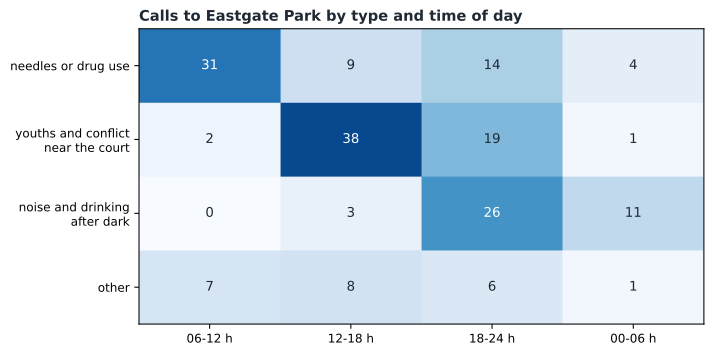
There were 180 calls. Three problems account for most of them, and each has its own time pattern: needles and drug use, found mostly in the morning; conflict involving young people near the basketball court in the afternoon and early evening; and noise and drinking after dark. Amara points out that the morning needle calls probably reflect when people find needles, after use during the night, rather than when the drug use happens. Ferreira confirms that most calls come from parents and city workers in the morning.
Analysis and consultation
The team divides the analysis. Jesse and Marco take the needles. They walk the park at different times with Ferreira and the city's parks supervisor, map where needles are found, and meet the harm reduction program at the community health center. They learn that most needles are found near the playground and behind the field house, where a broken light and overgrown shrubs create a sheltered spot, that the nearest sharps disposal box was removed during renovations last year, and that the supervised consumption service in the city center is a forty-minute walk away and closes at 22:00. Using the triangle, they note that the place lacks a manager after hours, that the targets, children and families, have lost their guardians because parents have stopped coming, and that the people using drugs have few handlers or alternatives nearby.
Amara and Linh take the conflict at the basketball court. They spend two afternoons at the court and talk to the youth program at the community center. The young people tell them that the court is the only free place to play in Eastgate, that there are not enough hours of court time, so groups argue over it, and that older men from outside the neighborhood sometimes take over the court and intimidate younger players. Several say they have been stopped and searched near the court and felt they were treated as suspects for being there. Two calls in the data involved a reported weapon, and one led to an arrest. The youth workers say a structured program at the court in the late afternoon would help, and that the community center's gym is empty most weekday afternoons.
Priya takes the after-dark noise and drinking, and the engagement plan. She attends the residents' association meeting, which is mostly older homeowners who want more patrol and a curfew for the park. She also visits the Lindell Avenue tenants' association, where newcomer families say they would use the park more if it felt safe and that they are afraid to call police about the noise because they do not speak English well. With Rahimi's help, she runs a short survey in four languages at the Newcomer Center, with 64 responses. At Harbor House, Okonkwo arranges for her to talk with men who sometimes sleep in the park; they tell her that they are often the ones who find needles and who are blamed for them.
The plan
The team proposes a plan with responses for each problem, organized by the partner who will lead each action.
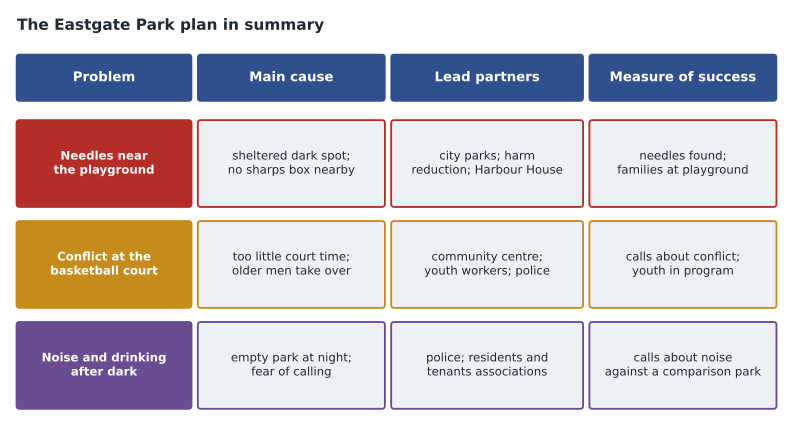
- Needles near the playground: the city will repair the light behind the field house, trim the shrubs and restore a sharps disposal box; the harm reduction program will add a morning needle sweep three days a week and outreach in the evening, with information about the supervised consumption service and safer use; Harbor House will offer paid needle pickup work to residents through its employment program. Police will respond to calls and refer people to outreach, and will not use the sharps box area for enforcement, so that people are not discouraged from using it.
- Conflict at the basketball court: the community center will open its gym on weekday afternoons and run a structured drop-in program at the court from 16:00 to 19:00, with youth workers; the city will post a court schedule; Officer Ferreira will continue the monthly basketball game and will brief patrol officers on the plan, stressing that being at the court is not grounds for a stop. Where there is information about weapons or intimidation by specific individuals, police will investigate those individuals, not the young people using the court.
- Noise and drinking after dark: police will make focused visits to the park between 21:00 and 01:00 for eight weeks, using procedurally just contacts and bylaw enforcement where needed; the residents' association and tenants' association will promote a non-emergency reporting line, with interpretation, and the service will translate information about it into the four main languages of the towers. The team rejects the proposal for a park curfew, explaining that it would exclude many legitimate users, especially young people and shift workers, and that it would be hard to enforce fairly.
For fairness and trust, the plan commits to recording every stop near the park with the grounds, reviewing the records monthly at the platoon level, reporting the numbers to the residents' and tenants' associations, and inviting the youth program to raise concerns directly with Haddad. For assessment, it sets measures for each problem: needles found and calls about needles; families using the playground, counted on set days; calls about conflict at the court and the number of young people in the program; and calls about noise and drinking, compared with the previous year and with another Port Ardent park as a comparison site. The team also plans a short follow-up survey of park users in the summer.
The panel review
The panel scores the plan and gives feedback. Darlene Price says she came expecting to argue for a curfew and was persuaded by the explanation of why it would not work, though she wants the after-dark visits to continue if the noise does not improve. Okonkwo praises the plan for treating the men at Harbor House as part of the solution rather than the problem. Rahimi says the translated survey reached families who have never been asked their views before. Haddad says the commitment to record and review stops is the part she will hold the team to.
# Panel scores for the Eastgate Park plan (each area out of 4)
scores = {"problem definition": 4, "analysis": 4, "engagement": 4, "responses": 3, "fairness and assessment": 3}
total = sum(scores.values())
print("total:", total, "out of", 4 * len(scores))
weakest = [k for k, v in scores.items() if v == min(scores.values())]
print("areas to strengthen:", ", ".join(weakest))total: 18 out of 20 areas to strengthen: responses, fairness and assessment
The plan scored 18 out of 20. The panel took a point from responses because the plan relied on funding for the gym program and needle sweeps that had not yet been confirmed, and asked the team to identify a fallback if the funding did not come through. It took a point from fairness and assessment because the comparison park was chosen for convenience and differed from Eastgate in size and use, and because the plan did not say how long it would run before the partners decided whether to continue. Desjardins tells the class that those are exactly the gaps that real projects have, and that a plan which names its own weaknesses is more credible than one that claims to have none.
Looking back on the course
Desjardins closes the course by connecting the plan to each lesson. The plan began with partnership, the core of community policing, and it used SARA and the problem analysis triangle to turn a vague complaint about the park into three specific problems. It protected procedural justice and trust by committing to explained, recorded contacts and by reporting back. It addressed bias by refusing to treat being at the court as suspicious and by reviewing stop records. It reached newcomer families in their own languages, treated people experiencing homelessness and people who use drugs as part of the community, and avoided responses that would exclude marginalized users of the park. It relied on partners to lead most actions. And it used CPTED, situational prevention and a comparison site to make the park safer and to learn whether the work succeeded.
Jesse says the course taught him that the hardest part of policing a community is listening to the people who do not call. Linh says it taught her that data can show a problem but cannot explain it without talking to people. Marco says he started the course thinking community policing was soft and ends it thinking it is the hardest kind of policing there is. Desjardins says that is the right conclusion, and that the next course, on mental health crisis response, will test all of it again.
Worked problem
Responding to the panel's feedback
The panel asked the team to name a fallback if the funding for the gym program and needle sweeps is not confirmed, and to choose a better comparison site. How should the team respond?
Show solution
- For the gym program, identify lower-cost options: volunteer coaches through the youth program, a partnership with a nearby school's gym, or a shorter program run by the community center's existing staff.
- For needle sweeps, ask whether the city's parks crew can add a morning check of the playground area, and whether the harm reduction program can train Harbor House residents as volunteers until paid work is funded.
- For the comparison site, ask the crime analyst to find a park similar in size, use and call history, ideally in a neighborhood with similar demographics, and check its calls over the past three years.
- Set a review point: the partners will meet after six months to review the measures and decide whether to continue, adjust or stop each response.
- Report the changes to the panel and to the residents' and tenants' associations.
Answer: Name concrete low-cost fallbacks for each funded action, ask an analyst to choose a better-matched comparison park, and set a six-month review point to decide whether to continue, adjust or stop each response.
Common mistakes
MistakeA community plan should give residents everything they ask for.
InsteadPlans should weigh what different residents want against evidence, rights and fairness, and explain the choices.
MistakeOne problem needs one response.
InsteadAnalysis usually shows several problems, each with its own causes and responses.
MistakePolice should lead every action in a community plan.
InsteadPartners best placed to address each cause should lead; police lead where enforcement or safety is needed.
MistakeA good plan has no weaknesses.
InsteadCredible plans name their gaps, such as unconfirmed funding, and say how they will address them.
Summary and key terms
- The Eastgate Park calls broke into three problems with different time patterns.
- Analysis combined call data, site visits, the problem analysis triangle and consultation with people who do not attend meetings.
- Responses were led by the partners best placed to address each cause.
- The plan protected fairness by recording and reviewing stops and reporting to residents.
- Assessment used measures for each problem and a comparison site; the panel asked for a better-matched one.
- The plan scored 18 out of 20 and named its own gaps.
- Capstone
- A final project that applies the learning of a whole course to a realistic problem.
- Review panel
- A group of practitioners and community members who assess a plan.
- Fallback
- An alternative action if a planned response cannot be carried out.
- Comparison site
- A similar place that does not receive the response, used to estimate its effect.
- Review point
- A set date when partners decide whether to continue, adjust or stop a response.
- Harm reduction
- Services that reduce the health and social harms of drug use without requiring abstinence.
Practice problems
Work each problem on paper first, then reveal the answer to check.
How many calls did the Eastgate Park data show, and which problem had the most?
Show answer
180 calls; youth and conflict near the court had 60.
Why did the team reject a park curfew?
Show answer
It would exclude legitimate users, especially young people and shift workers, and be hard to enforce fairly.
Why did the panel take a point from responses?
Show answer
Funding for the gym program and needle sweeps had not been confirmed and there was no fallback.
What is one way the plan protected fairness?
Show answer
Recording stops near the park with grounds and reviewing them monthly, with numbers reported to residents.
Lesson quiz · 5 questions
Score 60% or more to complete this lesson.
Create a free account to save your progress, take quizzes and earn a certificate.