
LES-113 · Lesson 3 of 12 · 19 min
Procedural justice and police legitimacy
▶ Video coming soon A video version of this lesson is on the way.
Desjardins begins with two stories from his patrol years. In the first, he stopped a driver for running a red light, explained what he had seen, listened to the driver say that the light had been yellow, explained why he disagreed, wrote the ticket and wished her a good day. A week later she wrote to the chief to say that she still thought she had been right but that the officer had been fair. In the second, a colleague stopped a teenager walking home, asked for identification without saying why, searched his backpack and let him go without a word. Nothing was found, no law was broken by either of them, and the teenager's mother filed a complaint that took months to resolve. 'Same service, same city, same year,' Desjardins says. 'One encounter built trust and one destroyed it. The difference was not the outcome. It was how people were treated.'
Why people obey the law
There are two broad explanations of why people comply with the law and cooperate with the police. The instrumental explanation says that people obey because they fear punishment and cooperate when they think the police are effective. The normative explanation says that people obey because they believe it is right to do so, and cooperate when they believe the police are legitimate, meaning that they have the right to exercise authority and deserve support. Both play a part. But research led by the psychologist Tom Tyler, beginning with his 1990 book Why People Obey the Law, found that legitimacy is a stronger and more stable influence on compliance and cooperation than fear of punishment or judgments of police effectiveness.
Tyler's most important finding was about where legitimacy comes from. People's judgments of the police depend less on whether they got the outcome they wanted, such as avoiding a ticket, than on whether they thought the process was fair. People who lose but feel fairly treated often accept the result. People who win but feel disrespected often leave angry. And each personal experience, along with the experiences people hear about from family and friends, adds to or subtracts from their overall view of the police.
The four elements of procedural justice
Procedural justice is usually described through four elements, sometimes called pillars. They are not a script, and they do not replace the law. They describe what people look for when they judge whether an encounter was fair.
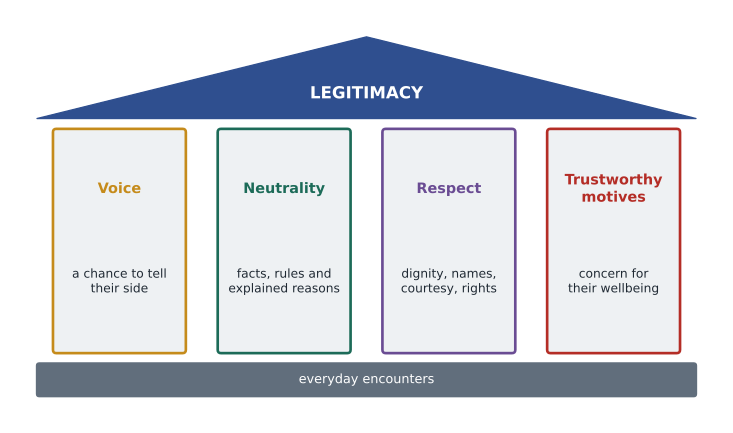
- Voice: people want a chance to tell their side of the story before a decision is made, and to feel that the officer listened. Voice matters even when it cannot change the outcome.
- Neutrality: people want decisions made on facts and consistent rules, not on bias or personal feelings, and they want the officer to explain the reasons so that the neutrality is visible.
- Respect: people want to be treated with dignity, called by their name, spoken to politely and have their rights acknowledged.
- Trustworthy motives: people want to believe that the officer cares about their wellbeing and is acting to help, not to harass or punish them.
Desjardins points out that each element maps onto something an officer can do. Voice means asking 'Can you tell me what happened?' and waiting for the answer. Neutrality means saying why: 'I stopped you because your car matches the description of one involved in a collision ten minutes ago.' Respect means using a person's name, keeping one's tone even and not making them wait without explanation. Trustworthy motives means showing concern: 'Is there anyone you want me to call?' None of these takes long, and most take less time than dealing with the anger that follows when they are missing.
What the research shows
The evidence on procedural justice is strong for attitudes and more mixed for behavior. A Campbell Collaboration review by Lorraine Mazerolle and colleagues in 2013 found that police interventions with a procedural justice component improved citizens' satisfaction, confidence in police and perceptions of procedural justice, and had smaller but positive effects on compliance and cooperation. The best-known single study is the Queensland Community Engagement Trial in Australia, in which officers at random breath-testing checkpoints used a short procedurally just script: they explained why they were testing, said that road deaths were a community concern, invited questions and thanked drivers. Drivers who received the script rated the police as fairer and more legitimate than those who received a standard test.
In Chicago, a large training program begun in 2012 taught procedural justice to thousands of officers. An evaluation by George Wood, Tom Tyler and Andrew Papachristos in 2020 found that complaints against trained officers and their use of force fell after the training, though later analyses raised questions about how much of the decline could be attributed to the training itself. That debate is a useful reminder that training is only one input. A service that teaches procedural justice in a classroom but rewards officers for stop counts and arrests will not get procedurally just policing on the street.
Procedural justice also matters inside police services. Studies of internal procedural justice find that officers who believe their supervisors and service treat them fairly are more likely to support community policing, to comply with policy and to treat the public fairly. Desjardins tells the class that the most procedurally just sergeant he ever worked for explained every decision, listened to complaints from her officers, and never humiliated anyone in front of others, and that her platoon had the lowest complaint rate in the service.
Procedural justice in Port Ardent stops
After a series of complaints about pedestrian stops in Eastgate, Sergeant Lisa Haddad, whose platoon covers Eastgate, reviewed a sample of body-worn camera footage from stops in the previous year and matched it to a follow-up survey that the service sends to some people after police contact. For each stop, a reviewer recorded whether the officer explained the reason for the stop within the first minute. The survey asked whether the person was satisfied with how they were treated.
# Port Ardent stops reviewed with matched follow-up surveys
explained = {"stops": 520, "satisfied": 412}      # reason given in the first minute
not_explained = {"stops": 180, "satisfied": 88}
for name, g in [("explained", explained), ("not explained", not_explained)]:
    print(name, g["stops"], "stops, satisfied:", round(g["satisfied"] / g["stops"], 2))
gap = explained["satisfied"] / explained["stops"] - not_explained["satisfied"] / not_explained["stops"]
print("difference:", round(gap, 2))explained 520 stops, satisfied: 0.79 not explained 180 stops, satisfied: 0.49 difference: 0.3
Satisfaction was 0.79 when the officer explained the reason in the first minute, and 0.49 when they did not, a difference of 0.30. Haddad was careful about what that showed. The stops were not assigned at random, so other differences, such as the reason for the stop or the person's mood, could explain part of the gap. People who were satisfied may also have been more likely to answer the survey. But the pattern matched the research, and the cost of explaining is almost nothing, so she made it a coaching point for every officer in the area and added it to the platoon's monthly footage review.
Procedural justice and the law
Procedural justice is not only good practice; parts of it overlap with legal requirements. Miranda warnings must be given before custodial interrogation, the Fourteenth Amendment requires equal protection, and many state laws and department policies require officers to identify themselves and give the reason for a stop when it is safe to do so. In Ohio, the Ohio Collaborative Community-Police Advisory Board, created in 2015, sets statewide standards for agencies seeking certification, including standards on bias-free policing and community engagement. The research adds a practical point: following these rules in a way that shows voice, neutrality, respect and concern makes them more effective.
Limits and objections
Some officers worry that procedural justice means being soft or letting people argue. It does not. Officers can listen, explain and be courteous while still making the decision the law requires, including arrest. Procedural justice is about how decisions are made and communicated, not about avoiding enforcement. In dangerous situations, safety comes first, and explanation can follow once the situation is controlled.
Others argue that procedural justice puts the burden on individual officers while ignoring policies and laws that people experience as unfair. If a community is subject to far more stops than others, courteous stops are better than discourteous ones, but they do not address why there are so many stops. That criticism is fair, and later lessons on bias and fair policing address it. Procedural justice is necessary for legitimacy, but it is not sufficient: people also judge the police by whether their policies and outcomes are fair.
Jesse says that in his community, people's views of the police are shaped by history as much as by any single encounter, and that one good stop does not erase generations of bad ones. Desjardins agrees and says that is why consistency matters so much: trust is built slowly, by many officers acting fairly over many years, and can be lost quickly by one.
Putting it into words
Desjardins asks the class to rewrite a stop that went badly. In the original, an officer approaches a young man sitting on a low wall outside a closed store at 01:00 and says, 'ID. Now.' The young man asks why, and the officer says, 'Because I asked.' The class rewrites it. Linh's version: 'Hi, I'm Officer Malhotra with Port Ardent police. We had a call about someone trying the door of this store a few minutes ago, so I'm checking with people nearby. Can I ask what you're doing here tonight?' If the young man answers and the officer has no grounds, she ends with, 'Thanks for your help. Sorry to bother you; have a good night.' If the officer has grounds to detain, she explains them and the person's rights, then listens.
Desjardins says Linh's version takes about fifteen seconds longer, gives the officer the same information, makes the legal position clear and leaves the young man more likely to cooperate now and to call the police if he ever needs them. He adds that it also leaves a body-worn camera recording that a supervisor, a court or the young man's mother would find fair.
Worked problem
Applying the four elements to a call
A woman calls police because her neighbor's music has been loud every night for a week. When Officer Malhotra arrives, the neighbor, a man in his sixties, says that he plays music to cope with tinnitus and that the woman has been hostile to him since he moved in. The music is clearly audible in the hallway. Using the four elements, how should Malhotra handle the call?
Show solution
- Voice: let each person explain their side separately, without interrupting, and acknowledge what they say, including the neighbor's tinnitus.
- Neutrality: explain the noise bylaw or law that applies and how it applies to what Malhotra can hear, so the decision rests on a rule, not on who complained.
- Respect: use their names, keep a calm tone and avoid taking sides in their history.
- Trustworthy motives: show concern for both, for example by suggesting headphones or a white noise device, and pointing to mediation services if the conflict continues.
- Decide: ask the neighbor to turn the music down now, explain what will happen if calls continue, and record the call so that a pattern is visible.
Answer: Hear both people, apply the rule openly, treat both with dignity, suggest practical help and a mediation service, ask for the music to be lowered now, and record the outcome.
Common mistakes
MistakeProcedural justice means not enforcing the law.
InsteadIt is about how decisions are made and explained; officers can still arrest or ticket.
MistakeOutcomes matter more than process to people's view of the police.
InsteadResearch consistently finds that fair process matters as much as or more than outcomes.
MistakeExplaining the reason for a stop wastes time.
InsteadIt takes seconds, often satisfies legal duties and improves cooperation.
MistakeProcedural justice training is enough on its own.
InsteadServices must also reward and supervise fair practice and review policies that people see as unfair.
Summary and key terms
- Legitimacy, the belief that police have the right to exercise authority, is a strong influence on compliance and cooperation.
- People judge the police more by fair process than by outcomes.
- The four elements are voice, neutrality, respect and trustworthy motives.
- Reviews find that procedural justice improves satisfaction and confidence, with smaller gains in compliance and cooperation.
- In Port Ardent, satisfaction was 0.79 when officers explained the reason for a stop and 0.49 when they did not.
- Procedural justice is necessary but not sufficient; policies and outcomes also shape legitimacy.
- Legitimacy
- The public's belief that the police have the right to exercise authority and deserve support.
- Procedural justice
- Fairness in how decisions are made and how people are treated.
- Voice
- Giving people a chance to tell their side before a decision.
- Neutrality
- Making decisions on facts and consistent rules, and explaining the reasons.
- Trustworthy motives
- Showing that the officer is acting out of concern for people's wellbeing.
- Ohio Collaborative
- The Ohio Collaborative Community-Police Advisory Board, which sets statewide standards for agency certification.
Practice problems
Work each problem on paper first, then reveal the answer to check.
What did Tyler find about outcomes and process?
Show answer
People judge the police more by whether the process was fair than by whether they got the outcome they wanted.
What did the Queensland Community Engagement Trial test?
Show answer
A short procedurally just script at random breath-test checkpoints; drivers rated the police as fairer and more legitimate.
In the code example, what was the satisfaction gap?
Show answer
0.79 minus 0.49, or 0.30.
Why was Haddad cautious about the gap?
Show answer
Stops were not randomly assigned and satisfied people may have been more likely to answer the survey.
Lesson quiz · 5 questions
Score 60% or more to complete this lesson.
Create a free account to save your progress, take quizzes and earn a certificate.