
LES-113 · Lesson 6 of 12 · 20 min
Fair and bias-free policing: law, policy and data
▶ Video coming soon A video version of this lesson is on the way.
Margaret Liu, the assistant prosecutor who reviews Port Ardent charges each week, visits the sixth class. She brings a transcript from a hearing in which a defense lawyer cross-examined an officer about why he had followed a car for four blocks before stopping it for a burned-out license plate light. The lawyer asked whether he had noticed the driver before he noticed the light. The officer said he could not remember. 'That answer cost us the case,' Liu says. 'Not because the officer was biased, which I don't know, but because he couldn't show that he wasn't.' Today's lesson is about the law against discriminatory policing, the policies that put it into practice, and the data that show whether it is working.
Defining racial profiling
In the United States, racial profiling is generally understood as the use of race, ethnicity or national origin, rather than behavior or individualized suspicion, as a basis for selecting people for stops, searches or other law enforcement action. Department of Justice guidance for federal law enforcement, first issued in 2003 and expanded in 2014, prohibits federal officers from relying on race, ethnicity, gender, national origin, religion, sexual orientation or gender identity in routine law enforcement decisions, except where a specific suspect description includes those characteristics.
Two points follow from these definitions. First, profiling does not require that race be the only reason for a decision; it is enough that race or a related characteristic was a factor that tipped the decision. Second, using race as part of a specific suspect description is not profiling: if a witness describes the person who committed a robbery as a tall white man in a red jacket, officers may look for a tall white man in a red jacket. What they may not do is treat a whole group as suspicious because of a general belief about that group.
The law in the United States
The Equal Protection Clause of the Fourteenth Amendment prohibits intentional discrimination by state and local governments, including police. But in Whren v. United States (1996), the Supreme Court held that an officer's subjective motive does not make a traffic stop unreasonable under the Fourth Amendment if there was probable cause of a violation, and said that the proper basis for objecting to intentionally discriminatory enforcement is the Equal Protection Clause, not the Fourth Amendment. Equal protection claims are hard to win because they require proof of discriminatory intent, not just unequal effect. Title VI of the Civil Rights Act of 1964 prohibits discrimination by programs receiving federal funds, which includes most police agencies, and 34 U.S.C. 12601 allows the Department of Justice to sue agencies that engage in a pattern or practice of conduct that violates constitutional rights.
Many states have added their own rules. Some require officers to record the perceived race of drivers in every traffic stop and publish the data, as California has done under its Racial and Identity Profiling Act of 2015. Others ban profiling by statute and require training. Federal pattern-or-practice investigations have led to consent decrees, court-enforced agreements that require reforms, in cities such as Los Angeles, Seattle, Chicago, Baltimore and Cleveland. In 2025 the Department of Justice moved to end several pending consent decree cases and closed some investigations, so the use of this tool has changed, but agreements already approved by courts remain in force until a court ends them.
Policy: putting the law into practice
Laws set the boundaries; policies tell officers what to do on a shift. A bias-free policing policy usually does several things. It defines profiling and prohibits it. It allows the use of personal characteristics only as part of a specific, reliable suspect description. It requires officers to articulate and record the grounds for stops, searches and other discretionary actions. It requires supervisors to review those records and to look for patterns. It sets out training, data collection and public reporting. And it describes how complaints of bias will be received and investigated.
Liu says the requirement to articulate grounds is the most important for officers, because it protects everyone. An officer who writes down, at the time, what they saw before a stop and why it justified the stop has made a record that a court, a supervisor or a complainant can test. An officer who writes 'suspicious behavior' has made a record that protects no one. She shows the class two notes from the same kind of stop. The first says, 'Male acting suspicious near cars, stopped and identified.' The second says, 'At 02:10 male tried door handles of three parked cars on Lindell Ave, looked around after each, walked away quickly when he saw cruiser.' Only the second shows grounds.
Data: how services measure fairness
Measuring disparities in policing is harder than it looks. The simplest approach compares the share of stops involving a group with that group's share of the population. If a group makes up 0.10 of a city's residents and 0.20 of stops, the disparity ratio is 2. But population is a crude benchmark. The people who drive in a city at a given time are not the same as its residents; commuters, visitors and young drivers are over-represented. Police are deployed more heavily in some areas, so the people who live or travel there face more chances of being stopped. Researchers have developed better benchmarks, each with its own limits.
- Residential population: easy to obtain, but often misleading, because it does not reflect who is on the road or in public spaces.
- Not-at-fault drivers in collisions: drivers who were hit by others are roughly a random sample of people on the road, so their make-up estimates who is driving.
- Direct observation: researchers count drivers by perceived group at sample locations and times, which is accurate but expensive.
- The veil of darkness test: compares the share of stops involving a group in daylight and after dark at the same times of day across the year. If officers are less able to see a driver's race after dark, and the group's share of stops falls after dark, that suggests race influenced daylight stops.
- Internal benchmarking: compares each officer with other officers working the same area and shift, which controls for place and time and identifies outliers for supervisory review.
Port Ardent began recording the perceived race of drivers in traffic stops in 2024. Desjardins shows the class the 2025 figures for one group, Black drivers, using three benchmarks.
# Port Ardent traffic stops in 2025: share involving Black drivers, compared with three benchmarks
stops_share = 0.171
benchmarks = {"residential population": 0.072,
              "not-at-fault collision drivers": 0.094,
              "stops by the same officers' peers on the same shifts": 0.118}
for name, b in benchmarks.items():
print(f"{name:52} benchmark {b:.3f} disparity ratio {stops_share / b:.2f}")residential population benchmark 0.072 disparity ratio 2.38 not-at-fault collision drivers benchmark 0.094 disparity ratio 1.82 stops by the same officers' peers on the same shifts benchmark 0.118 disparity ratio 1.45
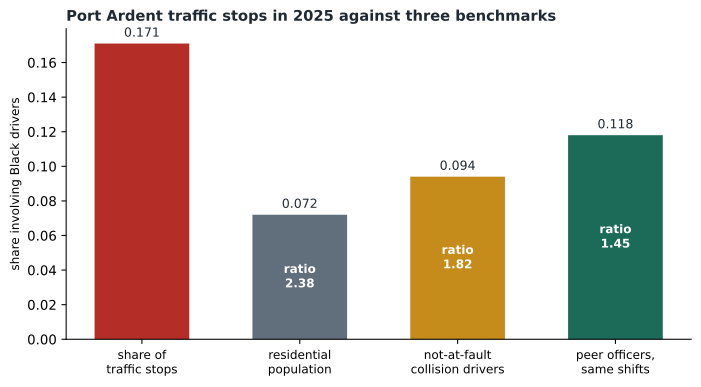
Against the residential population, the disparity ratio is 2.38. Against not-at-fault collision drivers, a better estimate of who is on the road, it is 1.82. Against the stops made by peer officers on the same shifts and in the same areas, it is 1.45, which suggests that some of the officers in the sample stop Black drivers more than their peers do. Desjardins asks what the numbers prove. Priya says they show a disparity but not its cause. Desjardins agrees: disparities can come from bias, from deployment decisions, from differences in driving behavior, from the reasons for stops or from errors in recording. But a persistent disparity that remains after reasonable benchmarks is a warning sign that a service must investigate, not explain away.
From data to action
Data matter only if someone acts on them. Good practice includes publishing the data and the method, so that the public can see both; involving community members in interpreting results; reviewing officers whose patterns stand out, as a supervisory matter rather than an accusation; reviewing policies that produce large numbers of low-value stops, such as stops for minor equipment violations, which in some cities produced few arrests or seizures but many negative encounters; and checking outcomes after stops, such as searches, hit rates and use of force, not just the stops themselves.
Several American cities and states have restricted stops for minor equipment and registration violations that do not threaten safety, and some evaluations have found reductions in stops of Black drivers with no measurable increase in collisions or crime, though the evidence is still developing. Marco asks whether restricting stops makes officers less effective. Desjardins says that depends on what the stops were achieving. If a type of stop almost never finds anything and generates complaints, the officer's time may be better spent on stops for dangerous driving or on problem-solving work.
Complaints of bias
When someone complains that they were treated unfairly because of their race or another characteristic, the complaint deserves a careful and respectful process. Most complaints of bias cannot be proven or disproven from one encounter, which is why patterns matter. But each complaint is also information. A service that treats complaints of bias as an attack will learn nothing; a service that investigates them properly, explains its findings and looks for patterns across complaints can improve. In Port Ardent, complaints can be made to the department's internal affairs unit and are reviewed by the Civilian Police Review Board in cases involving force or discrimination; in many cities, independent civilian bodies investigate or review complaints.
Supervisors and early intervention
Liu tells the class that the people best placed to prevent biased policing are sergeants. A sergeant who reviews notes and footage regularly will notice an officer whose grounds are vague, whose stops cluster on one group or whose encounters often end in complaints, long before a court or an oversight body does. Many services now use early intervention systems, which flag officers whose records show patterns such as many complaints, high use of force or unusual stop and search rates compared with peers. A flag is not a finding of misconduct. It is a prompt for a supervisor to look more closely, to talk with the officer and, where needed, to offer coaching, training or a change of assignment. Research on early intervention systems suggests they work best when supervisors are trained to use them, when officers see them as supportive rather than punitive and when the data are accurate. Haddad says that the most useful conversation she ever had with a young officer began with his own numbers on a screen and the question, 'What do you think is going on here?'
Worked problem
Writing grounds that show neutrality
Officer Dev Malhotra stops a car at 22:40 on Lindell Avenue. In his first draft notes he writes: 'Vehicle observed in area known for drugs. Driver appeared nervous. Stopped for safety check.' The driver, a Black man in his twenties, later complains that he was stopped because of his race. Rewrite the notes so that they show what Malhotra actually relied on, assuming he saw the car roll through a stop sign without stopping and then saw the driver drop something onto the passenger floor as the cruiser approached.
Show solution
- State the time, place and what was observed before the stop: the car rolled through the stop sign at Lindell and Third at 22:40 without stopping.
- State the legal basis for the stop: the traffic offense observed.
- Record what happened next separately: as the cruiser approached, the driver leaned and dropped an object onto the passenger floor.
- Remove vague and potentially biased phrases: 'area known for drugs' adds nothing to the grounds, and 'appeared nervous' is weak and common in innocent people.
- Record what was done and why, including whether any search was conducted and on what basis, and the outcome.
Answer: A good note gives the specific traffic offense as the reason for the stop, records the later observation separately, avoids vague phrases about the area and nervousness, and records what was done and why.
Common mistakes
MistakeUsing race in a suspect description is racial profiling.
InsteadUsing race as part of a specific, reliable description is lawful; treating a whole group as suspicious is not.
MistakeProfiling is only proven if race was the sole reason.
InsteadIt is enough that race was a factor in the decision.
MistakeA higher stop share than population share proves bias.
InsteadPopulation is a crude benchmark; better benchmarks narrow the gap but may not close it.
MistakeData about disparities are an attack on officers.
InsteadData help supervisors and services find and fix problems, including problems in policy.
Summary and key terms
- Racial profiling relies on stereotypes rather than individualized suspicion; using race in a specific suspect description is not profiling.
- The Equal Protection Clause, Title VI and pattern-or-practice authority shape the law; Whren limits Fourth Amendment challenges based on motive.
- Bias-free policies require articulation of grounds, supervision, data and complaint processes.
- Benchmarks for stop data include population, not-at-fault drivers, observation, the veil of darkness and internal benchmarking.
- In Port Ardent, the disparity ratio for Black drivers was 2.38, 1.82 or 1.45 depending on the benchmark.
- Data must be published, interpreted with the community and acted on.
- Racial profiling
- Using race, ethnicity or national origin, rather than behavior or individualized suspicion, to select people for law enforcement action.
- Disparity ratio
- A group's share of stops divided by its share of a benchmark population.
- Benchmark
- An estimate of the population at risk of being stopped, used to interpret stop data.
- Veil of darkness test
- Comparing stop shares in daylight and darkness at the same times of day.
- Internal benchmarking
- Comparing each officer with peers working the same area and shift.
- Consent decree
- A court-enforced agreement requiring a police agency to make reforms.
Practice problems
Work each problem on paper first, then reveal the answer to check.
Is using race in a suspect description racial profiling?
Show answer
Not if it is part of a specific, reliable description of a particular suspect.
What did Whren v. United States (1996) hold?
Show answer
An officer's subjective motive does not make a stop unreasonable under the Fourth Amendment if there was probable cause; discriminatory enforcement is challenged under equal protection.
In the code example, what was the disparity ratio against not-at-fault collision drivers?
Show answer
0.171 divided by 0.094, about 1.82.
Why are not-at-fault collision drivers a useful benchmark?
Show answer
They are roughly a random sample of people on the road.
Lesson quiz · 5 questions
Score 60% or more to complete this lesson.
Create a free account to save your progress, take quizzes and earn a certificate.