
LES-113 · Lesson 7 of 12 · 19 min
Policing with First Nations, Inuit and Métis communities
▶ Video coming soon A video version of this lesson is on the way.
For the seventh class, Jesse Morningstar has invited Elder Marion Shawanda from Nimkii Bay First Nation and Sergeant Paul Keeshig of the Nimkii Bay Anishinaabe Police Service. Elder Shawanda opens with a teaching and then tells the class about her father, who was taken to a residential school by an Indian agent with a police officer beside him. 'When I was a girl,' she says, 'the police car on the reserve road meant someone was being taken away. Paul's job is to make it mean someone is coming to help. That takes a long time.'
This lesson is about policing with Indigenous peoples. It covers history, because that history shapes relationships today; the legal framework, which is different from the framework that governs other communities; the current state of Indigenous policing; and the practical skills officers need to work respectfully and effectively with Indigenous people, in their own communities and in cities. Indigenous peoples in Canada include First Nations, Inuit and Métis, as recognized in section 35 of the Constitution Act, 1982. More than half of Indigenous people now live in urban areas.
History that shapes the present
Policing in Canada was part of colonization. The North-West Mounted Police, created in 1873, were sent west in part to establish Canadian authority over Indigenous lands before settlement. After the 1885 resistance, a pass system, which had no basis in law, was used to restrict First Nations people from leaving reserves without permission from an Indian agent. Police officers, including the RCMP after 1920, helped enforce attendance at residential schools, removed children from their families and enforced bans on ceremonies such as the potlatch and the sun dance. The Truth and Reconciliation Commission's final report in 2015 documented this history and issued 94 Calls to Action, several of which address justice and policing.
More recent events also shape trust. The 1990 standoff at Kanehsatà:ke, often called the Oka Crisis, and the death of Dudley George at Ipperwash Provincial Park in 1995, which led to the Ipperwash Inquiry's 2007 report, showed how police handling of land disputes could escalate into violence. In Saskatoon, the freezing death of Neil Stonechild in 1990 and later deaths of other Indigenous men after being driven to the city's outskirts by police, examined by a 2004 commission of inquiry, became known as starlight tours. The National Inquiry into Missing and Murdered Indigenous Women and Girls, which reported in 2019, found that police had often failed to take reports seriously and to investigate properly, and it issued 231 Calls for Justice, many directed at police services.
Desjardins says that officers who did not take part in this history sometimes feel it is unfair to be judged by it. Sergeant Keeshig answers that no one expects them to apologize for the past; they are expected to understand why people are wary, to listen, and to make sure their own conduct does not repeat it. He adds that Indigenous communities also want effective policing. They suffer high rates of victimization and want offenders held accountable, missing people found and their children safe. Trust and effectiveness go together.
The legal framework
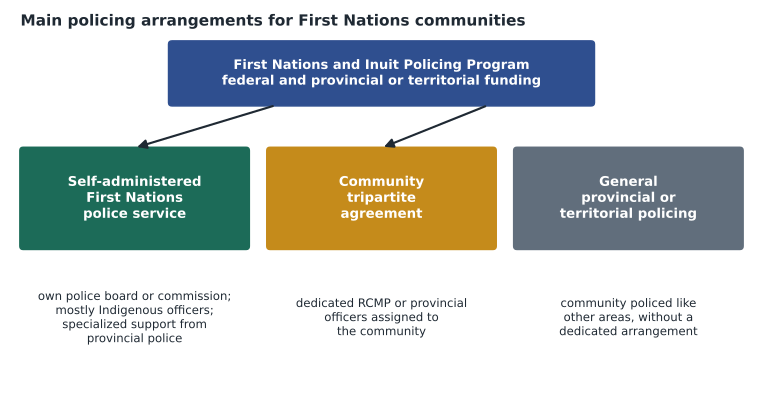
In Canada, policing of First Nations communities takes several forms. Under the First Nations and Inuit Policing Program, created by the federal government in 1991 and cost-shared with provinces and territories, communities can have a self-administered police service, governed by a police commission or board and staffed mostly by Indigenous officers, or a community tripartite agreement, under which the RCMP or a provincial service provides dedicated officers to the community. Many communities have neither and are policed under the general provincial arrangement. Self-administered services such as the Nishnawbe Aski Police Service, the Treaty Three Police Service and the Anishinabek Police Service in Ontario often police large areas with few officers and rely on the OPP for specialized support. For many years these services were funded as programs rather than as essential services, and some were not covered by provincial policing legislation. Ontario's Community Safety and Policing Act, 2019 allows First Nations to opt in to the provincial framework, and the federal government has worked on legislation to recognize First Nations policing as an essential service.
Indigenous people's rights also affect how officers act in many situations. Section 35 of the Constitution Act, 1982 recognizes and affirms existing Aboriginal and treaty rights, including rights to hunt, fish and gather that may apply even where general laws would otherwise prohibit the activity. Officers enforcing wildlife or fisheries laws must understand these rights. Section 718.2(e) of the Criminal Code, interpreted in R. v. Gladue (1999) and R. v. Ipeelee (2012), requires judges to consider the unique circumstances of Indigenous offenders at sentencing, and the same principles have been applied to bail. Police reports prepared for bail and sentencing should be accurate and fair, because they can influence those decisions.
Working across jurisdictions
Port Ardent borders Nimkii Bay First Nation, and the two services share calls along the road between them. Sergeant Keeshig describes the arrangements: a written protocol sets out which service responds to calls on reserve land and which off it, how the services back each other up, who investigates serious incidents and how information is shared. The Nimkii Bay service has 14 officers and relies on the OPP for major crime investigation, forensics and tactical support. He says the protocol works when officers on both sides know each other, and fails when a new officer treats Nimkii Bay as a place to drive through rather than a community with its own police and its own law.
Jesse asks what the biggest practical problem is. Keeshig says it is missing persons. When an Indigenous person is reported missing, families often report that police elsewhere delayed or dismissed the report, assuming the person had run away or was drinking. Clear policies requiring immediate investigation, regardless of the person's background, and good communication between services are essential.
# Missing person reports in the region around Port Ardent, 2025
reports = 310
indigenous_reports = 41
indigenous_population_share = 0.04
share = indigenous_reports / reports
print("share of reports involving Indigenous people:", round(share, 3))
print("compared with population share:", indigenous_population_share,
"ratio:", round(share / indigenous_population_share, 1))share of reports involving Indigenous people: 0.132 compared with population share: 0.04 ratio: 3.3
Indigenous people were the subject of about 0.132 of missing person reports, compared with about 0.04 of the regional population, a ratio of 3.3. Desjardins says the numbers matter for two reasons. They show that the region's missing persons work is, to a large extent, work with Indigenous families, so officers must be ready to do it well. And they are probably an undercount, because research has found that some missing Indigenous people are never reported to police at all, often because families do not expect a useful response.
Practical skills
Elder Shawanda and Sergeant Keeshig give the class practical advice.
- Learn about the specific community. Indigenous nations differ in language, culture, governance and history. Ask, and do not assume that what you know about one applies to another.
- Know who to contact. Many communities have Elders, band or tribal council members, health and social services staff, and community safety workers who can help officers understand a situation and reach people.
- Take reports seriously. Treat every report of a missing or harmed Indigenous person as urgent and investigate it fully from the start.
- Respect ceremony and sacred items. Items such as medicine bundles, eagle feathers and pipes are sacred; when a search is necessary, ask the person how they would like the item handled or allow them or an Elder to handle it.
- Communicate patiently. Some people take time before answering and may avoid direct eye contact as a sign of respect. Silence is not evasion.
- Remember trauma. Many Indigenous people have personal and family experience of trauma connected to state institutions. A calm, explained approach reduces fear.
Many services now provide Indigenous cultural training developed with Indigenous communities, and the TRC and the National Inquiry both called for training to be meaningful, ongoing and led by Indigenous people. Officers can also learn from Indigenous-led approaches to justice, such as community justice committees and restorative justice circles, which many First Nations use and which police can refer cases to.
Urban Indigenous communities
Most Indigenous people live in cities, not in their home communities, and urban officers will work with Indigenous people far more often than they may realize. Port Ardent has a Friendship Centre, part of a national network that provides services to urban Indigenous people, and Constable Ferreira meets its staff regularly. Desjardins says that many urban Indigenous people have complex connections to home communities, may have moved for school, work or services, and may face the same barriers as other marginalized groups, as well as racism specific to them. He says officers should know the local organizations, learn whether a person wants their home community or family contacted, and never assume that an Indigenous person in a city is in trouble because they are Indigenous.
Restorative approaches and community justice
Elder Shawanda tells the class that many Indigenous traditions understand harm as damage to relationships, and justice as the work of repairing them. That understanding has influenced restorative justice, which brings together the person who caused harm, the person harmed and the community to talk about what happened, its effects and what should be done. Police can play a role by referring suitable cases, with the consent of the people involved, to restorative programs instead of, or alongside, the court process. In Ontario, police can refer young people to extrajudicial measures under the Youth Criminal Justice Act, and many Indigenous communities and Friendship Centres run community justice programs that accept referrals for adults as well.
Sergeant Keeshig says that such programs are not a soft option. Facing the people you harmed, in front of Elders and family, is often harder than facing a judge. But they are more likely to change behaviour and to repair relationships, and they give communities a role in justice that colonial systems took away. He asks the students, when they become officers, to learn which programs exist in their area and to use them. He also asks them to remember that victims must be safe and must consent, and that restorative approaches are not suitable for every case, particularly some cases of intimate partner violence, where the power imbalance between the parties can make a face-to-face process dangerous.
Worked problem
A missing person report
At 21:00 on a Friday, a woman calls Port Ardent police to report that her 17-year-old niece, who is from Nimkii Bay First Nation and living with her in Port Ardent to attend high school, did not come home after school and is not answering her phone. The niece has stayed out late twice before without telling anyone. The call-taker asks whether the report can wait until morning. What should happen?
Show solution
- Treat the report as urgent: she is a youth, and policy and the lessons of past failures require immediate action regardless of past behaviour.
- Take a full report now, including recent photos, friends, social media, places she goes and any concerns about exploitation or harm.
- Notify the Nimkii Bay service in case she has gone home or contacted family there.
- Begin checks: phone location through the proper legal process, friends, school contacts and the places she visits.
- Keep the aunt informed of what is being done, and record every step and its timing.
Answer: Take the report immediately and investigate it as urgent, involve her home community's police and family, use proper legal processes for location data, and keep the aunt informed.
Common mistakes
MistakeIndigenous peoples are one group with one culture.
InsteadNations differ in language, culture, governance and history.
MistakeHistory is irrelevant to an officer who did not take part in it.
InsteadHistory shapes how people perceive police today; understanding it improves encounters.
MistakeA missing Indigenous youth who has stayed out before can wait until morning.
InsteadMissing person reports must be investigated promptly regardless of the person's background.
MistakeSacred items are just personal property to be searched like any other.
InsteadAsk the person how they wish the item handled, or allow them or an Elder to handle it, when a search is necessary.
Summary and key terms
- Police helped enforce colonial policies including the pass system and residential school attendance.
- The TRC (2015) and the National Inquiry into MMIWG (2019) issued calls directed at police.
- First Nations policing includes self-administered services and tripartite agreements under the First Nations and Inuit Policing Program.
- In Port Ardent's region, Indigenous people were the subject of about 0.132 of missing person reports, about 3.3 times their population share.
- Learn the specific community, take reports seriously, respect sacred items and communicate patiently.
- Most Indigenous people live in cities; urban officers need local relationships too.
- Self-administered police service
- A First Nations police service governed by its own commission or board.
- Community tripartite agreement
- An agreement under which the RCMP or a provincial service provides dedicated officers to a First Nation.
- Section 35
- The section of the Constitution Act, 1982 that recognizes and affirms Aboriginal and treaty rights.
- Gladue principles
- The requirement to consider the unique circumstances of Indigenous people at sentencing and bail.
- Calls for Justice
- The 231 recommendations of the National Inquiry into Missing and Murdered Indigenous Women and Girls.
- Starlight tours
- The practice, examined in Saskatoon, of police driving Indigenous people to the city outskirts and leaving them.
Practice problems
Work each problem on paper first, then reveal the answer to check.
What are the two main arrangements funded by the First Nations and Inuit Policing Program?
Show answer
Self-administered First Nations police services and community tripartite agreements.
In the code example, what was the ratio of the share of missing person reports to the population share?
Show answer
About 0.132 divided by 0.04, or 3.3.
Why might the missing person figures be an undercount?
Show answer
Some families do not report to police because they do not expect a useful response.
How should an officer handle a sacred item during a necessary search?
Show answer
Ask the person how they wish it handled, or allow them or an Elder to handle it.
Lesson quiz · 5 questions
Score 60% or more to complete this lesson.
Create a free account to save your progress, take quizzes and earn a certificate.