
LES-113 · Lesson 9 of 12 · 19 min
Policing with marginalized communities: poverty, homelessness, disability and LGBTQ+ people
▶ Video coming soon A video version of this lesson is on the way.
The ninth class meets not in the classroom but at Harbor House, the men's shelter two blocks from Eastgate Park. Its director, Tom Okonkwo, gives the students a tour and then sits with them in the dining room. He tells them that the men who stay there have more contact with the police than almost anyone else in the city, and that almost none of it is because they committed a serious crime. 'They're moved along, ticketed, woken up, searched, taken to hospital, taken to cells,' he says. 'Some officers know them by name and treat them like neighbors. Some treat them like garbage. The men know which is which, and so do I.'
What marginalization means
Marginalized communities are groups pushed to the edges of social, economic and political life, with less power, fewer resources and less voice in decisions that affect them. Poverty, homelessness, disability, mental illness, addiction, sexual orientation and gender identity, race and immigration status can all be sources of marginalization, and many people experience several at once. A person may be Indigenous, homeless and living with a disability, and each part of that experience shapes how they encounter the police. Researchers use the term intersectionality to describe how these overlapping identities combine to create distinct experiences.
Marginalized people are often both over-policed and under-protected. They are over-policed because their lives are lived in public, their behavior is more visible, and some laws, such as those against sleeping or drinking in public spaces, fall mainly on them. They are under-protected because they are victimized at high rates but are less likely to report, less likely to be believed when they do, and less likely to see offenders held accountable. Desjardins says that recognizing both halves is the starting point for fair policing of these communities.
Poverty and homelessness
Homelessness has become more visible in many cities in recent years, including in encampments in parks and public spaces. Police are often called by residents and businesses who want encampments removed, and by service providers who want help with safety. The legal framework for responding has been shaped by the courts. In the United States, the Ninth Circuit held in Martin v. City of Boise (2018) that punishing people for sleeping outside when no shelter was available violated the Eighth Amendment, but in City of Grants Pass v. Johnson (2024) the Supreme Court reversed that approach, holding that enforcing public camping bans does not violate the Eighth Amendment's ban on cruel and unusual punishment. States and cities now have wide discretion, and responses vary greatly from place to place.
Whatever the law allows, enforcement alone rarely solves homelessness. Moving people from one place to another often means they lose belongings, identification and medication, lose contact with outreach workers and end up in another public space. Research on encampment responses suggests that the most effective approaches combine outreach, offers of housing or shelter that people can actually accept, storage for belongings and coordination between police, outreach workers and housing services. Police have an important role in safety, in responding to crimes against and by people experiencing homelessness, and in connecting people to services, but they are rarely the right lead agency.
Okonkwo gives the class practical advice. Learn people's names. Explain what you are doing and why. If you are asking someone to move, tell them where they can go and when. Do not throw away belongings without warning, because a bag may hold someone's identification, medication or the last photographs of their children. Remember that many people experiencing homelessness are victims of assault and theft, and take their reports seriously. And know the outreach workers: one call to the right person can solve a problem that a ticket never will.
Data from Eastgate Park
Officer Ferreira has tracked the outcomes of calls involving people experiencing homelessness in and near Eastgate Park since the community response unit began working with outreach staff.
# Outcomes of calls involving people experiencing homelessness near Eastgate Park, 2025
outcomes = {"connected to outreach or shelter": 164, "taken to hospital": 47,
            "advised or moved along, no further action": 98, "ticket or bylaw charge": 21,
            "arrest": 30}
total = sum(outcomes.values())
helped = outcomes["connected to outreach or shelter"] + outcomes["taken to hospital"]
enforced = outcomes["ticket or bylaw charge"] + outcomes["arrest"]
print("calls:", total)
print("connected to help:", helped, round(helped / total, 2))
print("enforcement outcomes:", enforced, round(enforced / total, 2))calls: 360 connected to help: 211 0.59 enforcement outcomes: 51 0.14
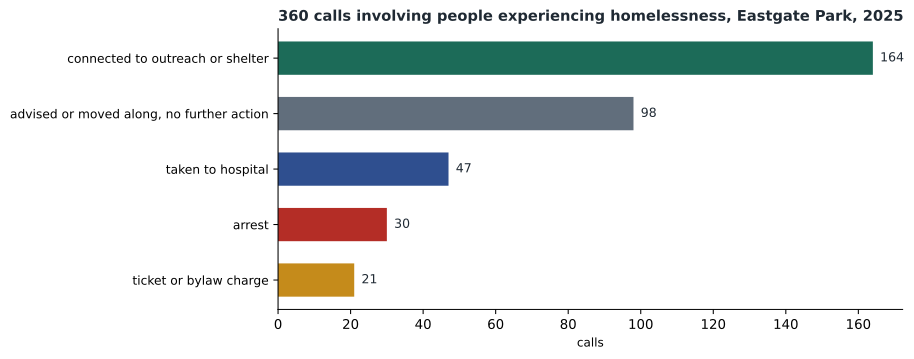
Of 360 calls, 0.59 ended with the person connected to outreach, shelter or hospital, and 0.14 ended in a ticket or arrest. The arrests were mostly for assaults, thefts and warrants, not for being homeless. Ferreira says the number she wants to bring down is the 98 calls that ended with someone simply being moved along, because those are calls where nothing changed. She is working with the outreach team on a protocol under which officers will call an outreach worker before moving anyone who is not committing an offense.
People with disabilities
People with disabilities include those with physical, sensory, intellectual, developmental and psychiatric disabilities, and disability affects police encounters in many ways. A deaf person may not hear commands. A person with autism may not respond to questions as expected, may avoid eye contact, may repeat words or may become distressed by lights, sirens or touch. A person with an intellectual disability may agree to things they do not understand, which matters for consent searches and for interviews. A person with cerebral palsy may be mistaken for someone who is intoxicated. In each case, behavior that an officer might read as noncompliance, evasion or impairment may be a feature of the disability.
Title II of the Americans with Disabilities Act applies to state and local governments, including police, and requires reasonable modifications to policies and practices to avoid discrimination against people with disabilities. Courts have applied it to arrests and interviews, though in City and County of San Francisco v. Sheehan (2015) the Supreme Court left open exactly how it applies when officers face a dangerous situation. Deaf and hard of hearing people are entitled to effective communication, which often means a qualified sign language interpreter. Practical steps include asking whether the person has a disability or needs an accommodation, speaking clearly and simply, allowing extra time, reducing noise and light where possible, avoiding touch unless necessary and explaining it first, using a qualified sign language interpreter for deaf people, and involving a support person or caregiver when appropriate. Some communities offer voluntary registries where families can share information about a person with a disability, such as their communication needs and calming strategies, so that responding officers can see it.
Mental illness and addiction are covered in depth in LES-114, the next course. Desjardins notes here only that people with mental illness are far more likely to be victims of violence than perpetrators, and that many of the calls involving them are calls for help, not reports of crime.
LGBTQ+ communities
Lesbian, gay, bisexual, transgender, queer and other sexual and gender minority people, often abbreviated LGBTQ+, have a complicated history with police in the United States. Police regularly raided gay bars, and the 1969 police raid on the Stonewall Inn in New York City led to days of protest that became a turning point in the gay rights movement. Laws criminalizing sex between people of the same sex were enforced in many states until the Supreme Court struck them down in Lawrence v. Texas (2003). In Bostock v. Clayton County (2020), the Court held that firing someone for being gay or transgender is sex discrimination under federal employment law. Transgender people, especially transgender women of color, report high rates of violence and of negative encounters with police.
Today, police services in both countries have liaison officers for these communities, and many officers are themselves members of them. But relationships remain strained in some places. Debates about whether uniformed officers should march in Pride parades reflect deep differences of view within the communities themselves. For officers, the practical points are straightforward. Use the name and pronouns a person uses for themselves. Follow your service's policy on searches of transgender and non-binary people, which usually allows the person to say whether they prefer an officer of a particular gender to conduct the search. Take reports of hate-motivated crimes seriously and record the motivation. And recognize that a person reporting intimate partner violence in a same-sex relationship needs the same response as anyone else.
Common threads
Desjardins draws the threads together. Marginalized people are more likely to be victims and less likely to report. They often have the most contact with police and the least power in those encounters. Their behavior may be misread because of disability, culture, trauma or circumstance. They are frequently better served by other agencies, with police in a supporting role. And they judge the police by the same standards as everyone else: voice, neutrality, respect and trustworthy motives. An officer who treats a man sleeping in a doorway with the same courtesy they would show a homeowner is practicing every principle in this course.
Marco asks whether officers have time to do all of this on a busy shift. Okonkwo answers before Desjardins can: 'Learning someone's name takes three seconds. Calling the outreach worker takes one minute. Coming back to the same doorway every night for a year because nothing changed takes a lot longer.'
Sex workers and people who use drugs
Okonkwo adds two groups that he says police often overlook as victims. Sex workers face high rates of violence, and in most states both selling and buying sexual services remain crimes. Many sex workers do not report violence because they fear arrest, eviction or the loss of their children, and violent offenders know that. People who use drugs face similar barriers. Most states, including Ohio, have Good Samaritan laws that protect people who call for help at an overdose from some drug charges, to encourage calls. Officers who know these protections and explain them can save lives, and officers who treat reports of violence against sex workers and people who use drugs as seriously as any other report can help stop offenders who target the people least likely to come forward.
Worked problem
A call to a bank vestibule
At 06:15 on a January morning, a bank manager calls police because a man is asleep in the bank's vestibule and customers will arrive at 07:00. When Officer Malhotra arrives, the man, who is in his fifties, wakes slowly, speaks with slurred words and has difficulty standing. He says his name is Gerald and that he usually sleeps at Harbor House, but it was full. How should Malhotra handle the call?
Show solution
- Check Gerald's health first: slurred speech and difficulty standing may be intoxication, but they may also be a medical problem such as hypothermia, a stroke or low blood sugar.
- Speak calmly, use his name and explain why Malhotra is there.
- If there is any medical concern, call paramedics rather than assuming intoxication.
- If he is well enough, help him gather his belongings and connect him with outreach or another shelter, calling ahead.
- Tell the manager what was done, and record the call, including any referral, so that the outreach team can follow up.
Answer: Treat it first as a possible medical call, use his name and explain, call paramedics if needed, help him leave with his belongings to a place he can go, and record the referral.
Common mistakes
MistakeMarginalized people come into contact with police mainly because they commit crimes.
InsteadMuch contact arises from visibility, public-space laws and calls for help; they are often victims.
MistakeMoving homeless people along solves the problem.
InsteadIt usually moves the problem and can separate people from services; coordination with outreach works better.
MistakeA person who does not follow commands is resisting.
InsteadDisability, deafness or distress may explain the behavior; check before escalating.
MistakeUsing a person's chosen name and pronouns is a matter of politeness only.
InsteadIt is a matter of respect and often of service policy and human rights law.
Summary and key terms
- Marginalized people are often both over-policed and under-protected.
- Grants Pass (2024) held that camping bans do not violate the Eighth Amendment, leaving wide discretion to states and cities.
- Enforcement alone rarely solves homelessness; outreach, housing and coordination are more effective.
- In Eastgate Park, 0.59 of calls involving people experiencing homelessness ended with a connection to help and 0.14 with a ticket or arrest.
- Disabilities can be mistaken for noncompliance or impairment; accommodation is a legal duty.
- LGBTQ+ communities have a history of hostile policing; respect for names, pronouns and safe search practices matters.
- Marginalization
- Being pushed to the edges of social, economic and political life.
- Intersectionality
- The way overlapping identities combine to shape distinct experiences.
- Encampment
- A group of people living in tents or makeshift shelters in a public space.
- Reasonable modification
- A change to a policy or practice required by the ADA to avoid discrimination against a person with a disability.
- Vulnerable persons registry
- A voluntary database where families share information about a person with a disability for responding officers.
- LGBTQ+
- Lesbian, gay, bisexual, transgender, queer and additional sexual and gender minority people.
Practice problems
Work each problem on paper first, then reveal the answer to check.
What does it mean that marginalized people are over-policed and under-protected?
Show answer
They have more enforcement contact but are victimized often and less likely to be believed or protected.
What did City of Grants Pass v. Johnson (2024) decide?
Show answer
Enforcing public camping bans does not violate the Eighth Amendment.
In the code example, what share of calls ended with a connection to help?
Show answer
211 of 360, about 0.59.
Why might a deaf person not follow an officer's commands?
Show answer
They may not hear them; officers should check for disability and use effective communication.
Lesson quiz · 5 questions
Score 60% or more to complete this lesson.
Create a free account to save your progress, take quizzes and earn a certificate.