
LES-113 · Lesson 2 of 12 · 19 min
Problem-oriented policing and the SARA model
▶ Video coming soon A video version of this lesson is on the way.
Desjardins opens the second class with a question. 'In 2023, Port Ardent police went to the Northgate Plaza 214 times. Fights in the parking lot, shoplifting, a man sleeping in the bank vestibule, cars racing at night, a break-in at the pharmacy, noise complaints from the apartments behind it. Every one of those calls was handled. Officers arrived, sorted it out and cleared. So was the plaza being policed well?' Amara Okafor says yes, because every call got a response. Marco DiSanto says no, because the calls kept coming. Desjardins says that the difference between those two answers is the subject of today's lesson.
From incidents to problems
Herman Goldstein, a law professor at the University of Wisconsin who had worked with the Chicago police, argued in 1979 that police had become preoccupied with means, such as staffing, response times and procedures, rather than ends, the problems the public wanted solved. He called the result the 'means over ends' syndrome. In his 1990 book Problem-Oriented Policing, he set out an alternative: police should group incidents into problems, study those problems in depth, develop responses tailored to their causes, using any lawful tool, not only arrest, and evaluate whether the responses worked.
A problem, in this sense, is a recurring set of related harmful events in a community that members of the public expect the police to address. That definition has four parts that officers can test: the events recur; they are related by place, time, offender, victim or behavior; they cause harm; and the public expects police to do something. A single serious crime is not a problem in this sense, though it may be part of one. A string of break-ins at the same type of business, a corner where fights happen every weekend night and a park where people stop taking their children because of discarded needles are problems.
Problem-oriented policing is related to community policing but not the same. Community policing emphasizes partnership and the relationship with residents. Problem-oriented policing emphasizes analysis and tailored responses. The best practice combines them: partners help define the problem and carry out the response, and analysis keeps everyone honest about whether it works.
The SARA model
In 1987 John Eck and William Spelman, working with the police department in Newport News, Virginia, described a four-step process that turned Goldstein's ideas into a working method. It is known by its initials: scanning, analysis, response and assessment.
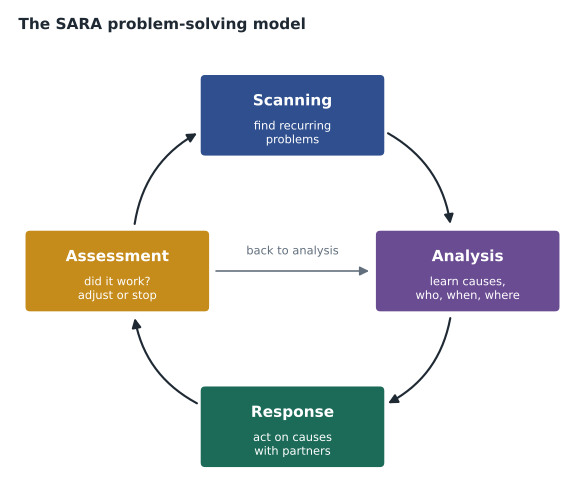
- Scanning means identifying recurring problems and choosing which to work on. Sources include call data, crime data, complaints, officer knowledge and what residents say at meetings and on the street.
- Analysis means learning as much as possible about the problem: who is involved, when and where it happens, what conditions make it possible and what has been tried before. It is the step most often skipped and the one that makes the biggest difference.
- Response means choosing and carrying out actions aimed at the causes identified in analysis, often with partners. Responses can include enforcement, but also changes to places, management practices, services and rules.
- Assessment means checking whether the response worked, using the same measures used in scanning and analysis, and deciding whether to continue, adjust or stop.
The COPS Office and the Center for Problem-Oriented Policing, now hosted by Arizona State University, publish problem-specific guides and response guides based on SARA, and the Herman Goldstein Award recognizes outstanding problem-oriented projects each year.
Analysis: the problem analysis triangle
Much problem analysis draws on routine activity theory, set out by Lawrence Cohen and Marcus Felson in 1979. They argued that a crime occurs when a likely offender and a suitable target come together in the same place at the same time, without a capable guardian present. The problem analysis triangle, also called the crime triangle, puts that idea in a form officers can use. The inner triangle has three sides: offender, target or victim, and place. The outer triangle names the people who can control each side: handlers, who have influence over offenders, such as parents, coaches or probation officers; guardians, who protect targets, such as neighbors, security staff or friends; and managers, who control places, such as property owners, landlords and business managers.
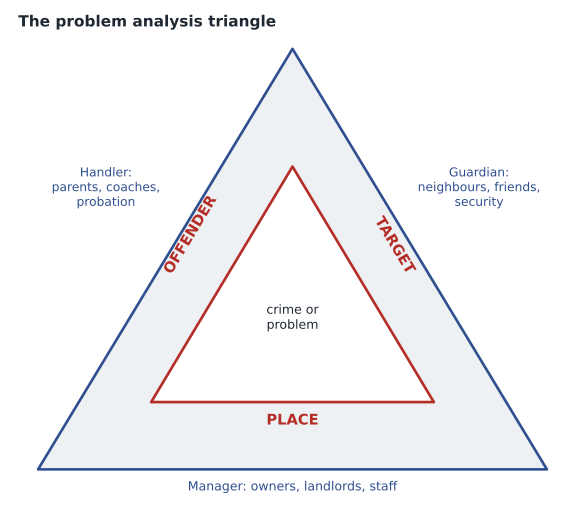
The triangle is useful because it suggests responses beyond arrest. If a problem persists because a place is badly managed, the most effective response may be persuading or requiring the owner to manage it better. If a target is repeatedly victimized, protecting that target may prevent more crime than catching any single offender. Research on repeat victimization supports this: a small share of victims, places and offenders accounts for a large share of incidents, so concentrating effort where problems repeat has a large effect.
The Northgate Plaza project
In early 2024, the community response unit took on Northgate Plaza. Officer Grace Ferreira, then a new member of the unit, led the analysis, and Desjardins, as the unit's last supervisor before retiring, signed off on the plan. Scanning was easy: the plaza had more calls than any other commercial property in the city. Analysis took two months. Ferreira read every call record for 2023, sat in the plaza on different days and nights, met each business owner, the property management company, residents of the apartment buildings behind the plaza and staff at the drop-in center two blocks away, and asked the call-takers what they heard.
The analysis found that the 214 calls were not one problem but four. About a third were fights and disturbances in the parking lot between 23:00 and 02:00 on weekends, linked to a bar that had changed its closing routine so that patrons spilled into the lot at once. About a quarter were shoplifting at a discount store whose layout put high-value goods near an unstaffed exit. A smaller group involved two or three men sleeping in the bank's vestibule in winter, who had nowhere else to go after the drop-in closed at 20:00. The rest were car meets and racing in the large, empty lot after midnight, made easy by the absence of lighting or barriers at the back.
The responses followed the analysis. The bar agreed to stagger its closing and post staff in the lot, after a meeting that included the liquor licensing inspector. The discount store moved goods and staffed the exit, with advice from the unit on layout. The drop-in center, with city funding obtained by a councillor who had attended a plaza meeting, extended its winter hours and added outreach, and the bank agreed to call outreach workers rather than police for people sleeping in the vestibule. The property manager installed lighting and a gate at the back of the lot. Officers continued to respond to calls and made arrests where needed, but enforcement was one response among several.
# Calls for service to Northgate Plaza and to the four blocks around it
years = [2023, 2024, 2025]
plaza = [214, 151, 96]
nearby = [140, 138, 131]   # checks whether the problem simply moved
for y, p, n in zip(years, plaza, nearby):
    print(y, "plaza", p, "nearby", n)
drop = (plaza[0] - plaza[2]) / plaza[0]
nearby_change = (nearby[2] - nearby[0]) / nearby[0]
print("plaza change 2023 to 2025:", round(-drop, 2))
print("nearby change 2023 to 2025:", round(nearby_change, 2))2023 plaza 214 nearby 140 2024 plaza 151 nearby 138 2025 plaza 96 nearby 131 plaza change 2023 to 2025: -0.55 nearby change 2023 to 2025: -0.06
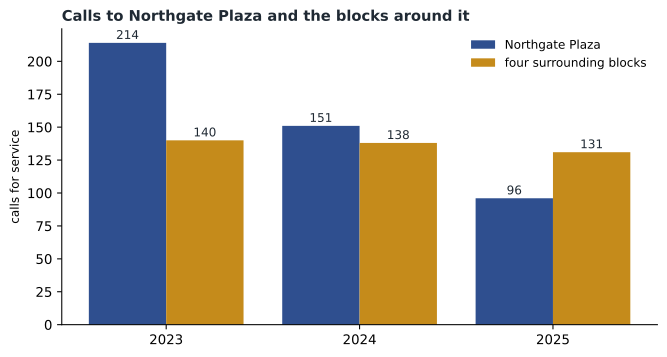
Assessment compared the plaza with itself over time and with the blocks around it. Plaza calls fell from 214 in 2023 to 96 in 2025, a drop of 0.55 of the starting level. Calls to the four surrounding blocks fell slightly, from 140 to 131, which suggests that the problem did not simply move next door. Desjardins points out the limits of the assessment: there was no comparison plaza elsewhere in the city, two years is a short period, and some changes, such as the drop-in's new hours, also affected other places. But the pattern was strong enough that the city asked the unit to run the same process for two other commercial strips.
Displacement and diffusion
A common objection to place-based work is that crime will just move around the corner. Research has looked hard at this. Reviews of situational and place-based interventions, including one by Rob Guerette and Kate Bowers in 2009, found that displacement does occur sometimes but is usually much smaller than the reduction at the target place, and that the opposite effect, called diffusion of benefits, is at least as common: nearby areas also improve, because offenders are not sure where the response stops or because the improvement changes the wider area. That is why the Northgate assessment counted calls in the surrounding blocks. Officers should always check, because the result can go either way.
Common pitfalls
Desjardins lists the ways problem-solving projects fail. The first is skipping analysis and going straight from scanning to a favorite response, often a crackdown. The second is defining the problem too broadly, such as 'drugs in Eastgate', which is too big to analyze or solve, rather than 'needles discarded near the playground in Eastgate Park in the mornings'. The third is relying only on enforcement, which can suppress a problem while officers are present but rarely changes the conditions behind it. The fourth is failing to assess, so that no one knows whether the work made a difference. The fifth is losing the project when the officer who led it is transferred, which is why written plans and partner ownership matter.
Priya Sandhu says the pitfalls sound like the projects she saw at the bank, where people jumped to solutions before they understood the fraud pattern. Desjardins agrees and says that analysis is a skill officers can learn, with help from crime analysts. He asks Linh, who has said she may want to become an analyst, to keep that in mind.
Worked problem
Scanning and defining a problem
Officer Ferreira's monthly report shows 38 calls in three months to Eastgate Park, on the edge of the Eastgate neighborhood: 14 about youths on bikes harassing people near the basketball court in the late afternoon, 11 about discarded needles near the playground, 8 about noise and drinking after dark, and 5 others. A resident at a community meeting says that parents have stopped using the playground. How should Ferreira define the problem or problems to work on?
Show solution
- Group the calls by behavior, place and time; the data suggest at least three different problems, not one.
- Check each against the definition of a problem: recurring, related, harmful and expected to be addressed by police.
- Prioritize by harm and by what residents say; the needles near the playground affect children's safety and are why parents have stopped coming.
- Write each problem narrowly enough to analyze: for example, 'needles discarded near the playground, mostly found in the morning'.
- Plan analysis for the chosen problem: where and when needles are found, who uses the area at night, what services exist nearby and who manages the park.
Answer: Define three separate problems and start with the needles near the playground, written narrowly enough to analyze, with a plan to learn who, when and why before choosing responses.
Common mistakes
MistakeProblem-oriented policing means more enforcement in hot spots.
InsteadIt means analysis and tailored responses; enforcement is only one possible response.
MistakeThe faster you respond, the better you have dealt with a problem.
InsteadResponse handles an incident; problem solving addresses why incidents keep happening.
MistakeAnalysis can be skipped if officers already know the area.
InsteadAnalysis often reveals that one apparent problem is several, each with different causes.
MistakePlace-based work just moves crime around the corner.
InsteadDisplacement is usually smaller than the reduction, and diffusion of benefits is common.
Summary and key terms
- Goldstein argued that police should focus on ends, the problems behind repeat incidents, not just on means.
- A problem is a recurring set of related harmful events that the public expects police to address.
- SARA stands for scanning, analysis, response and assessment; analysis is the step most often skipped.
- The problem analysis triangle links offender, target and place with handlers, guardians and managers.
- Northgate Plaza calls fell from 214 to 96 after responses tailored to four separate problems, with no rise nearby.
- Displacement is usually smaller than the reduction achieved, and diffusion of benefits is common.
- Problem
- A recurring set of related harmful events that the public expects the police to address.
- SARA
- Scanning, analysis, response and assessment, a four-step problem-solving process.
- Center for Problem-Oriented Policing
- A research center that publishes problem-specific and response guides.
- Problem analysis triangle
- A tool linking offender, target and place with the handlers, guardians and managers who control them.
- Displacement
- The movement of crime to another place, time, target or method after a response.
- Diffusion of benefits
- Improvement spreading to places or times not directly targeted.
Practice problems
Work each problem on paper first, then reveal the answer to check.
What are the four parts of Goldstein's definition of a problem?
Show answer
The events recur, are related, cause harm, and the public expects police to address them.
Who are the controllers in the outer problem analysis triangle?
Show answer
Handlers of offenders, guardians of targets and managers of places.
In the code example, how much did plaza calls fall from 2023 to 2025?
Show answer
From 214 to 96, a fall of 118, or 0.55 of the starting level.
Why did the Northgate assessment count calls in the surrounding blocks?
Show answer
To check for displacement; calls nearby did not rise.
Lesson quiz · 5 questions
Score 60% or more to complete this lesson.
Create a free account to save your progress, take quizzes and earn a certificate.