
LES-113 · Lesson 5 of 12 · 20 min
Understanding bias: how it forms and how it affects decisions
▶ Video coming soon A video version of this lesson is on the way.
Desjardins starts the fifth class with an exercise. He shows a photograph for two seconds: a street at night, two men beside a car with its door open, one holding something. He asks the class to write down what is happening. Answers vary. Some write that a car is being broken into. Some write that a man is helping a friend who locked himself out. Some write that a man is handing another man a phone. The photograph, taken by a Port Ardent officer for training, shows a man passing his brother a phone charger. 'Every one of you filled in the gaps,' he says. 'That's what brains do. The question for a police officer is what you fill them in with, and whether you check before you act.'
What bias is
In everyday speech, bias means unfairness. In psychology, it has a broader meaning: a systematic tendency to favor one interpretation, judgment or group over another, often without awareness. Bias is not the same as prejudice, which is a negative attitude toward a group, or discrimination, which is unequal treatment. But bias can lead to discrimination, and in policing, where decisions are made quickly and affect people's liberty, that link matters a great deal.
Researchers distinguish between explicit and implicit bias. Explicit bias is conscious: a person knows they hold a belief or attitude and could report it, such as a belief that a particular group is more likely to commit crime. Implicit bias refers to associations that operate automatically and may differ from what a person consciously believes. A person who sincerely believes in equality may still, under time pressure, associate certain faces with threat more quickly than others. Most people hold some implicit associations that reflect the culture they grew up in, the media they consume and their personal experience.
Desjardins is careful about what the research on implicit bias does and does not show. The Implicit Association Test, a computer task developed by Anthony Greenwald, Debbie McGhee and Jordan Schwartz in 1998, measures how quickly people pair concepts and has been taken by millions of people. It reveals widespread associations at the group level. But studies have found that an individual's score varies from one test to the next and predicts their behavior only weakly. So the test is better at showing that associations are common in a population than at diagnosing any one person. The broader finding, that automatic associations exist and can influence fast decisions, is well supported by many kinds of studies.
How bias forms
Bias grows from ordinary mental processes. People sort the world into categories because it makes thinking efficient: a category such as 'dog' lets you predict how an animal will behave without studying it. Categories of people work the same way, which is useful when the predictions are accurate and harmful when they are not. Stereotypes are beliefs about the typical traits of a category. They are learned from family, peers, news, entertainment and experience, and they are reinforced when people notice cases that fit them and forget cases that do not.
Policing creates particular risks. Officers see a skewed sample of the population: much of their work involves people in conflict, in crisis or suspected of crime, and they see some neighborhoods far more than others. Experience in high-crime areas can lead officers to associate the residents of those areas, or groups that are concentrated there, with crime, even though most residents are not involved in crime at all. Training, war stories and briefings can reinforce those associations. Desjardins says that after ten years on patrol in Eastgate he caught himself assuming that any young man on a bike at night was up to something, until his own nephew, visiting from out of town, was stopped by a colleague for exactly that.
Cognitive shortcuts that affect police decisions
Bias is one part of a wider set of thinking errors. Desjardins lists the ones he sees most often in reviews of Port Ardent cases.
- Confirmation bias: looking for and giving more weight to information that supports a first impression, and discounting information that does not. In investigations, it can lead to tunnel vision, where officers focus on one suspect and miss evidence pointing elsewhere.
- Anchoring: relying too heavily on the first piece of information received, such as a dispatcher's description, even after new information should change the picture.
- Availability: judging how likely something is by how easily examples come to mind, so that a recent or vivid incident distorts the assessment of risk.
- Attribution error: explaining other people's behavior by their character while explaining one's own by circumstances, so that a nervous driver seems guilty rather than frightened.
- In-group favouritism: giving more trust, patience and benefit of the doubt to people who seem similar to oneself.
Tunnel vision is a recurring factor in wrongful convictions. Studies of exonerations recorded by the National Registry of Exonerations and by the Innocence Project have found that investigators often focused early on one suspect and interpreted later evidence to fit, and that mistaken eyewitness identification, often influenced by suggestive procedures, is one of the most common contributing factors.
When bias matters most
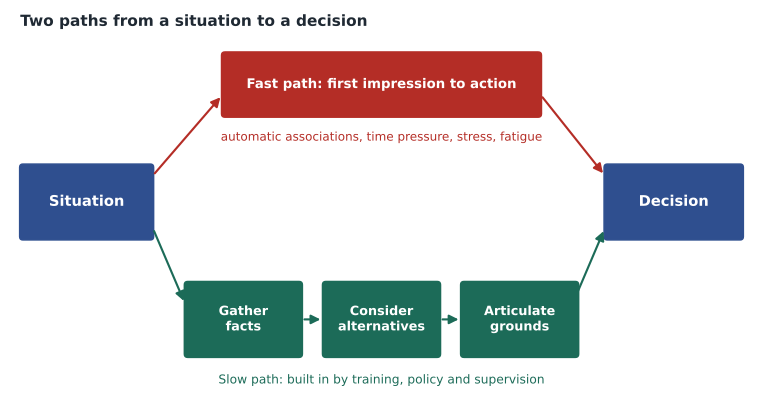
Bias is most likely to influence decisions when information is ambiguous, when time is short, when the decision-maker is stressed, tired or distracted, and when there is wide discretion with little review. Those conditions describe much of patrol work. In studies using shooting simulations, research teams led by Joshua Correll and by Lois James have tested whether participants, including police officers, decide more quickly or differently when a target is Black or white. The results are mixed in revealing ways: civilians often show a bias in speed and errors, while trained officers in some studies show smaller biases in errors, and in some laboratory studies officers were slower to shoot armed Black suspects. The broad lesson that researchers draw is that training and experience can reduce the effect of automatic associations on split-second decisions, but that the conditions of real encounters are harder than any simulator.
Most police decisions are not split-second. They are decisions about whom to watch, whom to approach, whom to question, whose story to believe, whom to search and whom to arrest or release. These choices happen many times a day, with time to think, and small biases in them add up across thousands of encounters. Desjardins says that is where bias does its most damage: not in the dramatic moment, but in the ordinary decisions about who gets attention.
Measuring bias in outcomes: the outcome test
Because individuals rarely know whether their decisions are biased, services look for patterns in outcomes. One method is the outcome test, often called the hit-rate test, developed by economists including John Knowles, Nicola Persico and Petra Todd. It looks at searches. If officers search people from two groups using the same standard of suspicion, the share of searches that find contraband should be about the same for both. If searches of one group find contraband less often, that suggests officers are searching that group on weaker evidence, which is a sign of bias in the decision to search.
Desjardins shows the class the results of a Port Ardent internal audit of searches during traffic stops in one year, with the groups labeled A and B, as they were in the audit before the results were discussed with the community.
# Searches during Port Ardent traffic stops, one year (internal audit)
groups = {"group A": {"searches": 120, "found": 30},
          "group B": {"searches": 60, "found": 24}}
for g, d in groups.items():
    rate = d["found"] / d["searches"]
    print(g, "searches", d["searches"], "found contraband", d["found"], "hit rate", round(rate, 2))
a = groups["group A"]["found"] / groups["group A"]["searches"]
b = groups["group B"]["found"] / groups["group B"]["searches"]
print("difference in hit rates:", round(b - a, 2))group A searches 120 found contraband 30 hit rate 0.25 group B searches 60 found contraband 24 hit rate 0.4 difference in hit rates: 0.15
Searches of group A found contraband in 0.25 of cases, compared with 0.40 for group B. If both groups were searched on the same standard, the rates should be similar. The lower rate for group A suggests that officers searched people in that group on weaker grounds, and it means that many more people in group A were searched and found to have nothing. The test has limits: if the groups differ in how they hide contraband, or if officers search for different reasons, the comparison is less clean, and small numbers produce uncertain rates. But it avoids the hardest problem in measuring bias, which is knowing the true rate of offending in each group, because it looks only at people who were actually searched.
Bias is not only individual
Bias can also be built into systems. A policy that directs officers to stop as many people as possible in areas with high crime will produce more stops of the groups who live there, regardless of any individual's attitudes. A deployment model that sends officers where arrests were made last year can create a feedback loop: more officers in an area produce more recorded crime there, which justifies sending more officers. Data-driven tools trained on past arrests can inherit the patterns of past decisions. This is sometimes called systemic or institutional bias. Recognizing it does not mean that every officer is biased; it means that fair outcomes require attention to policies and systems as well as to individuals.
Marco says he has heard officers say that talk of systemic bias means calling every cop a racist. Desjardins answers that it means the opposite: if bias is partly in the system, then good officers following a bad policy can produce unfair results without intending to, and the fix is to change the policy. He says that understanding that is what lets officers and communities talk about the problem without each side becoming defensive.
Reducing the influence of bias
The evidence on what reduces bias in policing is still developing. Short training sessions that raise awareness of implicit bias have, on their own, shown limited effects on behavior. A large evaluation of implicit bias training in the New York City Police Department, published in 2020 by Robert Worden and colleagues, found that officers' knowledge and stated intentions improved, but found little change in the racial patterns of their stops, frisks and arrests afterwards. Approaches with more promise change the conditions under which decisions are made: clearer standards for when officers may stop and search, requirements to articulate and record grounds, supervision and review of patterns in each officer's decisions, slowing down encounters when safety allows, and holding services accountable for outcomes through published data.
For the individual officer, Desjardins offers practical habits. Pay attention to your first impression and ask what it is based on. Ask whether you would make the same decision if the person were of a different group. Look for information that would prove you wrong. Slow down when you can. Explain your grounds aloud and in writing, because if you cannot articulate them, you may not have them. And review your own patterns: an officer who looks at their own stop and search records may see things they would never notice one encounter at a time.
Worked problem
Checking a decision for bias
At 23:30 an officer on patrol in Eastgate sees two young men standing beside a parked car with its interior light on. One is leaning into the car. The officer feels sure something is wrong and starts to pull over. Using the habits from the lesson, what should the officer do in the next thirty seconds?
Show solution
- Name the first impression: two young men, at night, at a car. Ask what it is based on: the time, the place and the people, not any sign of forced entry.
- Look for information that would prove the impression wrong: is a window broken, is there a tool, does the car's owner appear to be one of them, is anyone watching for police?
- Ask whether the same scene with two middle-aged women would produce the same feeling.
- If there are no signs of an offense, a casual check-in or simply driving past may be enough; if there are signs, the officer has grounds to approach and should articulate them.
- Record the decision and the reasons either way.
Answer: Pause, test the impression against observable facts, ask whether it depends on who the people are, and act only on grounds the officer could articulate.
Common mistakes
MistakeBiased decisions come only from biased people.
InsteadAutomatic associations are common, and policies and systems can produce unfair outcomes without biased intent.
MistakeAn implicit bias test can tell whether an officer is biased.
InsteadIndividual scores vary and predict behavior weakly; the test shows group-level associations.
MistakeImplicit bias training solves the problem.
InsteadAwareness training alone has shown limited effect on behavior; standards, supervision and data matter more.
MistakeA lower search hit rate for a group means that group offends less.
InsteadIt suggests the group was searched on weaker grounds.
Summary and key terms
- Bias is a systematic tendency to favor one interpretation or group; it can lead to discrimination.
- Explicit bias is conscious; implicit associations operate automatically and are widespread.
- Police work exposes officers to a skewed sample of people and places, which can strengthen stereotypes.
- Confirmation bias, anchoring, availability, attribution error and in-group favouritism affect police decisions.
- The outcome test compares search hit rates: in the Port Ardent audit, 0.25 for group A and 0.40 for group B.
- Reducing bias depends more on standards, articulation, supervision and data than on awareness training alone.
- Bias
- A systematic tendency to favor one interpretation, judgment or group over another.
- Implicit bias
- Automatic associations that may differ from a person's conscious beliefs.
- Stereotype
- A belief about the typical traits of members of a group.
- Confirmation bias
- Favoring information that supports a first impression.
- Tunnel vision
- Focusing early on one suspect or explanation and interpreting evidence to fit.
- Outcome test
- Comparing search success rates across groups to detect differences in the standard used to search.
Practice problems
Work each problem on paper first, then reveal the answer to check.
What is the difference between explicit and implicit bias?
Show answer
Explicit bias is conscious and reportable; implicit associations operate automatically.
Why is the Implicit Association Test weak as a diagnostic tool for individuals?
Show answer
Scores vary between sessions and predict individual behavior only weakly.
In the code example, what were the hit rates?
Show answer
0.25 for group A and 0.40 for group B, a difference of 0.15.
What did the 2020 NYPD implicit bias training evaluation find?
Show answer
Knowledge improved but there was little change in racial patterns of enforcement.
Lesson quiz · 5 questions
Score 60% or more to complete this lesson.
Create a free account to save your progress, take quizzes and earn a certificate.