
IRW-110 · Lesson 6 of 12 · 22 min
Fall protection for connectors and decking crews
▶ Video coming soon A video version of this lesson is on the way.
Grace's first Tuesday toolbox talk after Shay started, on September 22, was about one thing: falls. She drew the Ashcroft frame on the whiteboard, three tiers of steel with floors about 14 ft apart, and marked where the connectors stood, where the decking crew would spread the deck, and where the open edges were. "Falls from height kill more ironworkers than anything else," she said. "Not cranes, not collapses. Falls. Every one of you has a harness. The question is what you tie it to, when, and what happens if you actually fall." This lesson covers the rules for fall protection on steel erection and the methods used to protect connectors and decking crews. The next lesson covers the equipment in detail.
Why falls are different on steel
On most construction sites, fall protection means guardrails around floor edges and openings, covers over holes, and harnesses for the jobs where guardrails cannot be used. Steel erection is harder. Until the steel is up, there are no floors to put guardrails on. Connectors stand on the top flange of a beam 6 to 12 in wide, or climb columns, to make connections. Decking crews work at a leading edge that moves forward with every sheet they lay. Anchor points above the worker are few, because the worker is usually at the highest level of steel. And the structure itself is not yet stable.
For all those reasons, fall protection on steel erection is planned before the steel arrives. The erection plan shows where workers will be, how each will be protected, where anchors and lifelines will go, and how a fallen worker will be rescued. The planning starts with a simple order of preference, often called the hierarchy of fall protection.
The hierarchy of fall protection
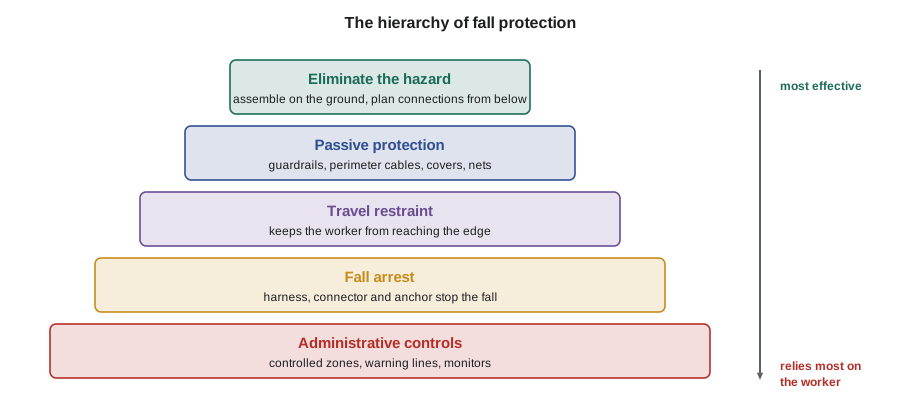
The best protection removes the fall hazard; the weakest relies on the worker doing everything right. In order of preference:
- Eliminate the hazard: assemble pieces on the ground and lift them as a unit, plan connections that can be made from a lift or from below, install perimeter cables or guardrails on members before they are raised.
- Prevent the fall with passive protection: guardrails, perimeter safety cables, covers over openings and safety nets, which protect everyone without the worker doing anything.
- Restrain the worker: a travel restraint system that keeps the worker from reaching an edge.
- Arrest the fall: a personal fall arrest system with a full body harness, connector and anchor, which stops a fall after it starts.
- Control the work: controlled access zones, warning lines and safety monitors, used only where the rules allow and the other methods are not practical.
When fall protection is required
OSHA's steel erection standard (29 CFR 1926 Subpart R) sets its own fall protection rules for steel erection work. Each worker on a walking or working surface with an unprotected side or edge more than 15 ft above a lower level must be protected by guardrails, safety nets, personal fall arrest, positioning devices or fall restraint. Two groups have special rules: connectors and workers in a controlled decking zone. Workers who are not steel erectors, and steel erection work that Subpart R does not cover, fall under the general fall protection rules of Subpart M, which use 6 ft as the trigger height in construction.
Crossbeam's own rule on every job is stricter than the minimum: 100 in 100 tie-off above 6 ft wherever a guardrail is not in place, connectors and deckers included, and no work at an unprotected edge without a plan. Many steel erectors use a similar rule.
Connectors
Connectors work at the top of the steel, guiding beams onto columns and making the first bolted connections. Their work is the hardest to protect, because they must move along beams and climb columns while loads swing nearby, and because the best anchor points are often the member they are connecting.
Under Subpart R, a connector working more than two stories or 30 ft above a lower level, whichever is less, must be protected by conventional fall protection. Between 15 ft and that height, the connector must wear a complete personal fall arrest system with the equipment needed to tie off, and must be able to tie off; Crossbeam requires them to do so. Connectors must also complete the specific connector training required by 29 CFR 1926.761, covering the nature of the hazards, how to connect safely and how to use their fall protection. Common methods of protection are beam clamps or beam straps on a member already bolted, self-retracting lifelines mounted on columns, horizontal lifelines installed on the beams before they are lifted, and connecting from aerial lifts where the ground allows.
Good practice for connectors includes:
- Tie off before stepping onto the member and stay tied off while moving, using a twin-leg lanyard or two connectors so that one is always attached.
- Never ride the load or stand on a beam that is not yet bolted at both ends.
- Stay out from under the load and out of its path; guide it with tag lines until it is close enough to reach safely.
- Make at least the minimum required bolts at each end, tightened by hand, before the crane releases the load.
- Climb columns using the column ladder, the attached climbing features or an aerial lift, with fall protection, never by shinnying.
Decking crews
Once a tier of beams is connected and bolted, the decking crew spreads bundles of metal deck across the beams and fastens it down. The leading edge, where the next sheet will go, moves forward as they work. Behind them, the deck is the floor; ahead of them is open steel.
Under Subpart R, a controlled decking zone (CDZ) may be used instead of conventional fall protection while metal deck is first being installed and forms the leading edge of a work area more than 15 ft and up to 30 ft above a lower level. A CDZ has strict limits: only workers trained in CDZ work who are doing leading-edge work may enter; the zone may be no more than 90 ft wide and 90 ft deep from any leading edge; no more than 3,000 square feet of unsecured deck may be in the zone; the boundary must be marked with control lines or an equivalent; safety deck attachments must run from the leading edge back to the control line, at least two per sheet; and final deck attachments and shear connectors may not be installed in the zone. Above 30 ft or two stories, conventional fall protection is required. Perimeter safety cables must be installed at the final interior and exterior perimeters of multi-story structures as soon as the deck is in place.
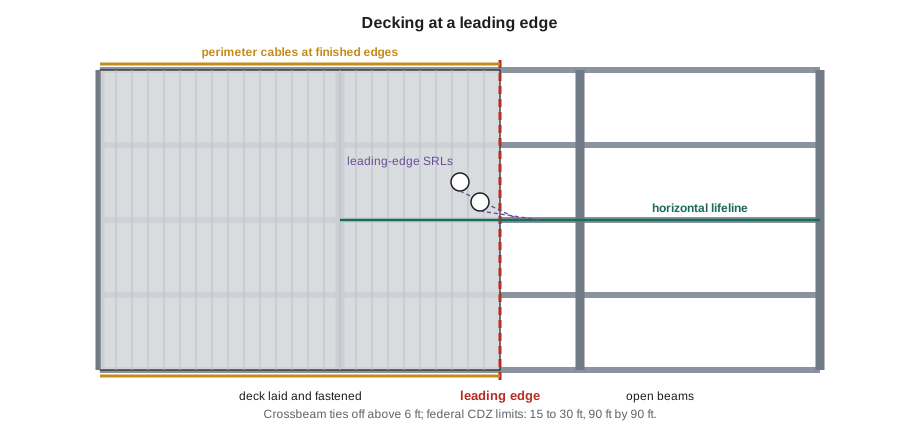
Deck is slippery when wet, frosty or oily, and sheets act like sails in wind. Deck bundles must be landed on beams strong enough to carry them, near a column or as the erection drawings show, and must not be broken open until the bundle is secured, because loose sheets blow off. Openings in the finished deck are covered or guarded right away and marked.
Other workers on steel
Bolt-up crews, welders and detailers follow the raising gang. They work on beams that are already connected, often from aerial lifts, floats or scaffolds, and sometimes on deck that is in place but has openings. Each needs fall protection as the height and the rules require. A worker who walks a beam to reach a connection is exposed exactly like a connector and must be tied off the same way.
Worked problem
Which rule applies?
At Ashcroft, the second-floor beams are 14 ft above the slab on grade, the third-floor beams 28 ft and the roof beams 42 ft. Shay is helping bolt from a boom lift at the second floor; Andy is connecting roof beams; Nate's crew is decking the third floor. What does Subpart R require for each, and what does Crossbeam add?
Show solution
- Shay at 14 ft: in a boom lift, the OSHA aerial lift rules require a harness and lanyard attached to the platform anchor regardless of height.
- Andy at 42 ft: above 30 ft, so as a connector he must use conventional fall protection.
- Nate at 28 ft: between 15 and 30 ft and not more than two stories, so a CDZ could be used; Crossbeam does not use CDZs and requires tie-off to a horizontal lifeline.
- Crossbeam: 100 in 100 tie-off above 6 ft for all three.
Answer: The federal minimums differ by job; Crossbeam treats them all the same, with tie-off above 6 ft.
Training
Subpart R requires training by a qualified person for every worker exposed to fall hazards in steel erection, covering the hazards, the fall protection systems used and how to use, inspect and maintain them, and the rescue procedures. Connectors and workers in a CDZ need additional, specific training. Shay completed an OSHA 10-hour construction course and Crossbeam's steel erection fall protection training on September 8 and 9, 2026, and he will do connector training later in his apprenticeship.
Training is not a one-time event. At Crossbeam, every new job starts with a site-specific orientation that walks through the fall protection plan, the anchors and the rescue procedure, and the Tuesday toolbox talks return to falls every few weeks.
Planning fall protection for a job
At Crossbeam, every erection job has a written fall protection plan, prepared before the steel is delivered and reviewed with the crew at the site orientation. The Ashcroft plan was eight pages and a set of marked-up erection drawings. It showed, for each stage of erection:
- Where workers would be exposed to falls: column tops, beam lines, the leading edge of the deck, the perimeter and openings.
- The protection for each: column-mounted SRLs fixed on the ground before each column was lifted, beam clamps on bolted beams, a horizontal lifeline along each girder line for the decking crew, boom lifts for bolt-up, and perimeter cables installed on each floor as soon as the deck was down.
- The anchors to be used and their ratings, and the engineered drawings for the horizontal lifelines.
- The clearance at each level and the connecting devices that would work there.
- The rescue method and equipment for each location (lesson 11).
- Who was responsible for installing, inspecting and removing each part, and when.
The plan was a living document. When the third-floor east side turned out to be beyond the reach of the boom lift because a utility trench had been opened, Carla changed the bolt-up method there to beam clamps and SRLs, changed the rescue method to the rescue kit, and briefed the crew before the work started.
Perimeter cables and guardrails
Perimeter cables are wire ropes strung around the edge of each floor, usually at the top rail and mid-rail heights of a guardrail, through holes or brackets in the columns. They protect the crews that follow the raising gang: the decking, detailing and bolt-up crews, then the other trades. Perimeter cables must be tensioned so they do not deflect too far when pushed, attached to columns strong enough to hold them, flagged for visibility, and inspected regularly. They are removed only when the permanent walls or guardrails replace them, and if they are taken down for a delivery or for the curtain wall installer, the opening is protected by other means before work continues there.
Perimeter safety cables in steel erection must meet the guardrail criteria of 29 CFR 1926.502: a top rail at about 42 in, a mid-rail, and the ability to withstand a force of at least 200 lb applied outward or downward at the top edge without deflecting below 39 in.
Covers and openings
Holes in the deck for stairs, shafts, ducts and plumbing are left by design, and holes are made later by other trades. Every hole a worker could fall through, or step into, must be covered or guarded. Covers must be strong enough for the loads that may cross them, secured so they cannot slide or be kicked off, and marked with a word such as HOLE or COVER. Never remove a cover without permission, and never leave a hole uncovered when you walk away, even for a minute.
Fall protection and the other trades
When Crossbeam finished each floor, the perimeter cables, covers and any horizontal lifelines left in place became the protection for everyone who followed. Equipment left for other trades must be inspected and accepted by the general contractor, who takes responsibility for it, and nobody may remove or alter it without permission. At Ashcroft, Priscilla Hahn walked each floor with Carla before Tallcorn accepted the perimeter cables, and any cable taken down for a delivery was put back, or the edge protected another way, before the area was reopened.
Common mistakes
MistakeTreating a harness as the first choice.
InsteadUse the hierarchy: eliminate the hazard and use passive protection first; fall arrest comes later.
MistakeWalking a beam untied to reach a connection.
InsteadAnyone on a beam is exposed like a connector and must be tied off.
MistakeBreaking open a deck bundle before it is secured.
InsteadSecure bundles before opening them; loose sheets blow off and fall.
MistakeAssuming the federal minimum is the rule on site.
InsteadFollow the site and employer rules, which are often stricter.
MistakeReleasing a beam before the minimum bolts are in.
InsteadInstall the required bolts at each end before the crane lets go.
MistakeLeaving an opening in new deck unmarked.
InsteadCover or guard every opening at once and mark it.
Summary and key terms
- Falls are the leading cause of death in ironwork; fall protection is planned before the steel arrives.
- The hierarchy: eliminate, passive protection, travel restraint, fall arrest, and administrative controls last.
- Subpart R requires protection above 15 ft, with special rules for connectors (conventional protection above two stories or 30 ft) and controlled decking zones (15 to 30 ft, 90 ft by 90 ft, 3,000 square feet).
- Connectors and deckers use beam clamps, column-mounted SRLs, horizontal lifelines, aerial lifts and leading-edge SRLs.
- Perimeter cables or guardrails go up as soon as the deck is down; openings are covered at once.
- Subpart R requires fall protection training, with extra training for connectors and CDZ workers.
- Hierarchy of fall protection
- The order of preference for protecting workers from falls, from eliminating the hazard to administrative controls.
- Travel restraint system
- A system that keeps a worker from reaching an edge where a fall could happen.
- Fall arrest system
- A system that stops a worker after a fall has started.
- Leading edge
- The edge of a floor or deck that moves forward as work progresses.
- Perimeter safety cable
- Wire rope strung around the edge of a floor to act as a guardrail.
- Anchor point
- A secure point on the structure to which fall protection is attached.
- Horizontal lifeline
- A cable or rail between anchors that workers attach to and move along.
Practice problems
Work each problem on paper first, then reveal the answer to check.
Above what height does Subpart R require fall protection for steel erection in general?
Show answer
More than 15 ft.
Above what height must a connector use conventional fall protection under Subpart R?
Show answer
More than two stories or 30 ft, whichever is less.
What are the size limits of a controlled decking zone?
Show answer
No more than 90 ft wide and 90 ft deep from any leading edge, and no more than 3,000 square feet of unsecured deck.
May final deck attachments be made in a CDZ?
Show answer
No.
Name two ways to protect a connector.
Show answer
Beam clamp or strap on bolted steel; column-mounted SRL; horizontal lifeline on beams; connecting from an aerial lift.
Lesson quiz · 5 questions
Score 60% or more to complete this lesson.
Create a free account to save your progress, take quizzes and earn a certificate.