
IRW-110 · Lesson 5 of 12 · 23 min
Personal protective equipment
▶ Video coming soon A video version of this lesson is on the way.
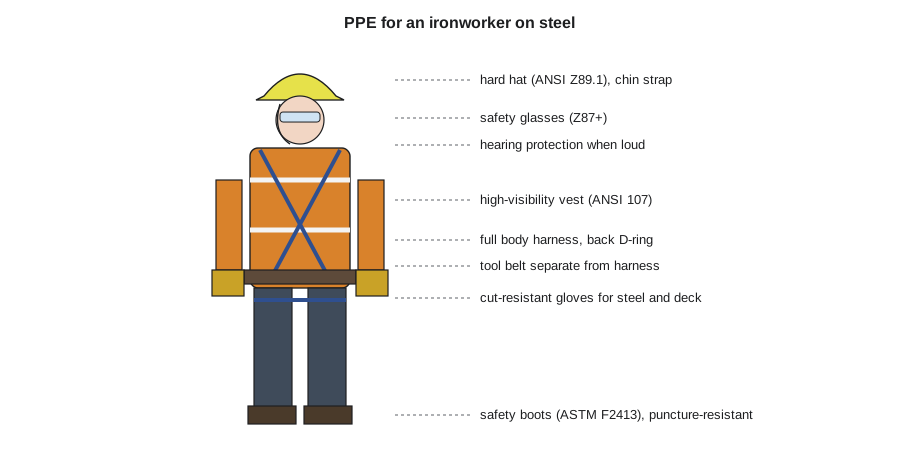
At the kit issue on his first morning, Grace handed Shay a hard hat with a chin strap, safety glasses, a face shield, earplugs and earmuffs, two kinds of gloves, a high-visibility vest, a full body harness with a shock-absorbing lanyard, and a voucher for boots. "The harness gets a whole lesson of its own," she said. "Today we fit the rest." Personal protective equipment, or PPE, is the last line of defense. It does not remove a hazard; it reduces the harm if the hazard reaches you. On a steel job, where some hazards cannot be engineered away, PPE matters a great deal. The general safety course (TRD-101) covered choosing, fitting and caring for PPE; this lesson is about the PPE an ironworker needs and why.
Head protection
Hard hats on construction sites must meet ANSI/ISEA Z89.1, as OSHA requires. The standard classifies hats by the kind of impact they protect against, Type I for the top only and Type II for the top and sides, and by electrical class, with Class E for high-voltage protection, Class G for general use and Class C for no electrical protection. Ironworkers are struck from the side as often as from above, by swinging loads, beam ends and tools, so many contractors, Crossbeam among them, now issue Type II hats.
At height, a hard hat must stay on in a fall or when a worker bends over an edge, so ironworkers wear a chin strap. Crossbeam requires chin straps above the ground floor. A hat that falls off is a falling object and leaves the worker unprotected. Replace a hard hat after any significant impact, if the shell is cracked, faded, brittle or chalky, or when the maker's service life is reached; the suspension usually needs replacing more often. Do not paint shells, drill them or store them on the rear window of a truck in the sun.
Eye and face protection
Eye protection is worn at all times on site. Safety glasses must meet ANSI/ISEA Z87.1, marked Z87+ for impact, with side protection. Grinding, chipping and cutting add a face shield over the glasses, and cutting and welding need filter lenses or helmets with the right shade for the process. Tinted glasses help in bright sun but must not be worn indoors or at dusk, when they cut visibility on steel.
Shade numbers rise with the brightness of the process. Typical ranges are about shade 3 to 6 for oxy-fuel cutting, depending on plate thickness, and about 10 to 13 for arc welding and plasma cutting, depending on current; the welding courses give the full table. Anyone near the work needs protection from the arc's ultraviolet light too, and welding screens keep it from reaching people nearby.
Hearing protection
Steel jobs are loud. Impact wrenches, grinders, air arcs, cranes, generators and steel banging on steel all exceed the level at which hearing is damaged over time. Hearing loss from noise is permanent, painless and gradual; most workers do not notice it until it is too late.
OSHA's construction rule sets a permissible exposure of 90 dBA averaged over 8 hours, with a 5 dB exchange rate: every increase of 5 dB halves the time allowed. Many contractors, Crossbeam included, follow the stricter guidance of NIOSH and require hearing protection at 85 dBA, where NIOSH recommends a 3 dB exchange rate.
Worked problem
How long at the grinder?
Nate's grinder measures 97 dBA at the operator's ear. Under OSHA's construction limit of 90 dBA for 8 hours with a 5 dB exchange rate, how long may a worker be exposed without hearing protection? How long under the NIOSH recommendation of 85 dBA with a 3 dB exchange rate?
Show solution
- OSHA: increase 97 − 90 = 7 dB; halvings 7 ÷ 5 = 1.4; time 8 ÷ 2^1.4 = 8 ÷ 2.64 ≈ 3.0 hours.
- NIOSH: increase 97 − 85 = 12 dB; halvings 12 ÷ 3 = 4; time 8 ÷ 16 = 0.5 hours.
Answer: About 3 hours under OSHA but only 30 minutes under NIOSH. Crossbeam follows the stricter figure: anyone grinding for more than a few minutes wears hearing protection, and so do people working close by.
Earplugs must be inserted correctly to work: rolled, inserted deep with the ear pulled up and back, and held until they expand. Earmuffs must seal against the head; safety glasses arms and long hair break the seal. On steel, workers must still hear signals and warnings, so communication is planned: radios with headsets, agreed hand signals, and a horn or whistle code for the crane.
Hand protection
Steel edges, burrs, wire rope, rebar ends and sheet deck cut hands every day. Ironworkers wear cut-resistant gloves for handling steel and deck, leather gloves for rigging and hot work, and insulated gloves in cold weather. Cut resistance is rated on a scale; in North America the ANSI/ISEA 105 scale runs from A1, the lowest, to A9, the highest, and many contractors require A4 or higher for handling sheet deck and sharp steel. Gloves must fit; a loose glove can be caught by a rotating drill or pulled into a pinch point.
- Never wear gloves near a rotating drill bit or chuck; they can be caught and wrap the hand in.
- Use leather or heat-resistant gloves for cutting and welding; synthetic gloves can melt into skin.
- Keep hands out of pinch points: between a load and the steel, between a sling and a load, and in bolt holes while pieces are moving.
Foot protection
Safety footwear must meet ASTM F2413, as OSHA requires, with protective toes and, on steel jobs, puncture-resistant soles. Many ironworkers choose boots with ankle support and soles that grip steel; a smooth sole is slippery on wet or frosty beams. Crossbeam requires electrical-hazard rated boots on jobs near energized equipment.
Many ironworkers prefer boots with a defined heel when walking beams and climbing, and soft, flexible soles for feeling the steel, but footwear must still meet the standard. Keep soles clean of mud, ice and oil before climbing; a muddy sole on steel is like a skate.
Visibility and clothing
High-visibility apparel must meet ANSI/ISEA 107, usually Class 2 or Class 3 on construction sites near traffic and equipment. Crane operators and equipment drivers must be able to see every worker, especially on the ground among moving loads and trucks.
Clothing should be close-fitting, without loose ends that catch on steel, and made of natural fibers or flame-resistant fabric for hot work, because synthetics melt. Ironworkers work in all weather, so layers matter: base layers that move sweat away from the body, an insulating layer, and a wind and rain shell. Heat and cold both affect judgment and grip. In hot weather, drink water often and take breaks in the shade; in cold weather, watch for numb fingers and toes and for a coworker who becomes confused or clumsy.
Respiratory protection
Cutting, welding and grinding steel produce fumes and dust. Galvanized steel gives off zinc oxide fume when cut or welded, which can cause metal fume fever, a flu-like illness. Painted steel may carry lead or other metals in old coatings, especially on bridges and older buildings. Welding fume contains manganese and other metals. The first defense is to work outdoors or with good ventilation and to stay out of the plume; where that is not enough, a respirator chosen for the hazard and fitted by a fit test is needed. Respirators are covered in the welding courses and the hazardous materials material in TRD-101.
Caring for PPE
PPE works only if it is in good condition and worn correctly. Inspect it before every shift, clean it as the maker says, store it out of the sun and away from chemicals and sparks, and replace it when it is damaged or worn out. Report damaged PPE; the employer must replace it. Shay's kit check each morning took two minutes: hat and strap, glasses, hearing protection, gloves, vest, boots and, separately and carefully, the harness and lanyard.
PPE in hot and cold weather
Ironworkers wear the same PPE in a heat wave as in a January wind, and both make it harder. In heat, hard hats, harnesses and long sleeves trap heat, and sweat makes gloves slippery and glasses fog. Crossbeam's heat plan has water and shade at every work level, more frequent breaks as the temperature and humidity rise, earlier start times in summer, and a buddy system so that workers watch each other for signs of heat illness: heavy sweating or no sweating, headache, dizziness, nausea, confusion and clumsiness. Heat stroke is a medical emergency; call for help and cool the worker at once.
In cold weather, the danger is numb hands and feet, stiff muscles and slowed reactions. Hard hat liners that fit under the hat without lifting it off the suspension, insulated gloves that still let a worker grip a wrench, and boots with insulation and good soles all help. Frostbite shows first as white or gray, waxy, numb skin; hypothermia shows as shivering, then confusion, slurred speech and clumsiness. Wind makes cold much worse, and the steel itself pulls heat out of hands and knees.
PPE does not replace planning
Every piece of PPE in this lesson is the last line of defense. A hard hat does not make it acceptable to work under connectors; it protects against the bolt that falls despite the controlled zone. A face shield does not make it acceptable to stand in line with a grinder wheel; it protects against the fragment that leaves despite the guard. Hearing protection does not make a noisy job quiet; quieter tools and keeping people away from the noise come first. Each time Grace introduced a piece of PPE, she asked the same question first: what could we do so that we do not need it?
Who pays, who decides
Under OSHA rules, employers must pay for most PPE that workers need, including hard hats, eye and face protection, hearing protection, harnesses and lanyards, with a few exceptions such as ordinary safety-toe footwear and prescription safety glasses worn off the job, which employers may choose to pay for. Workers must wear and use the equipment the employer requires. Crossbeam gives each new apprentice a boot voucher and replaces worn harnesses, hard hats and gloves at no cost.
Workers have a say too. A worker who is issued PPE that does not fit, is damaged or is not right for the hazard should report it to the foreperson or the safety coordinator and get it replaced before starting work. Shay's first pair of gloves was too large for his hands, and he was issued a smaller size the same morning. A glove that is too big is not just uncomfortable; it reduces grip and can be caught.
Worked problem
Glove choice by task
Shay has three pairs of gloves in his bag: cut-resistant knit gloves rated A4, leather rigger's gloves and leather welding gauntlets. Which should he wear for each task: carrying sheet deck, handling wire rope slings, holding a torch to cut a clip, and running a magnetic drill?
Show solution
- Sheet deck: the A4 cut-resistant gloves, because deck edges are sharp.
- Wire rope slings: leather rigger's gloves, which resist broken wires and abrasion.
- Cutting with a torch: leather welding gauntlets, which resist heat and spatter.
- Magnetic drill: no gloves near the rotating cutter; keep hands clear and use a brush or hook for chips.
Answer: Different tasks need different gloves, and one task needs none. Carrying the right gloves for the day is part of planning the work.
A daily PPE routine
Shay's two-minute check each morning followed the same order, top to bottom, so nothing was missed: hard hat shell and suspension, chin strap, safety glasses clean and unscratched, face shield if grinding was planned, earplugs in his pocket and earmuffs on the hat, high-visibility vest clean and intact, the right gloves for the day's tasks, boots laced with soles clear of mud, and then the harness and lanyard on their own, checked strap by strap. Anything worn or damaged went to Grace before the toolbox talk, not after the first lift. A routine like that takes less time than finding a missing glove at the top of a column.
Common mistakes
MistakeWearing a hard hat without a chin strap at height.
InsteadUse a chin strap above the ground floor so the hat stays on and does not become a falling object.
MistakeGrinding with only safety glasses.
InsteadAdd a face shield over the glasses for grinding, chipping and cutting.
MistakePushing earplugs halfway in.
InsteadRoll, insert deep with the ear pulled up and back, and hold until they expand.
MistakeWearing gloves at a drill press or mag drill.
InsteadKeep gloved hands away from rotating bits and chucks.
MistakeCutting steel in synthetic clothing.
InsteadWear natural fibers or flame-resistant clothing for hot work.
MistakeKeeping a cracked or chalky hard hat.
InsteadReplace hats after impact, when damaged or at the maker's service life.
Summary and key terms
- Hard hats meet ANSI/ISEA Z89.1; Type II hats protect the top and sides, and chin straps keep them on at height.
- Safety glasses are worn all the time, with face shields for grinding and filter lenses for cutting and welding.
- OSHA's construction noise limit is 90 dBA for 8 hours with a 5 dB exchange rate; NIOSH recommends 85 dBA with 3 dB.
- Cut-resistant gloves protect against sharp steel; gloves stay away from rotating bits.
- Safety boots, high-visibility clothing and flame-resistant clothing for hot work complete the kit.
- Inspect PPE every shift and replace it when damaged.
- PPE
- Personal protective equipment: clothing and equipment worn to reduce harm from hazards.
- Type 2 hard hat
- A hard hat tested for impacts on the top and the sides.
- Chin strap
- A strap that keeps a hard hat on in a fall or when bending over.
- Exchange rate
- The increase in noise level that halves the allowed exposure time.
- dBA
- A sound level measured with a weighting that matches the response of the human ear.
- Cut resistance
- A glove rating for how well it resists being cut by a sharp edge.
- Metal fume fever
- A flu-like illness caused by breathing zinc oxide or other metal fume.
Practice problems
Work each problem on paper first, then reveal the answer to check.
Why do many ironworkers now wear Type II hard hats?
Show answer
They protect against side impacts from swinging loads, beam ends and tools.
How long may a worker be exposed to 95 dBA under OSHA's construction limit?
Show answer
95 − 90 = 5 dB, one halving: 8 ÷ 2 = 4 hours.
Why should gloves not be worn at a rotating drill?
Show answer
They can be caught and pull the hand in.
Which standard covers safety footwear in the US?
Show answer
ASTM F2413.
What illness can cutting galvanized steel cause?
Show answer
Metal fume fever.
Lesson quiz · 5 questions
Score 60% or more to complete this lesson.
Create a free account to save your progress, take quizzes and earn a certificate.