
IRW-110 · Lesson 10 of 12 · 25 min
Site layout and material staging
▶ Video coming soon A video version of this lesson is on the way.
Before the first column went up at Ashcroft, Carla Duquette spent two days on the ground. She walked the site with Priscilla Hahn, the superintendent for Tallcorn Builders, the general contractor, and marked out where the crane would stand, where the steel trucks would come in and turn, where each load would be laid down and sorted, and where nobody would be allowed to walk. "A good erection job is won or lost on the ground," she told Shay. "If the steel is in the wrong place, you rehandle it. Every time you rehandle steel, somebody can get hurt." This lesson covers how a steel job is laid out on the ground: access and traffic, the crane location, laydown and shakeout areas, storing materials and keeping people out of the hazard zones.
Planning the site
Site layout starts with the drawings and the erection plan. The general contractor controls the site and assigns areas to each trade; the steel erector needs room for the crane, for deliveries and for laying out the steel. The plan answers a few questions:
- Where does the crane set up for each part of the job, and can it reach every piece from there with the capacity needed?
- Where do delivery trucks enter, unload, turn and leave, without backing through work areas?
- Where is the steel laid down and sorted, within reach of the crane and close to where it will be erected?
- Where are the controlled access zones below overhead work, and how do other trades get around them?
- Where are bolts, deck, consumables, gas cylinders and tools stored?
- Where are the first aid station, the muster point and the access for emergency vehicles?
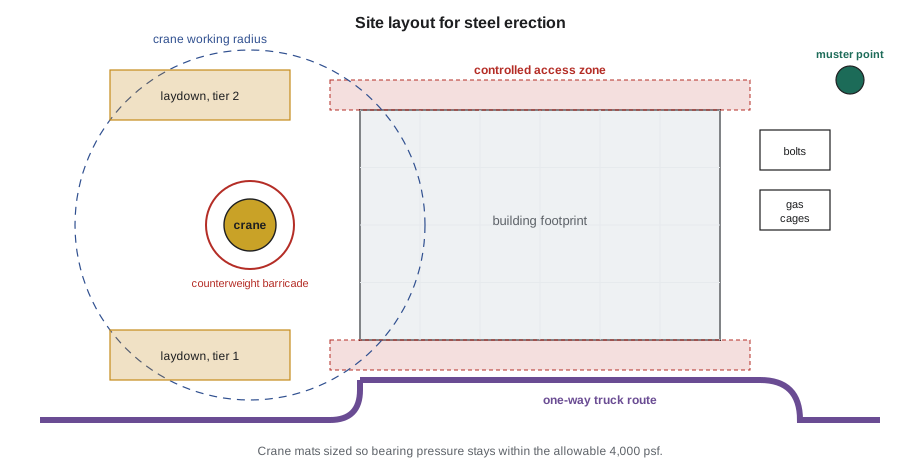
Access and traffic
Steel arrives on flatbed and float trailers, often long and heavy, and the trucks need firm, wide roads to get in and out. A one-way loop that lets trucks drive in forwards and leave forwards is best, because reversing trucks are a leading cause of struck-by deaths on sites. Where trucks must reverse, a signaler guides them, and nobody walks behind a reversing vehicle. Workers on the ground wear high-visibility clothing and keep eye contact with drivers and the crane operator.
Delivery is scheduled to match erection. Most erectors want the steel to arrive in the order it will be erected, so it can be unloaded and sorted once. A load that arrives out of sequence has to be stored, then rehandled later. The fabricator ships according to shipping lists that show every piece on each truck, and the ironworkers check each piece against the list as it comes off.
The crane location
The crane is placed where it can reach the most work with the capacity needed. Its capacity falls quickly as the load moves farther out, so a crane that can lift a column next to its base may not be able to set the same column at the far side of the building. The crane operator and the erector's planner work out each pick from the crane's load chart, as IRW-120 explains.
The ground under a mobile crane's outriggers must carry very high loads. A loaded outrigger can push into the ground with tens of tons on a small pad, more than most soils can take without help. Cranes therefore set up on firm, compacted ground with outrigger mats or cribbing that spread the load, never over backfilled trenches, buried services, basement walls or soft fill unless an engineer has checked it. The general contractor is responsible for providing ground that can carry the crane, and the crane company and the erector check it.
Worked problem
Outrigger mats
The crane company estimates the worst outrigger load for the heaviest pick at Ashcroft at 88,000 lb. The geotechnical report gives an allowable bearing pressure of 4,000 psf for the compacted pad. What pressure would a 4 ft by 4 ft mat put on the ground, and what mat is needed?
Show solution
- Force: 88,000 lb.
- Small mat: 88,000 ÷ (4 × 4 = 16 ft²) = 5,500 psf. Too high.
- Area needed: 88,000 ÷ 4,000 = 22 ft².
- A 5 ft by 5 ft mat: 25 ft², pressure 88,000 ÷ 25 = 3,520 psf. Acceptable.
Answer: A mat at least 5 ft by 5 ft, or larger as the crane maker and the engineer require. The mat itself must be stiff enough to spread the load across its whole area; a mat that bends puts most of the load under the pad.
Around the crane, the counterweight swings as the crane turns. The area it sweeps is barricaded so that nobody can be caught between the counterweight and anything fixed. Nobody enters the barricade while the crane is working without the operator's knowledge.
Laydown and shakeout
The laydown area is where steel is stored after delivery; the shakeout is the sorting and laying out of pieces in erection order, so the hooker-on can rig them one after another. At Ashcroft, Carla set two laydown areas inside the crane's reach, one for each half of the building, and the first-tier columns and beams were shaken out on the Monday before erection began.
- Lay steel on dunnage or blocking, never directly on the ground, so slings can be passed under it and pieces do not sink or rust in water.
- Keep the ground firm and level; steel sliding off uneven blocking crushes feet and legs.
- Stack pieces no higher than is stable, with the heaviest at the bottom, and block them so they cannot roll or tip; wide-flange shapes can tip onto their flanges.
- Keep piece marks visible and face them the same way; the hooker-on must find each piece quickly.
- Leave walkways between rows wide enough to walk and rig safely.
- Keep the laydown clear of the truck route and outside the controlled access zones.
Every piece has a piece mark painted or tagged on it, matching the erection drawings. The mark tells the crew where the piece goes. Pieces also carry a size designation that tells their weight. Ironworkers learn to estimate weights from the designation, because the rigging and the crane must be chosen for the weight of the load.
In the United States, wide-flange shapes are designated by nominal depth in inches and weight in pounds per foot: a W12×26 is about 12 in deep and weighs 26 lb for every foot of length. Metric designations appear on some drawings.
Worked problem
Weight from a designation
A second-floor beam at Ashcroft is marked B2-14, a W12×26 cut 30 ft long, with two clip angles that weigh about 14 lb together. What does it weigh?
Show solution
- Beam: 26 lb/ft × 30 ft = 780 lb.
- Clips: about 14 lb.
- Total: about 794 lb.
Answer: About 794 lb. Shay rounded it to 800 lb for choosing the rigging, a habit Carla encouraged: round weights up, never down.
Storing bolts, deck and consumables
Structural bolts must be kept clean, dry and lubricated as the maker supplied them, in closed kegs or containers, under cover. High-strength bolts that are rusty, dirty or dried out may not reach the right tension when tightened, and tension-control bolts are especially sensitive. Crossbeam keeps bolts in a shipping container at the site and takes out only what will be installed that shift, returning the rest at the end of the day.
Deck bundles are stored flat on blocking, sloped slightly to drain, and covered if they will sit for long, because water trapped between galvanized sheets causes white rust. Bundles are banded and must stay banded until they are landed on the steel and secured. Welding rod, gases and grinding wheels are stored as their makers require: rod dry, gas cylinders upright and secured in separate cages for oxygen and fuel, wheels flat and dry.
Controlled access zones on the ground
Wherever work is going on overhead, the ground below is a drop zone. Controlled access zones are marked with barricade tape, fencing or barriers, with signs, and only workers involved in the overhead work may enter. Other trades and visitors are routed around them. At Ashcroft, the zones moved with the work: along the building edge where the connectors were working, under any cutting or welding, and under the crane's load path.
- Set zones wide enough for objects that bounce or are blown sideways; Crossbeam's rule is at least 10 ft beyond the outside edge of the work on a low building, and more for higher work, for wind and for cutting.
- Keep zones in place until the overhead work is finished and the area above is cleared of loose material.
- Never stand in a zone to watch the work.
Housekeeping completes the picture. Loose bolts, scrap, banding and dunnage on the ground trip people; on the steel and deck they can fall. Clear scrap and banding as you go, keep walkways open, and pick up dropped bolts.
Unloading trucks
Unloading is one of the most hazardous parts of the ground work. Steel shifts in transit, and when the driver releases the chains or straps, a piece can roll or slide off the trailer. The safe sequence is the same every time: the truck is parked on level ground in the unloading area with its brakes set; nobody stands beside the trailer on the side the load could fall; the load is checked for shifted pieces before any binder is released; the crane or a telehandler takes up the weight of a piece before its binders are loosened where the load may move; and nobody climbs on the load while it is being rigged unless there is a safe way to do so with fall protection. Drivers stay in a safe place away from the trailer while it is being unloaded, as the site rules say.
Tag lines are used on every piece lifted off the truck. A beam picked off a trailer swings as soon as it clears the deck, and the hooker-on must be clear of it. Pieces are set down on the dunnage in the laydown area, not dragged.
Housekeeping on the deck
Once the deck is down, it becomes a storage area as well as a walking surface. Bolts, deck screws, scrap, bands and offcuts collect quickly. On deck, every loose item is a tripping hazard and, near an edge or opening, a falling object. Crews clear scrap as they go into bins that are secured against wind and lowered by crane, never thrown off the building. Material stored on the deck is placed only where the structure can carry it, kept back from edges and openings, and secured against wind at the end of every shift.
Emergency access and the muster point
The site layout must leave a clear route for an ambulance or fire truck to reach the building and the crane, and a muster point where everyone gathers if the site is evacuated. At Ashcroft, the muster point was at the site gate, and Tallcorn's site orientation showed every worker where it was and how the evacuation horn sounded. Rescue equipment, first aid kits and fire extinguishers were marked on the site plan and posted in the trailer. When the crane or a truck blocked the emergency route for a lift, a worker stood by to move or guide it if an emergency vehicle arrived.
Worked problem
Laydown area size
The first tier at Ashcroft has about 90 pieces: 20 columns about 28 ft long and 70 beams averaging about 25 ft long. Carla lays them out in rows on dunnage, allowing an average of 2 ft of width for each piece including the walkway between rows. If each row is 32 ft long and holds one piece end to end, how much area does the shakeout need?
Show solution
- Rows needed: 90 pieces, one per row: 90 rows.
- Width: 90 × 2 = 180 ft.
- Area: 180 × 32 = 5,760 ft².
Answer: About 5,760 ft². Carla split it into two laydown areas of about 2,900 ft² on each side of the building, both within the crane's reach, and had the second tier delivered only after the first was erected.
Changing the layout as the job moves
A site layout is not fixed. As the building rises, the crane moves to its second setup, laydown areas shift, controlled zones follow the work, and other trades take over areas the steel crew has finished with. At Ashcroft, Carla updated the site plan for each tier and walked the changes with Priscilla before the crew started, so that the drawing in the trailer always matched what was on the ground.
Common mistakes
MistakeSetting the crane on ground nobody has checked.
InsteadConfirm the ground can carry the outrigger loads, and use mats that spread the load.
MistakeLaying steel directly on the ground.
InsteadLay it on dunnage so slings can pass under it.
MistakeLeaving bolts in open kegs in the rain.
InsteadKeep bolts clean, dry and lubricated, under cover.
MistakeRounding a load weight down.
InsteadRound weights up when choosing rigging.
MistakeWalking behind a reversing truck.
InsteadUse a one-way route or a signaler, and stay out from behind reversing vehicles.
MistakeRemoving a controlled access zone because nobody is working right now.
InsteadKeep zones until overhead work is finished and loose material is cleared.
Summary and key terms
- Plan crane location, truck routes, laydown, storage, controlled zones and emergency access before steel arrives.
- Crane outriggers need firm ground and mats sized so the bearing pressure is within what the ground can carry.
- Shake out steel on dunnage in erection order, with piece marks visible and walkways clear.
- A W12×26 weighs 26 lb per foot; estimate and round up weights for rigging.
- Store bolts clean, dry and lubricated; keep deck banded and drained; store gases upright in separate cages.
- Mark controlled access zones below all overhead work and keep them until it is finished.
- Laydown area
- The area where delivered steel is stored on site.
- Shakeout
- Sorting and laying out steel in erection order.
- Dunnage
- Timbers or blocking placed under stored steel.
- Piece mark
- The mark on each piece that matches it to the erection drawings.
- Outrigger mat
- A mat or cribbing placed under a crane outrigger to spread its load.
- Bearing pressure
- The force on the ground divided by the area it acts on.
- Counterweight swing radius
- The area swept by a crane counterweight as the crane turns.
Practice problems
Work each problem on paper first, then reveal the answer to check.
What does a W12×26 designation tell you?
Show answer
About 12 in deep, 26 lb per foot.
What does a 20 ft W10×22 beam weigh?
Show answer
22 × 20 = 440 lb.
A 66,000 lb outrigger load sits on a 5 ft by 5 ft mat. What is the pressure?
Show answer
66,000 ÷ 25 = 2,640 psf.
Why is steel laid on dunnage?
Show answer
So slings can pass under it and it stays out of mud and water.
Why must bolts be kept dry and lubricated?
Show answer
Dirty, rusty or dry bolts may not reach the right tension.
Lesson quiz · 5 questions
Score 60% or more to complete this lesson.
Create a free account to save your progress, take quizzes and earn a certificate.