
IRW-110 · Lesson 7 of 12 · 23 min
Anchors, lanyards and self-retracting lifelines
▶ Video coming soon A video version of this lesson is on the way.
On Thursday of his first week, Shay found a problem at the morning equipment check. The self-retracting lifeline he had been issued pulled out and locked as it should, but near the snap hook the cable's plastic jacket was split and the strands under it were frayed. He showed Andy. He looked, nodded and handed him a red tag. "That's the right call," he said. "That one goes back to Grace. You don't hang your life on 'it'll probably be fine.'" A personal fall arrest system is only as good as its weakest part. This lesson covers the parts of the system, how they are chosen and inspected, and how to work out whether a system will stop a fall before the worker hits anything.
The ABCs of a fall arrest system
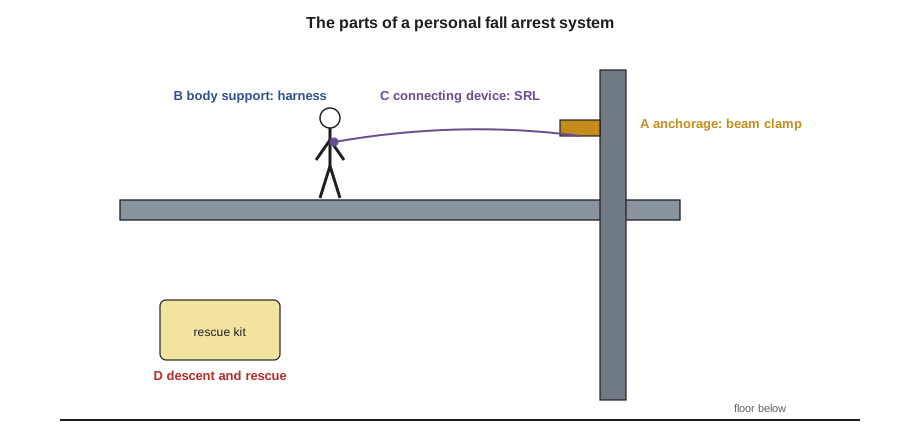
A personal fall arrest system has four parts, often remembered as A, B, C and D:
- Anchorage: the secure point the system is attached to, such as a beam clamp, a beam strap, an engineered anchor or a horizontal lifeline.
- Body support: the full body harness, which spreads the forces of the arrest across the thighs, pelvis, chest and shoulders.
- Connecting device: the lanyard or self-retracting lifeline, with its snap hooks or carabiners, that joins the harness to the anchorage.
- Descent and rescue: the plan and equipment to get a fallen worker down quickly (lesson 11).
Every part must be compatible with the others, rated for the user's weight with tools, inspected before each use and used as the maker's instructions say. Mixing parts from different makers is allowed only where the makers say the parts are compatible.
Full body harnesses
A full body harness for fall arrest must meet ANSI/ASSP Z359.11, and OSHA has prohibited body belts for fall arrest since 1998. Harnesses have a back (dorsal) D-ring for fall arrest and may have front, side or shoulder attachments for ladder climbing, positioning, rescue or confined space work. Fall arrest always uses the dorsal D-ring unless the maker's instructions say otherwise, for example the front D-ring of a ladder climbing system.
Fit matters. The back D-ring should sit between the shoulder blades. Leg straps should be snug enough that a flat hand fits under them but a fist does not; loose leg straps can injure the groin in a fall and let the worker slip partly out. The chest strap sits across the middle of the chest, not at the throat or the belly. Adjust the harness every time it is put on, over the clothing actually worn that day. Ironworkers often choose harnesses with padding, tool loops kept clear of the attachment points and webbing that resists sparks for hot work.
Lanyards and energy absorbers
A lanyard is a short flexible line, usually webbing or rope, that connects the harness D-ring to the anchorage. A fall arrest lanyard must include an energy absorber, a pack of tear-away webbing that rips apart in a fall to slow the worker down over a short distance and keep the force on the body low. A plain lanyard with no energy absorber is used only for travel restraint or positioning, never for fall arrest.
ANSI/ASSP Z359.13 classifies energy-absorbing lanyards by the free fall they are designed for. A 6 ft free fall lanyard must keep the average arresting force to about 900 lb and deploy no more than about 4 ft; a 12 ft free fall lanyard, used where the anchor is below the D-ring, may deploy up to about 5 ft with an average force of about 1,350 lb. OSHA limits the maximum arresting force on a worker in a harness to 1,800 lb and free fall to 6 ft, unless the system is designed for more and stays within the force limit.
Twin-leg (Y) lanyards have two legs joined at the harness end. A connector or a worker moving along steel clips one leg on before unclipping the other, so they are never untied. The unused leg must be stored on a lanyard keeper on the harness, never clipped back to the harness webbing or D-ring, because in a fall that can defeat the energy absorber.
Self-retracting lifelines
A self-retracting lifeline (SRL) is a drum of cable or webbing on a spring, like a seatbelt. The line pays out and retracts as the worker moves, and locks within a short distance when a fall starts. SRLs keep free fall short, so they need much less clearance than a lanyard, and they let the worker move over a wider area. They are the most common connecting device for ironworkers today.
SRLs are covered by ANSI/ASSP Z359.14. Since the 2021 edition, SRLs are Class 1 or Class 2. A Class 1 SRL may be anchored only at or above the D-ring. A Class 2 SRL may also be anchored below the D-ring, down to about 5 ft below it, and its line has been tested over a sharp steel edge for leading-edge use. Both classes are limited to a maximum arrest distance of 42 in in the standard's tests. On steel, where anchors are often at foot level, only a Class 2 (leading-edge) SRL may be used that way, with the setback and edge conditions its maker specifies.
SRLs must be inspected before each use: pull the line out its full length and let it retract under control, check that it locks sharply when jerked, look for cuts, frays, kinks, corrosion and damaged hooks, and check the impact indicator, which shows if the unit has arrested a fall. Any SRL that has arrested a fall, or whose indicator shows deployment, is taken out of service until the maker or an authorized service center inspects it. Shay's split jacket and frayed strands meant the unit could not be trusted at all.
Connectors
Snap hooks and carabiners join the parts of the system. They must be self-closing and self-locking, so the gate cannot open unless the worker deliberately unlocks it, and their gates must be rated to resist a side load, so a hook pressed against a D-ring or a structure cannot be forced open. Connect hooks only to compatible attachment points: a large hook around a small bar, a hook clipped to another hook, or two hooks on one D-ring can roll out. Never tie knots in a lanyard or wrap it around steel and clip it back to itself unless the lanyard is made for that use.
Anchors on steel
An anchor must hold the forces of a fall, which are much higher than the worker's weight. On steel, common anchors are:
- Beam clamps: adjustable clamps that grip the flange of a beam and have a D-ring or swivel. They are set on beams that are already connected and bolted, sized for the flange width, and tightened as the maker says.
- Beam straps and anchor slings: webbing or wire rope slings wrapped around a beam or column. They must be protected from sharp edges, and the beam must be able to carry the load.
- Beam trolleys: anchors that roll along the bottom flange so the worker can move without unclipping.
- Column-mounted SRL brackets and engineered anchors bolted or welded to the steel, installed as the engineer's design says.
- Horizontal lifelines: cables or rails stretched between anchors along a beam, so the worker can travel its length while attached.
OSHA requires anchors for personal fall arrest to support at least 5,000 lb for each worker attached, or to be designed, installed and used under the supervision of a qualified person as part of a complete system with a safety factor of at least two. Horizontal lifelines must be designed, installed and used under the supervision of a qualified person. Never anchor to handrails, conduit, pipe, ladders, unbolted steel or a beam that the crane is still holding.
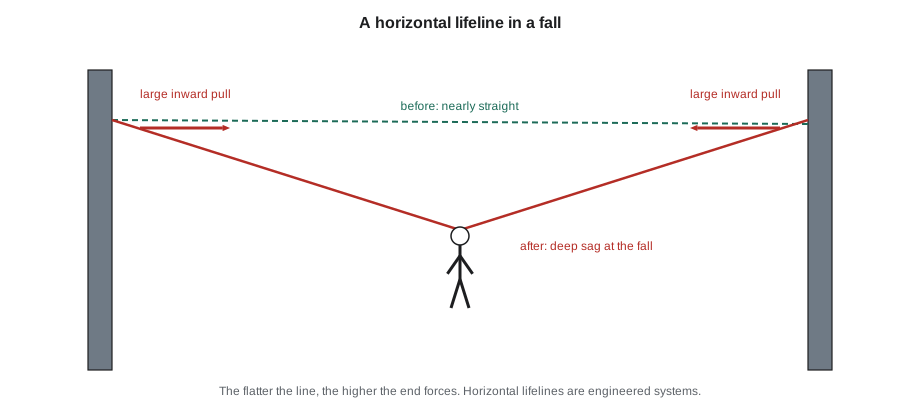
Horizontal lifelines need special care. When a worker falls on a horizontal lifeline, the line sags and pulls inward on its end anchors with a force far larger than the force on the worker; the flatter the line, the higher the force. That is why horizontal lifelines are engineered systems with specified spans, sags, end anchors and numbers of users, and why ironworkers never string an improvised line of wire rope between two columns and call it a lifeline.
Fall clearance
A fall arrest system must stop the worker before they hit the floor below, a beam, equipment or anything else. The distance needed is the fall clearance. It is the sum of several distances, measured down from the anchor or the working surface:
- Free fall: how far the worker drops before the system starts to slow them.
- Deceleration distance: how far the energy absorber deploys, or how far the SRL pays out while locking.
- Harness stretch and D-ring shift: how far the harness stretches and the D-ring slides up the back, typically about 1 ft.
- Height of the D-ring above the worker's feet: about 5 ft for most adults.
- Safety margin: extra distance so the worker stops clear of anything below, commonly about 3 ft.
Worked problem
Lanyard or SRL at the second floor
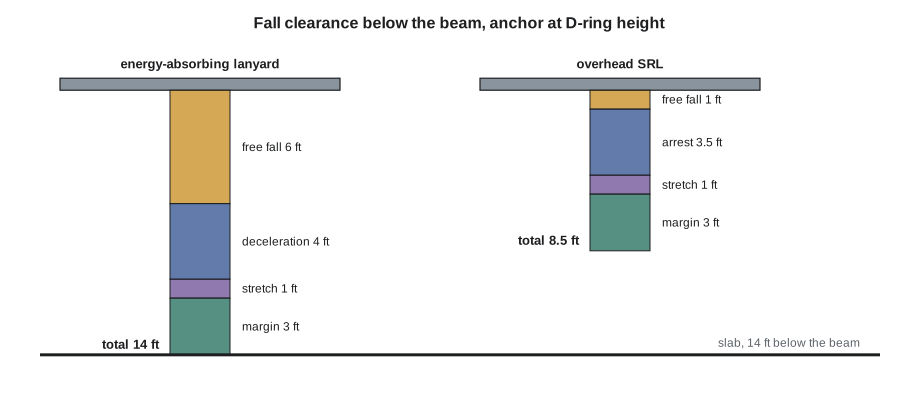
Shay is working on the second-floor beams at Ashcroft, 14 ft above the slab, with the anchor at the height of his back D-ring. Compare a 6 ft energy-absorbing lanyard (deployment up to 4 ft) with an overhead SRL (free fall about 1 ft, arrest distance up to 42 in). How far below the beam would his feet go in each case, with harness stretch of 1 ft and a safety margin of 3 ft?
Show solution
- With the anchor at D-ring height, his feet drop the same distance as the D-ring.
- Lanyard: 6 + 4 + 1 = 11 ft of fall, plus 3 ft margin = 14 ft clearance needed below the beam.
- SRL: 1 + 3.5 + 1 = 5.5 ft of fall, plus 3 ft margin = 8.5 ft clearance needed.
- Available: 14 ft to the slab, less any material, equipment or a lower beam in the way.
Answer: The lanyard needs all 14 ft available, with no room for anything on the slab; it is not acceptable. The SRL needs about 8.5 ft and is the right choice. At low heights, lanyards often do not have enough clearance.
Worked problem
Tying off at foot level
On the roof beams, Andy's anchor is a beam clamp on the top flange at his feet, so it is about 5 ft below his D-ring. If he used a 6 ft lanyard, how far would he free fall?
Show solution
- Free fall = lanyard length + height of D-ring above anchor = 6 + 5 = 11 ft.
Answer: About 11 ft of free fall, more than the 6 ft OSHA allows for an ordinary system, and close to the limit of a 12 ft free fall lanyard. That is why Andy uses a Class 2 SRL anchored as its maker allows, or a 12 ft free fall lanyard with the clearance it needs.
Swing falls are the other danger. A worker anchored off to one side swings like a pendulum after a fall and can strike a column or the steel beside them. Keep the anchor as close to directly overhead as possible, and limit how far the worker moves to the side of it.
Inspection, storage and retirement
Every part of the system is inspected by the user before each use and by a competent person at the intervals the maker and the rules set, often at least once a year, with records kept. Look for cuts, burns, weld spatter, frays, broken stitching, chemical damage, corrosion, deformed hardware, missing labels and deployed energy absorbers or impact indicators. Any part that has stopped a fall is removed from service. Store equipment clean and dry, out of the sun and away from chemicals and sparks, and never let it ride loose in the gang box under steel and tools.
Compatibility and the user's weight
Fall protection equipment is rated for a range of user weights, and the weight that counts is the worker with clothing, tools and anything carried. A worker who weighs 210 lb with a full tool belt and a bolt bag can be well over 240 lb. Check that the harness, the connecting device and the anchor are all rated for that total, and that the parts are made to work together. When in doubt, ask the safety coordinator before going up, not after.
Common mistakes
MistakeUsing a plain rope lanyard for fall arrest.
InsteadFall arrest lanyards must have an energy absorber.
MistakeClipping the unused leg of a twin lanyard to the harness webbing.
InsteadStore it on the lanyard keeper so it cannot defeat the absorber.
MistakeUsing any SRL at foot level over an edge.
InsteadUse only an SRL rated for leading-edge use, as its maker allows.
MistakeAnchoring to a beam the crane is still holding.
InsteadAnchor only to steel that is connected and able to carry the load.
MistakeStringing an improvised wire rope between columns as a lifeline.
InsteadHorizontal lifelines are engineered systems.
MistakeIgnoring fall clearance at low heights.
InsteadCalculate clearance; at low heights, use an SRL.
Summary and key terms
- A fall arrest system has an anchorage, a body harness, a connecting device and a rescue plan.
- Use the back D-ring for fall arrest, fitted snugly with leg straps tight.
- Z359.13 lanyards are rated for 6 ft or 12 ft free fall; OSHA limits arrest force to 1,800 lb and free fall to 6 ft.
- SRLs are Class 1 (anchor at or above the D-ring) or Class 2 (may anchor below and rated for leading edges).
- Anchors must hold 5,000 lb per worker or be designed by a qualified person with a safety factor of two.
- Fall clearance is free fall + deceleration + stretch + D-ring height + margin; at low heights, SRLs are usually needed.
- Anchorage
- A secure point to which a fall protection system is attached.
- Full body harness
- A harness that spreads fall arrest forces over the thighs, pelvis, chest and shoulders.
- Energy absorber
- A device in a lanyard that tears or deforms to reduce the force of a fall arrest.
- Self-retracting lifeline
- A lifeline on a spring-loaded drum that locks quickly when a fall starts.
- Free fall
- The distance a worker falls before the fall arrest system begins to slow them.
- Fall clearance
- The distance needed below the working surface so a falling worker stops before hitting anything.
- Swing fall
- A pendulum swing after a fall when the anchor is not overhead.
- Beam clamp
- An anchor that grips the flange of a steel beam.
Practice problems
Work each problem on paper first, then reveal the answer to check.
Name the four parts of a fall arrest system.
Show answer
Anchorage, body support, connecting device, descent and rescue.
What is the difference between a Class 1 and a Class 2 SRL?
Show answer
Class 1 anchors at or above the D-ring; Class 2 may anchor below and is tested for leading edges.
With a 6 ft lanyard anchored 5 ft below the D-ring, how far is the free fall?
Show answer
6 + 5 = 11 ft.
How much must an anchor for personal fall arrest support, per worker, under OSHA?
Show answer
5,000 lb, or a qualified-person design with a safety factor of two.
Why are horizontal lifelines engineered?
Show answer
In a fall the sagging line puts very large forces on its end anchors.
Lesson quiz · 5 questions
Score 60% or more to complete this lesson.
Create a free account to save your progress, take quizzes and earn a certificate.