
IRW-110 · Lesson 1 of 12 · 21 min
The ironworker trade and its branches
▶ Video coming soon A video version of this lesson is on the way.
At seven o'clock on Monday, September 14, 2026, Shay Donnelly stood in the lunchroom of the Crossbeam Steel & Rebar yard in Obetz, just south of Columbus with a new hard hat, a new harness still in its bag and a coffee he had not touched. Grace Ndlovu, Crossbeam's safety coordinator, slid a binder across the table. "Before anybody puts you on steel," Grace said, "you need to know what this trade is, who does what, and why we are so fussy about the rules. Then Andy can show you the rest." Andy Pruszynski, a connector with 28 years in the trade, raised his cup from the next table. "Welcome to the trade," he said. "Most people think we just bolt beams together. By the end of the year you'll know better."
This course is the first ironworker course in the program. The general trades courses taught site safety, drawings, tools, rigging and the apprenticeship system for every trade. This course is about the ironworker trade in particular: what ironworkers build, the tools they carry, and how they work safely at height, where most of the trade's serious injuries happen. Each lesson follows Shay through his first months at Crossbeam, on the steel frame of the Ashcroft Medical Building in Westerville, north of Columbus, a three-story medical office building with a composite steel deck.
What ironworkers do
Ironworkers build the steel skeleton of a structure and much of the metal that goes into and onto it. On a typical building they unload and sort the steel, rig and hoist it with a crane, stand the columns, connect the beams and girders, plumb and bolt the frame, lay the metal deck, and install the stairs, railings and other metalwork. On a concrete structure they place and tie the reinforcing steel that the concrete is poured around. On a bridge they may do all of that and more. The common thread is heavy metal, installed in place, usually high above the ground and often with a crane.
The word ironworker comes from the days when structures were built of wrought iron and cast iron. Today almost everything is steel, but the old name stuck, along with many old terms: a raising gang, a connector, a pusher, a shakeout, a widow-maker. Learning the language is part of learning the trade, and this course introduces the words as they come up.
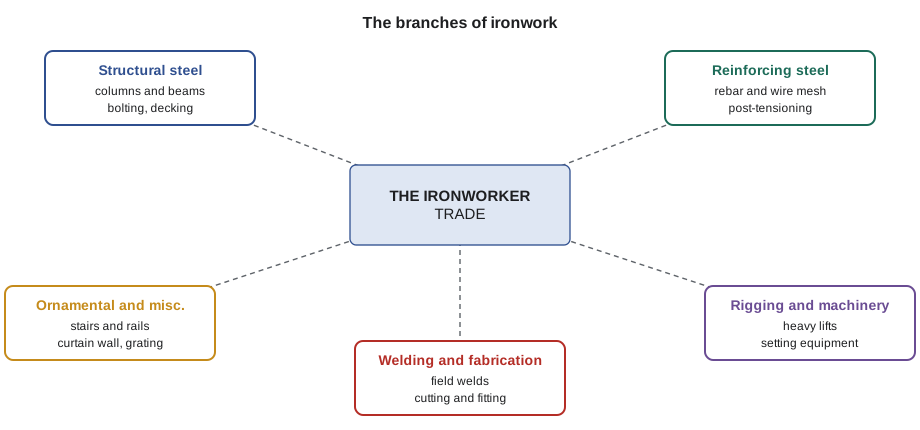
The branches of the trade
Ironwork is one trade with several branches. Some ironworkers spend a whole career in one branch; most move between them as work comes and goes. The main branches are:
- Structural steel erection: unloading, shaking out, rigging, raising, connecting, plumbing and bolting the steel frames of buildings, bridges, towers, stadiums and industrial plants, and laying metal floor and roof deck. The crew that hoists and connects the steel is the raising gang; the crews that follow to plumb, bolt and finish connections are the bolt-up and detail crews.
- Reinforcing steel: cutting, bending, placing and tying the reinforcing bars (rebar) and welded wire reinforcement that give concrete its strength in tension, and installing post-tensioning tendons. Workers in this branch are often called rodbusters or rodmen.
- Ornamental and miscellaneous metals: installing stairs, handrails and guardrails, ladders, gratings, canopies, curtain wall frames, metal windows and doors, and the many smaller steel items in a building, from lintels to equipment supports.
- Rigging and machinery moving: moving and setting heavy equipment, such as presses, transformers, boilers and turbines, often inside existing buildings with jacks, rollers, gantries and cranes.
- Welding and fabrication: welding in the field, cutting and fitting steel, and in some shops fabricating the pieces that the erectors later install. Ironworkers who weld structural connections must be qualified welders, a subject of the welding courses in this program.
Precast concrete erection and pre-engineered metal buildings also belong to ironworkers in many places. Precast beams, columns and wall panels are rigged and connected much like steel, and metal buildings arrive as a kit of frames, purlins, girts and sheeting. Later courses in this program cover each branch in depth: rigging and cranes in IRW-120, reinforcing steel in IRW-130 and IRW-220, steel erection in IRW-210 and later courses, and welding in the WLD courses.
| Branch | Typical work | Course in this program |
|---|---|---|
| Structural steel | Columns, beams, bracing, bolting, deck | IRW-210 and Level 3 courses |
| Reinforcing | Rebar, welded wire, post-tensioning | IRW-130, IRW-220 |
| Ornamental and miscellaneous | Stairs, rails, curtain wall, gratings | Level 3 courses |
| Rigging and machinery moving | Lifts, heavy equipment setting | IRW-120 and later courses |
| Welding | Field welds, cutting, fitting | WLD-110, WLD-120, WLD-210 |
Who is on a steel erection crew
On the Ashcroft job, Carla Duquette ran the raising gang. In ironworker language she was the pusher, the foreperson who directs the gang, plans each lift with the crane operator and decides who goes where. A typical raising gang on a building of this size has five to eight people:
- Foreperson (pusher): plans the day, the lift sequence and the crew, checks the work and talks to the general contractor, the crane operator and the inspector.
- Connectors: usually two ironworkers working at the top of the steel, who guide each beam into place and make the first bolted connection at each end. Andy and Marco Bellini were Carla's connectors.
- Signal person: the one worker who gives signals to the crane operator for each lift, by hand or by radio. Signaling is covered in IRW-120.
- Hooker-on (rigger): the worker on the ground who attaches the rigging to each piece, checks the load and tag lines, and keeps the lift moving.
- Tag line and ground hands: workers who sort and prepare the steel, hand up bolts and tools, and control loads with tag lines.
Behind the raising gang come the bolt-up crew, who install and tighten the rest of the bolts and plumb the frame, and the decking crew, who spread and fasten the metal deck. Nate Okonkwo led Crossbeam's bolt-up and detail crew at Ashcroft. The crane and its operator often belong to a crane rental company; at Ashcroft the crane was a 100-ton hydraulic truck crane from Summitline Crane Rental, run by Dwayne Mercer.
Shay started as a ground hand: sorting steel, rigging pieces under supervision, handling tag lines, carrying bolts. An apprentice moves up as skill and judgment grow, and only after the right training. Connecting is the most dangerous job on the crew, and nobody is sent up to connect until they have specific training and the foreperson trusts them to do it.
The apprenticeship
In the United States, most ironworker apprentices train in registered apprenticeship programs, either through the union and the contractors who employ its members or through open-shop programs. Programs are registered with the US Department of Labor or with a state apprenticeship agency. A union apprenticeship usually lasts three or four years and combines several thousand hours of work on the job with a set number of hours of classroom and shop training each year, often on evenings, weekends or in winter blocks. The program sets the wage steps, which rise as the apprentice moves through the program. Ohio has no state license for ironworkers; completion of a registered apprenticeship is the recognized credential. Shay joined the union's registered apprenticeship as a first-year apprentice; his first winter of classes runs from late 2026 into 2027.
Apprentices log their hours and the skills they have practiced, and journeyworkers sign off the skills they have seen done. The general apprenticeship course (TRD-107) explains the system. For ironworkers, the logbook is full of things you cannot learn in a classroom: plumbing a column, hanging a beam, reading a bolt pattern, judging a load.
Worked problem
Planning the hours
Shay's program asks for about 6,000 hours on the job over four years. Crossbeam's erection season is about 36 weeks of 40 hours. Roughly how many seasons of work will it take to log the hours if he loses about 8 in 100 of his hours to weather?
Show solution
- Hours offered per season: 36 × 40 = 1,440 hours.
- Hours worked after weather: 1,440 × 0.92 ≈ 1,325 hours.
- Seasons for 6,000 hours: 6,000 ÷ 1,325 ≈ 4.5 seasons.
Answer: About four and a half seasons, unless winter work, overtime or indoor jobs add hours. Many ironworkers pick up winter hours on indoor rebar, shop work or plant shutdowns.
What makes ironwork different
Every trade has hazards. Ironwork packs several of the worst into one job. Ironworkers work at height on narrow steel, often before there is any floor, guardrail or wall. They work under and beside loads weighing tons hanging from a crane. They handle heavy, sharp, slippery pieces, often in wind, cold and rain. They use torches and grinders that throw sparks onto anything below. And the structure they are standing on is not finished: until the frame is bolted, braced and decked, it can move or collapse.
Because of that, ironwork has its own safety rules. Steel erection has a dedicated part of the federal construction regulations, Subpart R of 29 CFR 1926, with special rules for connectors, decking crews, bolting, column anchorage and the sequence in which steel is erected. Many contractors, Crossbeam among them, set stricter rules of their own. Lessons 6 to 11 cover these rules.
The trade has a proud history and a hard one. Lesson 2 tells some of it. The point for a new apprentice is simple: the rules you will learn were written after people fell, were crushed or were struck. Andy's first rule for Shay was the same one his own mentor gave him: you tie off 100 in 100 of the time you are exposed to a fall, and you never let anyone talk you out of it.
Qualities of a good ironworker
Carla had trained dozens of apprentices. Asked what makes a good one, she gave the same list every year:
- Respect for the hazards. Confidence is good; being casual about height or loads is not.
- Attention. On steel, you watch the load, the crane, your footing and the people around you, all at once.
- Fitness and balance. The work is physical: climbing, carrying, pulling and standing on narrow steel all day.
- Good communication. A raising gang works as a team, and a missed signal can kill someone.
- Mechanical sense and arithmetic. Reading drawings, figuring weights and sling angles, and working out clearances all take numbers.
- Willingness to speak up. An apprentice who stops a job because something looks wrong is doing the job right.
Shay's fear of heights came up in his first conversation with Andy. "Good," he said. "Fear keeps you careful. Training and good fall protection keep you alive. What we don't want is somebody with no fear and no training." Most new ironworkers find that working at height becomes normal with time, and that the right protection makes it manageable.
Where ironworkers work
Ironworkers work wherever heavy metal goes into a structure. Commercial and institutional buildings, like Ashcroft, are the bread and butter of many erectors: offices, hospitals, schools, stores and warehouses. Industrial work takes ironworkers into steel mills, refineries, power plants and factories, often during shutdowns when equipment is replaced on a tight schedule. Bridges and highway structures need erection crews, rebar crews and, later, repair crews. Towers, stadiums, transit stations and parking structures each bring their own methods. Some ironworkers travel widely, following large projects; others stay with one contractor in one city for a whole career.
Work is seasonal in many places. Steel erection slows in the coldest months, but it rarely stops; crews work through winter with heaters, windbreaks and extra care on frosty steel. Rebar work on foundations and parking structures often runs year-round inside heated enclosures. Plant shutdowns cluster in spring and fall. An apprentice who is willing to work in different branches usually finds more hours.
The ironworker's day
A typical day on an erection crew starts early, often at seven, with a toolbox talk about the day's lifts, the weather, the fall protection and any changes to the plan. Workers inspect their harnesses, lanyards and tools, and the crane operator does the crane's daily checks. The raising gang then works through the lift sequence while the bolt-up and decking crews follow. Breaks are taken on the ground or on finished deck, never sitting on an open beam end. At the end of the day, loose material is cleared or secured against wind, bolts are returned to dry storage, tools and equipment are put away, and the next day's work is reviewed. Every piece of that routine exists because something once went wrong without it.
Common mistakes
MistakeThinking ironwork means only structural steel.
InsteadIronwork includes structural steel, reinforcing, ornamental and miscellaneous metals, rigging and machinery moving, and welding.
MistakeExpecting an apprentice to start as a connector.
InsteadApprentices start on the ground and in support jobs; connecting comes later and needs specific training.
MistakeAssuming the general fall protection rules are all that apply.
InsteadSteel erection has its own rules, and the employer's rules are often stricter than the law.
MistakeTreating fear of heights as a reason to quit.
InsteadTraining, good equipment and experience make height manageable; respect for it keeps you careful.
MistakeNot logging hours and skills as you go.
InsteadLog hours and skills every week and get them signed while the work is fresh.
Summary and key terms
- Ironworkers erect structural steel, place reinforcing steel, install ornamental and miscellaneous metals, rig and move machinery, and weld.
- A raising gang includes a foreperson (pusher), connectors, a signal person, a hooker-on and ground hands; bolt-up and decking crews follow.
- In the United States, ironworkers train in registered apprenticeships of usually three or four years that combine on-the-job hours with classroom training.
- Ironwork combines work at height, heavy suspended loads, hot work and unfinished structures, so it has its own safety rules.
- Apprentices start on the ground and move up as training and judgment grow.
- Raising gang
- The crew that rigs, hoists and connects structural steel.
- Pusher
- Ironworker term for the foreperson who directs a gang.
- Connector
- An ironworker who works at the top of the steel guiding pieces into place and making the first connections.
- Hooker-on
- The worker who attaches rigging to each piece on the ground.
- Shakeout
- Sorting and laying out steel on the ground in erection order after delivery.
- Rodbuster
- Trade term for an ironworker who places and ties reinforcing steel.
- Miscellaneous metals
- The smaller steel items in a building, such as lintels, ladders, gratings and supports.
- Bolt-up crew
- The crew that follows the raising gang to install and tighten the remaining bolts and plumb the frame.
Practice problems
Work each problem on paper first, then reveal the answer to check.
Name four branches of the ironworker trade.
Show answer
Structural steel; reinforcing; ornamental and miscellaneous metals; rigging and machinery moving; welding.
What does the pusher do?
Show answer
Directs the gang, plans lifts with the crane operator, assigns work and checks it.
Which part of the federal construction rules covers steel erection?
Show answer
Subpart R of 29 CFR 1926.
Does Ohio license ironworkers?
Show answer
No; a completed registered apprenticeship is the recognized credential.
Why does an apprentice not start as a connector?
Show answer
Connecting is the most dangerous job; it needs specific training and experience.
Lesson quiz · 5 questions
Score 60% or more to complete this lesson.
Create a free account to save your progress, take quizzes and earn a certificate.