
IRW-110 · Lesson 11 of 12 · 23 min
Rescue planning after a fall
▶ Video coming soon A video version of this lesson is on the way.
On Friday afternoon of his first week, Shay hung from a beam. It was a drill: Grace had rigged a rescue training anchor on a low beam at the edge of the yard, and each new worker took a turn suspended in their harness while the crew carried out the rescue. Shay's legs started tingling within a couple of minutes, and he understood why Grace kept a stopwatch running. Marco drove the boom lift under him, Andy cleared his lanyard, and he was standing in the basket in 5 minutes and 10 seconds. "Good," said Grace. "Our target is under six. Now let's talk about why." A fall arrest system that stops a fall is only half the job. The other half is getting the worker down, fast. This lesson covers why rescue must be quick, what the law requires, how rescues are planned and carried out on steel, and what to do after.
Why rescue must be fast
A worker hanging in a harness after a fall is not safe. Even if they are uninjured, hanging upright and still in a harness can quickly become dangerous. The leg straps press on the veins of the thighs, and with the legs hanging and not moving, blood pools in the legs instead of returning to the heart. The heart and brain get less blood; the worker can feel faint, sick, short of breath and confused, and can lose consciousness. This is called suspension intolerance, sometimes known as suspension trauma or orthostatic intolerance. In some cases it can lead to death if the worker is not rescued.
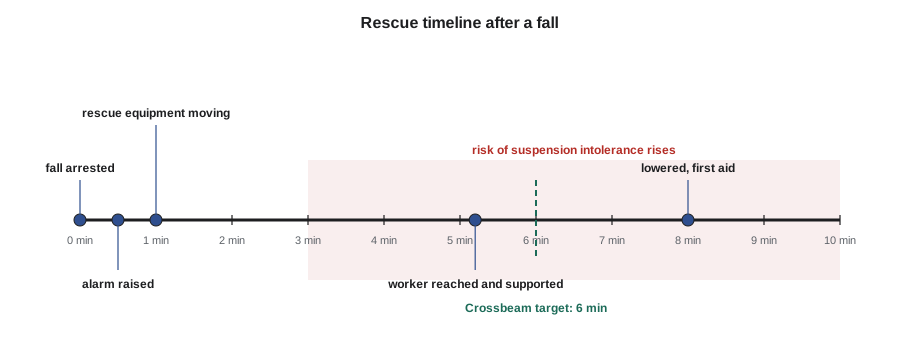
How fast it happens varies from person to person and depends on the harness, the fit, injuries from the fall, the weather and whether the worker can move their legs. Symptoms have been reported within a few minutes, and an unconscious worker who cannot move is at the greatest risk. For that reason, safety agencies and harness makers say rescue must be prompt, and many employers set a target of reaching and relieving the worker within a few minutes. Crossbeam's target is six minutes from the fall to the worker being supported.
What the law requires
OSHA requires employers to provide for prompt rescue of employees in the event of a fall, or to make sure employees can rescue themselves. Subpart R's training rules require that steel erection workers be trained in the procedures to be followed to prevent falls, including rescue. OSHA has also issued a safety bulletin warning that suspension in a harness can quickly become dangerous and that rescue plans must be in place before work begins. Calling 911 is part of every rescue, but it is not a rescue plan by itself, because emergency services may take too long to arrive and may not be able to reach a worker hanging from steel.
Planning a rescue
A rescue plan is made for each job, and often for each stage of a job, because the heights, anchors, access and equipment change as the steel goes up. Crossbeam's plan for Ashcroft answered these questions:
- Where might a worker fall, and where would they hang? Connectors at the column lines, deckers at the leading edge, bolt-up crews from lifts.
- How will the alarm be raised, and who will call emergency services and meet them at the gate?
- What is the primary method of rescue at each location, and what is the backup?
- What equipment is needed, where is it kept, and who checks it?
- Who is trained to carry out the rescue, and are they on site whenever the work is going on?
- How will the worker be lowered or brought to a safe level, and how will first aid be given?
The plan is reviewed at the site orientation, posted in the site trailer, and practiced. A plan that has never been practiced is a guess.
Rescue methods
Rescues on steel use one of a few methods, chosen for the situation:
- Self-rescue: a conscious, uninjured worker climbs back onto the steel, or uses relief straps or a self-rescue device to stand in loops and relieve pressure on the legs while help comes. Relief straps carried on the harness are a simple way to buy time, but they do not replace rescue.
- Assisted rescue from a lift: a boom lift or scissor lift is brought to the worker, who is pulled or helped into the platform and disconnected from the fall arrest system once secured to the platform anchor. This is the most common method on building steel where a lift can reach the area, and it was Crossbeam's primary method at Ashcroft.
- Assisted rescue with a rescue system: a pre-rigged rescue kit with a haul and lower system, or an SRL with a built-in rescue winch, lets trained workers raise the fallen worker back to the steel or lower them to the ground from an anchor above.
- Rescue by a ladder: possible only at low heights and for a conscious worker who can help, because carrying an unconscious person down a ladder is hazardous.
- Professional rescue: fire department or specialized rescue teams, called at once in every case, and relied on as the primary method only where the plan shows they can arrive and reach the worker in time.
The rescuers' own safety comes first. A rescuer who climbs out on steel without fall protection, or who overloads a lift, becomes a second casualty. Rescuers use their own fall protection, stay within the rated load of the lift or rescue system, and follow the plan.
Worked problem
Raising a worker with a rescue system
A rescue kit uses a 3 to 1 haul system to raise a fallen worker. Marco, who weighs 175 lb with his gear, is the fallen worker in a drill. Ignoring friction, what pull is needed on the haul line? If friction in the pulleys and rope means the system delivers only about 70 in 100 of its ideal advantage, what pull is needed?
Show solution
- Weight: 175 lb.
- Ideal pull: 175 ÷ 3 ≈ 58 lb.
- With friction: 58 ÷ 0.70 ≈ 83 lb.
Answer: About 83 lb, a steady pull that one rescuer can manage for a short raise but that two share more safely. A heavier worker or a longer haul needs a higher advantage or a lowering method instead.
Worked problem
Can the plan meet the target?
At Ashcroft, Crossbeam's plan for the roof level used the boom lift parked at the north end. In the drill, the times were: alarm and call, 30 seconds; operator to lift and start-up, 45 seconds; travel and raising to the worker, 3 minutes 20 seconds; securing and disconnecting the worker, 35 seconds. Does the plan meet the six-minute target?
Show solution
- Total: 30 + 45 + 200 + 35 seconds.
- Total: 310 seconds.
- In minutes: 310 ÷ 60 ≈ 5.2 minutes, or 5 minutes 10 seconds.
Answer: Yes, with 50 seconds to spare. Grace then asked what would happen if the lift were parked at the south end, a minute farther away: 6 minutes 10 seconds, over the target. The rule became that the lift is always parked near the work, with the key in it and a trained operator on the ground nearby.
Equipment for rescue
Rescue equipment is kept where it can be reached quickly, inspected like fall protection equipment and checked as part of the start of each shift. At Ashcroft, the site had:
- A boom lift parked near the work, fueled or charged, with a trained operator on the ground.
- A rescue kit with a pre-rigged haul and lower system, anchor slings, a pole for reaching the fallen worker's harness and a cutting tool for the lanyard, kept in a marked bag at each work level.
- Relief straps on every harness.
- A first aid kit, a blanket and an automated external defibrillator in the site trailer.
Grace checked the rescue kits each Monday and after each drill, and every worker on the steel knew where the nearest kit was.
After the rescue
Once the worker is down, first aid begins. A worker who has been suspended should be treated as a casualty even if they say they feel fine, watched closely and assessed by medical personnel; give care according to your first aid training and the instructions of emergency responders. Any injuries from the fall itself, such as from striking steel during a swing fall, are treated as well.
The equipment involved in a fall is removed from service at once and tagged, because it may be damaged in ways that cannot be seen, and an energy absorber that has deployed cannot be used again. The scene is preserved for investigation as the law and the employer require, and the fall is reported to the authorities where the law says it must be.
OSHA requires employers to report a work-related fatality within 8 hours and an in-patient hospitalization, amputation or loss of an eye within 24 hours.
Every fall, and every near miss, is investigated to find out why the system was needed and whether the fall could have been prevented. At Crossbeam, the investigation looks first at the plan, the equipment and the conditions, not just at what the worker did.
Practicing rescue
Grace ran rescue drills on the first Friday of each new worker's employment, at the start of each job and whenever the plan changed. The drills used a training anchor at low height, a volunteer in a harness and the real equipment, timed with a stopwatch. After each drill the crew talked about what went well and what was slow. Shay's drill showed that the haul system was faster than the lift at the third floor east side, so the plan was changed to make it the primary method there.
Rescue in special situations
Some locations make rescue harder, and the plan must deal with them before work starts:
- Over water: on bridges and waterfront structures, a fallen worker may land in water or hang above it. Plans may include personal flotation devices, a rescue boat and a ring buoy, as the rules for work over water require.
- Inside shafts and openings: a worker who falls into an elevator shaft or a stair opening may hang where a lift cannot reach. Pre-rigged rescue systems above the opening are the usual answer.
- At the top of a tall structure: lifts may not reach, and rescue kits that lower the worker to the ground or raise them to a platform are used.
- Near energized equipment: rescue must not expose the rescuers to electrical hazards; power may need to be shut off first.
- At night or in bad weather: lighting, communication and extra care for the rescuers.
Who can be a rescuer
Rescuers need training in the specific methods and equipment in the plan, and they must be on site whenever workers are exposed to a fall. On a small crew, that means more than one person must be trained, so that a rescue is still possible if the trained person is the one who falls. At Crossbeam, every member of a raising gang, including apprentices after their first month, is trained in the job's primary rescue method, and the foreperson checks at the start of each shift that a trained lift operator and a trained rescue kit user are on site.
Communication is part of the plan. Everyone must know how to raise the alarm: by radio, by a horn signal or by shouting to the foreperson. The person who calls emergency services gives the site address, the gate to use and the nature of the emergency, and someone goes to the gate to meet them and lead them in.
Rescue drills and records
Each drill is recorded: the date, the location, the method, the people involved, the times for each stage and what was learned. The records show the inspector and the general contractor that the plan works, and they show the crew where the plan is slow. Grace kept the Ashcroft drill records in the site binder beside the fall protection plan, and the results of each drill fed back into the plan.
Common mistakes
MistakeRelying on 911 as the rescue plan.
InsteadCall 911 every time, but have a plan the crew can carry out within minutes.
MistakeLeaving the rescue lift at the far end of the site.
InsteadPark it near the work, ready to go, with a trained operator nearby.
MistakeClimbing out on the steel to reach the worker without fall protection.
InsteadRescuers use their own fall protection and follow the plan.
MistakePutting a harness back in service after a fall because it looks fine.
InsteadRemove all equipment involved in a fall from service.
MistakeHaving a plan that has never been practiced.
InsteadDrill the plan, time it and improve it.
MistakeLetting a rescued worker go home because they say they feel fine.
InsteadTreat them as a casualty and get them medically assessed.
Summary and key terms
- Hanging in a harness can quickly cause suspension intolerance; rescue must be prompt.
- OSHA requires employers to provide for prompt rescue after a fall.
- A rescue plan covers locations, alarm, methods, equipment, trained people and first aid, and is practiced.
- Methods include self-rescue with relief straps, rescue from a lift, rescue systems, ladders at low height and professional rescue.
- Remove equipment involved in a fall from service, preserve the scene and report as the law requires.
- Time the drills; Crossbeam's target is six minutes from fall to support.
- Suspension intolerance
- Dangerous effects of hanging still and upright in a harness, as blood pools in the legs.
- Relief straps
- Loops carried on a harness that a suspended worker can stand in to relieve pressure on the legs.
- Rescue plan
- A written plan for rescuing a worker after a fall, specific to the job.
- Assisted rescue
- Rescue carried out by other workers using a lift or rescue equipment.
- Haul system
- A rope and pulley system that gives mechanical advantage for raising a load or person.
- Mechanical advantage
- The ratio of the load lifted to the pull needed.
- Critical injury
- A serious injury, such as one that endangers life or causes a fracture of a leg or arm, that the law requires to be reported.
Practice problems
Work each problem on paper first, then reveal the answer to check.
Why is a worker hanging in a harness in danger even if uninjured?
Show answer
Blood pools in the legs, which can cause fainting and worse.
What does OSHA require of employers after a fall?
Show answer
Prompt rescue, or that workers can rescue themselves.
With a 3 to 1 system, ideal pull for a 200 lb worker?
Show answer
200 ÷ 3 ≈ 67 lb.
Why is 911 not a rescue plan on its own?
Show answer
Emergency services may take too long or be unable to reach a worker on steel.
Within how many hours must a work-related fatality be reported to OSHA?
Show answer
8 hours.
Lesson quiz · 5 questions
Score 60% or more to complete this lesson.
Create a free account to save your progress, take quizzes and earn a certificate.