
IRW-110 · Lesson 8 of 12 · 25 min
Ladders, scaffolds and aerial lifts
▶ Video coming soon A video version of this lesson is on the way.
Shay's first time off the ground on the Ashcroft job was not on a beam. It was in the basket of a 60 ft articulating boom lift, on Wednesday afternoon of his first week, beside Nate Okonkwo with a bag of bolts. Before they went up, Nate walked him around the machine: tires, outriggers, the ground under it, the controls, the emergency lowering, the anchor point in the basket. "Most people who get hurt in these," he said, "get hurt because they didn't do that walk-around or because they got too clever with them." Ironworkers use ladders to reach the steel, scaffolds and floats to work at connections, and aerial lifts for bolting, welding and sometimes connecting. The general safety and rigging courses (TRD-101 and TRD-105) covered the basics of each. This lesson covers how ironworkers use them on steel.
Ladders on steel
Ladders are for getting up and down, and for short, light work where the worker can keep three points of contact. On a steel job, workers use portable ladders to reach the first tier, ladders tied to columns, and fixed ladders on stair towers and shafts. The rules are the same everywhere:
- Use a ladder rated for the load, including the worker, tools and materials, and in good condition.
- Set an extension ladder at about 4 up for every 1 out, which is an angle of about 75 degrees.
- Extend the side rails at least 3 ft above the landing, and tie the top so the ladder cannot slide or tip.
- Keep three points of contact while climbing, facing the ladder, with hands free; carry tools in a belt or raise them with a line.
- Never climb a ladder tied to a column that is not yet bolted, guyed or anchored as the erection plan requires.
Under OSHA's ladder rules, ladders used for access must extend at least 3 ft above the landing or be secured to a grab point, and workers must face the ladder and keep at least one hand on it. On steel, a worker who steps from a ladder onto a beam is exposed to a fall the moment they leave the ladder, so they tie off before they step across.
Worked problem
Setting the ladder
Shay must set an extension ladder against a column to reach a beam seat 18 ft above the slab. How far out from the column should the foot of the ladder be, and how long must the ladder be to reach the seat with the required extension above it?
Show solution
- Base distance: 18 ÷ 4 = 4.5 ft.
- Ladder length to the seat: √(18² + 4.5²) = √(324 + 20.25) = √344.25 ≈ 18.6 ft.
- Add the 3 ft extension along the ladder: about 18.6 + 3 = 21.6 ft.
Answer: Set the foot about 4 1/2 ft out and use a ladder that gives at least 21.6 ft of working length when extended, allowing for the overlap of the sections; a 24 ft extension ladder typically gives about 21 ft, so a 28 ft ladder is the safer choice.
Scaffolds and floats
Ironworkers build and use scaffolds less often than some trades, but they use them for bolting and welding connections that cannot be reached from a lift, for work on bridges and in plants, and for stair and railing installation. They also use floats: small platforms hung from the steel by wire rope or chain, giving a place to stand under a connection. Floats are an old ironworker tool and they are still used, but they are hazardous if they are not designed and rigged correctly.
- Scaffolds must be erected, moved, altered and dismantled by or under the supervision of a competent person, on sound footing with base plates and sills, plumb, braced and tied as the design requires.
- Platforms must be fully planked or decked, with guardrails on open sides and ends, and access by a built-in or attached ladder.
- Floats must be designed for their load, hung from steel that can carry them, with the rigging protected from sharp edges, and the worker on a float must be tied off to an anchor independent of the float.
- Inspect scaffolds and floats before each shift and after anything that might affect them, such as a storm, a strike by a load or a change to the steel.
OSHA's scaffold rules (Subpart L) require scaffolds to support their own weight and at least four times the intended load, to be erected by trained workers under a competent person, and to be inspected by a competent person before each shift.
Mobile elevating work platforms
Aerial lifts are now called mobile elevating work platforms (MEWPs). In the US, the ANSI/SAIA A92.20, A92.22 and A92.24 standards cover their design, safe use and training, alongside OSHA's aerial lift rule (29 CFR 1926.453) and its scaffold rules for scissor lifts. MEWPs are grouped by where the platform can go: Group A machines, such as scissor lifts and vertical masts, keep the platform inside the tipping lines of the base; Group B machines, such as boom lifts, can reach beyond them. They are also typed by how they travel: Type 1 travels only when stowed, Type 2 is driven from the chassis while raised, and Type 3 is driven from the platform while raised.
On a steel job, boom lifts (Group B, Type 3) are used to reach connections for bolting, welding and sometimes connecting, and scissor lifts (Group A, Type 3) for work under the steel on a level slab. A MEWP can be a safer place to work than a beam, but only if it is operated well.
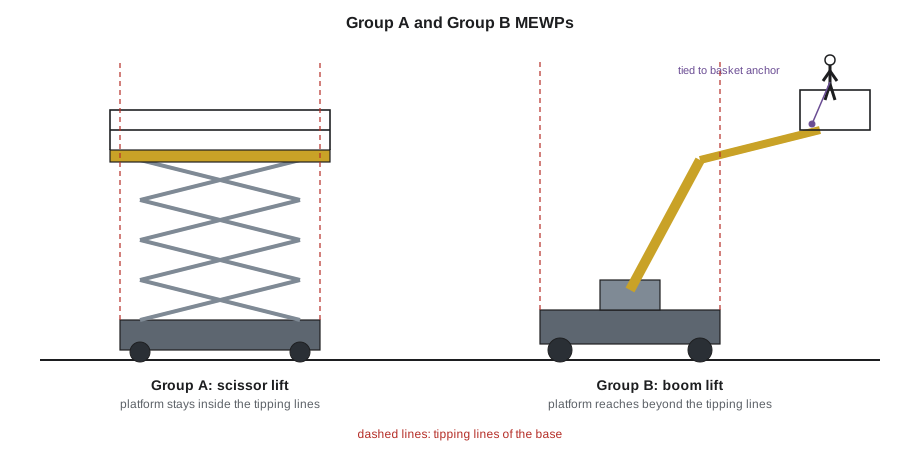
Only trained, authorized operators run a MEWP. Before each shift, the operator does a pre-start inspection and function test: tires and wheels, hydraulic leaks, guardrails and gates, anchor points, decals and the manual, ground controls, platform controls, emergency stop, tilt alarm and emergency lowering. Before raising the platform, the operator checks the work area:
- Ground: firm and level enough for the machine; watch for soft fill, backfilled trenches, holes, curbs and slopes beyond the maker's limit.
- Overhead: steel, loads, crane booms, power lines and other obstructions.
- People: nobody under the platform or in the swing path of the boom.
- Wind: stay within the maker's wind limit; many machines are rated for about 28 mph or less, and some for indoor use only.
OSHA requires occupants of boom lifts to wear a harness with a lanyard attached to the boom or basket. In scissor lifts, the guardrails are the fall protection, unless the maker or the employer also requires tie-off. Never tie off to the steel from a lift basket, unless the work plan says so for a transfer: if the lift moves, the worker can be pulled out.
Never climb on the guardrails, stand on buckets or boxes to gain height, or use the platform to lift loads it is not designed for, such as a beam hung from the basket. Never exit the platform at height except where the maker's instructions and the site's procedure allow it, with a planned transfer and continuous fall protection.
Worked problem
Platform load
The boom lift's platform is rated for 500 lb. Shay weighs 155 lb with his gear, Nate 210 lb, their tools 55 lb and the bolts they want to take up 35 lb. May they go up together with everything?
Show solution
- Total: 155 + 210 + 55 + 35 = 455 lb.
- Rated load: 500 lb.
- Margin: 500 − 455 = 45 lb.
Answer: Yes, with 45 lb to spare. Another keg of bolts would put them over; they would send it up on a second trip.
Power lines
Cranes, booms and lifts that come close to overhead power lines can cause electrocution without touching the line, because electricity can arc across the gap. OSHA requires aerial lifts and other equipment to stay at least 10 ft from lines up to 50 kV, with larger distances for higher voltages, unless the utility has de-energized and grounded the line; OSHA's crane rules set a 20 ft limit for lines up to 350 kV. A dedicated spotter watches the distance when equipment could approach the limit.
Treat every overhead line as energized until the utility confirms otherwise in writing. If a machine contacts a line, stay in the platform or cab unless there is a fire, warn others to stay away, and call for the utility to de-energize the line.
Rescue from lifts and ladders
A worker who falls from a boom lift basket while tied off will hang outside the basket and must be rescued quickly (lesson 11). Every MEWP has ground controls and an emergency lowering system that someone on the ground must know how to use. At Crossbeam, every lift operator shows the ground person the ground controls and the emergency lowering before going up, and the ground person stays nearby while the lift is in use.
Telehandlers and forklifts
Rough-terrain forklifts and telehandlers unload and sort steel, carry bolts and deck, and set light pieces. They are not aerial lifts, and workers must not ride on their forks or on a pallet. A telehandler fitted with a work platform made and approved by its maker for that machine can be used as a lift, under the maker's instructions and the rules for that combination. Telehandlers tip forward when the load is too far out for the boom angle and extension, and sideways on slopes and soft ground; operators use the machine's load chart and keep loads low while traveling.
Ground conditions for lifts
Most MEWP accidents involve tipping, and most tipping happens because of the ground: a wheel drops into a hole or soft spot, the machine is driven onto a slope steeper than its limit, or the ground gives way under an outrigger. On a steel job, the ground around the building is often disturbed: backfilled foundation walls, trenches for services, ruts from trucks and loose fill. Before driving a lift to a new location, walk the route and the work position. Look for:
- Backfill against foundation walls, which may be soft for weeks after placement.
- Trench lines, manholes, catch basins and covers that may not carry a wheel load.
- Slopes beyond the machine's rating, especially across the slope.
- Debris, rebar ends, curbs and holes that a wheel could drop into or strike.
- Overhead hazards along the route: steel, power lines, crane loads.
If the ground is doubtful, use the lift's outriggers or stabilizers where it has them, place mats under them, choose another location, or ask the general contractor to prepare the ground. The tilt alarm warns when the machine is off level; never ignore it or override it.
Getting on and off the steel from a lift
Sometimes a worker must move from a lift platform onto the steel or back: to reach a connection that the platform cannot get close to, or after a rescue. This is a planned transfer, done only where the lift maker's instructions and the site procedure allow it, because it is one of the most hazardous moments in lift work. The worker attaches to an anchor on the steel before disconnecting from the platform, keeping 100 in 100 tie-off throughout, the platform is positioned close to and level with the landing, and the operator does not move the lift until the transfer is complete. Many contractors, Crossbeam among them, forbid transfers except in rescue unless the work plan specifically includes one.
Worked problem
Ground pressure under a scissor lift wheel
A slab-type scissor lift weighs 5,500 lb with its load, and the maker says the heaviest wheel can carry 35 in 100 of the total when raised. A trench cover on the route is rated for 1,650 lb. Can the lift be driven over the cover?
Show solution
- Heaviest wheel: 5,500 × 0.35 = 1,925 lb.
- Cover rating: 1,650 lb.
- 1,925 > 1,650, so the wheel could overload the cover.
Answer: No. The crew plates over the trench with a steel plate rated for the load, or routes the lift around it.
Weather and lifts
Rain makes platform floors and controls slippery; ice and snow on the platform and the boom must be cleared before use; lightning means lowering and leaving the machine. Wind is the main limit: a raised platform with large panels or deck sheets in it catches far more wind than the machine was rated for, so the load and its surface area matter as much as the wind speed. When gusts approach the maker's limit, lower the platform and wait.
Common mistakes
MistakeStepping from a ladder onto a beam before tying off.
InsteadTie off before leaving the ladder.
MistakeTying off to the steel from a boom lift basket.
InsteadTie off to the platform anchor; a moving lift can pull you out.
MistakeSkipping the pre-start inspection because the machine worked yesterday.
InsteadInspect and function-test every shift.
MistakeDriving a raised lift over soft fill or near a trench.
InsteadCheck the ground and stay within the maker's slope limits.
MistakeLoading the platform beyond its rating to save a trip.
InsteadTotal the people, tools and material; take a second trip.
MistakeAssuming a power line is dead.
InsteadTreat it as energized until the utility confirms otherwise.
Summary and key terms
- Ladders are for access and short light work: about 4 up to 1 out, extended above the landing and tied.
- Scaffolds and floats are built and inspected by competent people; workers on floats tie off independently.
- MEWPs are Group A (scissor) or Group B (boom) and Type 1, 2 or 3 by how they travel.
- Boom lift occupants tie off to the platform anchor; scissor lift guardrails are usually the fall protection.
- Inspect and function-test every shift; check ground, overhead, people and wind.
- Keep aerial lifts at least 10 ft from lines up to 50 kV, more for higher voltages.
- Three points of contact
- Two hands and a foot, or two feet and a hand, on the ladder at all times.
- Float
- A small platform hung from the steel to give a place to stand at a connection.
- MEWP
- Mobile elevating work platform, such as a scissor or boom lift.
- Group B MEWP
- A MEWP whose platform can reach beyond the tipping lines of its base, such as a boom lift.
- Type 3 MEWP
- A MEWP that can be driven from the platform while raised.
- Pre-start inspection
- The check of a machine before each shift, including a function test.
- Limit of approach
- The minimum distance that equipment and workers must keep from energized lines.
Practice problems
Work each problem on paper first, then reveal the answer to check.
How far out should a ladder's base be to reach 20 ft up?
Show answer
20 ÷ 4 = 5 ft.
How far must a ladder extend above its landing?
Show answer
At least 3 ft.
What kind of MEWP is a boom lift?
Show answer
Group B; usually Type 3.
Where does a boom lift occupant tie off?
Show answer
To the boom or basket anchor.
What is OSHA's minimum distance from a 13,800 V line for an aerial lift?
Show answer
10 ft.
Lesson quiz · 5 questions
Score 60% or more to complete this lesson.
Create a free account to save your progress, take quizzes and earn a certificate.