
INS-130 · Lesson 10 of 12 · 23 min
Vapor retarders on cold piping
▶ Video coming soon A video version of this lesson is on the way.
Bernie keeps a photograph on her phone that she shows every new apprentice. It is the inside of a ceiling at a school Coldstream did not insulate, taken the summer after it opened: a chilled water line wrapped in glass fiber with an all-service jacket, every butt joint left untaped, and under each joint a brown stain on the ceiling tile. The insulation was the right material and the right thickness. It failed because the vapor retarder had gaps. "On hot work, a gap costs some heat," she told Devon. "On cold work, a gap is a hole for water to get in, and it never stops."
Cold piping, such as chilled water, domestic cold water, storm drainage, refrigerant suction lines and some process lines, is colder than the air around it for much or all of the year. Water vapor in the air moves toward the cold pipe and condenses wherever it reaches a surface below its dew point. The vapor retarder is the layer that stops the vapor from reaching the cold parts of the insulation. This lesson explains why vapor moves, how to tell when a surface will sweat, which materials act as vapor retarders, and how to keep the vapor retarder continuous through every joint, fitting, support and termination.
Why water vapor moves toward cold pipe
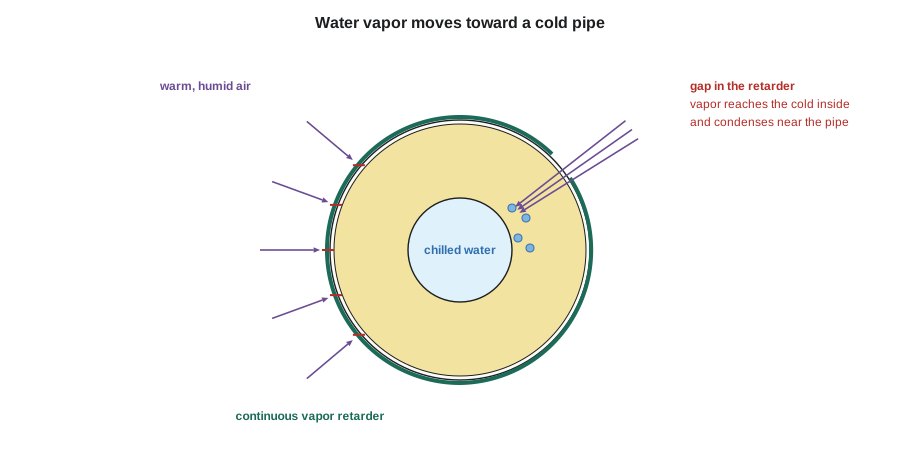
Air always holds some water vapor. Warm air can hold more than cold air. The amount of vapor in the air creates a vapor pressure, and vapor moves from places of higher vapor pressure to places of lower vapor pressure, just as heat moves from hot to cold. Around a cold pipe, the air close to the pipe is cold, and the vapor pressure at the cold surface is low, so vapor moves inward, toward the pipe, all the time the pipe is cold. This inward movement is called vapor drive.
Fibrous insulation such as glass fiber slows heat but hardly slows vapor at all; vapor passes through it almost as easily as through air. If nothing stops the vapor at the outside of the insulation, it travels inward until it reaches a layer that is colder than its dew point, and there it condenses into water. On a chilled water line, that layer is inside the insulation, close to the pipe. The water soaks the fibers, the wet insulation conducts heat much better than dry insulation, the pipe surface gets colder still, and more vapor condenses. In winter the vapor drive on some lines stops or reverses, but on chilled water serving a hospital all year, it never stops.
Dew point
The dew point of air is the temperature at which its water vapor starts to condense. It depends on the air's temperature and its relative humidity (RH), the amount of vapor in the air compared with the most it could hold at that temperature. Warm, humid air has a high dew point; cool, dry air has a low one. A surface colder than the dew point of the air around it collects condensation.
| Air condition | Dew point (approximate) |
|---|---|
| 72 °F, RH 40 in 100 (a dry winter office) | 46 °F |
| 75 °F, RH 50 in 100 (a typical conditioned space) | 55 °F |
| 84 °F, RH 75 in 100 (a humid summer ceiling space or mechanical room) | 75 °F |
| 90 °F, RH 80 in 100 (very humid, unconditioned space) | 83 °F |
Chilled water at Mountview is supplied at about 44 °F. Domestic cold water in spring can be 40 to 45 °F. Both are well below the dew point of almost any indoor air in summer, so both will sweat if bare and will soak their insulation if the vapor retarder leaks.
Worked problem
Will the jacket surface sweat?
An NPS 6 chilled water main at 44 °F runs through a mechanical room that, on a humid August afternoon with the doors open, reaches 84 °F at 75 in 100 RH. Its dew point is about 75.2 °F. A heat flow calculation like those in INS-120 gives these surface temperatures for glass fiber with ASJ: 1/2 in, 74.5 °F; 1 in, 78.9 °F; 1 1/2 in, 80.6 °F. Which thicknesses keep the surface dry?
Show solution
- 1/2 in: 74.5 °F is below the 75.2 °F dew point, so the surface sweats.
- 1 in: 78.9 °F is 3.7 °F above the dew point, so the surface stays dry under these conditions.
- 1 1/2 in: 80.6 °F is 5.4 °F above the dew point, a better margin.
Answer: 1 in or more keeps the outside dry, and the Mountview schedule calls for 1 1/2 in on chilled water NPS 1 1/2 and larger. But the thickness only protects the outside surface. If the vapor retarder has gaps, vapor still reaches the cold inside of the insulation, however thick it is.
That last point is the heart of this lesson. Thickness keeps the outer surface above the dew point; the vapor retarder keeps vapor out of the cold inside. Both are needed.
Vapor retarder materials
A vapor retarder is a material with a very low water vapor permeance, the rate at which vapor passes through it under a given difference in vapor pressure. Permeance is measured by ASTM E96 and reported in perms, where one perm is about 57 ng/(Pa·s·m²) in metric units. The lower the number, the better the retarder. Common vapor retarders on cold piping are:
- All-service jacket (ASJ), the factory jacket of kraft paper, scrim and foil, made to ASTM C1136, which sets a maximum permeance of 0.02 perm for its main types. The foil is the vapor retarder; the paper protects it.
- Low-permeance film jackets, such as polyvinylidene chloride (PVDC) or metallized film laminates, used where very low permeance is wanted, for example on refrigeration or below-freezing lines.
- Vapor retarder mastics and coatings, applied by brush, trowel or spray, usually with a reinforcing fabric, on fittings, irregular shapes and cellular glass systems.
- Vapor retarder tapes, matched to the jacket, for butt strips, seams and repairs.
- Closed-cell insulations that are themselves resistant to vapor: flexible elastomeric foam, whose foam and glued joints together form the retarder, and cellular glass, which is essentially impermeable but whose joints must be sealed.
Metal and PVC jackets are not vapor retarders on their own, because their seams are not sealed against vapor. On cold work they go over a separate, sealed vapor retarder and protect it. INS-220 covers jacketing.
Worked problem
Converting permeance
A PVDC film jacket is listed at 0.01 perm. How does it compare with ASJ at 0.02 perm, and what is it in metric units?
Show solution
- Comparison: 0.01 ÷ 0.02 = 0.5, half the permeance of ASJ at its limit.
- Metric value: 0.01 × 57.2 ≈ 0.57 ng/(Pa·s·m²).
Answer: Half that of ASJ, about 0.57 ng/(Pa·s·m²). Both are excellent retarders in sheet form; in practice, the seams and joints decide how well either works.
Continuity: the whole job
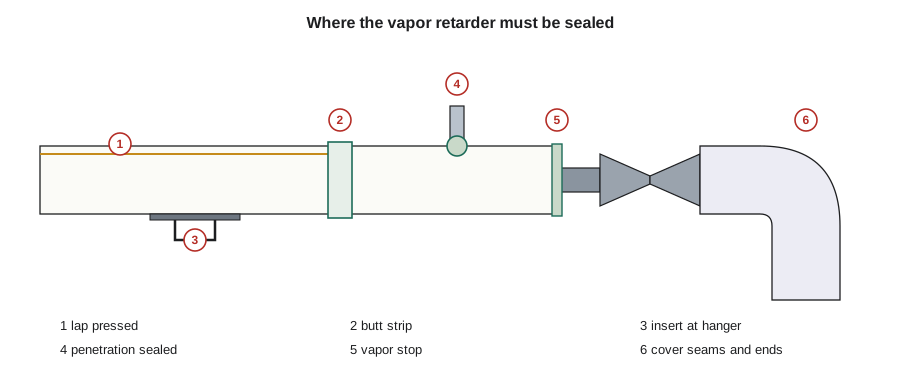
A vapor retarder works only if it is continuous. One open butt joint, one staple hole, one unsealed fitting cover or one hanger clamped to the pipe is enough to let vapor into the system. On a cold line, every one of these must be sealed:
- Longitudinal laps: SSL laps pressed firmly along their full length. On some specifications, laps on cold work are also coated with vapor retarder mastic or covered with tape.
- Butt joints: sealed with butt strips of vapor retarder tape, pressed into place all round.
- Fittings: PVC fitting covers sealed at every seam and both ends with vapor retarder tape or the cover maker's adhesive, or fittings coated with vapor retarder mastic and fabric lapped onto the adjacent jacket.
- Supports: inserts with their own vapor retarder lapped and sealed to the jacket on each side, as lesson 5 described, and shields outside the vapor retarder.
- Penetrations: thermometer wells, pressure taps, drain valves, hanger rods that cross the insulation and any other item that passes through the jacket, sealed around with mastic.
- Terminations: wherever the insulation ends, at a valve, a piece of equipment, a flange or a change of system, the insulation is sealed to the pipe with vapor retarder mastic so that vapor cannot travel along the pipe surface under the insulation.
- Staples: none, or every one sealed, as lesson 4 described.
Vapor stops
A vapor stop is a seal between the insulation system and the pipe, made by coating the end of the insulation and a short length of the pipe with vapor retarder mastic, or with a sealant recommended by the maker, so that vapor cannot travel along the pipe surface beneath the insulation. Vapor stops are required at every termination, such as each side of a valve, pump or flange left uninsulated or insulated separately, and at points where one insulation system meets another. Many specifications also call for vapor stops at intervals along long runs, so that if water does get in at one point, it is confined to a short section instead of spreading along the whole line. The specification gives the spacing where it is required.
On elastomeric foam systems, the foam is glued to the pipe at terminations with the maker's adhesive for the same purpose. On cellular glass systems on refrigeration lines, the joints themselves are sealed with a joint sealant, and vapor stops are formed at intervals and terminations as the specification describes.
Working practices for cold work
Cold work is unforgiving, and a few working rules prevent most failures:
- Install only as much insulation as you can seal the same day. A run left with open laps or unsealed joints overnight can collect moisture before it is closed, and the line may be put into service before anyone returns. The National Insulation Association gives the same advice for below-ambient systems.
- Insulate only clean, dry pipe. Never insulate a cold line that is already sweating; have the line shut down or warmed, dry it and then insulate.
- Keep tape and adhesive within their temperature limits, and keep surfaces free of dust and drywall mud, which stop adhesives from bonding.
- Do not puncture the jacket. Avoid staples, nails and screws through the vapor retarder; repair any accidental damage at once with the specified tape or mastic.
- Inspect each section before moving on, looking for open seams, lifted strips, gaps at fittings and unsealed penetrations.
- On a chilled water job with jacketing, make sure the vapor retarder is complete and inspected before the jacket goes over it and hides it.
At Mountview, the chilled water mains were insulated with glass fiber and ASJ, with high-density foam inserts at hangers and PVC fitting covers on elbows and tees, and in the mechanical room a PVC jacket over the top for protection. Bernie inspected every run herself before the jacketing crew was allowed to cover it, and she marked each inspected run on the floor plan with the date and her initials.
Repairing wet insulation on cold lines
When a cold line's insulation is found wet, for example from a stain on a ceiling or ice on a refrigeration line like the Kellerton ammonia suction line in INS-110, the repair is not to patch the outside. The wet insulation must be removed back to dry material, the source of the leak found and corrected, the pipe dried, and new insulation installed with a continuous vapor retarder and vapor stops at each end of the repair, sealed to the existing insulation. On a refrigeration line, the plant may need to warm the line or take it out of service so the pipe can be dried. Wet insulation left in place keeps wicking water along the pipe and, on carbon steel, causes corrosion under the insulation.
Common mistakes
MistakeLeaving butt joints untaped on cold work because the sections have an ASJ.
InsteadSeal every butt joint with a vapor retarder butt strip.
MistakeRelying on thickness alone to prevent condensation.
InsteadThickness keeps the outside dry; only a continuous vapor retarder keeps vapor out of the cold inside.
MistakeTreating a PVC or metal jacket as the vapor retarder.
InsteadInstall and seal a separate vapor retarder underneath the jacket.
MistakeLeaving terminations at valves unsealed.
InsteadForm vapor stops by sealing the insulation to the pipe at every termination.
MistakeInsulating a cold line that is already sweating.
InsteadHave the line shut down or warmed and dried, then insulate.
MistakeLeaving open laps overnight.
InsteadInstall only what can be sealed the same day.
Summary and key terms
- Vapor moves from warm, humid air toward cold pipe and condenses wherever it meets a surface below its dew point.
- The dew point depends on air temperature and relative humidity; chilled and domestic cold water are below it in most summer air.
- Thickness keeps the outer surface above the dew point; a continuous vapor retarder keeps vapor out of the cold inside.
- Vapor retarders include ASJ (ASTM C1136, permeance up to 0.02 perm), low-permeance films, mastics and tapes; elastomeric foam and cellular glass act as retarders when their joints are sealed.
- Metal and PVC jackets protect the vapor retarder but are not retarders themselves.
- Seal laps, joints, fittings, supports, penetrations and terminations; form vapor stops at terminations and at intervals where specified.
- Install only what can be sealed the same day, never on sweating pipe, and remove wet insulation rather than patching over it.
- Vapor drive
- The movement of water vapor from higher to lower vapor pressure, toward a cold surface.
- Dew point
- The temperature at which water vapor in air begins to condense.
- Relative humidity
- The amount of water vapor in air compared with the most it could hold at that temperature; RH.
- Vapor retarder
- A layer with very low water vapor permeance that limits vapor movement into insulation.
- Permeance
- The rate at which water vapor passes through a material under a given vapor pressure difference.
- Perm
- A unit of permeance; one perm is about 57 ng/(Pa·s·m²).
- Vapor stop
- A seal between the insulation system and the pipe that stops vapor from traveling along the pipe surface.
- Termination
- A point where an insulation system ends, such as at a valve or a piece of equipment.
Practice problems
Work each problem on paper first, then reveal the answer to check.
Why does vapor move toward a cold pipe?
Show answer
The vapor pressure at the cold surface is low, and vapor moves from high to low vapor pressure.
A space is at 75 °F and RH 50 in 100. Will a pipe surface at 60 °F sweat?
Show answer
No; the dew point is about 55 °F, and 60 °F is above it.
A surface at 72 °F is in air with a dew point of 75 °F. What happens?
Show answer
It sweats, because it is below the dew point.
Is a PVC jacket a vapor retarder on cold work?
Show answer
No; it protects a separate, sealed vapor retarder underneath.
Where must vapor stops always be made?
Show answer
At every termination, such as each side of a valve or piece of equipment where the insulation ends.
Lesson quiz · 5 questions
Score 60% or more to complete this lesson.
Create a free account to save your progress, take quizzes and earn a certificate.