
INS-130 · Lesson 1 of 12 · 28 min
Pipe sizes and insulation sizes
▶ Video coming soon A video version of this lesson is on the way.
On his third morning at Mountview Hospital, Devon Marsh carried a carton of pipe covering up to the second floor, opened it and tried to snap a section over a copper hot water line. It would not close. The hinge creaked, the lap stood open by a finger's width and the section rocked on the tube like a loose sleeve. Tessa Moreau looked at the label without even putting down her knife. "That's for NPS 1 steel," she said. "You're on 1 inch copper. Different pipe, different size. Read the box before you open it."
Every piece of pipe insulation is made to fit one particular outside diameter. Pipe and tube come in two families of sizes that look alike on a drawing but are not the same, and insulation is made separately for each family. Choosing the right size is the first step of every pipe insulation job, and getting it wrong wastes material, leaves gaps or makes the insulation too tight to close. This lesson explains how pipe and tube are sized, how pipe insulation is sized to match, how to identify a pipe on the job and how to read an insulation label.
Nominal size and actual size
Pipe and tube are named by a nominal size, a name that stands for a range of actual dimensions without being equal to any of them. The nominal size tells a pipefitter which fittings, valves and flanges go together. It does not tell an insulator the outside diameter, which is the one dimension that matters for insulation. The outside diameter (OD) is the distance across the outside of the pipe, measured through its center.
Steel pipe in North America is sized by Nominal Pipe Size (NPS), written as NPS 2, NPS 4 or NPS 6. The same sizes are often written in inches, as 2 in or 4 in pipe, and outside North America the equivalent is the metric DN number, such as DN 50 for NPS 2. For each NPS, the outside diameter is fixed, whatever the wall thickness. A heavier wall, such as Schedule 80 instead of Schedule 40, is made by moving the inside diameter inward. This is why insulation sized for NPS 4 fits every NPS 4 steel pipe, from thin-wall to extra heavy.
For pipe sizes from NPS 1/8 to NPS 12, the outside diameter is larger than the nominal size, and not by a fixed amount. From NPS 14 upward, the outside diameter equals the nominal size in inches: NPS 14 pipe is exactly 14 in across. Stainless steel pipe, and the plastic pipe made to iron pipe size dimensions, such as Schedule 40 PVC, use the same outside diameters as steel.
Copper tube is sized differently. Copper water tube of types K, L and M, the kind used for domestic water and many heating systems, has an outside diameter 1/8 in larger than its nominal size. A 1 inch copper tube is 1 1/8 in across; a 2 inch tube is 2 1/8 in. The type letter sets the wall thickness, and like steel pipe, the outside diameter stays the same for each type. Copper tube for refrigeration and air conditioning, called ACR tube, is named by its actual outside diameter, so 7/8 in ACR tube is the same outside diameter as 3/4 in water tube. Brass pipe and some PEX and CPVC plastic tubing are made to copper tube dimensions.
| Nominal size | Steel pipe OD (NPS) | Copper water tube OD |
|---|---|---|
| 1/2 | 0.840 in | 0.625 in |
| 3/4 | 1.050 in | 0.875 in |
| 1 | 1.315 in | 1.125 in |
| 1 1/4 | 1.660 in | 1.375 in |
| 1 1/2 | 1.900 in | 1.625 in |
| 2 | 2.375 in | 2.125 in |
| 2 1/2 | 2.875 in | 2.625 in |
| 3 | 3.500 in | 3.125 in |
| 4 | 4.500 in | 4.125 in |
| 6 | 6.625 in | 6.125 in |
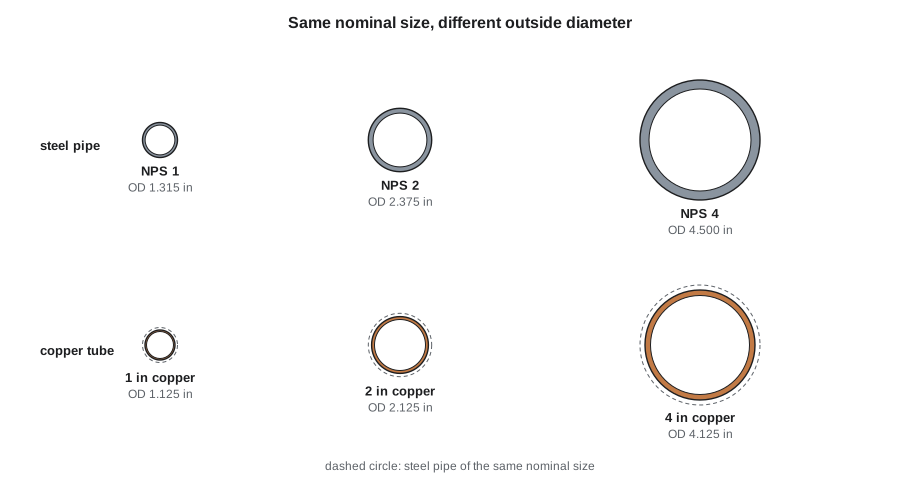
The table shows why Devon's section rocked on the tube. Insulation for NPS 1 steel has a bore made for 1.315 in; the copper was only 1.125 in. The gap of almost 0.19 in all around the tube would have let air move inside the insulation and, on a cold line, let condensation form. The reverse mistake is worse: insulation made for 1 inch copper will not close at all on NPS 1 steel, and forcing it splits the section.
Some sizes come close across the two families. 1 1/2 inch copper, at 1.625 in, is near NPS 1 1/4 steel at 1.660 in. An insulator in a hurry may be tempted to use whatever carton is closest. Bernie's rule ends the temptation: "If the label doesn't name the pipe you're standing at, it's the wrong box." Specifications require insulation sized for the actual pipe or tube, and a near fit that is a little loose on a cold line can be enough to start condensation.
How pipe insulation is sized
Pipe insulation sections are labeled with three facts that together define the piece: the pipe size it fits, whether that size is iron pipe size or copper tube size, and the nominal insulation thickness.
- Iron pipe size (IPS) insulation has a bore that fits the outside diameter of steel pipe of the stated NPS.
- Copper tube size (CTS) insulation has a bore that fits the outside diameter of copper tube of the stated nominal size. Some makers label CTS products as "copper" or "tube" sizes.
- The nominal thickness, such as 1 in or 1 1/2 in, is the thickness the specification calls for.
The dimensions behind these labels follow ASTM C585, the standard practice for the inner and outer diameters of rigid pipe insulation for the nominal sizes of pipe and tubing. It sets the inside diameter of each insulation size a little larger than the pipe or tube so that the section closes without forcing, and it sets a list of standard outside diameters. The outside diameters are chosen so that insulation of one size nests inside the bore of insulation for a larger size. This matters for two reasons. First, a second layer can be made from standard sections, because the outside of the first layer matches the bore of a section for a larger pipe. Second, standard jackets, fitting covers and hanger shields can be made for a limited set of outside diameters.
A consequence of standard outside diameters is that the actual thickness of a section can be slightly more or slightly less than its nominal thickness. The standard and most specifications allow this. When an insulator checks thickness on finished work, as lesson 11 describes, the measurement is compared with the outside diameter expected for that pipe size and nominal thickness, not with an exact millimeter or fraction of an inch.
Worked problem
Nominal outside diameter of an insulated pipe
A 2 in (NPS 2) steel heating water line is to receive 1 in of pipe insulation. Estimate the outside diameter of the insulated pipe, and compare it with the outside diameter of NPS 4 pipe.
Show solution
- Pipe outside diameter, from the table: 2.375 in.
- Insulation adds its thickness on both sides: 2.375 + 2 × 1 = 4.375 in.
- NPS 4 pipe is 4.500 in across.
Answer: About 4 3/8 in by the simple sum. Under ASTM C585 the section is made to a standard outside diameter close to that of NPS 4 pipe, about 1/8 in more than the simple sum, so the actual wall is a little over 1 in and a section made for NPS 4 would fit over it as a second layer.
Identifying pipe on the job
Drawings show nominal sizes, and on most jobs they are right. They are not always right, and they do not say whether a line was installed in steel or copper unless the specification is read with them. Insulators confirm the pipe in front of them before they open a carton. Bernie's saying, which Devon wrote in his notebook on the first day, is "Measure the pipe, not the drawing."
There are three common ways to identify a pipe:
- Look at the material. Steel pipe is gray or black, often with a mill coating, threaded or welded joints and heavy fittings. Copper is reddish brown with soldered or pressed joints. Stainless steel is bright and often has welded joints with heat tint. Plastic pipe has printed markings along its length that give the material, size and standard.
- Read the markings. Steel pipe is stencilled with the size, schedule and standard; copper tube is ink-printed with the type and size on hard-drawn lengths, and the color of the printing tells the type (green for K, blue for L, red for M).
- Measure the circumference. Wrap a flexible tape around the pipe and divide the reading by pi, about 3.1416, to get the outside diameter. Compare the result with the table.
Measuring the circumference is quick, needs only the tape every insulator carries and works on any pipe that can be reached. Callipers or a pipe diameter tape, which is printed so the outside diameter can be read directly, are faster still. A tape wrapped over paint, rust or a coating reads a little high, and a tape that is not square to the pipe reads high as well, so take the reading where the pipe is clean and keep the tape at right angles to the pipe.
Worked problem
Identifying a line by its circumference
Devon wraps a tape around an unmarked gray line in a ceiling space at Mountview. The tape reads 14 1/8 in. What is the pipe?
Show solution
- Outside diameter: 14.125 ÷ 3.1416 ≈ 4.496 in.
- From the table, 4.500 in is the outside diameter of NPS 4 steel pipe.
- Copper 4 inch tube would be 4.125 in, which would give a circumference of about 12 15/16 in, so the line is not copper.
Answer: NPS 4 steel, so IPS insulation for NPS 4 is needed.
Worked problem
Telling copper from steel by size
On the same floor, a reddish-brown line has a circumference of 7 9/16 in. Which size and type of insulation does it need?
Show solution
- Outside diameter: 7.5625 ÷ 3.1416 ≈ 2.407 in.
- The nearest values in the table are 2.375 in (NPS 2 steel) and 2.125 in (2 inch copper) or 2.625 in (2 1/2 inch copper).
- The color says copper, but 2.407 in matches no copper size. It matches NPS 2 steel almost exactly, so the line is probably painted or coated steel, or brass pipe made to iron pipe size. Check the fittings and joints before deciding.
Answer: IPS insulation for NPS 2, once the joints confirm it. The tape caught what the color would have missed.
The second example is not far-fetched. Red primer, brass pipe and copper-colored paint all fool the eye. On the third floor at Mountview, a short run of the same red-painted steel turned out to be the hospital's medical gas sleeve, which was not Coldstream's to insulate at all. When something does not add up, the right move is to ask the foreperson before cutting.
Reading the insulation label
Every carton of pipe insulation carries a label, and many sections are printed as well. Before opening a carton, an insulator checks the label against the pipe and the specification. Labels vary by maker, but most show the following:
- Product name and manufacturer, and the material, such as glass fiber, mineral wool, elastomeric foam or cellular glass.
- The pipe size and whether it is IPS or CTS, for example "2 IPS" or "1 1/8 CTS"; some makers print the actual tube diameter for CTS sizes, which is why 1 inch copper insulation may be labeled 1 1/8.
- The nominal insulation thickness.
- The jacket or facing, such as an all-service jacket (ASJ) with a self-sealing lap (SSL), or plain.
- The length of each section and the number of sections in the carton. Most rigid sections are 3 ft long; elastomeric tubing usually comes in 6 ft lengths.
- The ASTM material standard and type, such as ASTM C547 Type I, and markings such as surface burning ratings and ASTM C795 compliance for use on stainless steel.
- A lot or batch number, which ties the material to its production record if there is ever a complaint.
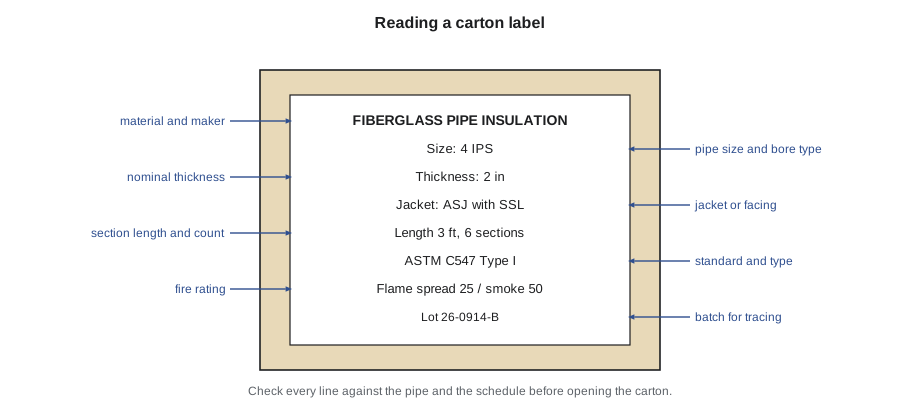
Bernie makes new apprentices read the label aloud, against the pipe, before every carton is opened. It feels slow for a week and then becomes habit. It catches the common mix-ups: CTS cartons delivered for IPS lines, the right size but the wrong thickness, plain sections where ASJ was specified and glass fiber where the line needed mineral wool. In INS-110, Devon learned how expensive it is to catch a thickness mistake late, when 130 ft of domestic hot water insulation had to be stripped and redone because he had worked from the material order rather than the specification.
Elastomeric and other flexible pipe insulation sizes
Flexible elastomeric foam tubing, used widely on refrigerant lines, cold water and small chilled water piping, is sized the same way: by IPS or CTS bore and by wall thickness. Because it stretches a little, it is more forgiving of a near fit, but the maker's sizing chart still governs. Stretching tubing over a pipe that is too large thins the wall and strains the glued seams; tubing that is too large leaves air spaces where condensation can form. Elastomeric sheet is used on pipes too large for tubing, and on those the insulator cuts the sheet to the circumference of the pipe, as lesson 2 describes.
Tubing sizes for refrigeration are usually listed by the actual outside diameter of the copper, such as 7/8 in or 1 1/8 in, because refrigerant tube is named that way. Mixing up a 7/8 in refrigeration size with a 7/8 in nominal water tube size would give the wrong bore: 7/8 in nominal water tube is actually 1 in across. Checking the pipe outside diameter, not the name, avoids the mix-up.
Pipe sizes on drawings and schedules
Mechanical drawings show each line with a size and a service abbreviation, such as "4" HWS", for a heating water supply of NPS 4. The specification's insulation schedule then gives the material and thickness by service and by pipe size range. A typical schedule line reads like this: heating water supply and return, up to and including NPS 1 1/4, 1 1/2 in; NPS 1 1/2 and larger, 2 in. The insulator needs both documents: the drawing for the size, confirmed by measurement, and the schedule for the thickness.
On drawings, the inch mark is easy to misread. A line marked 4" is NPS 4 steel with a 4.5 in outside diameter, or 4 inch copper with a 4.125 in outside diameter if it is copper; neither is 4 in across. Drawings for projects designed overseas, or for some manufacturers' equipment, may show metric DN sizes instead, such as DN 100 for NPS 4. The material column or the specification section tells which material, and the pipe itself confirms the size.
Common mistakes
MistakeAssuming the nominal size is the outside diameter.
InsteadLook up or measure the outside diameter; for NPS 12 and smaller it is always larger than the nominal size.
MistakeUsing IPS insulation on copper tube, or CTS insulation on steel pipe.
InsteadMatch the label to the pipe material: IPS for steel, stainless and IPS plastic; CTS for copper and tube-size plastics.
MistakeTaking the pipe size from the drawing without checking.
InsteadMeasure the pipe, especially where lines have been changed or where color and size do not agree.
MistakeWrapping the tape at an angle or over a lump of paint.
InsteadMeasure where the pipe is clean, with the tape square to the pipe.
MistakeWorking from the material order instead of the specification.
InsteadCheck size, thickness and jacket against the insulation schedule.
MistakeLeaving cut pieces unmarked.
InsteadMark size and thickness on any loose piece before it leaves the carton.
Summary and key terms
- Pipe and tube are named by nominal sizes; insulation must fit the actual outside diameter.
- Steel pipe (NPS) has a fixed outside diameter for each size, larger than the nominal size up to NPS 12.
- Copper water tube has an outside diameter 1/8 in larger than its nominal size; ACR tube is named by its actual outside diameter.
- Pipe insulation is made in iron pipe size (IPS) and copper tube size (CTS) bores and in nominal thicknesses.
- ASTM C585 sets standard inner and outer diameters so sections fit without forcing and nest for second layers; actual thickness can differ slightly from nominal.
- Identify a pipe by its material, its markings and its circumference: OD = circumference ÷ π.
- Read the label against the pipe and the specification before opening every carton.
- Nominal size
- The name of a pipe or tube size, which stands for a set of dimensions but is not itself a measurement.
- Outside diameter
- The distance across the outside of a pipe or tube; the dimension that pipe insulation must fit; OD.
- Nominal Pipe Size
- The North American sizing system for steel and stainless pipe, written NPS 2, NPS 4 and so on.
- Iron pipe size
- Insulation made to fit the outside diameter of steel pipe; IPS.
- Copper tube size
- Insulation made to fit the outside diameter of copper tube; CTS.
- ASTM C585
- The standard practice that sets the inner and outer diameters of pipe insulation for each pipe and tube size.
- Nesting
- The fit of one insulation size inside the bore of a larger size, which allows double layers from standard sections.
- ACR tube
- Copper tube for air conditioning and refrigeration, named by its actual outside diameter.
Practice problems
Work each problem on paper first, then reveal the answer to check.
What is the outside diameter of NPS 6 steel pipe?
Show answer
6.625 in.
A tape around a pipe reads 4 1/8 in. What is the outside diameter, and what might the pipe be?
Show answer
4.125 ÷ 3.1416 ≈ 1.313 in, which is NPS 1 steel pipe (1.315 in).
Why will insulation made for NPS 1 steel fit poorly on 1 inch copper tube?
Show answer
The steel pipe is 1.315 in across and the copper only 1.125 in, so the section is too loose.
What does ASTM C585 set?
Show answer
The inner and outer diameters of pipe insulation for each nominal size of pipe and tubing.
Name four things to check on the label before opening a carton.
Show answer
Any four of: material, pipe size, IPS or CTS, thickness, jacket, section length, ASTM standard and type, fire rating, C795 marking.
Lesson quiz · 5 questions
Score 60% or more to complete this lesson.
Create a free account to save your progress, take quizzes and earn a certificate.