
INS-130 · Lesson 5 of 12 · 25 min
Insulating hangers and supports
▶ Video coming soon A video version of this lesson is on the way.
The chilled water main in the Mountview third floor corridor hung from clevis hangers every 10 ft or so, and at each one the mechanical contractor had slipped a curved sheet metal shield under the pipe, ready for insulation. Devon reached the first hanger, cut his pipe covering to butt against the shield and moved on. Bernie stopped him at the second one. "What's carrying the pipe here?" she asked. He looked: the shield was resting on bare pipe, metal on metal, with nothing between. "In August, with the air on, that's a drip every few seconds. The shield goes outside the insulation, not inside it, and something hard goes between."
Supports are where pipe insulation fails most often. The pipe has to be held up, the hanger has to bear on something strong, and the insulation has to stay continuous and uncrushed. On hot systems, a gap at a support wastes energy and can leave a hot spot that burns hands. On cold systems, a gap at a support lets heat and moisture in, and the condensation that forms there wets the insulation along the pipe in both directions. This lesson covers the common types of hangers and supports, the two basic ways of insulating them, and the inserts and shields that make the second way work.
Hangers and supports
Pipe hangers and supports are installed by the pipefitters or plumbers, not the insulators, but insulators need to recognize them because each type is insulated differently. Hanger types and their components are described in the MSS SP-58 standard, which the specification usually refers to. Common types in commercial buildings are:
- Clevis hanger: a U-shaped strap under the pipe hung from a threaded rod, the most common hanger for horizontal pipe in ceilings.
- Split ring and band hangers: light hangers that wrap around small pipe.
- Trapeze: a horizontal channel or angle hung from two rods, carrying several pipes side by side on clamps, straps or rollers.
- Roller support: a roller under the pipe that lets it move along its length as it expands and contracts, used on hot lines.
- Riser clamp: a two-piece clamp bolted around a vertical pipe and resting on the floor or a beam at each level.
- Pipe clamp and U-bolt: clamps that grip the pipe directly and fix it to a support.
- Pipe saddle or shoe: a welded or clamped piece under the pipe, common on industrial racks, that raises the pipe so the insulation can pass under it.
Two ways to insulate at a support
There are two basic arrangements, and the specification says which one applies to each system:
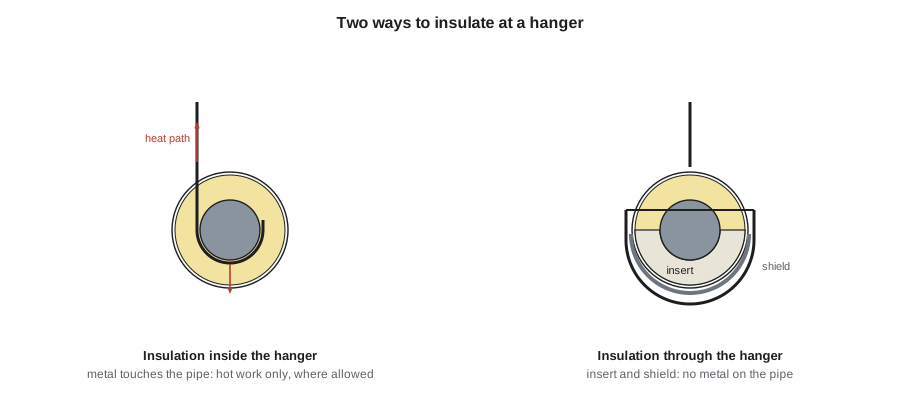
- Insulation inside the hanger: the hanger or clamp grips the pipe directly, and the insulation is fitted around the hanger and its rod. The hanger itself, being metal in contact with the pipe, is a path for heat. This arrangement is used on many hot systems in commercial buildings, where a small heat loss at each hanger is accepted, and where the hanger was installed tight to the pipe before insulation was planned.
- Insulation through the hanger: the hanger is sized for the outside of the insulation. An insert of rigid, high-strength insulation goes between the pipe and the hanger, and a metal shield goes between the insert and the hanger to spread the load. The insulation is continuous through the support, with no metal touching the pipe.
On cold systems, and on most well-specified hot systems, insulation through the hanger is required. On cold systems it is the only acceptable way: any metal touching a cold pipe and passing out through the insulation becomes cold, sweats and drips, and lets vapor in along its surface. The Kellerton ammonia line that iced up in INS-110 had exactly this fault: a hanger clamped directly to a pipe at −30 °F.
Inserts
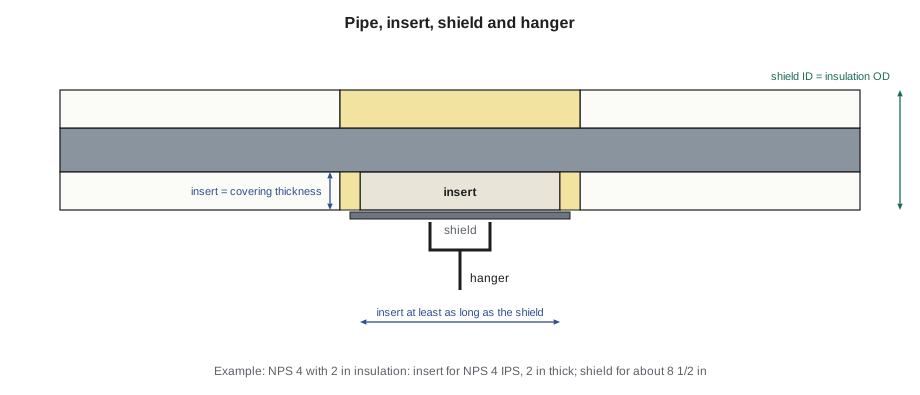
An insert is a short piece of rigid insulation with enough compressive strength to carry the weight of the pipe and its contents without crushing. It has the same inside diameter as the pipe covering and the same thickness, so it lines up with the insulation on each side. Inserts are usually half-round, covering the bottom half of the pipe where the shield bears, or full-round, and they are at least as long as the shield. Common insert materials are:
- Calcium silicate: strong and suitable for high temperatures; the usual insert on hot pipe.
- High-density polyisocyanurate or polyurethane foam, often with a factory vapor retarder: the usual insert on chilled water and other cold commercial piping.
- Cellular glass: strong, vapor-tight and suitable for a very wide range of temperatures, used on cold industrial piping, refrigeration and some hot work.
- High-density mineral wool or glass fiber: some makers offer dense fibrous inserts for light pipe and low loads, within limits stated by the maker.
- Wood blocks: once common and still allowed by some older specifications for small pipe, but they rot when wet and are a combustible material in the insulation system; most current specifications do not allow them.
Some manufacturers sell hanger shields with the insert already bonded inside, sized for each pipe and insulation thickness. The mechanical contractor installed these at Mountview on the chilled water and heating water mains, which is why the shields were already on the pipe when Devon arrived. The insulators' job was to make sure each shield sat in the right place and that the insulation butted to the insert on both sides with the vapor retarder carried across the joint.
Shields
A shield, called an insulation protection shield, is a curved sheet of galvanized or stainless steel that sits between the hanger and the insulation or insert. It spreads the load from the narrow hanger over a larger area so that the insulation is not cut or crushed. MSS SP-58 describes the shield as Type 40. Shields usually cover half the circumference, the bottom 180°, on clevis hangers and supports, and a full 360° on some clamps and on vertical pipe. They are made in standard lengths and gauges, longer and heavier for larger pipe and longer spans. A typical manufacturer's range runs from about 12 in long in light gauge for small pipe to 24 in long in heavier gauge for large pipe.
Three dimensions have to agree at every support:
- The insert's inside diameter matches the pipe's outside diameter.
- The insert's thickness matches the pipe covering's thickness, so the outside surfaces line up.
- The shield's inside diameter matches the outside diameter of the insulation, and the hanger is sized for the shield.
Worked problem
Sizing the shield and insert
A heating water main of NPS 4 at Mountview is insulated with 2 in glass fiber. What inside diameter and thickness does the insert need, and what inside diameter must the shield and hanger fit?
Show solution
- Insert inside diameter: the pipe outside diameter, 4.5 in (NPS 4 IPS).
- Insert thickness: the same as the covering, 2 in.
- Insulation outside diameter: 4.5 + 2 × 2 = 8.5 in.
- The shield must fit an insulation outside diameter of about 8 1/2 in, and the hanger must be sized for the shield, not the pipe.
Answer: Insert for NPS 4 IPS, 2 in thick; shield and hanger for about 8 1/2 in. A hanger sized for the NPS 4 pipe would be far too small.
When hangers are sized for the pipe instead of the insulation, there is no room for an insert, and the only options are to change the hanger or to fall back on insulation inside the hanger. On cold work the second option is not acceptable, so undersized hangers must go back to the mechanical contractor. This is a coordination problem that Coldstream's project managers try to catch at the submittal stage, by checking the hanger submittals against the insulation schedule.
Why fibrous insulation cannot carry the load
Glass fiber pipe covering has a very low compressive strength. Under the narrow edge of a hanger it crushes, the insulation thins at the support and the jacket tears. Even under a shield, a heavy water-filled pipe can compress fibrous insulation over time. The calculation below shows why inserts of stronger material are needed.
Worked problem
Load at a support
The NPS 4 heating water main is Schedule 40 steel, which weighs about 10.8 lb/ft empty and holds about 5.5 lb/ft of water. The 2 in glass fiber covering weighs about 1.1 lb/ft. Hangers are 10 ft apart and each carries the weight of 10 ft of pipe. The shield is 12 in long. What is the load on each hanger, and the average bearing pressure on the shield's projected area (length × insulation outside diameter of 8 1/2 in)?
Show solution
- Weight per foot: 10.8 + 5.5 + 1.1 = 17.4 lb/ft.
- Load per hanger: 17.4 × 10 = 174 lb.
- Projected area: 12 × 8.5 = 102 in².
- Pressure: 174 ÷ 102 ≈ 1.7 psi.
Answer: About 174 lb per hanger and an average of about 1.7 psi. That is far less than the strength of calcium silicate or high-density foam inserts, but enough to crush ordinary glass fiber covering over time. The real pressure is higher than the average where the shield bears hardest, at the bottom.
Insert and shield makers publish load tables by pipe size, insulation thickness and hanger spacing, and the mechanical engineer selects shield lengths and gauges from them. The insulator's job is to install what was selected, in the right place, and to flag anything that looks wrong, such as a short shield on a large pipe or a shield sitting off-center on its hanger.
Counting supports for an estimate
Every hanger on an insulated line through the hanger needs an insert and a shield, and every hanger on a line with insulation inside the hanger needs extra cutting and fitting. Estimators count them. On straight runs, the count is the run length divided by the hanger spacing, plus one for the end.
Worked problem
Inserts for a chilled water main
The Mountview third floor chilled water main is NPS 4, 138 ft long, with hangers at 10 ft spacing including one at each end. How many inserts and shields are needed?
Show solution
- Spaces: 138 ÷ 10 = 13.8, so 14 spaces (the last one shorter).
- Hangers: 14 + 1 = 15.
Answer: 15 inserts and 15 shields, plus any at branch take-offs and changes of direction shown on the hanger drawings.
Installing at a support, step by step
For insulation through the hanger, the usual order of work is:
- Check that the hanger is sized for the insulation and that the shield and insert are the right size and type for the system.
- If the insert is separate, place it on the pipe at the hanger; if it is bonded in the shield, check that it is centered on the hanger.
- Fit the pipe covering to butt tightly against each end of the insert, with no gap. Trim the covering, not the insert.
- Where the insert covers only the bottom half, fill the top half with pipe covering cut to fit, or with a matching half insert.
- Seal the joints between the insert and the covering. On cold work, carry the vapor retarder continuously across the insert, with the insert's own vapor retarder lapped and sealed to the jacket on each side, and seal every joint with vapor retarder tape or mastic.
- Make sure the shield sits centered on the hanger and does not cut into the jacket; on cold work, the shield goes outside the vapor retarder so it cannot puncture it.
For insulation inside the hanger on hot work, the covering is cut to fit snugly around the hanger and its rod, the gaps are filled with loose or cut insulation and the jacket is sealed around the rod. A neat job here takes practice: a clean slot in the top of the section for the rod, a notch for the hanger strap and a patch of jacket over the cuts.
On risers, riser clamps carry the weight of the pipe at each floor. On hot risers, insulation is usually fitted around the clamp. On cold risers, the clamp must be insulated as well, with the insulation and vapor retarder carried over it and sealed, or the clamp must be of a type that bears on an insert rather than the pipe.
Common mistakes
MistakeInstalling the shield on bare pipe, inside the insulation.
InsteadPut a rigid insert next to the pipe and the shield outside the insulation, under the hanger.
MistakeLetting glass fiber covering carry the pipe at a hanger.
InsteadUse an insert of calcium silicate, high-density foam or cellular glass at every support.
MistakeUsing an insert thinner than the covering.
InsteadMatch the insert thickness to the covering so the surfaces line up.
MistakeLeaving a gap between the insert and the covering.
InsteadButt the covering tightly to the insert and seal the joints.
MistakeAccepting hangers sized for the pipe on a cold line.
InsteadReport them; hangers on insulated lines through the hanger must be sized for the shield.
MistakeBreaking the vapor retarder at the insert.
InsteadLap and seal the insert's vapor retarder to the jacket on each side.
Summary and key terms
- Supports are where pipe insulation most often fails, by gaps, crushing or metal contact with the pipe.
- Insulation may go inside the hanger (hot work only, where allowed) or through the hanger with an insert and shield.
- On cold systems, no metal may touch the pipe and pass through the insulation.
- Inserts are rigid, high-strength insulation of the same bore and thickness as the covering: calcium silicate on hot work, high-density foam or cellular glass on cold work.
- Shields (MSS SP-58 Type 40) spread the hanger load; the shield fits the insulation outside diameter and the hanger fits the shield.
- Load at a support can crush fibrous insulation over time, which is why inserts are needed.
- Count hangers as run length ÷ spacing + 1 for estimates.
- Clevis hanger
- A U-shaped strap under a pipe hung from a threaded rod.
- Trapeze
- A horizontal support member hung from two rods that carries several pipes.
- Riser clamp
- A two-piece clamp around a vertical pipe that carries its weight at a floor.
- Insert
- A piece of rigid, high-strength insulation that carries the pipe load at a support.
- Insulation protection shield
- A curved metal sheet between the hanger and the insulation that spreads the load; MSS SP-58 Type 40.
- MSS SP-58
- The standard for pipe hanger and support materials, design and manufacture.
- Compressive strength
- The load per unit area a material can carry before it crushes or deforms a set amount.
Practice problems
Work each problem on paper first, then reveal the answer to check.
Why is insulation inside the hanger not acceptable on cold piping?
Show answer
The metal hanger touching the pipe becomes cold, sweats and lets moisture in.
What insert material is usual on hot pipe?
Show answer
Calcium silicate.
A line of NPS 2 has 1 1/2 in insulation. What outside diameter must the shield fit?
Show answer
2.375 + 2 × 1.5 = 5.375 in.
A 90 ft run has hangers at 10 ft including both ends. How many?
Show answer
90 ÷ 10 = 9 spaces, so 10 hangers.
Where does the shield go in relation to the vapor retarder on cold work?
Show answer
Outside it, so it cannot puncture the vapor retarder.
Lesson quiz · 5 questions
Score 60% or more to complete this lesson.
Create a free account to save your progress, take quizzes and earn a certificate.