
INS-130 · Lesson 8 of 12 · 23 min
Pipe insulation for plumbing systems
▶ Video coming soon A video version of this lesson is on the way.
Devon's most expensive lesson at Mountview was a plumbing lesson. In INS-110, he insulated the domestic hot water branches on the second floor with the thickness written on the material order instead of the one in the specification, and the crew spent half a day stripping and redoing 130 ft of pipe. Raj had read the line aloud from the insulation schedule: domestic hot water, 1 1/4 and up, 1 1/2 in. The second plumbing lesson came a week later, from the storm drains, and it was about why a pipe that carries rainwater needs insulation at all.
Plumbing systems carry water for drinking, washing and drainage. Much of that piping is insulated, for different reasons on different services. This lesson covers which plumbing systems are insulated and why, the materials used on each, what codes and specifications typically require, and the details that come up on plumbing work: small copper and plastic piping, piping in walls and under fixtures, and drainage piping that sweats.
Which plumbing systems are insulated, and why
| Service | Main reason for insulation | Usual vapor retarder? |
|---|---|---|
| Domestic hot water supply | Energy savings and keeping water hot at the fixture | Not for vapor control, but the jacket is usually ASJ |
| Domestic hot water recirculation | Energy savings; the loop runs all the time | As for hot water supply |
| Domestic cold water | Condensation control in warm, humid spaces; freeze protection where exposed to cold | Yes, sealed and continuous |
| Tempered water (mixed to a set temperature for fixtures such as emergency showers) | Keeping the temperature steady | Depends on the temperature |
| Storm drainage: roof drain bodies and horizontal rainwater piping inside the building | Condensation control when cold rain and snowmelt run through warm spaces | Yes, sealed and continuous |
| Sanitary drainage and vents | Usually not insulated; sometimes for noise, or for freeze protection where exposed | Depends on the reason |
| Piping under accessible lavatories and sinks | Protecting users from burns and contact | Not for vapor control |
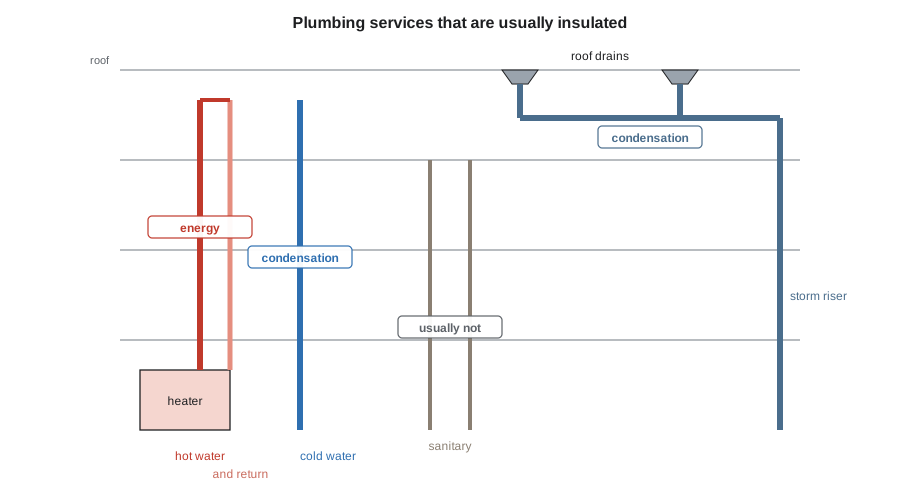
The reason matters because it decides the details. Hot water insulation is about heat flow, so a small gap costs some energy but does no damage. Cold water and storm insulation are about condensation, so a small gap in the vapor retarder lets moisture in and soaks the insulation over time. That is why Bernie treats domestic cold water and storm piping as cold work, with every seam and joint sealed, even though the water inside is not refrigerated.
Domestic hot water and recirculation
Domestic hot water (DHW) is heated in water heaters or heat exchangers and piped to fixtures. In large buildings, a recirculation line, also called a DHW return, carries water from the far ends of the system back to the heater, with a small pump, so that hot water arrives at a tap within seconds rather than after the pipes have drained their cooled water. Hospitals and health care buildings store hot water at a high temperature, 140 °F or more, to control Legionella bacteria, and mix it down to a safe temperature at the fixtures. At Mountview, the heaters store water at 140 °F and the distribution and recirculation piping run close to that.
Because the recirculation pump runs day and night, an uninsulated loop loses heat all year. The calculation below shows how much.
Worked problem
Heat saved by insulating a recirculation line
A 200 ft run of 1 inch copper recirculation line runs at about 130 °F in a 70 °F ceiling space, all year. Bare, it loses about 31.1 Btu/h per foot; with 1 in glass fiber insulation, about 6.8 Btu/h per foot. How much heat does the insulation save in a year of 8,760 hours?
Show solution
- Saving per foot: 31.1 − 6.8 = 24.3 Btu/h·ft.
- Saving for the run: 24.3 × 200 = 4,860 Btu/h.
- Saving per year: 4,860 × 8,760 ≈ 42.6 million Btu (42.6 MMBtu).
Answer: About 42.6 MMBtu a year, which is about 78 in 100 of the heat the bare pipe would lose, from one small line. The loss figures are approximate values for a still-air ceiling space, calculated as in INS-120.
Energy codes require insulation on service water heating piping, with minimum thicknesses that depend on the water temperature and the pipe size. Since March 1, 2024, Ohio's commercial energy code has been the 2021 International Energy Conservation Code with state amendments, with ASHRAE 90.1-2019 as an alternative path. The code tables set minimums, and project specifications often call for more. The insulation schedule in the specification is what the insulator follows; it already takes the code into account.
Domestic hot water insulation is usually glass fiber pipe covering with ASJ and SSL, with PVC fitting covers on elbows and tees. Small branches are sometimes insulated with flexible elastomeric tubing where the specification allows. Valves on hot water piping are insulated or left accessible as the specification says; at Mountview, balancing valves on the recirculation branches were left with their handles and test ports exposed, with the insulation stopped neatly on each side.
Domestic cold water
Domestic cold water (DCW) comes into the building from the water main at the temperature of the ground, which in central Ohio can be as low as 40 to 45 °F in late winter and early spring. In summer, the same pipes pass through ceiling spaces and mechanical rooms where the air is warm and humid. Whenever the pipe surface is colder than the dew point of the air around it, moisture condenses on it. Condensation on cold water lines drips onto ceilings, stains tiles and feeds mold. Lesson 10 explains dew point and vapor retarders in detail.
Cold water insulation must therefore have a continuous, sealed vapor retarder. Glass fiber covering with ASJ is common, with every SSL lap pressed, every butt joint sealed with a butt strip, fitting covers sealed with vapor retarder tape or adhesive and no staples. Elastomeric tubing, with every seam and joint glued, is also common on small sizes. Thicknesses are often modest, around 1/2 to 1 in, because the purpose is to keep the surface above the dew point rather than to save energy.
Cold water piping in places that can freeze, such as loading docks, unheated vestibules, parking garages and exterior walls, needs more thought. Insulation slows heat loss but does not stop water from freezing if it sits long enough in cold air; where freezing is possible, the specification usually calls for heat tracing under the insulation, or for the pipe to be rerouted. Insulators coordinate with the electrician who installs the heat trace, as lesson 3 noted.
Storm drainage piping
Storm drainage, also called rainwater drainage, carries water from roof drains down through the building to the storm sewer. A roof drain is a bowl-shaped fitting set into the roof with a strainer on top; below the roof, its body and the horizontal rainwater piping, called rain leaders, run through the top floor ceiling to a riser. When snow melts on the roof or cold rain falls, water at close to freezing runs through that piping. The pipes, and especially the large cast-iron roof drain bodies, become cold enough to sweat in the warm space below.
Specifications usually require insulation with a vapor retarder on roof drain bodies and horizontal rainwater piping, and sometimes on the first part of the vertical riser below the horizontal run. On the Mountview job, the drawings had a note saying to insulate storm drain piping 1 in, but the insulation schedule called for 1 1/2 in on horizontal rainwater piping and drain bodies. Coldstream sent a request for information (RFI), and the engineer confirmed the schedule. INS-110 told that story as an example of what to do when documents disagree.
Roof drain bodies are awkward shapes: a wide bowl, a clamp ring and an outlet that turns down or sideways. Insulators wrap them with flexible blanket or fit them with cut pieces of board or covering, then finish them with a vapor retarder mastic and fabric or a sealed jacket, making sure the vapor retarder is continuous with the insulation on the rain leader. The underside of the roof deck around the drain is often cold too, but insulating the deck is not part of the plumbing insulation unless the specification says so.
Small copper, plastic piping and fixtures
Plumbing involves a lot of small pipe. Domestic water branches to fixtures are often 1/2 to 3/4 in copper or PEX. Several points apply:
- Copper water tube needs CTS insulation, as lesson 1 explained. PEX tubing is made to copper tube outside diameters, so it also takes CTS insulation.
- CPVC is made in copper tube sizes in some product lines and iron pipe sizes in others, and PVC drainage pipe follows iron pipe size outside diameters. Check the marking on the pipe.
- Plastic piping softens at lower temperatures than metal and must not be heated; adhesives and tapes for insulation on plastic pipe must be compatible with it, so check that the insulation maker's adhesive is approved for the pipe material.
- Small branches inside walls and chases are often insulated before the walls are closed, so timing and coordination with the drywall trade matter as much on plumbing as on chilled water.
Lavatories and sinks used by people in wheelchairs need protection on the pipes underneath, so that hot water supply pipes and drains cannot burn or injure someone's legs. The ADA Standards for Accessible Design require water supply and drain pipes under accessible lavatories and sinks to be insulated or otherwise configured to protect against contact. On many projects this is done with preformed vinyl covers made for the trap and supply stops, installed by the plumber, but on some jobs it falls to the insulator, and the specification says which.
Taking off plumbing insulation
Plumbing drawings show the services by line type and abbreviation, such as DCW, DHW and DHWR, with sizes on each run. The insulation schedule gives the thickness by service and size. A takeoff, a measured list of the quantities, groups the pipe by service, size and thickness, because each combination is a different carton.
Worked problem
A plumbing takeoff for one floor
On the Mountview second floor, the takeoff shows 158 ft of 2 inch copper DHW, 170 ft of 1 inch copper DHWR and 164 ft of 2 1/2 inch copper DCW. The schedule calls for 1 1/2 in on DHW 1 1/4 and up, 1 in on DHW and DHWR up to 1 inch and 1 in on all DCW. Sections are 3 ft; allow 5 in 100 for waste. How many sections of each are needed, and in which size and thickness?
Show solution
- DHW, 2 inch CTS, 1 1/2 in: 158 ÷ 3 ≈ 52.7, so 53 pieces; with waste 53 × 1.05 ≈ 55.7, so 56 sections.
- DHWR, 1 inch CTS, 1 in: 170 ÷ 3 ≈ 56.7, so 57; with waste 57 × 1.05 ≈ 59.9, so 60 sections.
- DCW, 2 1/2 inch CTS, 1 in with a sealed vapor retarder: 164 ÷ 3 ≈ 54.7, so 55; with waste 55 × 1.05 ≈ 57.8, so 58 sections.
Answer: 56 sections of 2 CTS × 1 1/2 in, 60 of 1 CTS × 1 in and 58 of 2 1/2 CTS × 1 in, all with ASJ, before fittings. The three are different cartons, and the DHW size is the one Devon got wrong in September.
Fittings are counted separately: elbows, tees, valves and the fixture connections where the insulation stops. On plumbing, insulation often stops at a fixture's supply stop, the small shut-off valve under a sink or toilet, or at the wall where the branch enters a chase. The specification usually says how far toward the fixture the insulation must run.
Common mistakes
MistakeTreating domestic cold water as if it needs no vapor retarder because the water is not refrigerated.
InsteadSeal every lap, joint and fitting; it sweats in warm, humid spaces.
MistakeSkipping the storm drain bodies because they are an awkward shape.
InsteadInsulate drain bodies and rain leaders with a continuous, sealed vapor retarder as the specification requires.
MistakeUsing IPS insulation on PEX tubing.
InsteadPEX is made to copper tube outside diameters and takes CTS insulation.
MistakeFollowing a drawing note that conflicts with the insulation schedule.
InsteadRaise an RFI; do not pick one on your own.
MistakeCovering balancing valve handles and test ports.
InsteadStop the insulation neatly so valves can be read and adjusted, as the specification requires.
MistakeExpecting insulation alone to stop a cold water line from freezing in an unheated space.
InsteadInsulation slows heat loss; freeze protection usually needs heat tracing or rerouting.
Summary and key terms
- Domestic hot water and recirculation are insulated for energy; the recirculation loop runs all year.
- Domestic cold water is insulated for condensation and sometimes freeze protection, and needs a continuous, sealed vapor retarder.
- Roof drain bodies and horizontal rainwater piping sweat when cold water runs through warm spaces and need sealed insulation.
- Energy codes set minimum thicknesses for service water heating piping; the specification's schedule already takes them into account.
- Copper and PEX take CTS insulation; check plastic pipe markings and adhesive compatibility.
- Pipes under accessible lavatories must be protected against burns and contact.
- Take off plumbing by service, size and thickness, because each combination is a different carton.
- Domestic hot water
- Heated potable water for washing and other uses; DHW.
- Recirculation line
- A return pipe that circulates hot water back to the heater so it stays hot throughout the system; DHWR.
- Domestic cold water
- Potable water from the water main at ground temperature; DCW.
- Roof drain
- A fitting set into the roof that collects rainwater and feeds the storm drainage piping.
- Rain leader
- Horizontal or vertical piping that carries rainwater from roof drains.
- Supply stop
- The small shut-off valve on the water supply to a fixture.
- Takeoff
- A measured list of the quantities of each material needed for a job or area.
Practice problems
Work each problem on paper first, then reveal the answer to check.
Why does a recirculation line waste so much heat if it is bare?
Show answer
The pump runs all the time, so the line is hot all year.
Why is domestic cold water insulation treated as cold work?
Show answer
The pipe is often below the dew point of the air around it, so the vapor retarder must be sealed.
A 100 ft run of 3/4 inch copper DHW needs how many 3 ft sections with 5 in 100 waste?
Show answer
100 ÷ 3 ≈ 33.3, so 34; 34 × 1.05 ≈ 35.7, so 36 sections.
What insulation bore does PEX tubing take?
Show answer
CTS, because PEX is made to copper tube outside diameters.
Which parts of the storm drainage are usually insulated?
Show answer
Roof drain bodies and horizontal rainwater piping, sometimes the top of the riser.
Lesson quiz · 5 questions
Score 60% or more to complete this lesson.
Create a free account to save your progress, take quizzes and earn a certificate.