
INS-130 · Lesson 4 of 12 · 23 min
Securing insulation: bands, wire and tape
▶ Video coming soon A video version of this lesson is on the way.
In the Mountview mechanical room, the plain mineral wool on the medium-pressure steam line had to stay closed for a week before the PVC jacket went on. Devon wired the first run with ties wherever they seemed to be needed: two close together on one section, none on the next, a twist of wire sticking out like a pig's tail at every tie. Marcel Ouellet, the journeyworker on loan from the Kellerton crew for the steam work, ran his hand along it and caught his glove on three of the pigtails. "Three ties a section, even spacing, ends turned in," he said. "Somebody is going to put their hand on this pipe for the next forty years."
Insulation that falls off, sags or opens at the seams stops working. Securement is the general name for the wire, bands, tape, staples and adhesives that hold insulation and its jacket in place. The specification usually names the securement for each system, and manufacturers' instructions set limits for their products. This lesson describes the common methods for pipe covering, how they are spaced and installed and how to work out quantities.
Choosing the method
Which securement to use depends on the insulation, the jacket, the temperature and the environment:
- Jacketed fibrous sections with SSL laps and butt strips usually need no other securement on indoor commercial work; the lap and strips hold them closed. Some specifications add staples or bands on large sizes or on vertical runs.
- Plain fibrous sections that will be covered with a field-applied jacket are held with wire or bands until the jacket goes on.
- Rigid sections such as calcium silicate, perlite and cellular glass are held with bands or wire, because their weight and stiffness need a firm hold, and on cold work with tape that will be covered by mastic or jacketing.
- Elastomeric tubing is held by its glued seams and joints; it is not wired or banded, because wire cuts into the soft foam.
- Metal jackets are held by bands, screws or rivets, as INS-220 covers. Bands over the jacket are different from the ties that hold the insulation underneath.
Materials matter as much as method. On stainless steel piping, only stainless steel wire and bands are used, and only those that will not leave chlorides or rust stains; carbon steel ties on stainless can cause corrosion where they touch. Galvanized wire is common indoors on carbon steel pipe; outdoors and in wet areas, stainless steel wire and bands are standard. Aluminum bands go with aluminum jackets, and stainless steel bands are also used over aluminum when a separating material or the maker's approval allows, because mixing metals can cause galvanic corrosion, as INS-120 explained.
Wire ties
Wire is the simplest securement for plain sections. Typical insulation wire is soft annealed stainless steel or galvanized steel in about 16 or 18 gauge diameter, sold in coils. Soft annealed wire bends easily and holds a twist without springing back. To tie a section:
- Close the section firmly on the pipe.
- Wrap the wire around it once, snug against the surface, at the marked position.
- Twist the ends together with pliers or a twisting tool, about three full turns, until the wire is tight enough to hold the section closed but not so tight that it cuts into the insulation.
- Cut off the excess, leaving a short twisted end, and bend the end flat and push it into the insulation so no sharp point sticks out.
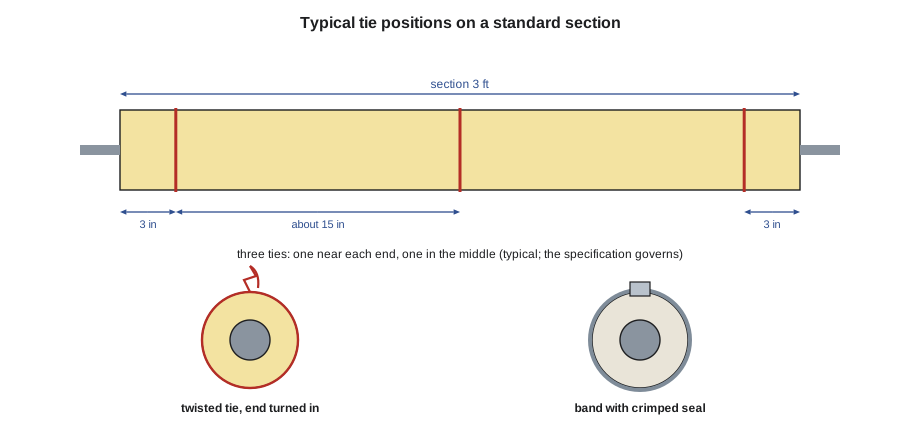
Spacing is set by the specification or the manufacturer. A common commercial and industrial practice for pipe covering is to place ties at no more than about 12 in apart, with at least two ties on every section and one within about 3 in of each end. On a standard 3 ft section, that usually means three ties: one near each end and one in the middle. Larger and heavier sections, and the outer layer of double-layer work, may call for more. These are typical values; the project specification and the maker's instructions govern.
Worked problem
Wire for a steam line
The Mountview medium-pressure steam line in the mechanical room is 3 in, 80 ft long, insulated with 2 in plain mineral wool sections 3 ft long. Each section gets three ties. Each tie uses the circumference of the insulation plus 6 in for the twist. How much wire is needed?
Show solution
- Pieces: 80 ÷ 3 ≈ 26.67, so 26 full sections and a filler: 27 pieces.
- Ties: 27 × 3 = 81. Short fillers may need only two, so 81 is a safe count.
- Insulation outside diameter: 3.5 + 2 × 2 = 7.5 in; circumference 3.1416 × 7.5 ≈ 23.6 in.
- Wire per tie: 23.6 + 6 = 29.6 in.
- Total: 81 × 29.6 ≈ 2,398 in ≈ 200 ft.
Answer: About 200 ft of wire, before allowing for fittings and waste. One coil covers it easily.
Bands and seals
Bands are flat metal straps, usually stainless steel or aluminum, used to hold rigid insulation, heavy sections and the outer layer of large pipe, and to hold metal and PVC jackets. Common sizes for pipe work are about 1/2 in wide and about 0.015 to 0.020 in thick for insulation, and 1/2 or 3/4 in wide over jackets. Bands are tensioned with a banding tool and locked with a seal, a small metal clip crimped over the overlapping ends, or with a wing seal or buckle formed on the band itself. Some bands come pre-cut with a factory-formed buckle in the length needed for each pipe size.
To install a band with a separate seal:
- Thread the band around the insulation and through the seal, leaving enough tail to grip with the tool.
- Tension the band with the banding tool. Hold it tight enough to hold the insulation without crushing it; on fibrous insulation, a band that bites into the surface is too tight.
- Crimp the seal with the tool, or with a seal crimper, while the band is under tension.
- Cut off the tail close to the seal and fold the cut end back so no sharp edge sticks out.
Bands under a jacket are placed at the same spacing as wire ties. Bands over a jacket are usually spaced farther apart, often at about 12 to 18 in on pipe, with one band on each circumferential lap of the jacket; INS-220 covers jacket banding. Band ends and seals are a common cause of cuts, so insulators wear gloves when banding and turn every cut end in.
Worked problem
Bands and seals for calcium silicate
A run of 4 in medium-pressure condensate in a Mountview service corridor is to be insulated with 2 in calcium silicate sections. The crew has 20 sections to band, three bands to a section. Each band needs the circumference of the insulation plus 3 in for the seal and the tool. How many seals and how much band are needed? Band comes in 100 ft coils.
Show solution
- Bands and seals: 20 × 3 = 60.
- Insulation outside diameter: 4.5 + 2 × 2 = 8.5 in; circumference 3.1416 × 8.5 ≈ 26.7 in.
- Band per tie: 26.7 + 3 = 29.7 in.
- Total band: 60 × 29.7 = 1,782 in = 148.5 ft.
- Coils: 148.5 ÷ 100 ≈ 1.49, so 2 coils.
Answer: 60 seals and 2 coils of band. Order a few extra seals; dropped seals are rarely found again.
Tapes
Tape has several jobs in pipe insulation: sealing butt joints and laps, repairing small tears, holding insulation temporarily and, on cold work, forming part of the vapor retarder. Common tapes are:
- ASJ tape, made of the same laminate as the all-service jacket, for butt strips and repairs on ASJ-jacketed covering.
- Foil-scrim-kraft (FSK) and aluminum foil tapes, for foil-faced products and duct wrap.
- PVC tape and vinyl tapes, for some PVC jackets and fitting covers.
- Low-permeance vapor retarder tapes, such as those with a PVDC or metallized film, for cold systems where the tape is part of the vapor retarder.
- Glass cloth tapes, for some high-temperature and specialty work.
A tape is only as good as its bond. Use the tape the specification or the jacket maker names; apply it to a clean, dry surface above its minimum application temperature; and press it firmly with a squeegee along its whole length. Tape used to hold insulation temporarily, for example to keep a section closed until it can be wired, is not a substitute for the specified securement, and ordinary duct tape or masking tape left inside a finished system loses its grip and leaves residue.
Staples
Outward-clinching staples, driven with a special stapler so their legs spread outward into the insulation rather than inward, are sometimes used to help hold the laps and butt strips of ASJ on hot systems. A typical specification puts them at about 4 in centers along the lap and along both edges of butt strips. Staples are made of stainless steel or Monel so they do not rust and stain the jacket.
Staples puncture the jacket, so on cold systems they puncture the vapor retarder. Many specifications forbid staples on cold piping. Where they are allowed, each staple must be covered with vapor retarder mastic or tape, so that the jacket is sealed again. Bernie's crews do not staple cold work at all. "Every staple is a hole," she told Devon. "On chilled water, I'd rather have no holes to cover."
Adhesives
Adhesives secure insulation in two ways: by bonding the insulation to itself, as on the seams and joints of elastomeric foam and the joints of cellular glass, and by bonding a jacket or facing to the insulation or to itself. Each adhesive is made for particular materials and temperatures. A contact adhesive for elastomeric foam is applied thinly to both surfaces and allowed to become tacky, then the surfaces are pressed together; once they touch, they cannot be moved. Joint sealants for cold cellular glass stay flexible so joints can move with the pipe. INS-120 covered adhesive types; on the job, the rule is to use the adhesive the insulation maker approves, within its temperature range and open time.
Adhesives and sealants carry WHMIS or HazCom labels and safety data sheets. Many contain solvents that are flammable and give off vapors in confined areas. Ventilate the work area, keep ignition sources away, close containers when not in use and wear the gloves the safety data sheet calls for.
Checking securement
Before moving on from a run, check it:
- Ties and bands are evenly spaced, at the specified spacing, with one near each end of every section.
- Ties and bands are snug but do not cut into the insulation.
- All twisted ends and band tails are turned in or folded back, with no sharp points.
- Laps and butt strips are pressed down along their full length with no lifted edges.
- No staples on cold work, or every staple sealed where the specification allows them.
- The right metals: stainless steel on stainless pipe and outdoors; compatible metals with metal jackets.
Marcel's last check on the steam line was the one Devon remembered: he closed his eyes and ran a gloved hand along the whole run. If his glove caught anywhere, the tie was redone.
Vertical runs and large pipe
Securement has to work harder on risers and on large-diameter pipe. On a vertical run, gravity pulls each section down, and the column of insulation above a joint pushes on it. Ties and bands on risers are usually placed at the same spacing as on horizontal pipe, but every section must be secured; none can be left to rest on the one below. On tall risers, specifications call for insulation support rings or collars, metal rings clamped or welded to the pipe at intervals, often at each floor or every 10 ft or so, that carry the weight of the insulation above them so the lower sections are not crushed.
On cold risers, a support ring is a piece of metal attached to cold pipe, so it must be insulated and sealed like any other metal attachment, with the vapor retarder carried over it and sealed. Some cold-system specifications use rings that bear on a block of high-density insulation instead of touching the pipe.
Large pipe, roughly NPS 12 and up, is often insulated with curved segments or with board cut into staves rather than with sections, because single sections become heavy and awkward. Those systems are held with bands at closer spacing and sometimes with an inner layer of wire mesh. INS-310 covers equipment and large-diameter work. On commercial jobs like Mountview, where the largest pipe was NPS 6, sections and the methods in this lesson cover nearly everything.
Common mistakes
MistakeSpacing ties wherever they seem to be needed.
InsteadMark positions and space ties evenly, at least two per section with one near each end.
MistakeLeaving twisted wire ends or band tails sticking out.
InsteadTurn wire ends into the insulation and fold band tails back.
MistakePulling bands so tight they cut into fibrous insulation.
InsteadTension bands only enough to hold the insulation closed.
MistakeUsing carbon steel wire on stainless steel pipe.
InsteadUse stainless steel securement on stainless steel and outdoors.
MistakeStapling ASJ laps on a chilled water line.
InsteadDo not staple cold work; where allowed, seal every staple with vapor retarder mastic or tape.
MistakeWiring elastomeric tubing.
InsteadGlue elastomeric seams and joints; wire cuts into the foam.
Summary and key terms
- Securement holds insulation and jackets in place; the specification and the maker's instructions set the method and spacing.
- Jacketed sections are held by SSL laps and butt strips; plain and rigid sections by wire or bands; elastomeric foam by glued joints.
- Typical tie spacing is about 12 in with at least two per section and one near each end, usually three on a 3 ft section.
- Wire for a tie is about the insulation circumference plus a twist allowance; bands need the circumference plus an allowance for the seal and tool.
- Use stainless steel securement on stainless pipe and outdoors, and metals compatible with any jacket.
- Use the specified tape on clean, dry surfaces above its minimum temperature, and press it firmly.
- Staples puncture the vapor retarder; avoid them on cold work or seal each one.
- Securement
- The wire, bands, tape, staples and adhesives that hold insulation and jackets in place.
- Annealed wire
- Wire softened by heat treatment so it bends easily and holds a twist.
- Band
- A flat metal strap tensioned around insulation or a jacket and locked with a seal or buckle.
- Seal
- A small metal clip crimped over the overlapping ends of a band.
- Outward-clinching staple
- A staple whose legs spread outward into the insulation when driven.
- Contact adhesive
- An adhesive applied to both surfaces and allowed to become tacky before the surfaces are joined.
- Galvanic corrosion
- Corrosion that occurs when two different metals touch in the presence of moisture.
Practice problems
Work each problem on paper first, then reveal the answer to check.
How many ties go on a standard 3 ft section under typical practice?
Show answer
Three: one near each end and one in the middle.
How much wire does one tie need on insulation with an outside diameter of 6.5 in, allowing 6 in for the twist?
Show answer
3.1416 × 6.5 ≈ 20.4 in, plus 6 = 26.4 in.
Why is elastomeric tubing not wired?
Show answer
The wire cuts into the soft foam; the glued joints hold it.
What must be done if staples are allowed on a cold line?
Show answer
Cover each staple with vapor retarder mastic or tape.
40 sections need three bands each. How many seals?
Show answer
120.
Lesson quiz · 5 questions
Score 60% or more to complete this lesson.
Create a free account to save your progress, take quizzes and earn a certificate.