
HSE-250 · Lesson 9 of 12 · 27 min
Training, roles and responsibilities
Every hazmat shipment passes through several pairs of hands: the person who classifies and packs it, the person who loads it, the driver or crew who move it, the warehouse worker who transfers it, and the person who receives and unloads it. The HMR assign duties to each of them and require that each hazmat employee be trained for the part they play. This lesson covers who is responsible for what, and how training and training records work.
The main roles
The HMR describe the main roles by function. The offeror or shipper is the person who performs or is responsible for pre-transportation functions such as classifying, packaging, marking, labeling and preparing shipping papers, and who tenders the shipment to a carrier. The carrier is the person who transports hazmat in commerce by highway, rail, air or vessel, including a private company carrying its own materials. The consignee is the person to whom the shipment is delivered. A hazmat employer is anyone who uses hazmat employees, and a hazmat employee is anyone whose work directly affects hazmat transport safety. One company can play several roles at once.
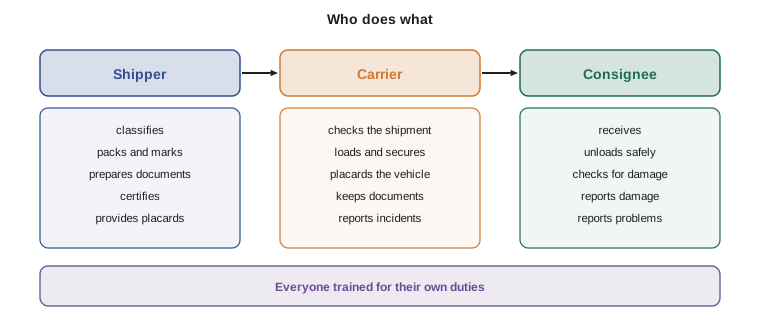
Shipper duties
The shipper carries the heaviest load. Before offering hazmat for transport, the shipper must classify it, choose and fill an authorized packaging, mark and label the packages, prepare the shipping paper with the certification, provide emergency response information and a monitored telephone number, register with PHMSA if it offers placarded quantities, and provide placards to the motor carrier unless the vehicle is already correctly placarded. A shipper that uses a third party, such as a packaging service or freight forwarder, remains responsible for the functions it performs or causes to be performed.
Carrier duties
The carrier must not accept hazmat unless it is properly described, packaged, marked, labeled and in proper condition, and must not transport leaking or damaged packages. During transport the carrier must placard the vehicle, keep shipping papers and emergency response information in the required place, block and brace packages, follow the segregation table, comply with routing rules for placarded and highway route controlled quantities, attend placarded vehicles as required by 49 CFR 397.5, and report incidents under 171.15 and 171.16. Drivers of placarded vehicles need a commercial driver's license with a hazmat endorsement, and carriers must train drivers in the HMR and in the safe operation of the vehicle.
Receiver duties
The consignee's role is lighter, but receiving hazmat is still handling it. Workers who unload vehicles or move packages before they reach their final destination are hazmat employees and must be trained for those functions. Receivers should check that packages arrive intact and report damage or leaks to the carrier, and in some cases, such as hazardous waste, sign and return the shipping documents. Once the hazmat has been delivered and leaves transportation, workplace rules such as OSHA HazCom take over.
Training requirements
Under 49 CFR 172.704, each hazmat employee must receive five kinds of training where relevant. General awareness or familiarization training provides an overview of the HMR and teaches employees to recognize and identify hazmat. Function-specific training covers the requirements that apply to the employee's own functions, such as preparing shipping papers or loading cargo tanks. Safety training covers emergency response information, measures to protect the employee from hazards, and methods to avoid accidents. Security awareness training covers the security risks of hazmat transport and how to recognize and respond to threats. In-depth security training is required for employees of companies that must have a security plan, covering the plan and their duties under it. Drivers also need training in vehicle-specific topics such as pre-trip inspections, loading and unloading, and the use of vehicle controls.
| Requirement | HMR |
|---|---|
| Who trains and certifies | The hazmat employer, who must test employees and certify they have been trained |
| Recurrent training | At least once every three years, and sooner when duties or rules change |
| New employees | May perform hazmat functions before training only under the direct supervision of a properly trained and knowledgeable employee, and must complete training within 90 days of hire or a change in job function |
| Records | Name, completion date, description or copy of materials, trainer name and address, and certification of testing |
| Record retention | For as long as the employee is employed, and for 90 days afterward |
| Penalty | At least $617 per employee per day for training violations under the 2025 penalty amounts |
Training records belong to the employer, and a new employer must provide its own training and certification even if a worker was trained elsewhere, although it may use the earlier training as part of its program if it verifies and documents it. Training can be delivered in any way, such as classroom courses, online modules or on-the-job coaching, as long as it is adequate and includes testing; the rules set the outcome, not the method. Training required by OSHA, the EPA or other agencies can count toward HMR training if it covers the same topics.
# Training certificate expiry check for a small crew (dates are invented).
from datetime import date
import calendar

def add_months(d, months):
    y, m = divmod(d.month - 1 + months, 12)
    year, month = d.year + y, m + 1
    return date(year, month, min(d.day, calendar.monthrange(year, month)[1]))

crew = [("A. Singh", date(2023, 11, 14), "road"),
        ("B. Moreau", date(2024, 2, 1), "air"),
        ("C. Lee", date(2025, 6, 30), "road")]
today = date(2026, 10, 19)
for name, issued, mode in crew:
    months = 24 if mode == "air" else 36
    expires = add_months(issued, months)
    days = (expires - today).days
    status = "EXPIRED" if days < 0 else ("renew soon" if days < 60 else "valid")
print(f"{name:<10} {mode:<4} issued {issued} expires {expires} {status} ({days} days)")A. Singh road issued 2023-11-14 expires 2026-11-14 renew soon (26 days) B. Moreau air issued 2024-02-01 expires 2026-02-01 EXPIRED (-260 days) C. Lee road issued 2025-06-30 expires 2028-06-30 valid (620 days)
The same idea applies in the United States: a hazmat employer must track when each employee's three-year recurrent training is due, and many use a learning management system to schedule refreshers. The example uses the Canadian 36- and 24-month periods because cross-border carriers often track both systems.
Security
Under 49 CFR 172.800 to 172.804, shippers and carriers of certain high-hazard materials, such as highway route controlled quantities of radioactive material, large quantities of explosives, bulk toxic-by-inhalation materials and placarded quantities of select agents, must have a written security plan. The plan must address personnel security, unauthorized access and en route security, and employees must receive in-depth security training on it. Drivers with a hazmat endorsement have passed a TSA security threat assessment. All hazmat employees receive security awareness training.
Worked problem
Who needs training in a small distribution company?
A distributor has an office clerk who enters orders, a warehouse worker who picks and packs paint and aerosols, a shipping supervisor who prints shipping documents and signs them, and a driver who delivers to customers. Who needs dangerous goods training?
Show solution
- The warehouse worker packs and marks dangerous goods: yes, for packaging, safety marks and safe handling.
- The shipping supervisor classifies, documents and certifies: yes, including classification, Schedule 1 or the HMR table, documents and certification.
- The driver transports: yes, including placards, documents, securement and emergency measures.
- The office clerk only enters orders and does not affect how the goods are classified, packed, documented or transported: probably not, unless their order entry selects shipping descriptions.
Answer: The warehouse worker, supervisor and driver all need training for their own duties; the clerk probably does not, unless their work directly affects the shipment's safety.
Worked problem
A new hire on the loading dock
A new loader starts on Monday. Their dangerous goods course is scheduled for the following month. Can they load dangerous goods on Monday?
Show solution
- Only under the direct supervision of a properly trained and knowledgeable hazmat employee, and their training must be completed within 90 days.
- Direct supervision means the trained person is present and watching, not just available by phone.
- Until trained, the new loader cannot sign documents or work alone with dangerous goods.
Answer: Yes, but only under direct supervision until they are trained and certified.
Building a training program
A good training program starts with a list of everyone who touches dangerous goods and what they actually do. A small table, called a training matrix, maps each job to the topics it needs. It makes gaps visible and gives an inspector a clear picture of how the employer decided what training was adequate.
| Job | Topics needed (examples) |
|---|---|
| Shipping supervisor | Classification, the dangerous goods list, packaging selection, safety marks, documents, certification, exemptions, ERAP or emergency information |
| Warehouse packer | Packaging and closure instructions, labels and marks, limited quantities, safe handling, spills |
| Loader | Placards, securement, segregation, damaged packages, emergency measures |
| Driver | Placards, documents and their location, securement, route rules, emergency actions, reporting |
| Receiver | Inspecting packages on arrival, safe unloading, removing placards, reporting damage |
Training should end with a check that the person understood, such as a short test or a practical demonstration, and the result should be recorded. Supervisors should watch for signs that training has not stuck, such as repeated document errors or poorly secured loads, and arrange coaching straight away rather than waiting for the next refresher.
Recurrent training is due every three years, but it may be needed sooner. When the regulations change, as they did with the August 2026 rules on limited quantity markings, materials of trade and electronic emergency information, employees whose functions are affected need an update. The same applies when someone moves to a new job, the company starts shipping a new class of materials, or an incident reveals a gap.
Drivers and their documents
Drivers of placarded vehicles must hold a commercial driver's license with a hazmat endorsement, which requires a knowledge test and a TSA security threat assessment that must be renewed when the endorsement is renewed. They must follow hours-of-service rules, carry the shipping paper and emergency response information, and attend the vehicle as required. Canadian drivers entering the United States with placarded loads must meet the US rules for foreign drivers, including the security assessment, and carriers should check these requirements before assigning cross-border loads.
Supervisors should keep a simple list of each driver's license class, endorsements and training dates, and check it before assigning a load. Assigning a placarded load to a driver without the right credentials is a violation for the carrier as well as the driver.
Keeping these records current is part of the employer's duty, not a favor to inspectors. When an incident happens, investigators almost always ask for training records first, because gaps in training are among the most common contributing causes of dangerous goods incidents.
Common mistakes
MistakeAssuming the carrier is responsible for everything.
InsteadShippers, carriers and receivers each have their own duties.
MistakeRelying on training records from a previous employer without verifying them.
InsteadEach hazmat employer must train, test and certify its own employees.
MistakeLetting untrained workers handle dangerous goods alone.
InsteadUntrained workers may only work under the direct supervision of a trained person.
MistakeLetting recurrent training lapse beyond three years.
InsteadRetrain at least every three years and when duties change.
MistakeLeaving loaded vehicles unlocked and unattended.
InsteadApply security measures, especially for high-risk goods.
Summary and key terms
- Shippers, carriers and consignees each have duties under the HMR.
- The shipper classifies, packs, marks, documents, certifies and provides placards; the carrier checks, placards, secures, carries documents and reports.
- Receivers and warehouse handlers also handle dangerous goods and need training.
- Every hazmat employee needs general awareness, function-specific, safety and security awareness training, plus in-depth security training where required.
- Recurrent training is required at least every three years; new employees must be trained within 90 days.
- Untrained workers may work only under the direct supervision of a trained person.
- Security measures protect high-risk goods from theft and misuse.
- Consignor (shipper)
- The person who offers dangerous goods for transport.
- Carrier
- The person who has possession of dangerous goods while they are in transport.
- Consignee
- The person to whom dangerous goods are being sent.
- Importer
- In Canada, the person who brings dangerous goods into the country and acts as consignor.
- Adequately trained
- Trained in the aspects of the regulations that relate to the person's own duties.
- Training certificate
- In Canada, the employer-issued document showing a worker is trained for specified duties.
- Direct supervision
- Supervision by a trained person who is present and watching the work.
- Function-specific training
- Training on the requirements that apply to the particular tasks a person performs.
- Security plan
- A written plan to protect high-risk dangerous goods from theft or misuse.
- Hazmat endorsement
- A US commercial driver's license endorsement needed to drive placarded vehicles.
Practice problems
Work each problem on paper first, then reveal the answer to check.
Name the three main roles in a shipment.
Show answer
Consignor or shipper, carrier and consignee.
Give four duties of the shipper.
Show answer
Any four of classifying, packaging, marking and labeling, preparing documents, certifying, providing placards and providing an emergency number.
Give four duties of the carrier.
Show answer
Any four of checking shipments, placarding, keeping documents in place, securing loads, segregating incompatible goods, following routes and reporting releases.
Does a warehouse worker who only unloads dangerous goods need training?
Show answer
Yes, unloading is handling and requires training for that task.
How often must recurrent hazmat training be given?
Show answer
At least once every three years.
Who certifies hazmat training?
Show answer
The hazmat employer.
Under what condition can an untrained worker handle dangerous goods?
Show answer
Under the direct supervision of a trained person who is present.
What must a training record contain?
Show answer
Name, completion date, description or copy of materials, trainer name and address, and certification of testing.
Why does a driver working for two companies need two certificates or two training records?
Show answer
Each employer must decide the worker is trained for its own operations.
Name two goods that need extra security measures.
Show answer
Any two of explosives, toxic gases, radioactive sources and large quantities of flammable liquids.
Lesson quiz · 5 questions
Score 60% or more to complete this lesson.
Create a free account to save your progress, take quizzes and earn a certificate.