
HSE-250 · Lesson 5 of 12 · 28 min
Identification numbers, shipping names and the Hazardous Materials Table
Once a material is classified, it needs an identity that everyone in the transport chain recognizes. That identity is its identification number and its proper shipping name, both taken from the Hazardous Materials Table in 49 CFR 172.101. The identification number is a four-digit number preceded by UN or NA, such as UN1203 for gasoline. The proper shipping name is the official name of the material as it appears in the table, such as Gasoline. Together with the hazard class and packing group, they form the basic description that appears on shipping papers, and the identification number often appears on the vehicle itself.
UN numbers
UN numbers are assigned by the UN Sub-Committee of Experts and run from UN0004 to above UN3500. Low numbers starting with 0 are explosives. Numbers in the 1000s include many common gases, liquids and solids; numbers in the 3000s and above tend to be newer entries, including many generic entries and lithium battery entries. A UN number can cover a single substance (UN1090 Acetone), a group of similar substances (UN1987 Alcohols, N.O.S.) or an article (UN3480 Lithium ion batteries). Responders use the UN number as their key to emergency information, so an incorrect number can send them to the wrong guidance.
A few numbers beginning with NA (North America) are used only in the United States and for shipments between the United States and Canada, for materials that have no UN number or that the United States classifies differently. For example, NA1993 covers combustible liquid, n.o.s., diesel fuel and fuel oil, and NA3082 covers some hazardous substances that are regulated domestically only because of their reportable quantity. NA numbers are not accepted for international air or sea shipments, which must use UN numbers.
Shipping names
In the Hazardous Materials Table, the proper shipping name is the part of column 2 printed in roman (upright) type. Words in italics are not part of the proper shipping name, although they help you choose the right entry; for example, Sulfuric acid with more than 51 percent acid tells you which concentration the entry covers. Some entries allow a choice of names. The proper shipping name may be written in upper or lower case on the shipping paper, but it must not be abbreviated or changed, apart from permitted variations such as singular and plural forms or the use of the word Waste or Residue in front of it.
Choosing the right entry
When more than one entry might fit, the rules give an order of preference. First, use an entry that names the substance exactly. Second, if there is no specific entry, use a generic entry that describes the chemical group, such as Alcohols, N.O.S. or Pesticide, liquid, toxic, flammable, N.O.S. Third, use the broadest generic entry for the hazard, such as Flammable liquid, N.O.S. or Toxic solid, organic, N.O.S. Generic and N.O.S. entries often require the technical name of the hazardous component, or of the two most hazardous components in a mixture, in brackets after the shipping name, for example FLAMMABLE LIQUID, N.O.S. (Toluene, Methanol). A trade name such as a brand name is never acceptable as a technical name.
Many entries carry special provisions, listed by code in column 7 and explained in 49 CFR 172.102. Codes with only numbers apply to all modes; codes starting with letters apply to particular situations, such as A for air, B for bulk packagings, IB and IP for intermediate bulk containers, N for non-bulk packagings, R for rail, T and TP for portable tanks and W for vessels. Special provisions can require extra information on the shipping paper, limit packaging, allow exceptions or forbid certain modes. Always read the special provisions listed for your entry before deciding how to ship.
Reading the list
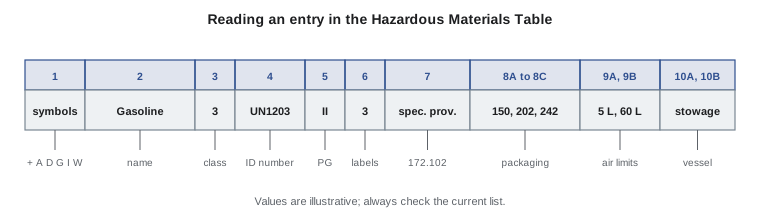
Each row of the Hazardous Materials Table contains the information you need to start a shipment. The table below summarizes its columns. The values for a few entries are given later in the worked example; always check the current table for the actual values, which change from time to time.
| Column | What it gives |
|---|---|
| 1 | Symbols: + fixes the name and class, A and W restrict to air or water only, D domestic only, G technical name required, I international only |
| 2 | Proper shipping name (roman type) and descriptive text (italics) |
| 3 | Hazard class or division, or the word Forbidden |
| 4 | Identification number (UN or NA) |
| 5 | Packing group |
| 6 | Label codes |
| 7 | Special provisions (see 172.102) |
| 8A, 8B, 8C | Packaging sections in Part 173 for exceptions, non-bulk and bulk packagings |
| 9A, 9B | Quantity limits per package for passenger aircraft or rail, and for cargo aircraft only |
| 10A, 10B | Vessel stowage location and other stowage requirements |
Some materials are listed with the word Forbidden in column 3, meaning they may not be offered or transported at all, usually because they are too unstable. Others are forbidden only on passenger aircraft or on all aircraft, as shown in columns 9A and 9B. A forbidden material can be shipped only under a special permit or approval issued by PHMSA.
Additional descriptions
Some shipments need more than the basic description. A hazardous substance, listed in Appendix A to 172.101, must be identified with the letters RQ (reportable quantity) when one package contains at least the reportable quantity, and if the proper shipping name does not identify it, its name must be added in parentheses. Marine pollutants must be identified when shipped by vessel or in bulk. Hazardous wastes need the word Waste and a hazardous waste manifest. Materials shipped hot need the word HOT or Molten. Lesson 8 covers these additions. Note that the August 2026 rules replace Appendix A with a reference to the EPA's list of hazardous substances in 40 CFR Part 302, taking effect by December 2026.
# Building basic shipping descriptions from a small, simplified extract of the list (illustrative).
LIST = {
    "UN1203": ("GASOLINE", "3", None, "II"),
    "UN1075": ("PETROLEUM GASES, LIQUEFIED", "2.1", None, None),
    "UN1830": ("SULFURIC ACID", "8", None, "II"),
    "UN3480": ("LITHIUM ION BATTERIES", "9", None, None),
    "UN1005": ("AMMONIA, ANHYDROUS", "2.3", "8", None),
}

def description(un, technical=None):
    name, cls, sub, pg = LIST[un]
    parts = [un, name + (f" ({technical})" if technical else "")]
    parts.append(cls + (f" ({sub})" if sub else ""))
    if pg:
        parts.append("PG " + pg)
    return ", ".join(parts)

for un in LIST:
print(description(un))UN1203, GASOLINE, 3, PG II UN1075, PETROLEUM GASES, LIQUEFIED, 2.1 UN1830, SULFURIC ACID, 8, PG II UN3480, LITHIUM ION BATTERIES, 9 UN1005, AMMONIA, ANHYDROUS, 2.3 (8)
The order of the basic description is fixed: identification number, proper shipping name, hazard class, subsidiary hazards in parentheses, packing group. The output above uses the international classification of anhydrous ammonia, 2.3 with a subsidiary 8; for domestic US transport, the table classes it as 2.2 with an inhalation hazard. Checking the right column for your mode and destination matters.
Worked problem
Choosing between entries for a paint thinner
A paint thinner is a mixture of toluene and methanol with a flash point of 5 °C and a boiling point above 35 °C. The dangerous goods list has entries for TOLUENE, for METHANOL, for PAINT RELATED MATERIAL and for FLAMMABLE LIQUID, N.O.S. Which should be used?
Show solution
- The product is a mixture, so neither single-substance entry (toluene or methanol) fits exactly.
- PAINT RELATED MATERIAL is a specific entry covering paint thinning and reducing compounds, so it is more specific than the generic Flammable liquid, N.O.S.
- Flash point 5 °C and boiling point above 35 °C give class 3, packing group II.
- Methanol is also toxic. If the mixture meets the division 6.1 criteria, an entry with a subsidiary class is needed, and the precedence table applies.
Answer: Use the paint related material entry, class 3, packing group II, unless the methanol content makes the mixture meet the toxic criteria, in which case an entry with a 6.1 subsidiary hazard is needed.
Worked problem
Reading the limited quantity column
The Hazardous Materials Table refers gasoline to 173.150 for exceptions. What does that mean for a shipper of small cans of fuel?
Show solution
- Section 173.150 sets limited quantity limits for class 3; for packing group II liquids, inner packagings may hold up to 1 L each.
- So gasoline in inner containers of 1 L or less, packed in a strong outer package within total mass limits, can ship as a limited quantity, with reduced requirements.
- Larger containers, such as 5 L or 20 L jerry cans, cannot use the limited quantity rules and must meet the full requirements unless another exemption applies.
- Lesson 10 covers limited quantities in detail.
Answer: Only inner containers of 1 L or less qualify as limited quantities; larger cans need full compliance or another exemption.
Using the list in practice
Most people search the table by name, not by number. The Hazardous Materials Table is arranged alphabetically by proper shipping name, and the electronic CFR and many commercial tools let you search by name, identification number or keyword. Searching by keyword helps when the product name on a label is a trade name or a synonym; the safety data sheet's section 14 usually gives the identification number, which you can then confirm in the table.
Similar names cause many errors. Ammonia, anhydrous (UN1005), a gas, and ammonia solution (UN2672), a class 8 corrosive liquid, are very different products. Sodium hydroxide, solid (UN1823) and sodium hydroxide solution (UN1824) have different entries because a solid and a liquid need different packaging. Several products have entries that depend on concentration, such as hydrogen peroxide or nitric acid, where the descriptive text tells you which range the entry covers. Always read the whole entry, including the descriptive text, before choosing.
| Look-alike pair | Why they differ |
|---|---|
| Ammonia, anhydrous (UN1005) and ammonia solution (UN2672) | Gas under pressure versus a corrosive liquid |
| Sodium hydroxide, solid (UN1823) and sodium hydroxide solution (UN1824) | Solid versus liquid packaging and spill behavior |
| Gasoline (UN1203) and diesel fuel (UN1202) | Packing group II versus packing group III |
| Lithium ion batteries (UN3480) and lithium ion batteries contained in equipment (UN3481) | Batteries alone versus installed in or packed with equipment |
When a product could fit more than one entry and you are unsure, ask the manufacturer, a dangerous goods specialist or the regulator before shipping. Writing down why you chose an entry, with the source you used, makes the decision easier to defend and easier for the next person to check.
When the list changes
Entries are added, removed and rewritten as the UN Model Regulations evolve. PHMSA's harmonization rules periodically add new identification numbers, revise proper shipping names and change special provisions to match international text, and the August 2026 rules replaced the hazardous substances appendix with a reference to the EPA list. A shipper that copied descriptions into its order system years ago may now be using an entry that has changed. Reviewing your regular products against the current table after each amendment, and keeping a dated record of the review, avoids that drift.
Common mistakes
MistakeUsing a trade name as the shipping name.
InsteadUse the shipping name exactly as listed; trade names are never technical names either.
MistakeAdding descriptive lower-case or italic text to the shipping name as if it were part of it.
InsteadOnly the capitalized (Canada) or roman-type (US) words form the shipping name.
MistakeChoosing a broad N.O.S. entry when a specific entry exists.
InsteadFollow the order of preference: exact name, then specific generic entry, then broad generic entry.
MistakeIgnoring the special provisions column.
InsteadSpecial provisions can add requirements, exemptions or prohibitions; read every one listed for your entry.
MistakeWriting the description elements in any order.
InsteadUse the fixed order: UN number, shipping name, class, subsidiary classes, packing group.
Summary and key terms
- Every dangerous good is identified by a four-digit UN number (or, in some North American cases, an NA number) and a shipping name.
- Both come from the Hazardous Materials Table in 49 CFR 172.101.
- Only the words in roman type form the proper shipping name.
- Choose the most specific entry that fits; generic entries often need a technical name in brackets.
- Special provisions modify the requirements for particular entries and must always be checked.
- The list also gives limited quantity, excepted quantity and other quantity limits, and shows forbidden products.
- The basic description follows a fixed order: UN number, shipping name, class, subsidiary classes and packing group.
- UN number
- A four-digit number assigned by the UN to a substance, group of substances or article, preceded by UN.
- NA number
- A North American identification number used in the US and between Canada and the US for products without a UN number or classed differently.
- Shipping name
- The official name of a dangerous good as it appears in the list, used on documents and packages.
- Generic entry
- A list entry that covers a group of substances or a hazard, such as Alcohols, N.O.S.
- Special provision
- A numbered or coded rule that modifies the requirements for a particular list entry.
- Limited quantity
- A small amount in inner containers below a set limit that can ship with reduced requirements.
- Excepted quantity
- A very small amount of dangerous goods, smaller than a limited quantity, with its own simplified rules.
- ERAP index
- In Canada, the quantity above which an emergency response assistance plan is required.
- Reportable quantity (RQ)
- In the US, the amount of a hazardous substance in one package that triggers extra description and release reporting.
- Basic description
- The UN number, shipping name, class, subsidiary classes and packing group in their required order.
Practice problems
Work each problem on paper first, then reveal the answer to check.
What is the UN number for gasoline?
Show answer
UN1203.
What do UN numbers starting with 0 identify?
Show answer
Explosives.
Where are NA numbers used?
Show answer
In the United States and for shipments between Canada and the United States, not for international air or sea.
In the Hazardous Materials Table, which words form the proper shipping name?
Show answer
The words in roman type.
List the order of preference for choosing an entry.
Show answer
Exact substance name, then a specific generic entry, then the broadest generic entry for the hazard.
What must often be added to an N.O.S. entry?
Show answer
The technical name of the hazardous component or the two most hazardous components.
Where are special provisions explained?
Show answer
49 CFR 172.102.
Write the basic description for anhydrous ammonia under the international classification.
Show answer
UN1005, AMMONIA, ANHYDROUS, 2.3 (8).
Why does a wrong UN number matter to responders?
Show answer
They use it to find emergency guidance, so the wrong number sends them to the wrong advice.
Can a brand name be used as a technical name?
Show answer
No.
Lesson quiz · 5 questions
Score 60% or more to complete this lesson.
Create a free account to save your progress, take quizzes and earn a certificate.