
HSE-250 · Lesson 4 of 12 · 27 min
Classification and packing groups
Classification is the first and most important decision in any hazmat shipment. It decides the hazard class and division, any subsidiary hazard, the packing group, the identification number and proper shipping name, and through them every other requirement: the packaging, the labels and placards, the shipping paper, the emergency response information and the exceptions that may apply. Under 49 CFR 173.22, the shipper (the person who offers the material for transport) is responsible for classifying it correctly, and the shipper's certification on the shipping paper declares that the material is properly classified, described, packaged, marked and labeled.
Where classification information comes from
Most shippers do not run laboratory tests themselves. They rely on the manufacturer's classification, which normally appears in section 14 (transport information) of the safety data sheet, introduced in HSE-102. That is a reasonable starting point, but it is not a guarantee. Safety data sheets can be out of date, written for another country, or wrong. If you change a product by diluting it, mixing it with something else or using it and shipping the waste, the original classification may no longer apply. When in doubt, check the regulations' criteria or ask the manufacturer or a qualified dangerous goods specialist.
The HMR do not require a general classification report for every product, but the shipper must be able to support its classification, and PHMSA inspectors may ask how a product was classified. Some materials, such as self-reactive substances, organic peroxides and explosives, need specific approvals or test data. After Lac-Mégantic, rules were added requiring sampling and testing programs for unrefined petroleum products such as crude oil, with records kept and made available to the Department of Transportation.
Listed by name or described generically
There are two ways a product can be identified. Some products are listed by name: gasoline, acetone, propane, sulfuric acid. If your product is exactly that substance, you use the name, class and packing group given in the list. Other products are mixtures or substances without their own entry. These are assigned to a generic or not otherwise specified entry, abbreviated N.O.S., such as Flammable liquid, N.O.S. or Corrosive liquid, acidic, organic, N.O.S. Generic entries require you to work out the class and packing group from the product's properties, and many of them require the technical name of the hazardous component in brackets on the shipping document so that responders know what they are dealing with.
Choosing the most specific entry that fits is a rule, not a preference. If an entry exists for the exact substance, use it. If not, use the most specific generic entry, for example Alcohols, N.O.S. rather than Flammable liquid, N.O.S. Lesson 5 explains how entries are chosen from the list.
Packing groups
Packing groups rank the degree of danger within classes 3, 4, 5.1, 6.1, 8 and 9: packing group I for great danger, II for medium danger and III for minor danger. Packing groups do not apply to class 2 gases, class 7, division 6.2 or most of class 1, which have their own systems. The packing group decides how strong the packaging must be, how much can be shipped as a limited quantity, and in some cases whether an emergency response assistance plan or special handling is needed. Packing groups are written in Roman numerals on documents, sometimes preceded by PG.
Flammable liquids
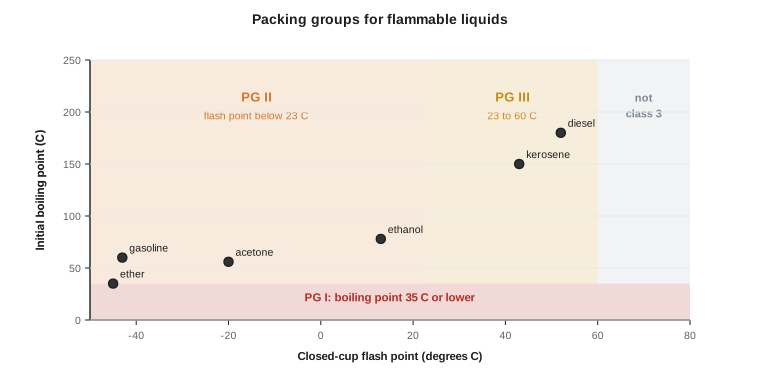
For class 3, two measurements decide the packing group: the flash point and the initial boiling point, the temperature at which the liquid starts to boil.
| Packing group | Flash point (closed cup) | Initial boiling point | Examples |
|---|---|---|---|
| I | Any | 35 °C or lower | Diethyl ether, some crude oils with dissolved gases |
| II | Below 23 °C | Above 35 °C | Gasoline, acetone, ethanol, toluene |
| III | 23 °C to 60 °C | Above 35 °C | Kerosene, some paints, turpentine |
Toxic substances
For division 6.1, the packing group comes from the substance's toxicity, measured in animal studies or estimated from the toxicity of its components. Three routes are considered: swallowing (oral LD50, the dose that kills half of test animals, in milligrams per kilogram of body weight), skin contact (dermal LD50) and breathing dusts or mists (inhalation LC50, in milligrams per liter of air). The most severe result decides the packing group.
| Packing group | Oral LD50 (mg/kg) | Dermal LD50 (mg/kg) | Inhalation LC50, dusts and mists (mg/L) |
|---|---|---|---|
| I | 5 or less | 50 or less | 0.2 or less |
| II | More than 5 up to 50 | More than 50 up to 200 | More than 0.2 up to 2 |
| III | More than 50 up to 300 | More than 200 up to 1,000 | More than 2 up to 4 |
Corrosives
For class 8, the packing group depends on how fast the substance destroys skin. Packing group I substances cause full-thickness destruction of skin within an observation period of 60 minutes after an exposure of 3 minutes or less. Packing group II substances do so after an exposure of more than 3 minutes up to 60 minutes. Packing group III substances do so after an exposure of more than 60 minutes up to 4 hours, or corrode steel or aluminum at more than 6.25 mm a year. Modern classification uses validated test methods that do not require animal testing for many products.
Other classes
Classes 4 and 5.1 have packing group criteria based on burning rates and other test results described in the UN Manual of Tests and Criteria. Organic peroxides (5.2) and self-reactive substances (4.1) are assigned to types A to G instead. Some class 9 entries have packing groups II or III. Gases are classified by flammability, toxicity and pressure. Radioactive materials are classified by activity and form.
# Assigning packing groups from test data (simplified from the criteria tables).
def pg_class3(flash_c, ibp_c):
    if flash_c > 60:
        return "not class 3 (unless shipped hot)"
    if ibp_c <= 35:
        return "PG I"
    return "PG II" if flash_c < 23 else "PG III"

def pg_toxic(oral=None, dermal=None, dust=None):
    limits = {"oral": (5, 50, 300), "dermal": (50, 200, 1000), "dust": (0.2, 2, 4)}
    results = []
    for route, value in (("oral", oral), ("dermal", dermal), ("dust", dust)):
        if value is None:
            continue
        a, b, c = limits[route]
        results.append(1 if value <= a else 2 if value <= b else 3 if value <= c else 9)
    best = min(results)
    return "not 6.1 by these routes" if best == 9 else "PG " + "I" * best

for name, fp, bp in [("ether", -45, 35), ("gasoline", -43, 39), ("acetone", -20, 56),
                     ("kerosene", 43, 150), ("diesel", 52, 180), ("glycol", 111, 197)]:
    print(f"{name:>9}: flash {fp:>4} C, boil {bp:>3} C -> {pg_class3(fp, bp)}")
print("pesticide A (oral 30, dermal 400):", pg_toxic(oral=30, dermal=400))
print("pesticide B (oral 600, dust 1.5):  ", pg_toxic(oral=600, dust=1.5))
print("cleaner C (oral 2500): ", pg_toxic(oral=2500))ether: flash -45 C, boil 35 C -> PG I gasoline: flash -43 C, boil 39 C -> PG II acetone: flash -20 C, boil 56 C -> PG II kerosene: flash 43 C, boil 150 C -> PG III diesel: flash 52 C, boil 180 C -> PG III glycol: flash 111 C, boil 197 C -> not class 3 (unless shipped hot) pesticide A (oral 30, dermal 400): PG II pesticide B (oral 600, dust 1.5): PG II cleaner C (oral 2500): not 6.1 by these routes
Observe that pesticide B is not toxic enough by mouth to be regulated, but its dust is harmful enough to inhale that it lands in packing group II. Every route must be checked, and the worst one wins.
Mixtures, solutions and wastes
A mixture or solution containing a listed substance is not automatically classed the same as the pure substance. A dilute solution may fall into a less severe packing group or out of the regulations altogether, while a mixture of two hazardous substances may need a different entry. The safety data sheet for the mixture should give its transport classification; if you prepared the mixture yourself, you must classify it. Wastes are classified the same way as products, based on their properties, and are usually shipped under the entry that fits their hazards with the word Waste added before the shipping name.
Samples whose hazards are not yet known, such as a field sample sent for analysis, can be assigned a tentative class, shipping name and packing group based on the shipper's knowledge of the material under 49 CFR 172.101(c)(11), using the most severe reasonable packing group. The word Sample may need to accompany the shipping name. This is not a loophole: the tentative classification must be reasonable.
When a product is not regulated
Many chemicals that are hazardous at work are not hazardous materials in transport. A cleaner that is a mild skin irritant, a paint with a flash point well above 93 °C or a substance toxic only after long-term exposure may be fully covered by OSHA HazCom but not by the HMR. When a material meets no hazard class definition and is not listed, it is not hazmat (unless it is a hazardous substance, hazardous waste or marine pollutant), and shipping it with labels or placards it does not need can mislead responders. The opposite mistake, assuming a product is not regulated because it seems familiar, is more common and more dangerous.
Worked problem
Assigning a packing group to a solvent
A solvent blend has a closed-cup flash point of 18 °C and an initial boiling point of 78 °C. It is not listed by name. What is its class and packing group?
Show solution
- The flash point (18 °C) is not more than 60 °C, so it is class 3.
- The initial boiling point (78 °C) is above 35 °C, so it is not packing group I.
- The flash point is below 23 °C, so it is packing group II.
- Because it is not listed by name, a generic entry such as Flammable liquid, N.O.S. applies, with the technical name of the main hazardous component shown in brackets.
Answer: Class 3, packing group II, under a generic N.O.S. entry with the technical name added.
Worked problem
Checking a corrosive with a second hazard
A corrosive liquid causes full-thickness skin destruction after a 30-minute exposure and has an oral LD50 of 40 mg/kg. What packing group applies?
Show solution
- Class 8: destruction after an exposure of more than 3 minutes up to 60 minutes gives packing group II.
- Division 6.1: an oral LD50 of 40 mg/kg is more than 5 and not more than 50, also packing group II.
- The precedence table decides the primary class; for this combination the regulations list which class wins.
- Both hazards are packing group II, so the shipment is packing group II, with the other hazard as a subsidiary class.
Answer: Packing group II, with one class primary and the other subsidiary according to the precedence table.
Common mistakes
MistakeCopying the classification from an old or foreign safety data sheet without checking.
InsteadConfirm that section 14 is current and applies to the product as shipped, including any dilution or mixing.
MistakeUsing a generic N.O.S. entry when the substance is listed by name.
InsteadUse the most specific entry: the named entry first, then the most specific generic entry.
MistakeChecking only the oral toxicity.
InsteadCheck oral, dermal and inhalation routes; the most severe result decides the packing group.
MistakeAssuming a waste has no classification because it is no longer a product.
InsteadWastes are classified by their properties and shipped with the word Waste added.
MistakeBeing unable to explain how a product was classified.
InsteadKeep the data that support the classification so you can show an inspector how it was done.
Summary and key terms
- The shipper must classify hazardous materials correctly before offering them for transport.
- Safety data sheet section 14 is a starting point, not a guarantee; changes such as dilution or mixing can change the classification.
- Products listed by name use the list entry; others use the most specific generic N.O.S. entry, often with a technical name.
- Packing groups rank danger within several classes: I great, II medium, III minor.
- Flash point and initial boiling point set the packing group for flammable liquids.
- Oral, dermal and inhalation toxicity set the packing group for toxic substances; the worst route wins.
- Shippers certify their classification on the shipping paper and must be able to support it.
- Consignor
- The person who offers dangerous goods for transport; called the shipper in the United States.
- N.O.S.
- Not otherwise specified; a generic entry used when a product has no specific listing.
- Technical name
- The recognized chemical name of the hazardous component, added in brackets to many generic entries.
- Initial boiling point
- The temperature at which a liquid begins to boil.
- Closed-cup flash point
- A flash point measured in a closed test vessel, the method used for transport classification.
- LD50
- The dose of a substance that kills half of a group of test animals, in milligrams per kilogram of body weight.
- LC50
- The concentration in air that kills half of a group of test animals over a set exposure time.
- Full-thickness destruction
- Corrosion of skin through all its layers, the test outcome used to classify corrosives.
- Proof of classification
- A record showing how a product was classified, such as a test report or the criteria applied.
- Manual of Tests and Criteria
- The UN companion volume that describes the tests used to classify dangerous goods.
Practice problems
Work each problem on paper first, then reveal the answer to check.
Who is responsible for classifying hazmat under the HMR?
Show answer
The shipper.
Which section of a safety data sheet gives transport information?
Show answer
Section 14.
Why might a safety data sheet classification not apply to your shipment?
Show answer
It may be outdated or written for another country, or the product may have been diluted, mixed or turned into waste.
What does N.O.S. mean, and what must often be added with it?
Show answer
Not otherwise specified; the technical name of the hazardous component.
A liquid has an initial boiling point of 30 °C. What packing group is it, if flammable?
Show answer
Packing group I.
A liquid has a flash point of 40 °C and a boiling point of 150 °C. Class and packing group?
Show answer
Class 3, packing group III.
What oral LD50 range defines packing group II for division 6.1?
Show answer
More than 5 up to 50 mg/kg.
What exposure time range defines packing group II for corrosives?
Show answer
Skin destruction after an exposure of more than 3 minutes up to 60 minutes.
Which classes do not use packing groups?
Show answer
Class 2, class 7, division 6.2 and most of class 1.
What must a shipper be able to show an inspector about classification?
Show answer
The data or reasoning that support the classification.
Lesson quiz · 5 questions
Score 60% or more to complete this lesson.
Create a free account to save your progress, take quizzes and earn a certificate.