
HSE-250 · Lesson 2 of 12 · 27 min
The legal framework
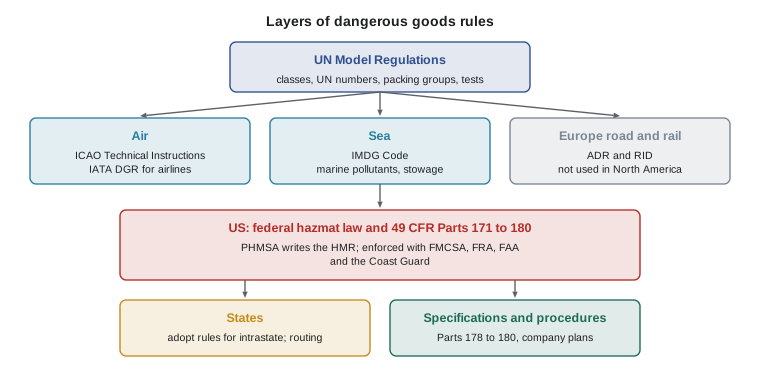
Hazmat rules come in layers. At the top sit international recommendations written by the United Nations. Below them are the international rules for air and sea transport, and the national law of each country. Below those are state laws, industry standards for packagings and the company procedures that put everything into practice. To work safely with hazardous materials you do not need to read every page, but you do need to know which document governs your shipment and where to look things up.
The United Nations Model Regulations
The United Nations Economic and Social Council has a Sub-Committee of Experts on the Transport of Dangerous Goods. Every two years it publishes a revised edition of the Recommendations on the Transport of Dangerous Goods, Model Regulations, nicknamed the Orange Book after its cover. The Model Regulations define the nine classes, the numbering system of four-digit UN numbers, the list of dangerous goods with their proper shipping names, the packing groups, the packaging performance tests and the design of labels and placards. They are not law in themselves. Countries and international bodies adopt them, sometimes with variations, into binding rules. A companion volume, the Manual of Tests and Criteria, explains the laboratory tests used to classify products.
Because almost every country builds on the same model, a drum of corrosive liquid classified and marked in Montreal, Chicago, Rotterdam or Singapore carries the same UN number, class label and packaging code. That shared language is what makes international trade in dangerous goods possible.
International rules for air and sea
Air transport is governed internationally by the International Civil Aviation Organization's Technical Instructions for the Safe Transport of Dangerous Goods by Air, usually called the ICAO Technical Instructions, issued in two-year editions. Airlines also follow the International Air Transport Association's Dangerous Goods Regulations, a manual that incorporates the ICAO rules and adds airline-specific restrictions; it is updated every year. Air rules are the strictest of all modes because of pressure changes, temperature extremes and the impossibility of stopping to deal with a leak at altitude. Many products allowed by road are limited or forbidden by air, especially on passenger aircraft.
Sea transport is governed by the International Maritime Dangerous Goods Code, the IMDG Code, published by the International Maritime Organization and updated every two years. It adds rules about stowage and segregation on ships and about marine pollutants, which are products that harm aquatic life. Amendment 42-24 of the IMDG Code became mandatory on 1 January 2026.
Road and rail rules in Europe are found in agreements known as ADR (road) and RID (rail). North America does not use them, but you may see the terms on documents for imported goods.
National law
In the United States, federal hazardous materials transportation law, codified at 49 U.S.C. 5101 and following sections, gives the Department of Transportation power to regulate hazmat transport. PHMSA writes the Hazardous Materials Regulations, and enforcement is shared with the modal administrations: the Federal Motor Carrier Safety Administration for highways, the Federal Railroad Administration for rail, the Federal Aviation Administration for air and the US Coast Guard for vessels. Civil penalties are adjusted for inflation; the amounts set for 2025 are up to $102,348 per violation per day, up to $238,809 when a violation causes death, serious illness, severe injury or substantial property destruction, and at least $617 for each training violation. The usual 2026 inflation adjustment was canceled in April 2026 because the government shutdown in late 2025 delayed the price data the law requires, so the 2025 amounts still apply. Knowing and wilful violations can also be prosecuted as crimes.
| Part of 49 CFR | What it covers |
|---|---|
| Part 107 | Program procedures, including special permits, approvals and annual hazmat registration |
| Part 171 | General information, definitions, incident reporting and the use of international and Canadian rules |
| Part 172 | The Hazardous Materials Table, shipping papers, marking, labeling, placarding, emergency response information, training and security plans |
| Part 173 | Shipper requirements: classification and packaging |
| Parts 174 to 177 | Mode-specific rules for rail, air, vessel and highway carriers |
| Parts 178 to 180 | Specifications and continuing qualification for packagings, cylinders, tank cars and cargo tanks |
The Hazardous Materials Table is in 49 CFR 172.101. For each entry it gives symbols that modify how the entry is used, the proper shipping name, the hazard class, the identification number, the packing group, the required labels, special provisions, packaging references for exceptions, non-bulk and bulk packagings, quantity limits for passenger aircraft and rail and for cargo aircraft, and vessel stowage requirements. Special provisions are listed in 49 CFR 172.102. Lesson 5 shows how to read the table.
Two sections of Part 171 matter a great deal in practice. Section 171.12 allows hazardous materials to be transported by highway or rail in the United States in compliance with the Canadian TDG Regulations, subject to conditions; for example, some products and some packagings are excluded, and shipping papers must include the information US carriers and responders need. Sections 171.22 to 171.25 allow shipments prepared under the ICAO Technical Instructions or the IMDG Code, again with conditions, so that air and sea shipments can move to and from ports and airports.
Provincial, territorial and local rules
Federal hazmat law preempts most state and local rules that are not substantively the same as the federal rules on classification, packaging, marking, labeling, placarding, documentation, incident reporting and the design of packagings. States can still regulate highway routing, within federal standards, and many states adopt the HMR by reference for intrastate commerce, sometimes with exceptions for small local carriers or farmers. Some states and cities restrict hazmat vehicles in tunnels, on bridges or in dense urban areas. Workplace rules such as the OSHA Hazard Communication Standard and state plan rules apply to the people who handle the goods.
Other federal rules touch hazmat too. Drivers of vehicles that require placards, or that carry certain quantities, need a commercial driver's license with a hazmat endorsement, which requires a Transportation Security Administration background check. Carriers of certain highly hazardous materials need an FMCSA hazmat safety permit. Shippers and carriers of placarded quantities must register annually with PHMSA. Explosives are also regulated by the Bureau of Alcohol, Tobacco, Firearms and Explosives, radioactive materials by the Nuclear Regulatory Commission, and hazardous waste by the Environmental Protection Agency under the Resource Conservation and Recovery Act, which requires a manifest to travel with the waste.
Standards for containers
Packaging specifications are in Parts 178 to 180. Part 178 contains the performance standards and test methods for non-bulk packagings, intermediate bulk containers and large packagings, and the DOT specifications for cylinders and cargo tank motor vehicles. Part 179 covers rail tank cars, including the tougher DOT-117 tank car required for flammable liquid trains after Lac-Mégantic. Part 180 covers retesting and requalification, such as periodic hydrostatic testing of cylinders. Lesson 6 explains how to read the marks that show a packaging meets a standard.
Finding the current rules
The official Hazardous Materials Regulations are in the Code of Federal Regulations, and the electronic version on eCFR is updated daily and free. Changes appear first in the Federal Register as proposed and final rules; the group of rules PHMSA finalized in August 2026, for example, takes effect by December 2026. PHMSA also publishes letters of interpretation, which answer specific questions and are useful for unusual cases. Check the date of any printed reference you use, because the table and special provisions change often.
# Which rule set governs a shipment? A simplified decision helper (not a substitute for the rules).
def rule_set(mode, origin, destination):
    if mode == "air":
        return "ICAO Technical Instructions (and IATA DGR for airlines)"
    if mode == "sea":
        return "IMDG Code (plus national port rules)"
    if {origin, destination} <= {"Canada"}:
        return "TDG Regulations"
    if {origin, destination} <= {"USA"}:
        return "49 CFR (HMR)"
    if {origin, destination} == {"Canada", "USA"}:
        return "TDG in Canada and 49 CFR in the US; either set is accepted for road and rail, with conditions"
    return "Check national rules of every country on the route"

for trip in [("road", "Canada", "Canada"), ("rail", "USA", "USA"),
             ("road", "Canada", "USA"), ("air", "Canada", "USA"), ("sea", "USA", "Mexico")]:
print(f"{trip[0]:>4} {trip[1]} to {trip[2]}: {rule_set(*trip)}")road Canada to Canada: TDG Regulations rail USA to USA: 49 CFR (HMR) road Canada to USA: TDG in Canada and 49 CFR in the US; either set is accepted for road and rail, with conditions air Canada to USA: ICAO Technical Instructions (and IATA DGR for airlines) sea USA to Mexico: IMDG Code (plus national port rules)
The helper above is deliberately simple, but it reflects how professionals think: identify the mode first, then the countries involved, then find the governing document. Real shipments add details, such as an air shipment that starts with a truck to the airport, which must meet both the road rules and the air rules for its whole journey.
Worked problem
Choosing the governing rules for a cross-border truck
A Buffalo distributor ships drums of a corrosive liquid by truck to a customer in Toronto. Which rules apply?
Show solution
- In the United States the HMR apply until the truck crosses the border.
- In Canada the TDG Regulations apply. Part 9 of the TDG Regulations allows the shipment to continue under 49 CFR, with conditions such as Canadian ERAP and reporting rules.
- In practice, many shippers prepare cross-border shipments to satisfy both sets of rules at once: same UN number, shipping name, class, packing group, labels and placards, with any extra items each country requires on the document.
- The driver must also meet licensing, hours-of-service and security requirements in each country.
Answer: Each country's rules apply on its territory, but reciprocal provisions let a shipment prepared properly under one set continue under the other. Preparing it to meet both avoids surprises at the border.
Worked problem
An air shipment that starts on the road
A laboratory sends a small package of a flammable liquid sample by courier to a lab overseas. The courier picks it up by van and flies it from a hub. What rules govern the package?
Show solution
- The air leg is governed by the ICAO Technical Instructions and, because a commercial airline carries it, the IATA Dangerous Goods Regulations.
- Air rules are stricter than road rules, so the package must be prepared to air standards from the start; it cannot be repackaged at the airport by the van driver.
- National road rules also apply to the van leg, but they generally accept packages prepared to air standards.
- The courier may have its own acceptance rules that are stricter still, and may refuse some dangerous goods entirely.
Answer: Prepare the package to the strictest rules on its route, which for any shipment that flies means the air rules, and check the courier's own conditions.
Reading regulatory text
Regulations are written precisely, and small words matter. Shall and must create obligations; may gives a choice. A list joined by and requires every item, while or requires only one. Definitions at the start of the regulations often give ordinary words a narrower meaning, so a term such as handling, offering for transport or bulk may not mean what it means in everyday speech. When a section seems to say something surprising, read the definitions and any exceptions that follow it before acting.
Common mistakes
MistakeUsing an old printed copy of the regulations.
InsteadCheck the current consolidated version online; the list and special provisions change with each amendment.
MistakeAssuming road rules are enough for a package that will fly.
InsteadPrepare any shipment that flies to air rules, which are the strictest.
MistakeThinking each state writes completely different hazmat rules.
InsteadFederal law preempts most different state rules; states mainly add routing and intrastate details.
MistakeTreating the UN Model Regulations as law.
InsteadThey are recommendations; national and international rules adopt them into binding law.
MistakeForgetting other laws that apply to some goods.
InsteadExplosives, radioactive materials and hazardous wastes have extra rules beyond the general transport rules.
Summary and key terms
- Dangerous goods rules come in layers: UN recommendations, international air and sea rules, national law, local law, standards and company procedures.
- The UN Model Regulations define the classes, UN numbers, packing groups, packaging tests and safety marks used almost everywhere.
- Air transport follows the ICAO Technical Instructions and IATA DGR; sea transport follows the IMDG Code.
- In the United States the HMR in 49 CFR, written by PHMSA and enforced with FMCSA, FRA, FAA and the Coast Guard, govern all modes.
- The Hazardous Materials Table is in 172.101, and 171.12 allows highway and rail shipments that comply with Canadian rules, with conditions.
- Standards for containers are incorporated by reference and decide how packagings are designed, tested and marked.
- Always use the current version of the rules, because lists and special provisions change regularly.
- 49 CFR
- Title 49 of the Code of Federal Regulations, which contains the Hazardous Materials Regulations.
- Hazardous Materials Table
- The list of hazardous materials and their requirements in 49 CFR 172.101.
- FMCSA
- The Federal Motor Carrier Safety Administration, which enforces hazmat rules for highway carriers.
- Preemption
- The principle that federal hazmat law overrides most state and local rules that differ from it.
- Federal Register
- The daily publication in which proposed and final federal rules appear.
Practice problems
Work each problem on paper first, then reveal the answer to check.
What is the nickname of the UN Model Regulations, and how often are they revised?
Show answer
The Orange Book; every two years.
Which document governs dangerous goods by air internationally?
Show answer
The ICAO Technical Instructions, with the IATA Dangerous Goods Regulations used by airlines.
Which document governs dangerous goods by sea?
Show answer
The IMDG Code.
Which section of 49 CFR covers hazmat employee training?
Show answer
172.704, in Part 172 Subpart H.
Which part of 49 CFR contains the shipper requirements for classification and packaging?
Show answer
Part 173.
Where is the Hazardous Materials Table?
Show answer
49 CFR 172.101.
Which section allows highway and rail shipments to follow Canadian rules?
Show answer
49 CFR 171.12.
Why should a package that will fly be prepared to air rules from the start?
Show answer
Air rules are the strictest and apply to the whole journey; the package cannot easily be redone at the airport.
What was the 2025 maximum civil penalty per hazmat violation per day?
Show answer
$102,348, or $238,809 if it causes death, serious injury or major property damage.
Where should you look for the current version of the rules?
Show answer
The eCFR, updated daily, and PHMSA guidance and interpretations.
Lesson quiz · 5 questions
Score 60% or more to complete this lesson.
Create a free account to save your progress, take quizzes and earn a certificate.