
HSE-250 · Lesson 10 of 12 · 27 min
Exceptions, limited quantities and materials of trade
Applying every requirement of the HMR to a single can of spray paint or a propane cylinder for a torch would bury small shippers in paperwork without making anyone safer. So the HMR contain exceptions that relieve small or low-risk shipments from some requirements when strict conditions are met. Exceptions are used every day by contractors, retailers, couriers, farmers and maintenance crews. They are also a common source of mistakes, because people remember the relief and forget the conditions. An exception is never a blanket release: it lists exactly which requirements no longer apply and which conditions must be met.
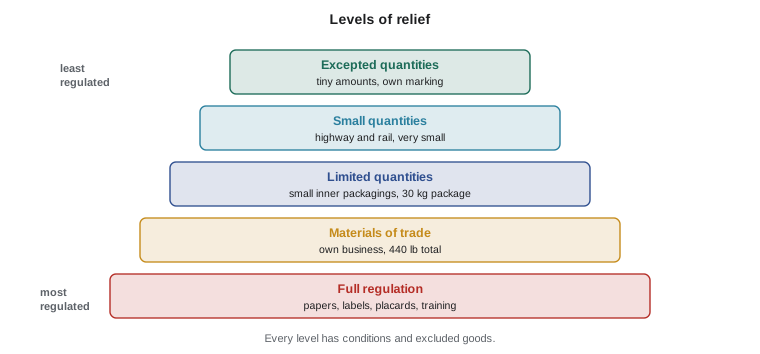
Excepted quantities
The smallest amounts of many hazardous materials can travel as excepted quantities under 49 CFR 173.4a. A code from E0 (not permitted) to E5, shown in the Hazardous Materials Table special provisions or packaging columns, sets the maximum amount per inner packaging (as little as 1 g or 1 mL for the most hazardous materials) and per outer package. Excepted quantity packages need strong combination packaging, absorbent material for liquids and the excepted quantity marking, a square with red hatched edges showing the class number. Laboratory samples and small reagents often travel this way. Section 173.4 has a separate small quantities exception for highway and rail.
Limited quantities
Limited quantities are small inner packagings, below the limits set in the packaging sections of Part 173 (for example 173.150 for class 3), packed in a strong outer package generally not exceeding 30 kg (66 pounds) gross weight. They cover a huge share of consumer and retail products: aerosols, paints, cleaners, adhesives, lighter fluid and fuel in small containers. Limited quantities by highway or rail do not need shipping papers (unless they are a hazardous substance, hazardous waste or marine pollutant), hazard labels, placards or specification packaging. In return, each package must carry the limited quantity marking; the August 2026 rules allow a reduced 25 mm marking in some cases. Air limited quantities have their own lower limits and a Y version of the marking. The old ORM-D consumer commodity marking ended on 31 December 2020.
| Exception | Main conditions | Main relief |
|---|---|---|
| Excepted quantities (173.4a) | Tiny inner and outer quantities by code; strong packaging; excepted quantity marking | Most of the HMR |
| Small quantities (173.4) | Very small amounts by highway or rail, in strong packaging with absorbent, with a statement on the package | Most of the HMR |
| Limited quantities (Part 173 packaging sections) | Inner packagings within the limits for the material; outer package generally 30 kg or less; limited quantity marking | Shipping papers (mostly), labels, placards and specification packaging |
| Materials of trade (173.6) | Carried by a private motor carrier in support of its business; per-package and 200 kg (440 lb) total limits; leak-tight, secured packaging; driver informed | Shipping papers, emergency response information, placards and formal training |
Materials of trade
Materials of trade, defined in 49 CFR 173.6, are hazardous materials carried on a motor vehicle to protect the health and safety of the driver or passengers, to support the operation or maintenance of the vehicle, or by a private motor carrier in direct support of a principal business that is not transportation, such as a contractor, landscaper, exterminator or utility. Typical examples are propane and acetylene cylinders for torches, gasoline for small engines, paints, pesticides and batteries.
Quantities are limited. For most classes, packing group II and III materials and class 9 are limited to 30 kg (66 pounds) or 30 L (8 gallons) per package, packing group I materials to 0.5 kg or 0.5 L, and division 2.1 and 2.2 cylinders to 100 kg (220 pounds) gross weight each. The total aggregate gross weight of all materials of trade on one vehicle must not exceed 200 kg (440 pounds), with some exceptions such as some cylinders and diluted mixtures. Packagings must be leak-tight, securely closed, secured against movement and protected from damage; gasoline must be in a metal or plastic can meeting set standards; cylinders must meet DOT specifications and be marked and labeled. Packages must be marked with a common name or proper shipping name, and the operator must be informed of the presence of the material and of the materials of trade requirements.
What materials of trade relieve
Shipments meeting all the materials of trade conditions do not need shipping papers, emergency response information, placards or formal training under 172.704, and do not need to meet the hazmat registration requirements for those materials. However, the vehicle must still meet the materials of trade conditions at all times, the driver must know what is on board, and incident reporting may still be required. Materials of trade cannot be used for materials that require placards in any quantity, self-reactive materials, poison-inhalation-hazard materials or hazardous waste. The August 2026 rules expanded materials of trade to allow equipment containing more lithium batteries, a change aimed at contractors who carry battery-powered tools, taking effect by December 2026.
Materials of trade work well for service vans and contractors' pickups, but they are not available to for-hire carriers delivering goods to customers. A plumbing company carrying its own cylinders qualifies; a gas supplier delivering cylinders to that plumbing company does not, and must follow the full rules or the limited quantity rules.
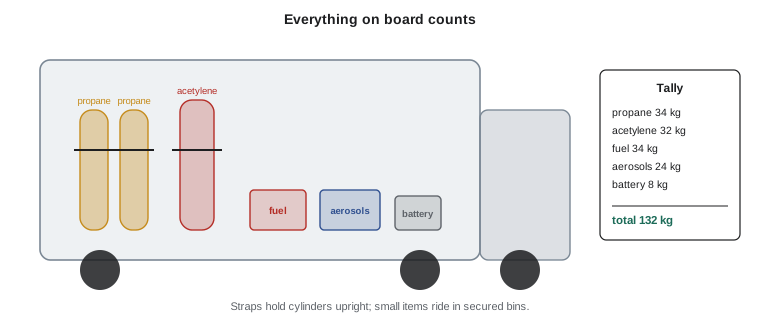
# Does a contractor's pickup qualify as materials of trade? (simplified; conditions abridged)
truck = [  # (item, class, packing group, gross weight lb, number)
    ("propane cylinder 20 lb", "2.1", None, 37, 2),
    ("acetylene cylinder", "2.1", None, 70, 1),
    ("gasoline can 5 gal", "3", "II", 37, 2),
    ("aerosol case", "2.1", None, 18, 3),
    ("battery pack", "9", None, 9, 2),
]
total = sum(w * n for _, _, _, w, n in truck)
problems = []
for item, cls, pg, w, n in truck:
    if cls.startswith("2") and w > 220:
        problems.append(f"{item}: cylinder over 220 lb")
    if not cls.startswith("2") and pg == "I" and w > 1.1:
        problems.append(f"{item}: PG I package too large")
    if not cls.startswith("2") and pg in ("II", "III", None) and w > 66:
        problems.append(f"{item}: package over 66 lb")
print(f"aggregate gross weight: {total} lb (limit 440 lb)")
if total > 440:
    problems.append("aggregate over 440 lb")
print("materials of trade:", "conditions met" if not problems else "; ".join(problems))aggregate gross weight: 290 lb (limit 440 lb) materials of trade: conditions met
The pickup's 290 pounds of materials is under the 440-pound aggregate limit, so it qualifies as materials of trade: no shipping papers, placards or formal training, but every package must be secured and leak-tight, the cylinders marked and labeled and the driver informed. Another 151 pounds, such as four more propane cylinders and a second acetylene cylinder, would push it over the limit, and the full rules, or another exception, would apply.
Lithium batteries and other special cases
Lithium batteries have their own section, 49 CFR 173.185, which sets out when cells and batteries packed with or contained in equipment are excepted from most requirements, how small batteries must be protected against short circuits and damage, and when the lithium battery mark is needed. Lithium-ion batteries shipped alone by air must generally be at a state of charge not exceeding 30 %, and many are forbidden on passenger aircraft. Damaged, defective or recalled batteries are excluded from most exceptions and need special packaging. Batteries carried by passengers for personal use follow separate airline rules.
Other exceptions cover agricultural operations (173.5), the fuel in a vehicle's own tanks, hazmat in use for vehicle operation, empty packagings that have been cleaned or purged, residue, and shipments by federal and state agencies in some circumstances. Special permits, issued by PHMSA under Part 107, allow specific shippers to depart from the regulations when they show an equivalent level of safety; the August 2026 rules wrote several commonly used special permits into the regulations so they are available to everyone.
Worked problem
Limited quantity aerosols by road
A distributor ships a pallet of cartons, each holding twelve 400 mL aerosol cans of lubricant, gross mass 7 kg per carton. Can these ship as limited quantities by road?
Show solution
- Aerosols (UN1950) have a limited quantity limit of 1 L per inner container, so 400 mL cans qualify.
- Each carton is well under the 30 kg gross mass limit.
- The cartons must be strong, with the cans protected from damage and accidental discharge, and must carry the limited quantity mark on one side.
- No shipping papers, hazard labels or placards are required for highway transport, but hazmat employees preparing the shipment must still be trained.
Answer: Yes, as limited quantities with the limited quantity mark on each carton, provided all conditions are met.
Worked problem
A homeowner and a contractor buy the same goods
A homeowner and a landscaping contractor each buy two 20 lb propane cylinders and a jerrican of gasoline at the same store. Are both treated the same way?
Show solution
- The homeowner is not in commerce, so the HMR do not apply to the trip home in a private car.
- The contractor is a private motor carrier carrying materials in support of its business, so the materials of trade exception will probably apply, with its quantity, packaging and marking conditions.
- Both must secure the cylinders upright and keep the gasoline in a proper container.
Answer: No. The homeowner is outside the HMR; the contractor needs the materials of trade exception or full compliance.
Exemption mistakes in the field
Inspectors and incident investigators see the same exemption errors repeatedly. A contractor's truck claims an exemption but carries one container larger than the per-container limit. A van claims to be under the total limit, but nobody counted the aerosols and limited quantity products in the back. A shipper uses the limited quantity rules for a product whose list entry shows that limited quantities are not permitted. A battery shipment uses the small-battery exception for batteries that are above the watt-hour limit or have been damaged. Each of these turns an exempt shipment into a non-compliant one, often with no placards, documents or emergency information to warn responders.
The safest habit is to write down which exception a regular load relies on and check it against a short list of conditions: aggregate weight, per-package limits, excluded materials, packaging condition, marking and who has been informed. Many companies print the checklist on a card kept in each vehicle.
Common mistakes
MistakeRemembering the relief but not the conditions.
InsteadCheck every condition of the exemption each time, including excluded goods and limits.
MistakeUsing materials of trade for deliveries to customers.
InsteadMaterials of trade are only for a private carrier's own business use, not for-hire delivery.
MistakeForgetting to count limited quantities and other exempt goods toward a vehicle total.
InsteadCount all materials of trade toward the 440-pound aggregate limit.
MistakeAssuming exempt shipments need no training.
InsteadLimited quantity shippers still need trained hazmat employees; only materials of trade relieve formal training.
MistakeShipping damaged lithium batteries under the usual battery exemptions.
InsteadDamaged or recalled batteries are excluded and need special packaging.
Summary and key terms
- HMR exceptions relieve small or low-risk shipments from some requirements under strict conditions.
- Excepted quantities are tiny amounts with strong packaging and their own mark.
- Limited quantities are small inner containers in packages of up to 30 kg, marked with the limited quantity mark and relieved of most documents, labels and placards.
- Materials of trade cover a private carrier's own working supplies within per-package and 440-pound vehicle limits.
- Materials of trade relieve shipping papers, placards, emergency information and formal training, but the conditions must be met at all times.
- Lithium batteries have special rules, and damaged batteries are excluded from most exemptions.
- Every exemption excludes some goods and lists exactly which requirements still apply.
- Exemption (exception)
- A provision that relieves a shipment from some requirements when its conditions are met.
- Excepted quantity
- A very small amount of dangerous goods with simplified rules and its own mark.
- Limited quantity
- Small inner containers in a strong package of up to 30 kg gross mass, with reduced requirements.
- Limited quantity mark
- A diamond with black top and bottom corners and a white center.
- 150 kg exemption
- In Canada, the exemption for consumer quantities carried by users, purchasers and retailers.
- 500 kg exemption
- In Canada, the exemption for mixed loads of up to 500 kg that removes placards and labels.
- Materials of trade
- In the US, hazardous materials carried by a private motor carrier in support of its business.
- Gross mass
- The mass of a container and its contents together.
- Special permit
- A permission to depart from the rules under conditions that give an equivalent level of safety.
- State of charge
- How fully charged a battery is, limited for lithium-ion batteries carried by air.
Practice problems
Work each problem on paper first, then reveal the answer to check.
What is the maximum gross mass of a limited quantity package?
Show answer
30 kg (66 pounds).
What mark goes on a limited quantity package?
Show answer
The limited quantity mark: a diamond with black top and bottom corners.
Does a limited quantity shipment by road need placards?
Show answer
No.
Who can use the materials of trade exception?
Show answer
Private motor carriers carrying materials in support of their own business, or for vehicle operation and safety.
What is the aggregate gross weight limit for materials of trade?
Show answer
200 kg (440 pounds).
What must the driver know under materials of trade?
Show answer
That materials of trade are on board and the requirements that apply.
Does materials of trade remove the need for formal hazmat training?
Show answer
Yes, formal 172.704 training is not required, but the driver must be informed.
Name three types of goods excluded from most small-quantity exemptions.
Show answer
Any three of most explosives, toxic gases, radioactive materials, infectious substances, goods needing temperature control and goods needing an ERAP.
What state of charge limit applies to lithium-ion batteries shipped by air?
Show answer
Generally not more than 30 % of rated capacity.
Why must all dangerous goods on a vehicle be counted toward an exemption limit?
Show answer
The limit applies to the vehicle total, including limited quantities and other exempt goods.
Lesson quiz · 5 questions
Score 60% or more to complete this lesson.
Create a free account to save your progress, take quizzes and earn a certificate.