
HSE-250 · Lesson 7 of 12 · 27 min
Markings, labels and placards
A truck driver, a warehouse worker and a firefighter may all have only seconds to decide how to treat a package or vehicle. Hazard communication on packages and vehicles is designed for that moment. The HMR divide it into three parts: markings (words, numbers and symbols such as the proper shipping name, identification number and special marks), labels (diamond-shaped hazard symbols on packages) and placards (larger diamonds on vehicles, freight containers and bulk packagings). They follow international designs, so a trained person can read them anywhere.
Labels
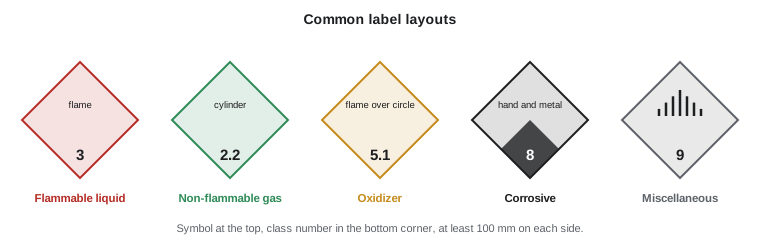
A label is a diamond (a square set on one corner) at least 100 mm on each side, with a solid line inside its edge. Its top half shows a symbol, such as a flame, skull and crossbones or exploding bomb, and its bottom corner shows the class or division number. Some labels also carry words, such as FLAMMABLE LIQUID or CORROSIVE, although words are optional in many cases. The background color helps recognition: red for flammable gases and liquids, green for non-flammable gases, yellow for oxidizers, white for toxic substances, black and white for corrosives, and white with vertical stripes for class 9.
Each package normally carries a label for its primary hazard and a label for each subsidiary hazard listed in column 6 of the Hazardous Materials Table. Labels must be printed on or affixed to a surface of the package near the proper shipping name, generally on the same side, and must not be obscured by other markings or attachments. When primary and subsidiary labels are required, they must be displayed next to each other. Small packages may use reduced labels where the package dimensions do not allow full size. A package must not carry a label that does not apply to its contents.
Package marks
Besides labels, most non-bulk packages must be marked with the proper shipping name and identification number, and with any technical names required in parentheses. Several other markings may be required depending on the material and the mode:
- Orientation arrows on combination packagings holding liquids, showing which way is up.
- The limited quantity marking, a diamond with black top and bottom corners and a white center, on limited quantity packages; the August 2026 rules allow a reduced 25 mm size in some cases.
- The marine pollutant mark, a diamond showing a dead fish and a bare tree, on packages of marine pollutants where required.
- The letters RQ with the description on packages of hazardous substances at or above the reportable quantity.
- The words INHALATION HAZARD on packages of materials poisonous by inhalation.
- The lithium battery mark, a rectangle with a red hatched border showing batteries and a flame.
- The consignee's or consignor's name and address on some packages, and the word OVERPACK on an outer package that holds labeled packages whose markings cannot be seen.
Placards
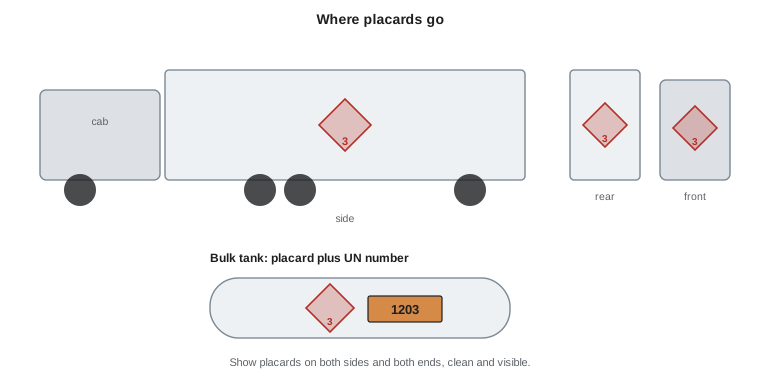
A placard is a large version of a label, at least 250 mm on each side, displayed on the outside of a vehicle, freight container, tank or other large means of containment. Placards must be displayed on each side and each end of the vehicle or container, so that they can be seen from any direction. They must be clearly visible, not hidden by doors, ladders or equipment, kept clean and in good condition, and removed or covered when the dangerous goods have been unloaded. A placard that does not match the contents is dangerous because it sends responders the wrong message.
When to placard is set out in 49 CFR 172.504. Hazmat in Table 1 must be placarded in any quantity: divisions 1.1, 1.2 and 1.3 explosives, division 2.3 poison gas, division 4.3 dangerous when wet materials, division 5.2 organic peroxides type B requiring temperature control, division 6.1 materials poisonous by inhalation in hazard zones A and B, and radioactive materials bearing the Radioactive Yellow-III label. Hazmat in Table 2, which covers most other classes, must be placarded when the aggregate gross weight of all Table 2 materials on the vehicle is 1,001 pounds (454 kg) or more. Below that threshold, Table 2 materials do not need placards, although the vehicle still needs shipping papers and emergency response information.
Bulk packagings, such as cargo tanks, portable tanks and tank cars, and vehicles carrying large quantities of one material, must also display the identification number. It goes in the center of the placard, on an orange panel next to it or on a white square-on-point, as set out in 172.332 to 172.336. Identification numbers are required on bulk packagings regardless of the placard threshold.
For mixed loads of two or more Table 2 categories, a DANGEROUS placard may be used instead of separate class placards. However, if 2,205 pounds (1,000 kg) or more of one Table 2 category is loaded at one facility, that class placard must be displayed in addition. Subsidiary placards are required for some materials, such as those poisonous by inhalation or dangerous when wet.
# Placarding decision for a mixed load (simplified; always check the regulations for exceptions).
load = [  # (description, class, gross mass kg, always-placard group?)
    ("Propane cylinders", "2.1", 210, False),
    ("Paint, PG II",      "3",   180, False),
    ("Corrosive cleaner", "8",   160, False),
]
always = [item for item in load if item[3]]
total = sum(item[2] for item in load)

# Canada: placard each primary class if total gross mass of dangerous goods exceeds 500 kg,
# or in any quantity for goods outside the 500 kg relief.
ca_classes = sorted({c for _, c, _, _ in load}) if total > 500 else sorted({c for _, c, _, a in always})
print(f"total dangerous goods: {total} kg")
print("Canada placards:", ca_classes or "none required")

# US: Table 2 materials need placards at 1,001 lb (454 kg) aggregate gross weight or more.
total_lb = total * 2.20462
us_classes = sorted({c for _, c, _, _ in load}) if total_lb >= 1001 else []
print(f"total in pounds: {total_lb:.0f} lb")
print("US placards (Table 2):", us_classes or "none required", "| DANGEROUS placard option for mixed Table 2 loads")total dangerous goods: 550 kg Canada placards: ['2.1', '3', '8'] total in pounds: 1213 lb US placards (Table 2): ['2.1', '3', '8'] | DANGEROUS placard option for mixed Table 2 loads
In this example the total of 550 kg crosses the Canadian 500 kg line, and at about 1,213 pounds it crosses the US 1,001-pound line, so placards for classes 2.1, 3 and 8 are needed in both countries (or a DANGEROUS placard for this mixed Table 2 load in the United States, if no single class reaches 1,000 kg from one facility). Remove one 160 kg item and the load drops below both lines, but every other requirement, such as documents and training, still applies.
Segregation
Some hazardous materials react violently with each other. An oxidizer next to a flammable liquid feeds a fire; an acid next to a cyanide can release toxic gas; water-reactive materials next to aqueous liquids can produce flammable gas if packages leak. Keeping incompatible materials apart is called segregation. For highway transport, the segregation table in 49 CFR 177.848 lists class combinations that must not be loaded together (marked X), or must be separated so they cannot mix in a release (marked O). For example, division 2.3 poison gas must not be loaded with class 3 flammable liquids, and some explosives must not be loaded with most other classes. Rail, air and vessel rules have their own segregation requirements.
Worked problem
Placarding a delivery truck
A truck carries 880 lb of aerosols (division 2.1), 660 lb of a corrosive (class 8, packing group II) and 44 lb of a poison gas cylinder (division 2.3). What placards are required in the United States?
Show solution
- The poison gas is a Table 1 material, so it must be placarded in any quantity: a 2.3 placard.
- The Table 2 materials total 1,540 lb, above 1,001 lb, so 2.1 and 8 placards are needed, or a DANGEROUS placard for the Table 2 portion.
- The DANGEROUS placard cannot replace the 2.3 placard, because Table 1 materials always need their own placard.
- The 2.3 cylinder must also be segregated from incompatible goods and secured, and the driver must know its emergency procedures.
Answer: A 2.3 placard plus 2.1 and 8 placards (or DANGEROUS for the Table 2 portion), on all four sides.
Worked problem
A small load below the threshold
A contractor's pickup carries 260 lb of gasoline in jerricans and 180 lb of propane cylinders. Does it need placards?
Show solution
- Both are Table 2 materials, totaling 440 lb, under 1,001 lb.
- So no placards are required.
- Shipping papers and emergency response information are still required unless an exception, such as materials of trade in lesson 10, applies.
Answer: No placards, but check whether an exemption applies before skipping documents and other requirements.
Placards on the road: practical points
Many carriers use placard holders with flip panels, so the driver can show the right class for each load. Flip placards are convenient but easy to leave on the wrong setting, so drivers should check every placard against the shipping document before each trip and after every drop-off on a multi-stop route. When a delivery removes the last of a class from the vehicle, its placard must come off or be covered.
Placards must stay readable. A placard caked in road grime or faded by the sun until its color and symbol cannot be recognized does not meet the rules. Placards must not be placed where doors, ladders or equipment hide them, and they must be at least 75 mm away from other markings that could reduce their effectiveness. On a trailer, the front placard can go on the front of the trailer or on the front of the tractor.
Empty packagings are not always free of the rules. A bulk packaging that has carried hazmat and has not been cleaned and purged of residue must remain placarded and marked with the identification number, and its shipping paper may describe it with the words Residue: Last contained before the basic description. Non-bulk packagings with residue are also regulated unless they have been cleaned or meet an exception.
Rail cars and freight containers follow the same idea at a larger scale: four placards, identification numbers for bulk loads and placards that match the contents. Intermodal containers carried by ship also follow the IMDG Code, so they may arrive with marks such as the marine pollutant mark that road-only shipments rarely show.
Drivers should also check placards after any event that could dislodge or damage them, such as a car wash, a collision with a loading dock or a long run through snow and salt, and carry spare placards for the classes they regularly haul.
Common mistakes
MistakeLeaving placards on an empty vehicle.
InsteadRemove or cover placards when the goods are unloaded, unless residue requires them to stay.
MistakePlacing placards only on the back of a truck.
InsteadDisplay placards on both sides and both ends.
MistakeApplying the 1,001-pound threshold to Table 1 materials.
InsteadTable 1 materials must be placarded in any quantity.
MistakeCovering labels with tape, other labels or straps.
InsteadLabels and marks must stay visible and legible near the shipping name.
MistakeLoading oxidizers next to flammable liquids.
InsteadSegregate incompatible goods according to the rules and safety data sheets.
Summary and key terms
- Labels are 100 mm diamonds with a symbol at the top and the class number at the bottom corner.
- Packages carry primary and subsidiary labels plus the UN number and shipping name and any special marks.
- Special marks include orientation arrows, limited quantity, environmentally hazardous, elevated temperature, inhalation hazard and lithium battery marks.
- Placards are 250 mm diamonds displayed on both sides and both ends of vehicles and large containers.
- Table 1 materials need placards in any quantity; Table 2 materials need them at 1,001 pounds aggregate or more.
- Bulk containers must also display the UN number.
- Incompatible goods must be segregated to prevent dangerous reactions if packages leak.
- Safety marks (hazard communication)
- The labels, placards and other marks that identify dangerous goods.
- Label
- A diamond at least 100 mm wide on a package showing a hazard symbol and class number.
- Placard
- A diamond at least 250 mm wide on a vehicle or large container showing the class.
- Subsidiary label
- A label for an additional hazard, displayed next to the primary label.
- Orange panel
- A rectangular orange sign that displays the UN number next to a placard.
- Limited quantity mark
- A diamond with black top and bottom corners used on limited quantity packages.
- Environmentally hazardous substance mark
- A diamond showing a dead fish and tree for marine pollutants and similar goods.
- Overpack
- An outer enclosure used to group packages, marked OVERPACK if inner labels are not visible.
- Segregation
- Keeping incompatible dangerous goods apart during transport.
- Mixed load
- A load containing dangerous goods of more than one class.
Practice problems
Work each problem on paper first, then reveal the answer to check.
What is the minimum size of a label and of a placard?
Show answer
100 mm and 250 mm on each side.
Where does the class number appear on a label?
Show answer
In the bottom corner.
What must appear on a package next to the label?
Show answer
The UN number and shipping name.
Where must placards be displayed on a truck?
Show answer
On both sides and both ends.
What is the US placarding threshold for Table 2 materials?
Show answer
1,001 pounds aggregate gross weight or more.
Name three Table 1 materials.
Show answer
Any three of divisions 1.1 to 1.3, division 2.3, division 4.3, temperature-controlled 5.2 type B, 6.1 inhalation hazard zones A and B, and Radioactive Yellow-III.
What does the environmentally hazardous substance mark show?
Show answer
A dead fish and a bare tree in a diamond.
When must the UN number appear on a bulk container?
Show answer
On bulk packagings regardless of the placard threshold.
Why is a wrong placard dangerous?
Show answer
It sends responders the wrong information about the hazard.
Why must oxidizers be kept away from flammable liquids?
Show answer
Oxidizers release oxygen that makes fires much more intense.
Lesson quiz · 5 questions
Score 60% or more to complete this lesson.
Create a free account to save your progress, take quizzes and earn a certificate.