
HSE-250 · Lesson 1 of 12 · 28 min
Why hazardous materials rules exist
Every day, trucks, trains, ships and aircraft carry fuels, acids, compressed gases, explosives, batteries, pesticides, medical samples and radioactive sources through cities and past homes, schools and rivers. Most of those trips end without anyone noticing. That quiet record is not luck. It rests on a detailed system of rules that decides how each hazardous product must be packaged, marked, documented and handled, and who is responsible at each step. In the United States that system is the Hazardous Materials Regulations, found in Title 49 of the Code of Federal Regulations, Parts 171 to 180, and enforced by the Department of Transportation.
This course explains how that system works, so that workers who prepare, load, drive, receive or supervise shipments of hazardous materials can recognize what the rules require and why. It is awareness training. Under 49 CFR 172.704, every hazmat employee must receive general awareness, function-specific, safety and security awareness training, and some need in-depth security training, with recurrent training at least once every three years. Completing this course does not certify anyone. Your hazmat employer must train, test and certify you for the specific functions you perform and keep a record of that training.
What makes a product dangerous in transport
A product can be harmless in a warehouse and dangerous on the road. Transport adds vibration, temperature swings, pressure changes in aircraft holds, impacts in collisions and derailments, and the chance that a leak will happen in a place full of people who have no idea what is in the container. Emergency responders arriving at a crash need to know within seconds whether they face a flammable liquid, a toxic gas or a radioactive source, and what to do about it. The transport rules exist mainly to answer three questions: how do we stop the product escaping, how do we tell everyone what it is, and who does what if something goes wrong?
The rules use the term hazardous materials, often shortened to hazmat. A hazardous material is a substance or material that the Secretary of Transportation has determined can pose an unreasonable risk to health, safety and property when transported in commerce. In practice that means anything listed in the Hazardous Materials Table in 49 CFR 172.101 or meeting the criteria of one of the nine hazard classes, plus hazardous substances, hazardous wastes, marine pollutants and elevated-temperature materials. The nine classes are explosives, gases, flammable liquids, flammable solids, oxidizers and organic peroxides, poisonous (toxic) and infectious substances, radioactive materials, corrosives and miscellaneous materials. Lesson 3 walks through each one.
Disasters that shaped the rules
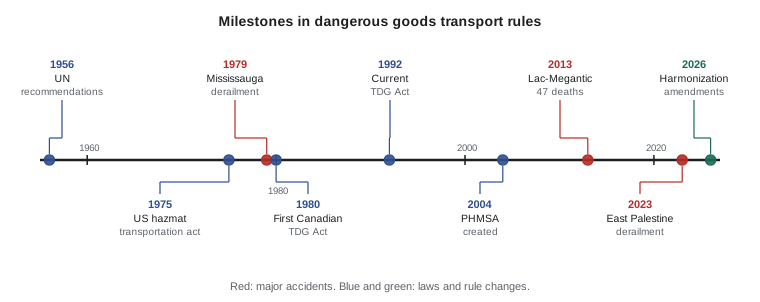
The modern US system began with the Hazardous Materials Transportation Act of 1975, which gave the Department of Transportation authority to regulate all modes of transport in one coherent set of rules. Congress acted after a series of rail and highway accidents involving chlorine, propane and other chemicals in the 1960s and 1970s showed that the existing patchwork of agency rules left responders and the public exposed. The Pipeline and Hazardous Materials Safety Administration, created in 2004, now writes the Hazardous Materials Regulations.
Two rail accidents in recent memory show what is at stake. On 6 July 2013 at Lac-Mégantic, Quebec, just north of the Maine border, an unattended train of 72 tank cars of crude oil rolled away, derailed in the town center and burned, killing 47 people. Investigators found that the oil had been classified in a lower-hazard packing group than tests supported, among many other failures. The disaster led to joint US and Canadian rules for tougher tank cars carrying flammable liquids and new testing and classification requirements for crude oil. On 3 February 2023 a Norfolk Southern train derailed in East Palestine, Ohio, after a wheel bearing overheated. Several cars carried vinyl chloride. Fearing an explosion, officials evacuated nearby residents, and crews deliberately vented and burned the contents of five cars. No one died, but the fire and smoke caused lasting fear and disruption, and the National Transportation Safety Board later concluded that the vent and burn had not been necessary. The accident renewed debate about train length, detector spacing and how quickly responders receive accurate information about what a train is carrying.
How the system reduces risk
The transport rules attack risk from several directions at once. Classification decides how dangerous a product is. Packaging standards keep it inside its container under normal transport conditions and, for the most dangerous products, under accident conditions as well. Labels, placards and marks warn handlers and responders from a distance. Documents travel with the load so that anyone who needs to know can find out exactly what is on board. Training makes sure that the people involved know what to do. Emergency response requirements put specialist help a phone call away. Incident reporting lets regulators learn from failures. If one layer fails, the others still give protection.
| Layer of protection | What it does | Covered in |
|---|---|---|
| Classification | Decides the class, packing group and therefore every later requirement | Lessons 3 and 4 |
| Identification | Gives each product a UN number and proper shipping name | Lesson 5 |
| Packaging | Keeps the product contained under normal and, for some products, accident conditions | Lesson 6 |
| Hazard communication | Labels, placards and marks warn people at a glance | Lesson 7 |
| Documentation | Tells carriers and responders exactly what is on board and who to call | Lesson 8 |
| Training and responsibilities | Makes sure each person knows their duties | Lesson 9 |
| Emergency response and reporting | Brings help fast and lets regulators learn from incidents | Lesson 11 |
Why the numbers look good, and why that is not enough
Measured per shipment, serious dangerous goods incidents are rare. Millions of shipments move every year across North America, and only a small fraction involve a release, and of those only a few cause injury. But a low rate multiplied by a very large number of shipments still means that releases happen somewhere every day. And because the consequences of the worst incidents are so severe, regulators and companies treat even small failure rates seriously. The example below shows why.
# Rare per-shipment failures still add up over many shipments (illustrative numbers).
p_release = 1 / 20000        # chance any single shipment has a reportable release
for shipments in (100, 1000, 10000, 100000):
    p_none = (1 - p_release) ** shipments
print(f"{shipments:>7} shipments: chance of at least one release = {1 - p_none:6.1%}")100 shipments: chance of at least one release = 0.5% 1000 shipments: chance of at least one release = 4.9% 10000 shipments: chance of at least one release = 39.3% 100000 shipments: chance of at least one release = 99.3%
The numbers are illustrative, but the lesson is real. A company making a hundred shipments a year might go many years without a release and come to believe that the rules are overkill. A company making a hundred thousand shipments will almost certainly have several. The rules are written for the whole system, not for one lucky shipper.
Who is covered
The Hazardous Materials Regulations apply to anyone who offers, accepts or transports hazardous materials in commerce, or who manufactures, reconditions or tests packagings sold for hazmat use. That includes manufacturers and distributors shipping chemicals, retailers sending products to customers, contractors carrying fuel and gas cylinders to job sites, couriers, airlines, railroads, vessel operators and warehouse staff who load and unload vehicles. Interstate, intrastate and foreign commerce are all covered for highway transport, and most states adopt the federal rules for intrastate shipments through their own laws, often with some exceptions for small local carriers. Workplace use of the same products, once they arrive, is covered by the OSHA Hazard Communication Standard, as introduced in HSE-102.
Transport rules and workplace rules overlap but are not the same. A drum of corrosive cleaner carries DOT hazard labels and markings while it travels and an OSHA HazCom label once it is in the workplace, and often both at once. Both systems are based on the United Nations Globally Harmonized System, but transport classification and workplace classification can differ, and a product can be hazardous under one and not the other. Knowing which rules apply at which moment is part of the job.
The international foundation
Hazardous materials move across borders constantly, so the rules have to fit together. The foundation is the United Nations Recommendations on the Transport of Dangerous Goods, known as the Model Regulations or the Orange Book, first published in 1956 and updated every two years. PHMSA periodically harmonizes the Hazardous Materials Regulations with the Model Regulations and with the international rules for air and sea, and in August 2026 it finalized a group of seventeen rules, largely taking effect by early December 2026, that eased several domestic requirements and adopted a number of special permits into the regulations. Because the United States and Canada trade so heavily, the HMR allow most shipments prepared under the Canadian TDG Regulations to travel by highway or rail in the United States, and the reverse is largely true as well. Lesson 2 explains the framework in detail.
Worked problem
Recognizing a dangerous goods shipment you might miss
A small plumbing contractor loads its van every morning with a propane cylinder for a torch, two cans of solvent cement, a case of aerosol lubricant and a lithium-ion battery pack for power tools. Do the Hazardous Materials Regulations apply to this van?
Show solution
- Propane is a flammable gas (Class 2.1). Solvent cement is usually a flammable liquid (Class 3). Aerosols are Class 2. Lithium-ion batteries are Class 9.
- So the van does carry dangerous goods, even though each item is small and bought from a supplier.
- Whether the full rules apply depends on quantities and exceptions such as the materials of trade exception in 49 CFR 173.6, covered in lesson 10.
- Even where an exemption applies, conditions remain: containers must be secured, must not leak and are limited in size.
Answer: Yes, the van carries hazardous materials. The materials of trade exception will probably relieve it of placards and shipping papers, but only if its conditions are met, so the contractor must know which exception it relies on.
Worked problem
Thinking about why classification matters
A shipper classifies a flammable liquid in packing group III (the lowest danger) based on old data, when its actual flash point and boiling point put it in packing group I. What could go wrong?
Show solution
- Packing group decides the packaging performance level. Packing group I needs the strongest packaging, marked with the letter X.
- It also changes the quantities allowed under exemptions and limited quantity rules, and can change whether an emergency response plan is required.
- Responders reading the documents will expect a less volatile product than is actually present.
- This is one of the failures found at Lac-Mégantic.
Answer: Wrong classification passes wrong information to every later layer: packaging, exemptions, emergency planning and response. Lesson 4 shows how packing groups are assigned.
Common mistakes
MistakeThinking the Hazardous Materials Regulations apply only to tank trucks and trains.
InsteadSmall packages, courier parcels, service vans and aircraft cargo are all covered, subject to the exemptions.
MistakeAssuming a product bought at a store cannot be dangerous goods.
InsteadFuels, aerosols, batteries, pool chemicals and many cleaners are regulated; consumer exemptions have conditions.
MistakeTreating this course as hazmat certification.
InsteadOnly your hazmat employer can train, test and certify you for the functions you perform.
MistakeTreating classification as paperwork.
InsteadClassification drives packaging, marking, documents and emergency response; errors carry through every layer.
MistakeAssuming workplace labels are enough for transport.
InsteadTransport and workplace labeling are separate systems, although exemptions sometimes allow overlap.
Summary and key terms
- The Hazardous Materials Regulations in 49 CFR Parts 171 to 180 govern hazmat transport in the United States.
- Transport adds hazards such as impact, vibration and pressure change, and puts products near people who do not know what they are.
- The rules answer three questions: how to keep the product contained, how to tell people what it is, and what to do if it escapes.
- The 1975 Hazardous Materials Transportation Act created the modern system; Lac-Mégantic in 2013 and East Palestine in 2023 drove further changes.
- Protection comes in layers: classification, identification, packaging, hazard communication, documents, training and emergency response.
- The rules are built on the UN Model Regulations, so national, air and sea rules fit together.
- This is awareness training; only your hazmat employer can certify your training.
- Hazardous material
- A substance or material the Department of Transportation has found can pose an unreasonable risk in transport, as listed or classified under 49 CFR.
- Hazardous Materials Regulations (HMR)
- The federal regulations in 49 CFR Parts 171 to 180 that set the detailed transport rules in the United States.
- PHMSA
- The Pipeline and Hazardous Materials Safety Administration, which writes the HMR within the Department of Transportation.
- Hazmat employee
- A person whose work directly affects hazmat transport safety, such as loading, preparing packages or driving.
- UN Model Regulations
- The United Nations recommendations on dangerous goods transport on which national and international rules are based.
- Class
- One of nine categories of dangerous goods grouped by their main hazard.
- Packing group
- A rating of danger within some classes: I for great danger, II for medium and III for minor danger.
- Classification
- Deciding which class, division and packing group a product belongs to.
- Placard
- A large diamond-shaped sign on a vehicle or large container that shows the class of dangerous goods inside.
- Emergency responder
- A firefighter, police officer, paramedic or hazmat technician who responds to releases and accidents.
Practice problems
Work each problem on paper first, then reveal the answer to check.
Name three ways transport adds hazards that a product would not face in storage.
Show answer
Any three of impact in collisions, vibration, temperature swings, pressure changes in aircraft and closeness to unaware members of the public.
What three questions do the transport rules mainly answer?
Show answer
How to keep the product contained, how to tell people what it is and who does what if it escapes.
Which 1975 law created the modern US hazmat system?
Show answer
The Hazardous Materials Transportation Act.
What did the Lac-Mégantic investigation find about the crude oil's classification?
Show answer
It had been classified in a lower-hazard packing group than tests supported.
List the seven layers of protection in the transport system.
Show answer
Classification, identification, packaging, hazard communication, documentation, training and responsibilities, and emergency response and reporting.
Why do regulators care about rare incidents?
Show answer
Because a low rate multiplied by a very large number of shipments still means frequent releases, and the worst consequences are severe.
Who certifies hazmat employee training?
Show answer
The hazmat employer.
Give two consumer products that are regulated in transport.
Show answer
Any two of gasoline, propane cylinders, aerosols, lithium batteries, pool chemicals and flammable solvents.
What international document are national rules built on?
Show answer
The UN Recommendations on the Transport of Dangerous Goods, the Model Regulations.
Which rule covers the same products once they are in use at a workplace?
Show answer
The OSHA Hazard Communication Standard.
Lesson quiz · 5 questions
Score 60% or more to complete this lesson.
Create a free account to save your progress, take quizzes and earn a certificate.