
HSE-250 · Lesson 12 of 12 · 27 min
Capstone: preparing a shipment of cylinders and batteries for road transport
This capstone brings the course together in one realistic job. Ridgeback Welding Supply, an invented distributor in Duluth, Minnesota, has an order from a construction contractor for a set of gas cylinders and a box of large lithium-ion battery packs for cordless tools. Ridgeback will deliver the order on its own flatbed truck to a job site 25 miles away. You are the shipping supervisor. Your task is to work out everything the HMR require, step by step, from classification to what the driver does if something goes wrong. The company and its numbers are invented for teaching; the method is real.
The order
| Item | Quantity | Gross weight each | Notes |
|---|---|---|---|
| Acetylene cylinders | 4 | 176 lb | Dissolved acetylene, standard industrial size |
| Oxygen cylinders | 4 | 154 lb | Compressed oxygen |
| Argon cylinders | 2 | 143 lb | Compressed argon for welding |
| Lithium-ion tool battery packs | 1 box of 10 | 53 lb per box | Each pack above 100 Wh, shipped on their own, not in equipment |
| Anti-spatter aerosol | 2 cartons of 12 | 13 lb per carton | Prepared by the manufacturer as limited quantities |
Step 1: Classify and identify
Start with the Hazardous Materials Table. Each material is listed by name, so you use those entries rather than generic ones. Acetylene is a flammable gas. Oxygen is a non-flammable gas with an oxidizer subsidiary hazard. Argon is a non-flammable compressed gas. The battery packs are class 9. The aerosols are flammable aerosols, already packaged and marked as limited quantities.
| Product | UN number | Shipping name | Class | Subsidiary |
|---|---|---|---|---|
| Acetylene | UN1001 | ACETYLENE, DISSOLVED | 2.1 | none |
| Oxygen | UN1072 | OXYGEN, COMPRESSED | 2.2 | 5.1 |
| Argon | UN1006 | ARGON, COMPRESSED | 2.2 | none |
| Battery packs | UN3480 | LITHIUM ION BATTERIES | 9 | none |
| Aerosols | UN1950 | AEROSOLS, flammable | 2.1 | none |
Before moving on, read the special provisions for each entry. The lithium battery entry has several, covering how batteries must be protected against short circuits, the packaging needed for batteries above set watt-hour ratings and the battery mark. The aerosol entry's provisions set the limited quantity conditions. The gas entries refer you to cylinder requirements.
Then check whether any special requirements apply beyond the basic rules: none of these materials is a hazardous substance at these quantities or a poison inhalation hazard, so no RQ notation or inhalation markings are needed. For this exercise, assume no security plan is required for these quantities.
Step 2: Check for exemptions
Could an exception avoid the full rules? Materials of trade does not fit: Ridgeback is delivering goods it has sold to a customer, not carrying its own working supplies, and the total is far above 440 pounds anyway. The aerosols qualify as limited quantities on their own, but the cylinders and batteries need full compliance.
Step 3: Check the containers
Each cylinder must meet a DOT specification (or an authorized UN specification), be within its requalification date under 180.205, have a closed valve protected by a cap or a guard, and show no damage. Acetylene cylinders contain a porous mass and solvent and must always be transported upright. Oxygen cylinders and fittings must be kept free of oil and grease, which can ignite in contact with high-pressure oxygen. The battery packs must be packed in UN specification packaging as 173.185 requires, with each pack protected against short circuits and movement, and must not be damaged or recalled.
Worked problem
A cylinder fails the check
During the check, one oxygen cylinder shows a requalification stamp from eleven years ago, and its type requires requalification every ten years. Another acetylene cylinder has a bent valve guard. What should you do?
Show solution
- The oxygen cylinder is past its requalification date. It must not be filled or shipped full until it has been requalified, so it is pulled from the order and replaced.
- The acetylene cylinder's valve protection is damaged, which could let the valve be struck off in a fall. It is set aside, tagged and returned for repair.
- Two replacement cylinders are checked the same way before loading.
Answer: Replace both cylinders. Never ship a cylinder that is out of date or whose valve protection is damaged.
Step 4: Total the load and decide on placards
# Ridgeback Welding Supply: placard and shipping paper check for the US delivery (invented example).
load = [  # (description, ID, class, subsidiary, gross lb each, count, limited quantity?)
    ("Acetylene, dissolved", "UN1001", "2.1", None, 176, 4, False),
    ("Oxygen, compressed", "UN1072", "2.2", "5.1", 154, 4, False),
    ("Argon, compressed", "UN1006", "2.2", None, 143, 2, False),
    ("Lithium ion batteries", "UN3480", "9", None, 53, 1, False),
    ("Aerosols, flammable", "UN1950", "2.1", None, 13, 2, True),
]
regulated = [x for x in load if not x[6]]
table2 = sum(m * n for _, _, cls, _, m, n, _ in regulated)
print(f"aggregate gross weight of Table 2 materials: {table2} lb")
classes = sorted({x[2] for x in regulated if x[2] != "9"})   # class 9 placard not required domestically
per_class = {c: sum(m * n for _, _, cls, _, m, n, _ in regulated if cls == c) for c in classes}
if table2 >= 1001:
    print("placards:", ", ".join(classes), "| or DANGEROUS (no single class reaches 2,205 lb):", per_class)
print("shipping paper entries (X in HM column):")
for name, un, cls, sub, m, n, lq in regulated:
    c = cls + (f" ({sub})" if sub else "")
    unit = "box" if cls == "9" else "cylinders"
print(f" X {n} {unit}, {un}, {name}, {c}, {m * n} lb")aggregate gross weight of Table 2 materials: 1659 lb
placards: 2.1, 2.2 | or DANGEROUS (no single class reaches 2,205 lb): {'2.1': 704, '2.2': 902}
shipping paper entries (X in HM column):
X 4 cylinders, UN1001, Acetylene, dissolved, 2.1, 704 lb
X 4 cylinders, UN1072, Oxygen, compressed, 2.2 (5.1), 616 lb
X 2 cylinders, UN1006, Argon, compressed, 2.2, 286 lb
X 1 box, UN3480, Lithium ion batteries, 9, 53 lbThe aggregate of 1,659 pounds of Table 2 materials is above 1,001 pounds, so the truck must display 2.1 and 2.2 placards on both sides and both ends, or a DANGEROUS placard, since no single class reaches 2,205 pounds loaded at one facility. An OXYGEN placard may be used in place of the 2.2 placard for oxygen in domestic transport. A class 9 placard is not required for domestic transport of the batteries, although it may be displayed. Because the vehicle is placarded, the driver needs a commercial driver's license with a hazmat endorsement, and Ridgeback must hold a current PHMSA hazmat registration.
Step 5: Load, segregate and secure
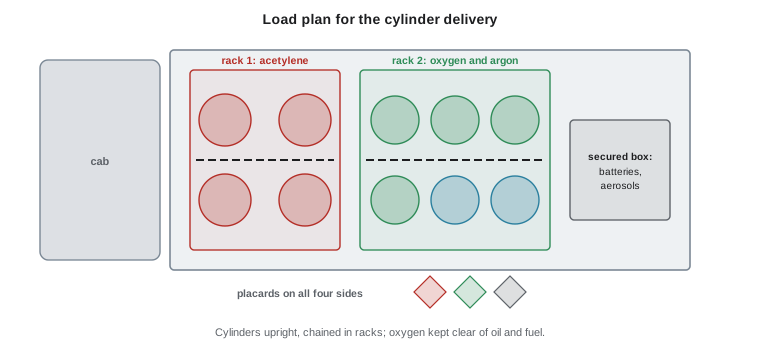
Cylinders must be secured upright in racks or cradles designed for them, restrained so they cannot move, roll or fall, with valve caps or guards in place, as 177.840 requires for gases. On a flatbed they are best carried in a cylinder rack chained to the deck. The segregation table in 177.848 allows divisions 2.1 and 2.2 to travel together, so acetylene and oxygen can share the vehicle, but they should be in separate racks and the oxygen kept away from any oil, grease or fuel. Cylinders should never be carried in a closed passenger compartment, where a leak could fill the space. The battery box and aerosol cartons go in a secured cargo box, protected from rain and from being crushed by the cylinders.
Step 6: Mark and label
Each cylinder must be marked with its proper shipping name and identification number and carry its label, and the oxygen cylinders also carry an oxidizer subsidiary label. On cylinders, labels are usually printed on a neck ring or tag, which the HMR allow for cylinders. The battery box must show the identification number and proper shipping name and carry the class 9 lithium battery label, as required for these battery sizes. The aerosol cartons carry the limited quantity marking.
Step 7: Prepare the shipping document
Ridgeback prepares a shipping paper listing the hazmat entries first or marked with an X in the HM column, each with the number and type of packages, the basic description and the total quantity, followed by a 24-hour emergency response telephone number and the signed shipper's certification. The driver also carries emergency response information, usually the ERG with the shipping paper. The paper stays within the driver's reach, and on the seat or in the door holder when the driver is out of the truck. Ridgeback keeps a copy for two years.
Step 8: Training and the driver's briefing
Everyone involved must be a trained hazmat employee: the warehouse worker who selected and checked the cylinders, the supervisor who classified the shipment and signed the shipping paper, and the driver, whose training must include driver-specific topics. Each must have been trained within the past three years, with records kept. Before leaving, the supervisor briefs the driver on the load, the route, where the papers are and what to do in an emergency.
Step 9: The emergency plan
The driver should know the ERG guides for the load before setting off: guide 116 for acetylene (flammable gases, unstable), guide 122 for oxygen (oxidizing gases), guide 121 for argon (inert gases) and guide 147 for lithium-ion batteries. If a cylinder leaks, the driver moves away upwind, keeps people back and eliminates ignition sources. If the truck crashes or a fire starts, the driver calls 911, warns responders that pressurized cylinders and lithium batteries are on board, gives them the shipping document, and calls Ridgeback's 24-hour number. Cylinders involved in fire can rupture violently, so the ERG advises large isolation distances.
If an incident meets the 171.15 conditions, the carrier must notify the National Response Center within 12 hours, and any unintentional release requires a Form 5800.1 report to PHMSA within 30 days.
| Step | Done when |
|---|---|
| 1 Classify and identify | UN numbers, shipping names and classes confirmed from the current list; special provisions read |
| 2 Exemptions | Each possible exemption checked; full compliance confirmed for cylinders and batteries |
| 3 Containers | Cylinder specifications, requalification dates, valves and guards checked; battery packaging confirmed |
| 4 Totals and placards | Vehicle total calculated; placards chosen and supplied |
| 5 Loading | Cylinders upright and restrained; incompatible items separated; packages secured |
| 6 Marks and labels | Shipping names, UN numbers, labels and special marks in place |
| 7 Document | Shipping document complete, signed or named, and placed in the cab |
| 8 Training | Certificates or training records current for everyone involved |
| 9 Emergency plan | Driver briefed on guides, actions and reporting |
Worked problem
The customer adds an order at the last minute
Just before departure, the contractor phones to add a 44 lb cylinder of propane and three 5-gallon cans of gasoline (37 lb each). What changes?
Show solution
- The Table 2 aggregate rises to 1,659 + 44 + 111 = 1,814 pounds; a class 3 placard is added (or the DANGEROUS placard continues to cover the mixed load).
- The shipping document needs entries for UN1075 PETROLEUM GASES, LIQUEFIED (or PROPANE), 2.1, and UN1203 GASOLINE, 3, PG II.
- The gasoline must be in permitted containers, kept away from the oxygen cylinders, and secured.
- The driver is briefed on two more ERG guides: 115 for propane and 128 for gasoline.
Answer: Add a class 3 placard, two document entries and the right containers and segregation, and brief the driver; never just add goods to a loaded truck without redoing the checks.
Common mistakes
MistakeLaying acetylene cylinders on their side on the deck.
InsteadTransport acetylene upright, restrained in a rack.
MistakeForgetting to count limited quantity aerosols toward the vehicle total.
InsteadAll dangerous goods on the vehicle count toward totals and thresholds.
MistakeShipping a cylinder past its requalification date because it is full.
InsteadOut-of-date cylinders must be requalified before they are shipped full.
MistakeAdding last-minute items without updating placards and documents.
InsteadRedo the checks for every change to the load.
MistakeLetting oil or grease contact oxygen cylinders or fittings.
InsteadKeep oxygen equipment clean and separate from fuels and lubricants.
Summary and key terms
- Start every shipment with classification from the current list and read the special provisions.
- Check every possible exemption, but confirm full compliance when the conditions are not met.
- Check containers: specifications, requalification dates, valves, guards and battery packaging.
- Total the load, including limited quantities, and choose placards from the thresholds.
- Load cylinders upright and restrained, separate incompatible items and secure small packages.
- Mark and label every package and prepare a complete, certified shipping document.
- Make sure everyone is trained, and brief the driver on the ERG guides, emergency actions and reporting.
- Dissolved acetylene
- Acetylene held in a solvent within a porous mass inside the cylinder; must be kept upright.
- Cylinder rack
- A frame that holds cylinders upright and restrained on a vehicle.
- Valve guard (cap)
- A cap or collar that protects a cylinder valve from being struck.
- Neck label
- A smaller hazard label or tag designed for the shoulder of a gas cylinder.
- Watt-hour rating
- The energy capacity of a battery, which decides which lithium battery rules apply.
- Load plan
- A plan showing where each item goes on a vehicle and how it is secured.
- Pre-departure check
- A final check of load, placards, documents and briefing before a vehicle leaves.
- Oxygen enrichment
- An atmosphere with more oxygen than normal, in which materials burn far more readily.
- Last-minute change
- An addition or removal that requires the placard, document and loading checks to be redone.
- Consignee briefing
- Information given to the receiver about the goods and safe unloading.
Practice problems
Work each problem on paper first, then reveal the answer to check.
What UN number and class apply to dissolved acetylene?
Show answer
UN1001, class 2.1.
What subsidiary class does compressed oxygen have?
Show answer
5.1, oxidizer.
Why does materials of trade not apply to this delivery?
Show answer
Ridgeback is delivering goods it sold, not carrying its own working supplies, and the total exceeds 440 pounds.
Why must acetylene cylinders be transported upright?
Show answer
They contain a solvent and porous mass; lying them down can let solvent reach the valve and make the cylinder unsafe.
Why must oxygen cylinders be kept free of oil and grease?
Show answer
Oil and grease can ignite in contact with high-pressure oxygen.
Which placards does the original load need?
Show answer
2.1 and 2.2 (or DANGEROUS), on both sides and both ends; class 9 is optional domestically.
Which ERG guide applies to lithium-ion batteries?
Show answer
Guide 147.
What must happen if a cylinder is past its requalification date?
Show answer
It must not be shipped full until it is requalified; replace it.
What must be redone when the customer adds gasoline to the order?
Show answer
The vehicle total, placards, document entries, container check, segregation and the driver briefing.
Where should cylinders never be carried?
Show answer
In a closed passenger compartment.
Lesson quiz · 5 questions
Score 60% or more to complete this lesson.
Create a free account to save your progress, take quizzes and earn a certificate.