
HSE-250 · Lesson 11 of 12 · 27 min
Incidents, release reporting and emergency response
Despite every precaution, packages leak, trucks crash and tank cars derail. When that happens, the first minutes decide how bad the outcome will be. This lesson covers what drivers, warehouse workers and supervisors should do when dangerous goods are released or about to be released, how to use the Emergency Response Guidebook, and what the law requires you to report and to whom. It is awareness training: it does not prepare you to clean up a spill or enter a contaminated area. Spill response is covered in HSE-251, and hazardous materials responders receive specialized training far beyond this course.
The first actions
If you are the driver or the person on site when dangerous goods are released, your priorities are, in order: protect yourself, protect others, call for help and give responders accurate information. In practice that means:
- Stop the vehicle in a safe place if you can, away from people, buildings, drains and waterways, turn off the engine and set the brakes.
- Stay out of any vapor, smoke, mist or spilled material. Do not walk into or touch it, and do not try to plug leaks unless you are trained and protected.
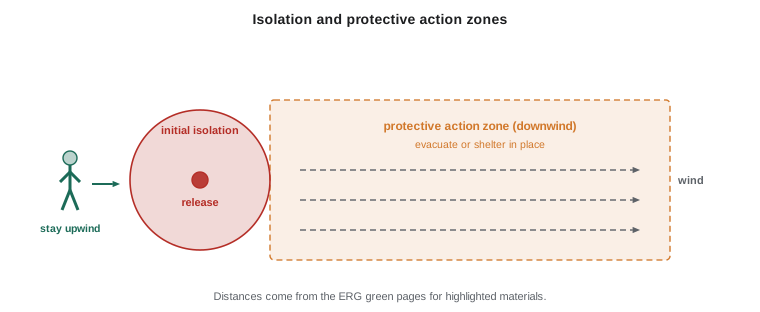
- Move yourself and others away, upwind, uphill and upstream of the release.
- Warn others, keep bystanders back and prevent smoking or other ignition sources.
- Call 911 or the local emergency number and give your location, the UN numbers or shipping names, the classes, the quantities and what you can see happening.
- Take the shipping documents with you if it is safe, and hand them to the first responders who arrive.
- Follow the instructions of responders, and call the emergency telephone number on the shipping document.
Do not move damaged packages, restart a vehicle that is leaking fuel, or let curiosity draw you closer. Several gases, including hydrogen sulfide (HSE-244) and carbon monoxide, can disable people within minutes or seconds, and others such as propane are heavier than air and collect in low areas where a single spark can ignite them.
The Emergency Response Guidebook
The Emergency Response Guidebook (ERG) is published jointly by the US Department of Transportation, Transport Canada and Mexico's transport secretariat, and PHMSA distributes it free to emergency services. The current edition is ERG 2024; editions are normally issued every four years. It is designed for first responders in the first 30 minutes of an incident involving hazmat, before more detailed information is available. Many carriers carry it as their emergency response information under 172.602, and it is free as an app and online.
The ERG is organized in colored sections:
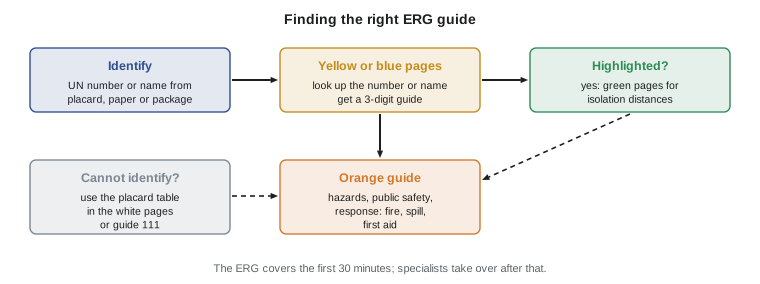
- The white pages at the front explain how to use the guide, show the placards with the guide to use if only the placard can be seen, and include rail car and road trailer identification charts.
- The yellow pages list materials by UN number, each with a three-digit guide number. Entries highlighted in green indicate a material that is toxic by inhalation, reacts with water to produce toxic gases, or is a chemical warfare agent.
- The blue pages list the same materials alphabetically by name, with the same guide numbers.
- The orange pages are the guides themselves, numbered from 111 to 174. Each guide gives potential hazards (fire or explosion and health), public safety advice (isolation distances, protective clothing, evacuation) and emergency response actions (fire, spill or leak, first aid).
- The green pages give initial isolation and protective action distances for the highlighted materials, for small and large spills, by day and by night, and for some large spills of common toxic gases, by wind speed.
# A tiny ERG-style lookup: UN number -> guide number -> first message (simplified extract).
YELLOW = {"1203": 128, "1075": 115, "1830": 137, "3480": 147, "1005": 125}
ORANGE = {
    115: "Gases, flammable: extremely flammable; may form explosive mixtures with air.",
    125: "Gases, corrosive: toxic, may be fatal if inhaled; fumes extremely irritating.",
    128: "Flammable liquids (non-polar/water-immiscible): highly flammable; fumes may travel to an ignition source.",
    137: "Substances, water-reactive, corrosive: reacts with water; contact causes severe burns.",
    147: "Lithium ion and sodium ion batteries: may ignite; may release toxic and flammable gases.",
}
GREEN = {"1005"}   # toxic-by-inhalation entries highlighted in the yellow pages (illustrative)

for un, guide in YELLOW.items():
    flag = " -> check green pages for isolation distances" if un in GREEN else ""
print(f"UN{un}: guide {guide}. {ORANGE[guide]}{flag}")UN1203: guide 128. Flammable liquids (non-polar/water-immiscible): highly flammable; fumes may travel to an ignition source. UN1075: guide 115. Gases, flammable: extremely flammable; may form explosive mixtures with air. UN1830: guide 137. Substances, water-reactive, corrosive: reacts with water; contact causes severe burns. UN3480: guide 147. Lithium ion and sodium ion batteries: may ignite; may release toxic and flammable gases. UN1005: guide 125. Gases, corrosive: toxic, may be fatal if inhaled; fumes extremely irritating. -> check green pages for isolation distances
In a real incident, responders use the full guide, not a short extract like this. The point is the workflow: identify the material by UN number or name, find the guide, check the green pages if the entry is highlighted, and read the whole orange guide before acting. If the material cannot be identified, guide 111 (mixed load or unidentified cargo) gives cautious general advice.
Emergency advice centers
CHEMTREC, a call center funded by the chemical industry, provides 24-hour emergency response information and can connect responders with shippers and manufacturers; many shippers list it as their emergency response number. Emergency services also contact the National Response Center, operated by the US Coast Guard, which receives release reports and alerts federal agencies. Calling the emergency response number on the shipping paper brings in the people who know the product best. For cross-border shipments, CANUTEC in Canada provides the equivalent service.
What must be reported
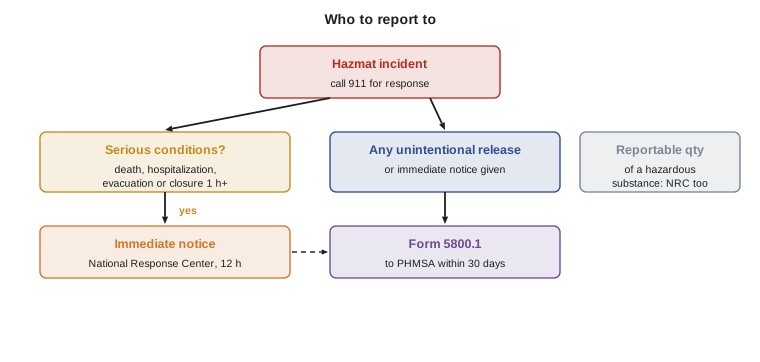
Under 49 CFR 171.15, a carrier must give immediate telephone or online notice to the National Response Center, at 1-800-424-8802, as soon as practical and no later than 12 hours after an incident in which, as a direct result of the hazmat, a person is killed or injured and hospitalized, the general public is evacuated for one hour or more, a major transportation artery or facility is closed for one hour or more, the flight pattern of an aircraft is altered, there is fire, breakage, spillage or suspected contamination involving radioactive material or an infectious substance (other than regulated medical waste), or a marine pollutant is released above set amounts. The carrier must also report any situation it judges important enough to report.
Under 171.16, a written Hazardous Materials Incident Report, DOT Form F 5800.1, must be submitted to PHMSA within 30 days for any unintentional release of hazmat in transportation, including loading and unloading, with some exceptions for small releases of certain lower-hazard materials, and for any incident that required an immediate notice. Undeclared hazmat discovered in transportation must also be reported. A follow-up report may be required within a year if new information comes to light. Releases of hazardous substances at or above their reportable quantity must also be reported to the National Response Center under environmental law, and state and local rules may add their own reporting duties.
# Which US reports are needed? (simplified from 171.15 and 171.16; check the regulations)
def reports(release, hospitalized=False, evac_hours=0, artery_closed_hours=0,
            radioactive_or_infectious=False, small_exempt=False):
    out = []
    if hospitalized or evac_hours >= 1 or artery_closed_hours >= 1 or radioactive_or_infectious:
        out.append("immediate notice to National Response Center within 12 hours")
    if (release and not small_exempt) or out:
        out.append("Form 5800.1 to PHMSA within 30 days")
    return out or ["no DOT incident report (still clean up and record)"]

cases = [("small leak of consumer paint, exception applies", (True, False, 0, 0, False, True)),
         ("drum of solvent leaks at dock", (True,)),
         ("tank truck rollover, highway closed 3 hours", (True, False, 0, 3))]
for label, args in cases:
print(label, "->", "; ".join(reports(*args)))small leak of consumer paint, exception applies -> no DOT incident report (still clean up and record) drum of solvent leaks at dock -> Form 5800.1 to PHMSA within 30 days tank truck rollover, highway closed 3 hours -> immediate notice to National Response Center within 12 hours; Form 5800.1 to PHMSA within 30 days
These helpers show the logic, not the full legal test. When in doubt, report: regulators would rather receive an unnecessary report than miss one that was required, and failing to report is itself a violation.
After the emergency
Once responders have the situation under control, the shipper, carrier and their response contractors arrange cleanup, product transfer and disposal, often under environmental law. Everyone involved should preserve evidence, record what happened and cooperate with investigators. A good internal review asks why the release happened (a loose closure, a wrong packaging, poor securement, a crash) and what will prevent the next one, using the investigation methods covered in HSE-403.
Worked problem
A leaking drum on the dock
A warehouse worker finds a 55-gallon drum of a class 8 corrosive, packing group II, leaking onto the dock floor after being unloaded from a truck. About 5 gallons have spilled. Nobody is hurt. What must happen?
Show solution
- Keep people away, avoid contact and ventilate if the product gives off fumes. Use the safety data sheet and the ERG (the guide for the product) for initial precautions.
- Trained spill responders, using the right protective equipment, contain the spill (HSE-251).
- Releases during loading and unloading count as transportation. The carrier must file Form 5800.1 within 30 days. An immediate NRC notice is not required unless one of the 171.15 conditions applies.
- If the corrosive is a hazardous substance and the spill reached its reportable quantity, an NRC report under environmental law is also required.
Answer: Contain the spill with trained staff and file Form 5800.1 within 30 days; check whether the reportable quantity was reached.
Worked problem
A rollover with a toxic gas
A truck carrying cylinders of anhydrous ammonia rolls over. Responders see a vapor cloud and evacuate a nearby street. What do the driver and the company need to do?
Show solution
- The driver, if able, moves away upwind and uphill, calls 911 with the UN number (UN1005), class and quantity, and hands over the shipping documents.
- Responders use the ERG: UN1005 is a highlighted entry, so the green pages give initial isolation and protective action distances.
- An evacuation lasting an hour or more triggers immediate notice to the National Response Center within 12 hours, followed by Form 5800.1 within 30 days.
- The company preserves records and cooperates with investigators.
Answer: 911, immediate NRC notice and a written Form 5800.1 report within 30 days.
Common mistakes
MistakeWalking up to a leaking package to read the label.
InsteadRead placards and labels from a distance, upwind, using binoculars if needed.
MistakeTrying to clean up a spill without training or protective equipment.
InsteadLeave cleanup to trained responders; awareness-level workers protect themselves, warn others and call for help.
MistakeLeaving the shipping documents in a burning or leaking cab when it is safe to take them.
InsteadTake them if it is safe and give them to responders.
MistakeUsing the ERG for long-term cleanup decisions.
InsteadThe ERG is for the first 30 minutes; later decisions use detailed product information and specialists.
MistakeNot reporting because nobody was hurt.
InsteadReporting duties depend on the goods, the quantity and the consequences, not only on injuries.
Summary and key terms
- At a release, protect yourself, protect others, call for help and give responders accurate information.
- Approach and stay upwind, uphill and upstream, and keep people and ignition sources away.
- The ERG 2024 guides first responders through the first 30 minutes using UN numbers, names and guide numbers.
- Highlighted ERG entries have isolation and protective action distances in the green pages.
- CHEMTREC and shippers' emergency numbers give expert advice; the National Response Center receives release reports.
- Section 171.15 requires immediate NRC notice for serious incidents, and 171.16 requires a Form 5800.1 report within 30 days.
- Losses, thefts and undeclared goods must also be reported, and incidents should be investigated to prevent recurrence.
- Release
- An escape of dangerous goods from their means of containment.
- Anticipated release
- A situation in which a release is likely, such as a damaged tank that has not yet leaked.
- ERG 2024
- The current Emergency Response Guidebook for first responders.
- Guide number
- A three-digit number in the ERG that leads to the orange guide for a material.
- Initial isolation zone
- The area around a release from which everyone should be kept back.
- Protective action zone
- The area downwind of a release where people may need to evacuate or shelter in place.
- Shelter in place
- Staying indoors with windows and ventilation closed to avoid exposure to a release.
- National Response Center
- The US federal center that receives reports of hazmat and pollution incidents.
- Emergency report
- In Canada, the report to the local authority required for releases above Part 8 thresholds.
- Form 5800.1
- The US written hazardous materials incident report submitted to PHMSA.
Practice problems
Work each problem on paper first, then reveal the answer to check.
List the first priorities at a release, in order.
Show answer
Protect yourself, protect others, call for help and give responders accurate information.
From which direction should you approach or stay near a release?
Show answer
Upwind, uphill and upstream.
Which ERG section lists materials by UN number?
Show answer
The yellow pages.
What do the orange pages contain?
Show answer
The numbered guides with potential hazards, public safety advice and emergency response actions.
When should you go to the green pages?
Show answer
When the entry in the yellow or blue pages is highlighted.
Which guide is used for an unidentified cargo?
Show answer
Guide 111.
What is the telephone number of the National Response Center?
Show answer
1-800-424-8802.
When is immediate notice to the NRC required?
Show answer
When a hazmat incident causes death or hospitalization, an evacuation or closure of one hour or more, involves radioactive or infectious material, or meets other listed conditions.
What written report follows a serious incident, and when?
Show answer
Form 5800.1 to PHMSA within 30 days.
Why should workers not try to clean up spills without training?
Show answer
They may be exposed to toxic, corrosive or flammable materials and make the situation worse.
Lesson quiz · 5 questions
Score 60% or more to complete this lesson.
Create a free account to save your progress, take quizzes and earn a certificate.