
HSE-246 · Lesson 8 of 12 · 25 min
Controls II: enclosures, negative air and decontamination
When asbestos work can release large numbers of fibers, source controls alone are not enough. Class I work, and some Class II work, takes place inside a regulated area with critical barriers, usually a negative pressure enclosure with HEPA-filtered exhaust and a decontamination area through which every person and every bag of waste must pass. This lesson explains how enclosures are built, how negative air works and is sized, how decontamination areas operate, and how competent persons inspect them. It describes the principles so that supervisors and other trades understand the system; building and running enclosures is work for trained, accredited abatement crews.
What an enclosure does
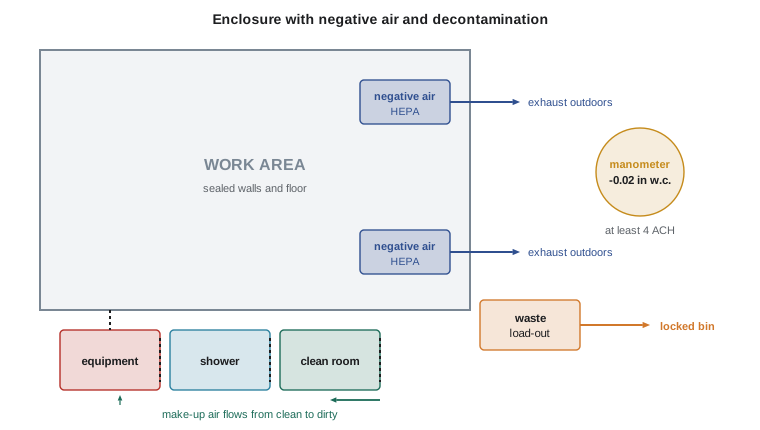
An enclosure creates a sealed room around the work so that fibers released inside cannot escape into the rest of the building. It does three things. It contains the dust physically with plastic sheeting and sealed openings. It holds the inside at lower air pressure than the outside, so that any leak draws clean air in rather than letting dusty air out. And it controls the only ways in and out, through a decontamination facility for people and a waste load-out route for materials.
Building the enclosure
Enclosure construction follows a standard sequence, set out in more detail in regulations and project specifications:
- Prepare the area. Remove movable items, or clean and cover items that cannot be moved. Shut down, lock out and seal the building ventilation serving the area, and isolate electrical circuits that are not needed.
- Seal openings with critical barriers. Cover windows, doors, vents, diffusers, pipe penetrations and other openings with polyethylene sheeting sealed with tape or spray adhesive.
- Line floors and walls. Cover floors and walls with polyethylene so that the room can be cleaned and the sheeting removed as waste. OSHA requires impermeable drop cloths on surfaces beneath all Class I removal activity, and many project specifications call for two layers of 6-mil sheeting on floors and walls.
- Build entry and exit points. Attach the decontamination facility to the enclosure and provide a separate waste load-out where the project is large enough. Provide emergency exits that can be opened quickly, marked so that they are visible.
- Install negative air units and run exhaust ducts outdoors, away from air intakes, windows and people, or into a filtered return where outdoor exhaust is impossible and the specification allows it.
- Test and inspect. Start the negative air, check the pressure differential with a manometer, look for leaks with smoke tubes, and inspect the enclosure before work begins.
Enclosures must also allow safe work: lighting, emergency exits, fire extinguishers, ground-fault protected power, and planning for heat stress, because workers inside an enclosure in disposable coveralls and respirators can overheat quickly.
Negative air
A negative air unit, sometimes called a negative air machine or air filtration device, is a fan with a series of filters ending in a HEPA filter. It draws air out of the enclosure, filters it and exhausts it. Because more air leaves than enters by direct openings, the enclosure is held at a slightly lower pressure than its surroundings. Make-up air enters through the decontamination facility and any small leaks, flowing from clean to dirty areas.
OSHA's construction standard requires negative pressure enclosures for Class I work to maintain a pressure differential of at least 0.02 inches of water column relative to adjacent areas and at least four air changes per hour, with HEPA-filtered exhaust. The pressure differential must be checked before work begins and monitored during the work, often continuously with a recording manometer. Project specifications commonly require more air changes, such as six or eight per hour.
Sizing negative air
The number of negative air units needed depends on the enclosure volume, the required air changes per hour, and the delivered airflow of each unit. Delivered airflow is always lower than the rated airflow, because filters, ducts and bends add resistance, and it falls further as filters load. Specifications often derate units to about 70 to 80 percent of their rated capacity for planning purposes.
import math

def units_needed(volume_m3, ach, unit_rating_m3h, derate=0.75):
    required = volume_m3 * ach                  # m3 per hour
    per_unit = unit_rating_m3h * derate
    return required, math.ceil(required / per_unit)

# Enclosure 12 m x 9 m x 3 m, a unit rated at 3,400 m3/h (about 2,000 cfm)
volume = 12 * 9 * 3
for ach in (4, 6, 8):
    req, n = units_needed(volume, ach, 3400)
    print(f"{ach} ACH: need {req:5.0f} m3/h ({req / 1.699:5.0f} cfm) -> {n} unit(s)")

# Air changes delivered by two units as filters load
for derate in (0.9, 0.75, 0.5):
    ach = 2 * 3400 * derate / volume
    print(f"two units at {derate:.0%} of rating: {ach:4.1f} air changes per hour")

# Pressure differential conversion
in_wc = 0.02
print(f"{in_wc} in w.c. = {in_wc * 249.09:.1f} Pa")4 ACH: need 1296 m3/h ( 763 cfm) -> 1 unit(s) 6 ACH: need 1944 m3/h ( 1144 cfm) -> 1 unit(s) 8 ACH: need 2592 m3/h ( 1526 cfm) -> 2 unit(s) two units at 90% of rating: 18.9 air changes per hour two units at 75% of rating: 15.7 air changes per hour two units at 50% of rating: 10.5 air changes per hour 0.02 in w.c. = 5.0 Pa
The script shows two practical points. First, the number of units depends heavily on the air change rate chosen, so the specification matters. Second, as filters load, delivered airflow can fall below the required rate even though nothing visibly changes. This is why pressure must be monitored, pre-filters changed often, and spare units kept on site.
What negative air does not do
Negative air keeps fibers from escaping the enclosure; it does not make the air inside the enclosure safe to breathe. Concentrations inside an active enclosure can be very high, so workers inside must wear the respirators required for the task. Negative air also does not replace wetting: fibers that never become airborne do not need to be filtered.
The decontamination facility
Every person leaving the enclosure is a possible carrier of fibers on skin, hair, clothing and equipment. The decontamination facility removes the contamination before the person reaches clean areas. A full facility has three rooms in sequence, each separated by curtained doorways made of overlapping polyethylene sheets that act as air locks.
| Room | Purpose | What happens there |
|---|---|---|
| Equipment room | Next to the work area; contaminated | Remove gross contamination, HEPA vacuum or wipe coveralls, remove and bag disposable coveralls and footwear covers; keep the respirator on |
| Shower room | Between dirty and clean sides | Shower thoroughly, washing hair and body, with the respirator on until wet, then wash the respirator facepiece |
| Clean room | Next to the outside; must stay clean | Dry off, put on street clothes, store clean equipment; never enter in contaminated clothing |
OSHA requires a decontamination area for Class I work involving more than 25 linear feet or 10 square feet of TSI or surfacing material, consisting of an equipment room, shower area and clean room in series, adjacent to and connected with the regulated area. Workers must enter and exit the regulated area through the decontamination area, shower before leaving, and must not leave the equipment room wearing contaminated clothing. For smaller Class I jobs and for Class II and III work, the employer must provide an equipment room or area where workers decontaminate clothing and equipment with HEPA vacuums or wet methods before leaving.
Entry works in reverse: workers change into clean protective clothing in the clean room, pass through the shower room, and enter the work area through the equipment room. Respirators are put on and checked before entering the work area and stay on until the person is in the shower.
Waste load-out
Bags of waste must leave the enclosure without contaminating the decontamination facility or the route outside. On larger projects, a separate waste load-out has a washing area, where the outside of each bag is wet-wiped or HEPA vacuumed and placed inside a second clean bag, and a holding area. Waste is then carried directly to a sealed, labeled container or vehicle. On smaller projects without a load-out, waste passes through the decontamination facility only when no one is showering, and the bags are cleaned and double-bagged first. Lesson 11 covers waste handling in detail.
Inspecting enclosures
OSHA requires the competent person to inspect Class I enclosures and areas at least once per shift and to check the integrity of barriers, the pressure differential and the decontamination area. Leaks, breaches and pressure losses must be corrected before work continues.
| Check | What to look for |
|---|---|
| Barriers and walls | Tears, loose tape, gaps at floors, ceilings and penetrations; sheeting pulled in by negative pressure is a good sign, billowing outward is not |
| Pressure differential | Manometer reading at or below the required negative value; record readings |
| Negative air units | Running, pre-filters clean, HEPA filters intact, exhaust ducts sealed and discharging away from people and intakes |
| Decontamination facility | Curtains intact and overlapping, shower working with hot water, clean room clean, supplies stocked |
| Housekeeping | Debris bagged, floors kept wet, no dry material accumulating, waste moved out promptly |
| Emergency readiness | Exits marked and unobstructed, fire extinguishers present, first aid and communication available |
When things go wrong
Power failures, fan breakdowns or torn barriers can lead to loss of negative pressure. If negative pressure is lost, stop removal work, keep material wet, close the enclosure, restore negative air as quickly as possible (spare units should be on site), and do not open the enclosure to the outside until pressure is restored. If a barrier is breached and fibers may have escaped, the area outside should be assessed and cleaned under controlled conditions, and air monitoring may be needed. In a medical emergency, life safety comes first: injured workers are removed through the quickest route, and contamination is managed afterwards.
Worked problem
Sizing and checking an enclosure
An abatement contractor is setting up a Class I enclosure 50 ft by 33 ft with an 11.5 ft ceiling to remove sprayed fireproofing. The specification requires six air changes per hour, and each negative air unit is rated at 2,000 cfm, derated to 75 percent. How many units are needed, and what pressure must the manometer show?
Show solution
- Volume = 50 × 33 × 11.5 ≈ 18,975 ft³.
- Required airflow = 18,975 × 6 ÷ 60 ≈ 1,898 cfm.
- Delivered airflow per unit = 2,000 × 0.75 = 1,500 cfm.
- Units needed = 1,898 ÷ 1,500 = 1.27, rounded up to 2 units; a third spare unit is good practice.
- The manometer must show at least 0.02 inches of water column negative relative to adjacent areas, monitored during the work.
Answer: Two units meet the requirement with some margin, and a spare protects against breakdowns and filter loading.
Common mistakes
MistakeTreating negative air as protection for the workers inside.
InsteadNegative air prevents escape; workers inside still need the required respirators.
MistakeSizing negative air from the units' rated airflow.
InsteadDerate for filters and ducts, monitor pressure and keep spares.
MistakeLeaving the enclosure through a side door to save time.
InsteadEvery person must exit through the decontamination facility.
MistakeRemoving the respirator in the equipment room.
InsteadKeep the respirator on until wet in the shower.
MistakeContinuing removal after negative pressure is lost.
InsteadStop removal, keep material wet and restore negative air before continuing.
Summary and key terms
- High-risk asbestos work takes place in sealed enclosures under negative pressure with HEPA-filtered exhaust.
- Enclosures are built by preparing the area, sealing openings with critical barriers, lining floors and walls, adding decontamination and load-out, and testing.
- OSHA requires negative pressure enclosures to hold at least 0.02 inches of water column and four air changes per hour.
- Size negative air from volume and air change rate using derated delivered airflow, and keep spares.
- Negative air prevents escape; it does not make the air inside safe to breathe.
- A three-room decontamination facility (dirty room, shower, clean room) removes contamination from people leaving the enclosure.
- Enclosures must be inspected each shift, and loss of pressure or breaches stop removal until fixed.
- Enclosure
- A sealed work area of polyethylene sheeting that contains fibers released during abatement.
- Critical barrier
- Sheeting that seals windows, doors, vents and other openings in the work area.
- Negative air unit
- A fan with HEPA filtration that exhausts air from an enclosure and keeps it under negative pressure.
- Negative pressure
- Air pressure inside the enclosure lower than outside, so leaks draw air in.
- Air changes per hour (ACH)
- The number of times the volume of air in an enclosure is replaced each hour.
- Manometer
- An instrument that measures the pressure difference between the enclosure and outside.
- Make-up air
- Air that enters the enclosure to replace air exhausted by the negative air units.
- Decontamination facility
- A series of rooms through which workers pass to remove contamination when leaving the work area.
- Curtained doorway
- Overlapping sheets of polyethylene acting as an air lock between rooms.
- Waste load-out
- A dedicated route with washing and bagging areas for removing waste from an enclosure.
Practice problems
Work each problem on paper first, then reveal the answer to check.
What three things does an enclosure do?
Show answer
Contains dust physically, holds the inside at negative pressure, and controls entry and exit.
Why does negative pressure help if the enclosure leaks?
Show answer
Leaks draw clean air in rather than letting contaminated air out.
What negative pressure and air change rate does OSHA require for negative pressure enclosures?
Show answer
At least 0.02 inches of water column and four air changes per hour.
An enclosure of 300 m³ needs 6 ACH. What airflow is required?
Show answer
1,800 m³/h.
Why should negative air units be derated in calculations?
Show answer
Filters, ducts and bends reduce delivered airflow below the rated value.
Does negative air make the air inside the enclosure safe?
Show answer
No; workers inside still need respirators.
List the three rooms of a decontamination facility in exit order.
Show answer
Equipment or dirty change room, shower room, clean change room.
When should a worker remove their respirator when leaving?
Show answer
In the shower, once wet.
What should happen if negative pressure is lost?
Show answer
Stop removal, keep material wet, keep the enclosure closed and restore negative air.
Name three items on an enclosure inspection checklist.
Show answer
Barriers, pressure differential, negative air units, decontamination facility, housekeeping, emergency readiness (any three).
Lesson quiz · 5 questions
Score 60% or more to complete this lesson.
Create a free account to save your progress, take quizzes and earn a certificate.