
HSE-246 · Lesson 10 of 12 · 25 min
Air monitoring and clearance
Air monitoring tells you whether controls are working, whether workers have the right respirators, whether fibers are escaping the work area, and whether an area is clean enough to be reoccupied. This lesson explains the purposes and types of asbestos air sampling, how phase contrast microscopy counts fibers and what its results mean, why transmission electron microscopy is sometimes needed, and how clearance testing works. It is written to help supervisors and workers understand monitoring results, not to train air sampling technicians.
Why monitor
| Type of sampling | Purpose | Where and when |
|---|---|---|
| Personal sampling | Measure workers' exposure to check compliance with limits and confirm respirator selection | Sampler in the worker's breathing zone during the task |
| Background (pre-work) sampling | Establish fiber levels before work starts, for comparison later | In and around the work area before set-up |
| Perimeter or outside-enclosure sampling | Detect fibers escaping the work area | Outside the enclosure, near the decontamination facility and load-out, and at the exhaust discharge, during work |
| Clearance sampling | Confirm the area is clean enough to remove the enclosure and reoccupy | Inside the enclosure after cleaning and drying, before barriers come down |
OSHA requires employers to monitor asbestos exposure: initial monitoring at the start of each job unless a valid negative exposure assessment exists, daily monitoring for Class I and II work in regulated areas unless the employer has an NEA and other conditions are met, and periodic monitoring for other operations representative of each worker's exposure. Employees must be notified of results within 5 working days, in writing or by posting. OSHA does not set clearance criteria; EPA's AHERA rule does for schools, and most project specifications for other buildings adopt similar criteria.
Phase contrast microscopy (PCM)
Most asbestos air samples are analyzed by phase contrast microscopy using NIOSH Method 7400. Air is drawn by a battery-powered pump through a 25-millimeter mixed cellulose ester filter held in a cassette with a conductive extension cowl. In the laboratory or a site lab, a wedge of the filter is made transparent and examined under a phase contrast microscope at about 400 times magnification. The analyst counts fibers in a set of graticule fields according to counting rules.
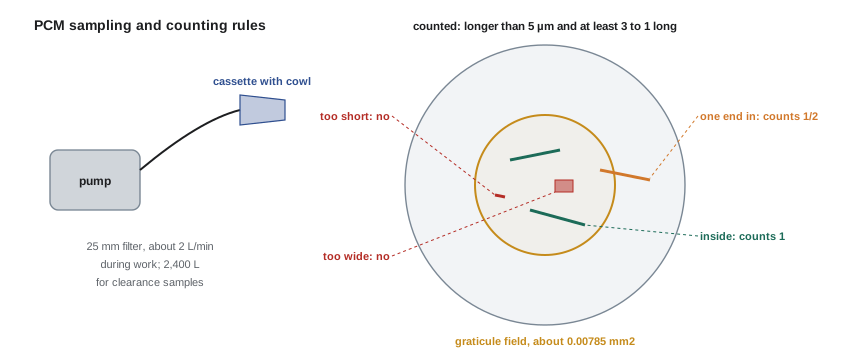
Under the A counting rules of NIOSH 7400, a fiber is counted if it is longer than 5 micrometers and has a length-to-width ratio of at least 3 to 1. A fiber lying entirely inside the graticule counts as one; a fiber with one end inside counts as a half; fibers crossing the graticule entirely, or with both ends outside, do not count. The analyst counts until 100 fibers have been counted or 100 fields examined, with a minimum of 20 fields.
PCM has an important limitation: it counts all fibers that meet the size rules, not only asbestos. Gypsum, cellulose, fiberglass, mineral wool and other fibers are counted too. PCM also cannot see the thinnest asbestos fibers, below about 0.25 micrometers wide. PCM results are therefore an index of fiber exposure that works well for comparing against the limits, which were set using PCM, but they cannot prove whether fibers are asbestos.
Calculating a PCM result
The laboratory converts the fiber count into a concentration. The fiber density on the filter (fibers per square millimeter) is the count per field, corrected for the blank, divided by the area of one graticule field. Multiplying by the effective area of the filter gives the total fibers collected, and dividing by the air volume gives the concentration.
Here \(C\) is the concentration in fibers per cubic centimeter, \(E\) the fiber density in fibers per square millimeter, \(A_c\) the effective collection area of the filter (about 385 mm² for a 25-mm filter), \(V\) the air volume in liters, \(F\) and \(n_f\) the fiber count and number of fields on the sample, \(B\) and \(n_b\) the count and fields on the blank, and \(A_f\) the field area (about 0.00785 mm² for a standard graticule).
A_C = 385.0      # mm2, effective collection area of a 25 mm filter
A_F = 0.00785    # mm2, area of one Walton-Beckett graticule field

def pcm_concentration(count, fields, volume_l, blank_count=0.0, blank_fields=100):
    density = (count / fields - blank_count / blank_fields) / A_F   # f/mm2
    return density, density * A_C / (volume_l * 1000)

# Personal sample during wet removal: 2.0 L/min for 120 min
d, c = pcm_concentration(count=48.5, fields=40, volume_l=2.0 * 120, blank_count=1, blank_fields=100)
print(f"personal sample: density {d:6.1f} f/mm2, concentration {c:.3f} f/cc")

# Clearance sample: 10 L/min for 240 min = 2,400 L
d, c = pcm_concentration(count=9.5, fields=100, volume_l=2400, blank_count=1, blank_fields=100)
print(f"clearance sample: density {d:5.1f} f/mm2, concentration {c:.4f} f/cc -> "
      f"{'pass' if c <= 0.01 else 'fail'} at 0.01 f/cc")

# Approximate limit of detection: about 7 f/mm2 by NIOSH 7400
lod_density = 7
for v in (240, 1200, 2400):
print(f"volume {v:5d} L: limit of detection about {lod_density * A_C / (v * 1000):.4f} f/cc")personal sample: density 153.2 f/mm2, concentration 0.246 f/cc clearance sample: density 10.8 f/mm2, concentration 0.0017 f/cc -> pass at 0.01 f/cc volume 240 L: limit of detection about 0.0112 f/cc volume 1200 L: limit of detection about 0.0022 f/cc volume 2400 L: limit of detection about 0.0011 f/cc
The output shows why clearance samples need large volumes. With only 240 liters, the method cannot reliably measure concentrations as low as 0.01 f/cc; with 2,400 liters, it can. Personal samples during work are smaller because filters overload when dust is heavy, and an overloaded filter cannot be counted.
Transmission electron microscopy (TEM)
Transmission electron microscopy uses an electron beam to see fibers far thinner than PCM can detect, and it identifies asbestos by its crystal structure and chemical composition. TEM can therefore tell asbestos fibers from other fibers and count structures that PCM misses. It is slower and more expensive than PCM. TEM methods include NIOSH 7402, which is used to determine what fraction of the fibers counted by PCM are asbestos, and the AHERA TEM method, which counts asbestos structures per square millimeter of filter and is used for clearance in schools.
TEM is useful when PCM results are high and it is suspected that non-asbestos fibers, such as gypsum or cellulose from demolition, are responsible, and when the strongest possible assurance of cleanliness is needed.
Clearance testing
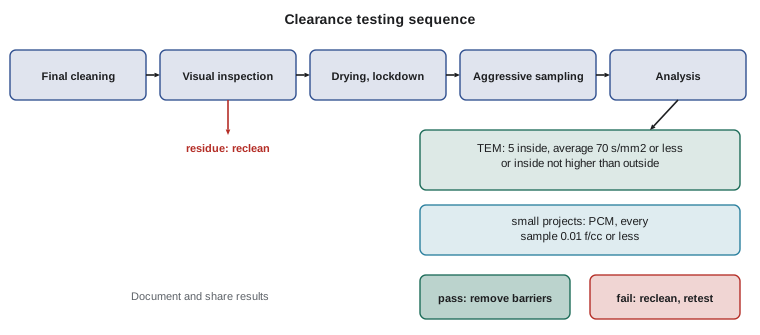
Clearance testing is the final check before an enclosure is removed and the area is returned to use. It happens in a fixed sequence.
- Final cleaning. All visible debris is removed, and surfaces are HEPA vacuumed and wet wiped, often more than once.
- Visual inspection. A competent person or consultant inspects the area for any remaining debris or residue. Visible residue means the area fails before any air test.
- Drying and, in many specifications, lockdown. Surfaces are allowed to dry, and a lockdown encapsulant may be sprayed on surfaces from which asbestos was removed to bind any remaining fibers.
- Aggressive air sampling. Air is stirred with fans and leaf blowers directed at surfaces before and during sampling so that any settled fibers become airborne. AHERA requires aggressive sampling for clearance.
- Analysis and decision. Samples are analyzed and compared with the clearance criteria. If the area fails, it is recleaned and retested.
AHERA sets clearance criteria for school abatement projects. For most projects, five samples inside the work area are analyzed by TEM; the area passes if the average is no more than 70 structures per square millimeter of filter, or, using five inside and five outside samples plus blanks, if a statistical test shows inside concentrations are not significantly higher than outside. For small projects, up to 160 square feet or 260 linear feet, PCM may be used and each sample must be 0.01 f/cc or less. Outside schools, project specifications usually adopt AHERA-style criteria, and some states set their own.
Interpreting results as a supervisor
Supervisors do not need to analyze filters, but they should be able to read a monitoring report and act on it. Useful questions include:
- Was the sample personal or area, and what task was under way?
- What was the sampling time and volume, and was the result above the limit of detection?
- Is the result compared with the right limit: 8-hour limit, excursion limit, respirator MUC or clearance criterion?
- Do outside-enclosure results show any rise, which would suggest a leak?
- Were PCM results high enough that TEM analysis is needed to tell asbestos from other fibers?
A rising trend outside the enclosure, or personal results approaching the respirator MUC, should lead to action: stopping work, checking barriers and negative air, improving wetting, or upgrading respirators.
Worked problem
Reading a clearance report
Five PCM samples were taken after a small project removing 120 square feet of sprayed ceiling material in an office. Results were 0.004, 0.006, 0.012, 0.005 and 0.003 f/cc. Does the area pass?
Show solution
- Because the project is under 160 square feet, PCM clearance is permitted under the AHERA approach, with every sample required to be 0.01 f/cc or less.
- One sample, 0.012 f/cc, exceeds 0.01 f/cc, so the area does not pass, even though the average is below 0.01 f/cc.
- The area must be recleaned and retested, or the specification may allow TEM analysis to determine whether the fibers are asbestos.
- The results should be documented and shared with the building owner and workers.
Answer: The area fails on PCM because one sample exceeds 0.01 f/cc. Averaging does not rescue a failing sample under these criteria.
Quality in air sampling
Air sampling results are only as good as the way samples are collected and analyzed. Sampling pumps must be calibrated with the sampling cassette in line before and after each sample, and samples whose flow changed by more than the method allows are invalid. Field blanks, cassettes taken to the site and handled like samples but with no air drawn through them, detect contamination of filters. Each sample needs a record of the location, worker or area, start and stop times, flow rate and task, and a chain of custody that follows the sample to the laboratory.
PCM analysts should have completed the NIOSH 582 course or an equivalent, and laboratories should participate in proficiency testing such as the AIHA programs; TEM laboratories doing AHERA analysis must be NVLAP accredited. Project specifications often require on-site analysis so that results are available the same day, which allows problems to be fixed during the work rather than discovered afterwards.
Sharing results with workers
Workers have a right to know the results of air monitoring that concerns them. OSHA requires written notification of personal monitoring results within 5 working days, by individual notice or by posting in an accessible place, and employees and their representatives have the right to observe monitoring. Explain what results mean in plain language. Results that show controls are not working should lead to visible action, so workers can see that monitoring is used to protect them and not only to fill a file.
Common mistakes
MistakeTreating PCM results as proof that fibers are asbestos.
InsteadPCM counts all fibers meeting the size rules; use TEM to identify asbestos.
MistakeTaking clearance samples with small air volumes.
InsteadUse the required volume, such as 2,400 liters per PCM filter, so the method can measure low levels.
MistakeClearance testing before the area is dry or visually clean.
InsteadComplete cleaning, visual inspection and drying first.
MistakeSampling clearance air without stirring it.
InsteadUse aggressive sampling with forced air so settled fibers are measured.
MistakeAveraging away a failing clearance sample.
InsteadUnder PCM criteria, every sample must meet the limit.
Summary and key terms
- Air monitoring checks exposure, respirator selection, containment and final cleanliness.
- PCM by NIOSH 7400 counts fibers longer than 5 micrometers with a 3 to 1 aspect ratio, but cannot identify asbestos.
- Concentration equals fiber density times filter area divided by air volume; larger volumes give lower limits of detection.
- TEM sees thinner fibers and identifies asbestos, and is used when PCM results are ambiguous or for school clearance.
- Clearance follows cleaning, visual inspection, drying and aggressive sampling.
- AHERA requires TEM clearance at 70 structures per square millimeter or a statistical comparison, with PCM at 0.01 f/cc allowed for small projects.
- Supervisors should check sample type, volume, limit of detection and the right comparison limit, and act on rising trends.
- Phase contrast microscopy (PCM)
- A light microscopy method that counts fibers on air sample filters.
- NIOSH 7400
- The standard PCM method for counting airborne fibers.
- Transmission electron microscopy (TEM)
- An electron microscopy method that identifies and counts asbestos structures.
- Graticule
- A calibrated circle in the microscope eyepiece defining the counting field.
- Aspect ratio
- The ratio of a fiber's length to its width.
- Limit of detection
- The lowest concentration a method can reliably detect.
- Personal sample
- An air sample taken in a worker's breathing zone.
- Clearance sampling
- Air sampling after cleaning to confirm an area can be reoccupied.
- Aggressive sampling
- Sampling while air is stirred by fans or blowers to resuspend settled fibers.
- Lockdown encapsulant
- A coating applied after removal to bind residual fibers on surfaces.
Practice problems
Work each problem on paper first, then reveal the answer to check.
Name the four main types of asbestos air sampling.
Show answer
Personal, background, perimeter or outside-enclosure, and clearance sampling.
Which particles count as fibers under NIOSH 7400 A rules?
Show answer
Particles longer than 5 micrometers with a length-to-width ratio of at least 3 to 1.
Why can PCM not prove that fibers are asbestos?
Show answer
It counts all fibers meeting the size rules, including gypsum, cellulose and glass fibers.
A filter has a density of 30 f/mm² from 2,400 L. What is the concentration?
Show answer
30 × 385 ÷ (2,400 × 1,000) ≈ 0.0048 f/cc.
Why do clearance samples need large air volumes?
Show answer
To lower the limit of detection so concentrations around 0.01 f/cc can be measured.
What does TEM do that PCM cannot?
Show answer
Sees very thin fibers and identifies asbestos by structure and composition.
What must happen before clearance air sampling?
Show answer
Final cleaning, visual inspection with no residue, and drying.
What is aggressive sampling?
Show answer
Sampling while fans or blowers stir the air to resuspend settled fibers.
What is the AHERA TEM clearance criterion for five inside samples?
Show answer
An average of 70 structures per square millimeter or less.
What should a rising trend in outside-enclosure samples prompt?
Show answer
Stopping work and checking barriers, negative air and wetting.
Lesson quiz · 5 questions
Score 60% or more to complete this lesson.
Create a free account to save your progress, take quizzes and earn a certificate.