
HSE-246 · Lesson 12 of 12 · 26 min
Emergencies, accidental disturbance and capstone: an asbestos work plan
Even with good surveys and planning, asbestos is sometimes disturbed unexpectedly: a hidden pipe wrap behind a wall, a ceiling tile that crumbles, a flood or fire that damages insulation. How people respond in the first minutes determines whether a small problem becomes a building-wide contamination. This lesson first covers the response to accidental disturbance and emergencies, then brings the whole course together in a capstone: preparing an asbestos work plan for an invented renovation. The building, quantities and results in the capstone are invented for teaching.
Accidental disturbance: the first minutes
The response to an accidental disturbance follows a simple sequence that every worker on a site with older materials should know.
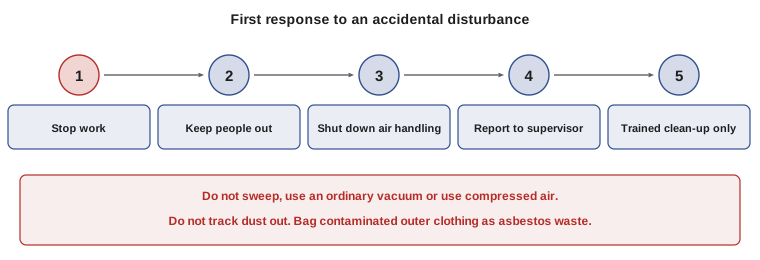
- Stop work immediately. Do not finish the cut, the hole or the task. Every additional movement releases more fibers.
- Keep people out. Move people away, close doors and put up a temporary barrier or sign. Do not let others walk through the area.
- Shut down air handling serving the area if this can be done safely and quickly, so fibers are not spread through the building.
- Report. Tell the supervisor at once. The supervisor notifies the employer, the building owner and, where required, the regulator and the joint committee or representative.
- Do not clean up yourself unless you are trained and equipped for asbestos work. Do not sweep, use an ordinary vacuum or blow the dust away.
- Limit your own contamination. If your clothing is dusty, avoid spreading the dust: stay near the area, and with guidance remove outer clothing carefully, bag it as asbestos waste, and wash hands and face. Do not go to the lunchroom or your vehicle first.
OSHA requires the employer to treat newly discovered suspect material as asbestos-containing until it is assessed, and the building owner and employers on site must be informed. Work that would disturb the material stops until it is assessed and, if it is ACM, until the right class of controls is in place. State rules may require notification to the regulator.
Assessment and clean-up after a disturbance
After the immediate response, a competent person assesses the situation. The material is sampled or assumed to be asbestos-containing. The extent of contamination is estimated by inspection and, where needed, air or surface sampling. The area is classified and cleaned by trained workers using the controls for the appropriate risk level or class, often with a temporary enclosure, HEPA vacuuming and wet wiping, followed by clearance testing before reoccupation where the disturbance involved friable material. The incident is recorded, exposed workers are told about the exposure and given the information they need for their medical records, and the cause is investigated: why was the material not identified, and what will prevent a repeat?
Emergencies involving asbestos
| Emergency | Asbestos concern | Key actions |
|---|---|---|
| Medical emergency inside an enclosure | Contamination of the injured worker and rescuers | Life safety first: give first aid and remove the worker by the quickest safe route; wrap the worker in a blanket or sheet to limit spread; tell emergency responders about asbestos; decontaminate afterwards |
| Fire | Damaged asbestos materials and debris after the fire | Evacuate; tell firefighters about known asbestos; after the fire, treat debris as asbestos-containing until assessed |
| Flood or water damage | Wet, collapsing insulation and ceiling materials | Keep people out; do not let materials dry and crumble; arrange assessment before drying and repair |
| Structural collapse or storm damage | Broken asbestos-cement and insulation scattered over a wide area | Restrict access, wet down debris where safe, assess before clean-up |
| Loss of negative pressure or barrier failure | Fibers escaping the enclosure | Stop removal, keep materials wet, restore negative air, assess and clean outside areas |
| Asbestos waste spill in transport | Broken bags on a road or site | Keep people away, follow emergency instructions, report to authorities, rebag and clean |
Capstone: an asbestos work plan
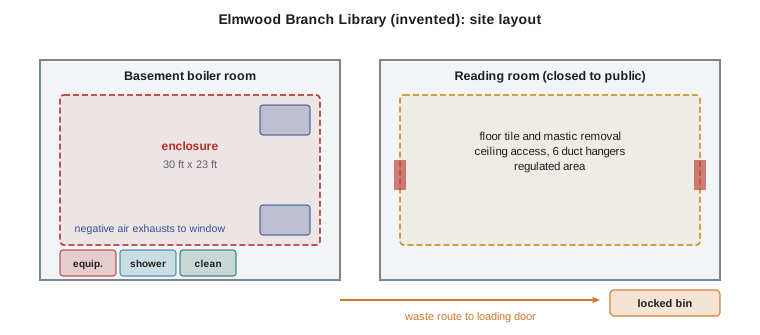
The capstone project is a renovation of the invented Elmwood Branch Library, a single-story building with a basement, built in 1968 and owned by a municipality. The work includes replacing the boiler and its piping in the basement, removing the original floor tiles in the reading room, and installing new ductwork above the reading room ceiling. The owner's pre-renovation survey, carried out by an accredited inspector, lists the materials below.
| Material | Location | Result | Quantity | Condition |
|---|---|---|---|---|
| Pipe and boiler insulation (TSI) | Basement boiler room | 35 % chrysotile, 10 % amosite (friable) | Boiler 190 ft², pipe 230 linear ft | Fair, some damage |
| Floor tiles (9 in) | Reading room | 3 % chrysotile (non-friable) | 2,260 ft² | Good |
| Black mastic under tiles | Reading room | 5 % chrysotile (non-friable) | 2,260 ft² | Good |
| Sprayed acoustic texture (surfacing) | Reading room ceiling deck above suspended tiles | 8 % chrysotile (friable) | 2,260 ft², to be disturbed at 6 duct hangers | Good |
| Drywall joint compound | Office walls | None detected in 3 samples | — | Good |
Step 1: Classify each task
The work plan starts by classifying every task that will disturb asbestos.
| Task | Classification | Reason |
|---|---|---|
| Remove boiler and pipe insulation | Class I | Removal of thermal system insulation |
| Remove floor tiles and mastic | Class II | Removal of ACM that is not TSI or surfacing material |
| Remove suspended ceiling tiles to access the deck | Class IV, or Class III if the texture is disturbed | Contact without disturbance unless debris or texture is disturbed |
| Install six duct hangers through the sprayed texture | Class III | Repair and maintenance work disturbing surfacing material |
Step 2: Notifications, training and sequencing
The boiler room removal involves 230 linear feet of pipe insulation and 190 square feet of boiler insulation, so it is below the 260 linear foot threshold for pipe but above the 160 square foot threshold for other components; NESHAP notification to the state or EPA is therefore required at least 10 working days before work. State licensing and notification rules must also be checked. The Class I and II crews need MAP-accredited training and a competent person with supervisor training; the Class III electricians and mechanical installers need at least 16 hours of operations and maintenance training. The work is sequenced so that the boiler room abatement and clearance are finished before the mechanical contractor starts, and the reading room is closed to the public throughout.
Step 3: Controls for each task
- Boiler room (Class I): regulated area with critical barriers, negative pressure enclosure at 0.02 inches of water column and at least four air changes per hour with HEPA exhaust, decontamination area with equipment room, shower and clean room, amended water, glove bags where suitable, respirators as the standard requires (pressure-demand supplied air unless a valid negative exposure assessment exists), inspection by the competent person each shift, and clearance testing.
- Floor tiles (Class II): regulated area, wet methods, remove tiles intact, no sanding, remove mastic by wet methods or approved low-odor solvents, respirators unless an NEA exists, HEPA clean-up.
- Ceiling tiles (Class IV or III): lower tiles carefully, HEPA vacuum debris on top, and treat as Class III if texture or debris is disturbed.
- Duct hangers (Class III): wet the texture, use a drill with a shroud and HEPA vacuum, mini-enclosure or drop cloths, respirators with HEPA filters, HEPA clean-up.
Step 4: Quantities, equipment and schedule
import math

# Boiler room enclosure (imperial): 30 ft x 23 ft x 10.5 ft
volume = 30 * 23 * 10.5
ach = 6
unit_rating = 2000       # cfm
derate = 0.75
required = volume * ach / 60
units = math.ceil(required / (unit_rating * derate))
print(f"enclosure volume {volume:.0f} ft3, need {required:.0f} cfm -> {units} negative air unit(s) + 1 spare")

# NESHAP notification check for the boiler room
pipe_lf, other_ft2 = 230, 190
notify = pipe_lf >= 260 or other_ft2 >= 160
print(f"pipe {pipe_lf} lf, boiler {other_ft2} ft2 -> NESHAP notification {'required' if notify else 'not required'}")

# Waste bags (illustrative capacities)
bags = math.ceil(pipe_lf / 10) + math.ceil(other_ft2 / 27) + 25   # + sheeting and PPE
print(f"boiler room waste: about {bags} double-bagged loads ({2 * bags} bags)")

# Simple schedule in working days, after the 10-working-day notice period
tasks = [("NESHAP notice period", 10), ("set-up and inspection", 2), ("removal", 4),
         ("cleaning and drying", 2), ("clearance and teardown", 1)]
day = 0
for name, d in tasks:
    print(f"days {day + 1:2d}-{day + d:2d}: {name}")
day += denclosure volume 7245 ft3, need 724 cfm -> 1 negative air unit(s) + 1 spare pipe 230 lf, boiler 190 ft2 -> NESHAP notification required boiler room waste: about 56 double-bagged loads (112 bags) days 1-10: NESHAP notice period days 11-12: set-up and inspection days 13-16: removal days 17-18: cleaning and drying days 19-19: clearance and teardown
The script sizes negative air, confirms that NESHAP notification is required because the boiler insulation exceeds 160 square feet, estimates waste and lays out a schedule that includes the 10-working-day notice period. The waste capacities are illustrative.
Step 5: Monitoring, clearance, waste and emergencies
The plan specifies initial and daily personal monitoring for the Class I and II work unless a valid negative exposure assessment exists, area sampling outside the enclosure with a stop-work trigger, notification of results to employees within 5 working days, and clearance after cleaning and lockdown using AHERA-style TEM criteria as the owner's specification requires. Waste is wetted, double bagged, labeled with the OSHA warning and the generator's name and location, stored in a locked lined container, and transported with a waste shipment record to a NESHAP-compliant landfill, with the signed record tracked. The emergency plan covers medical emergencies in the enclosure, loss of negative pressure, fire, and accidental disturbance of materials not in the survey, with contact details for the competent person, consultant, owner's representative and state agency.
Step 6: Review the plan
A plan is only as good as its weakest assumption. Before approving the Elmwood plan, the reviewer asks: Does the survey cover every material the work will disturb, including the pipe chases and the duct route? Has every task been classified, including the ceiling tile removal that gives access to the sprayed deck? Are the workers trained and, where required, certified? Is the clearance criterion written into the contract? Are waste arrangements in place before removal starts? And does everyone on site, including the mechanical contractor and library staff, know what to do if they find a material that is not on the list?
Worked problem
Responding to a discovery during the Elmwood project
Midway through the project, the mechanical installer opens a pipe chase in the reading room wall and finds gray, crumbly insulation on an old pipe that was not in the survey. What should happen?
Show solution
- The installer stops work, closes the chase opening as far as possible without disturbing the material, keeps people away and reports to the supervisor.
- The supervisor stops work that could disturb the material, informs the owner and other employers, and treats the material as asbestos-containing until assessed.
- The consultant samples the insulation or it is assumed to be asbestos-containing, and the area is checked for debris.
- The task is classified and the work plan is amended; the material is removed or isolated by trained workers before the mechanical work continues.
- The incident is recorded, the installer is told about the possible exposure, and the survey is updated so the gap is closed.
Answer: Stop, isolate, report, assess, amend the plan and only then continue. An unexpected discovery is a routine event in old buildings if everyone knows the response.
Common mistakes
MistakeFinishing the cut after uncovering suspect material.
InsteadStop immediately; every extra movement releases more fibers.
MistakeSweeping up the debris to tidy the area before reporting.
InsteadLeave clean-up to trained workers with proper controls.
MistakeDelaying first aid to decontaminate an injured worker.
InsteadLife safety comes first; manage contamination afterwards.
MistakeWriting a work plan without classifying access tasks.
InsteadClassify every task that could disturb asbestos, including access work such as removing ceiling tiles.
MistakeLeaving the survey unchanged after a discovery.
InsteadUpdate the survey and the plan so the gap is closed.
Summary and key terms
- The first response to an accidental disturbance is to stop, keep people out, shut down air handling, report and leave clean-up to trained workers.
- Newly discovered suspect material is treated as asbestos-containing until assessed, and the owner and other employers are informed.
- Assessment, classification, controlled clean-up, clearance, records and investigation follow the immediate response.
- In medical emergencies life safety comes first; fires, floods and collapses need asbestos assessment before clean-up.
- A work plan classifies every task, sets notifications, training and sequencing, and specifies controls for each task.
- The plan sizes equipment, waste and schedule, and sets monitoring, clearance, waste handling and emergency arrangements.
- Review every plan for survey gaps, unclassified tasks, training, clearance criteria, waste arrangements and the discovery procedure.
- Accidental disturbance
- An unplanned disturbance of asbestos-containing material, often because it was not identified.
- Unexpected discovery
- Finding suspect material during work that was not identified in the survey.
- Work plan
- A written plan describing how asbestos work will be done safely and in compliance.
- Stop-work trigger
- A monitoring result or condition that requires work to stop and be reviewed.
- Site layout
- A plan showing work areas, enclosures, decontamination, negative air, waste routes and signs.
- Sequencing
- Arranging the order of tasks so asbestos work is completed before others enter the area.
- Emergency plan
- Procedures and contacts for emergencies during asbestos work.
- Incident investigation
- Finding the causes of an event and the actions that will prevent a repeat.
- Survey update
- Amending the asbestos survey with new information from discoveries or sampling.
- Capstone
- A final project that brings together the knowledge from a course.
Practice problems
Work each problem on paper first, then reveal the answer to check.
List the first five actions after accidentally disturbing suspect asbestos.
Show answer
Stop work, keep people out, shut down air handling, report to the supervisor, and leave clean-up to trained workers.
Why should a worker not go to the lunchroom after a disturbance?
Show answer
They may spread fibers from their clothing.
How should newly discovered suspect material be treated under OSHA?
Show answer
As asbestos-containing until it is assessed.
What comes first in a medical emergency inside an enclosure?
Show answer
Life safety: first aid and removal by the quickest safe route.
Why is a flooded building with asbestos insulation a concern?
Show answer
Wet insulation can collapse and, once dry, crumble and release fibers.
Classify the removal of boiler insulation in the Elmwood project.
Show answer
Class I.
Classify installing duct hangers through the sprayed texture.
Show answer
Class III.
A boiler room is 8 m × 6 m × 3 m and needs 6 ACH with units delivering 2,550 m³/h. How many units?
Show answer
864 m³/h needed, so 1 unit, plus a spare.
Name four elements of an asbestos work plan.
Show answer
Classification, notifications, training, controls, equipment sizing, monitoring, clearance, waste, emergency arrangements, schedule (any four).
What should happen to the survey after an unexpected discovery?
Show answer
It should be updated with the new information.
Lesson quiz · 5 questions
Score 60% or more to complete this lesson.
Create a free account to save your progress, take quizzes and earn a certificate.