
HSE-246 · Lesson 5 of 12 · 25 min
Surveys, inspections and sampling
Every safe asbestos project begins with knowing where the asbestos is. Surveys and sampling turn suspicion into information: which materials contain asbestos, how much, what type, in what condition, and where. This lesson explains the different kinds of asbestos surveys, how homogeneous areas are defined, how many bulk samples are needed, how laboratories analyze them, and how to read and use a survey report. It is written for supervisors and workers who rely on surveys, not for the accredited or qualified people who carry them out.
Types of surveys
| Survey type | Purpose | When it is done | Typical depth |
|---|---|---|---|
| Management survey | Locate accessible asbestos-containing material so it can be managed in place | Ongoing ownership of a building | Accessible areas, minimal destructive inspection |
| Pre-renovation survey | Identify all asbestos that planned work will disturb | Before renovation, repair or alteration | All areas affected by the work, including concealed spaces |
| Pre-demolition survey | Identify all asbestos in the building before demolition | Before demolition | Fully destructive: inside walls, floors, roofs, equipment and services |
| Reassessment | Check the condition of known materials and update records | Periodically, such as every six months under AHERA surveillance and a reinspection every three years | Visual check of known materials |
Under OSHA, owners must identify ACM and PACM before construction work, and the employer must confirm the presence or absence of asbestos where a material will be disturbed. NESHAP requires a thorough inspection of the affected part of a facility before demolition or renovation. AHERA requires schools to have accredited inspectors survey every building, prepare management plans, carry out surveillance every six months and reinspect every three years. Many states require accredited inspectors for any building survey.
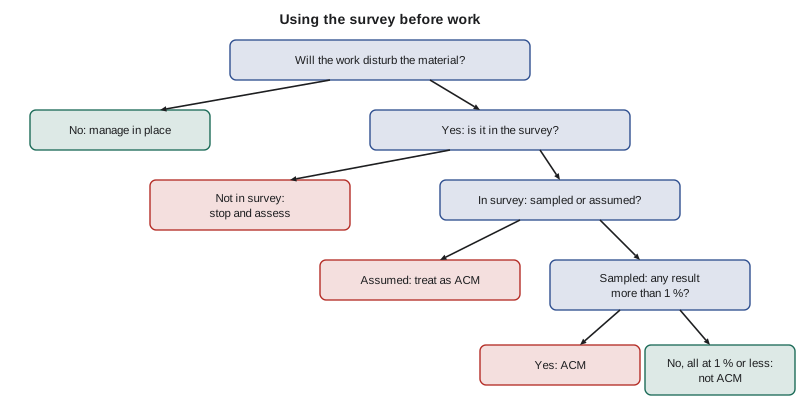
A management survey is not enough for renovation or demolition. Management surveys often avoid destructive inspection, so asbestos hidden inside walls, under floors or in equipment may be missed. Before work that will disturb the building fabric, the survey must cover every area and material that the work will reach, including concealed spaces.
Homogeneous areas
Sampling is organized around homogeneous areas. A homogeneous area, or homogeneous material, is a material that is uniform in color, texture, appearance and likely date of installation. Examples are all the 9-inch floor tiles of one pattern installed in one wing, all the pipe lagging on one system, or the textured ceiling throughout one apartment. Materials that look different, were installed at different times, or are in different additions of a building are separate homogeneous areas, even if they serve the same purpose.
Defining homogeneous areas well is a professional skill. If two different materials are lumped together, a sample from one may give a false answer for the other. If one material is split into many areas, sampling costs rise without adding information.
How many samples
AHERA sets minimum numbers of samples for school inspections, and the same numbers are widely used as good practice elsewhere. The numbers depend on the type of material and, for surfacing material, the size of the homogeneous area.
| Material | Area of homogeneous material | Minimum bulk samples |
|---|---|---|
| Surfacing material | Less than 1,000 ft² | 3 |
| Surfacing material | 1,000 to 5,000 ft² | 5 |
| Surfacing material | More than 5,000 ft² | 7 |
| Thermal system insulation | Each homogeneous area | 3, taken in a manner sufficient to determine whether it is ACM |
| Thermal system insulation patch | Less than 6 linear or square feet | 1 |
| Miscellaneous material | Each homogeneous area | Enough to determine whether it is ACM |
If any one sample from a homogeneous area is found to contain more than 1 percent asbestos, the whole area is treated as asbestos-containing; laboratories often offer positive stop analysis so that remaining samples need not be analyzed. To conclude that a material is not asbestos-containing, all the required samples must be analyzed and all must be at or below the threshold.
import math

# Minimum bulk samples for surfacing material (Ontario Table 1 style, metric)
def surfacing_samples_metric(area_m2):
    if area_m2 < 90:
        return 3
    if area_m2 < 450:
        return 5
    return 7

# Benchmark used for AHERA school inspections (imperial)
def surfacing_samples_imperial(area_ft2):
    if area_ft2 < 1000:
        return 3
    if area_ft2 <= 5000:
        return 5
    return 7

for m2 in (40, 89, 90, 300, 450, 1200):
    ft2 = m2 * 10.764
    print(f"{m2:5d} m2 ({ft2:7.0f} ft2): metric table {surfacing_samples_metric(m2)}, "
          f"imperial table {surfacing_samples_imperial(ft2)}")

# Why more samples help: chance that n random samples all miss asbestos
# when only a fraction p of the area actually contains it (illustrative)
for p in (0.5, 0.3):
    for n in (1, 3, 5, 7):
        miss = (1 - p) ** n
print(f"area {p:.0%} contaminated, {n} samples: chance all miss = {miss:.1%}")40 m2 ( 431 ft2): metric table 3, imperial table 3 89 m2 ( 958 ft2): metric table 3, imperial table 3 90 m2 ( 969 ft2): metric table 5, imperial table 3 300 m2 ( 3229 ft2): metric table 5, imperial table 5 450 m2 ( 4844 ft2): metric table 7, imperial table 5 1200 m2 ( 12917 ft2): metric table 7, imperial table 7 area 50% contaminated, 1 samples: chance all miss = 50.0% area 50% contaminated, 3 samples: chance all miss = 12.5% area 50% contaminated, 5 samples: chance all miss = 3.1% area 50% contaminated, 7 samples: chance all miss = 0.8% area 30% contaminated, 1 samples: chance all miss = 70.0% area 30% contaminated, 3 samples: chance all miss = 34.3% area 30% contaminated, 5 samples: chance all miss = 16.8% area 30% contaminated, 7 samples: chance all miss = 8.2%
The two tables give similar but not identical results because their thresholds are set in different units. The second part of the script shows why the minimums exist. If a material is not uniform, so that only part of an apparently homogeneous area contains asbestos, a single sample can easily miss it. Three, five or seven samples taken from locations spread across the area greatly reduce that chance. The probabilities are illustrative; real materials vary in many ways, which is why the defined minimums must be followed.
Taking bulk samples safely
Bulk sampling disturbs the material, so it must be done carefully by a trained person. Good practice includes:
- Planning sample locations to represent the whole homogeneous area, including different floors, rooms and runs.
- Keeping other people out of the immediate area during sampling and wearing appropriate respiratory protection and disposable coveralls.
- Lightly wetting the material with a fine mist and placing a small bag or container under the sampling point.
- Taking a core through all layers of the material, because asbestos may be in only one layer.
- Sealing the sample in a labeled, airtight container, and sealing the sampled spot with a patch, tape or sealant.
- Cleaning tools and the area with damp wipes or a HEPA vacuum, and recording the location of each sample on a plan.
Workers who are not trained and, where required, accredited to sample should never take samples themselves. If a suspect material is found during work, stop and call the person responsible for asbestos assessment.
Laboratory analysis
Bulk samples are normally analyzed by polarized light microscopy (PLM) using EPA Test Method EPA/600/R-93/116. Laboratories analyzing samples for AHERA must be accredited under the National Voluntary Laboratory Accreditation Program (NVLAP), and NVLAP accreditation is the usual benchmark for other work.
| Method | What it does | Typical use |
|---|---|---|
| Polarized light microscopy (PLM) | Identifies asbestos minerals by their optical properties and estimates the percentage | Standard method for bulk samples |
| PLM point counting | Counts hundreds of points on the sample to estimate low percentages more precisely | Used when a visual estimate is under 10 percent, to confirm whether the material exceeds 1 percent |
| Gravimetric reduction with PLM or TEM | Removes binders such as vinyl or asphalt before analysis | Non-friable organically bound materials such as floor tiles, where PLM can miss very fine fibers |
| Transmission electron microscopy (TEM) | Uses an electron microscope to identify very fine fibers | Floor tiles, mastics and other materials where fibers are too fine for PLM; also used for some air samples |
Non-friable organically bound materials, such as vinyl floor tiles and mastics, can give false negatives by PLM because the asbestos fibers are very fine and coated by the binder. A negative PLM result for a floor tile or mastic should be treated with caution; many consultants confirm such results by TEM or gravimetric methods before declaring the material asbestos-free.
Reading a survey report
A good survey report gives workers and supervisors what they need to plan safely. It should include the building and areas surveyed, the date, the name and qualifications of the surveyor, the methods used, any areas not accessed, a list of homogeneous materials with sample results, the asbestos type and percentage, quantity, condition and location of each asbestos-containing material, drawings or photos, and recommendations.
Supervisors should check four things before relying on a survey:
- Scope. Does it cover all the areas and materials the work will disturb? A management survey of accessible areas is not a pre-demolition survey.
- Limitations. Which areas were not accessed, such as wall cavities, locked rooms, live equipment or roofs? These must be treated as unknown.
- Date. Has anything changed since the survey, such as earlier renovations, damage or additions?
- Results. Which materials are asbestos-containing, which are assumed, and which tested negative? Assumed materials must be handled as asbestos-containing.
Worked problem
Checking a survey before work
A supervisor receives a survey for a school wing renovation. It lists sprayed fireproofing above the corridor ceilings, 4,300 ft² in area, with three samples all reported as 'none detected', and states that the mechanical shafts were not accessed. What concerns should the supervisor raise?
Show solution
- Surfacing material of 4,300 ft² needs at least five samples under the AHERA benchmark, not three, so the negative conclusion is not supported.
- The mechanical shafts were not accessed, so any materials there are unknown and must be treated as asbestos-containing until surveyed.
- Because it is a school, the supervisor should also check whether the survey meets any specific requirements for school buildings.
- The supervisor should ask for additional samples and a survey of the shafts before the work proceeds.
Answer: The survey does not yet support the conclusion that the fireproofing is asbestos-free, and part of the work area was not surveyed. Work should wait for more sampling.
Managing asbestos left in place
Many owners choose to leave asbestos-containing material in place when it is in good condition. This is often the safest and least costly choice, but it creates a long-term duty to manage the material. A management program, sometimes called an operations and maintenance program, keeps the survey up to date, labels or marks known materials where practical, inspects their condition on a schedule, controls work that could disturb them through work permits, trains maintenance and custodial staff, and specifies how small repairs and clean-ups are done. Every contractor who works in the building should receive the relevant survey information before starting, so that the material left in place does not become the next accidental disturbance.
Common mistakes
MistakeUsing a management survey for demolition.
InsteadDemolition and renovation need a survey that covers every material the work will disturb, including concealed spaces.
MistakeTaking one sample of a large sprayed ceiling.
InsteadTake at least the minimum number of samples for the material type and area.
MistakeSampling only the top layer of a multi-layer material.
InsteadCore through all layers, because asbestos may be in only one.
MistakeAccepting a negative PLM result for floor tile without question.
InsteadConfirm negative results for organically bound materials with TEM or gravimetric methods where appropriate.
MistakeIgnoring areas the survey did not access.
InsteadTreat unsurveyed areas as unknown and assess them before work.
Summary and key terms
- Management surveys support managing asbestos in place; renovation and demolition need surveys of every material the work will disturb.
- Sampling is organized by homogeneous areas, materials uniform in appearance and date of installation.
- The AHERA benchmark is 3, 5 or 7 samples for surfacing material depending on area, 3 for thermal system insulation and 1 for small patches.
- One positive sample makes the whole homogeneous area asbestos-containing; a negative conclusion needs all required samples analyzed.
- Bulk samples must be taken by trained people, through all layers, with precautions to avoid exposure.
- PLM is the standard method; TEM or gravimetric methods may be needed for floor tiles and mastics.
- Before relying on a survey, check its scope, limitations, date and results.
- Management survey
- A survey of accessible asbestos-containing material for managing it in place.
- Pre-demolition survey
- A fully destructive survey identifying all asbestos before a building is demolished.
- Homogeneous area
- A material uniform in color, texture, appearance and date of installation, sampled as a unit.
- Bulk sample
- A small piece of a material taken for laboratory analysis.
- Positive stop
- Stopping analysis of further samples from a homogeneous area once one sample is positive.
- Polarized light microscopy (PLM)
- The standard laboratory method for identifying asbestos in bulk samples.
- Point counting
- A PLM technique that estimates low asbestos percentages more precisely.
- Transmission electron microscopy (TEM)
- An electron microscope method able to identify very fine fibers.
- NVLAP
- The US National Voluntary Laboratory Accreditation Program, which accredits asbestos laboratories.
- Assumed or presumed ACM
- Material treated as asbestos-containing without sampling.
Practice problems
Work each problem on paper first, then reveal the answer to check.
What is the difference between a management survey and a pre-demolition survey?
Show answer
A management survey covers accessible materials for managing in place; a pre-demolition survey is fully destructive and covers everything.
Define a homogeneous area.
Show answer
A material uniform in color, texture, appearance and date of installation.
How many samples does the AHERA benchmark require for 3,000 ft² of sprayed fireproofing?
Show answer
5.
How many samples are required for a small patch of thermal insulation?
Show answer
1.
What does the positive stop rule allow?
Show answer
Treating the whole homogeneous area as ACM after one positive sample, without analyzing the rest.
Why should a bulk sample be cored through all layers?
Show answer
Asbestos may be present in only one layer.
Why may PLM miss asbestos in vinyl floor tile?
Show answer
The fibers are very fine and coated by the binder.
Name four things a survey report should include.
Show answer
Areas surveyed, date, surveyor and qualifications, methods, inaccessible areas, results, quantities, condition, locations, drawings (any four).
What should a supervisor do about areas a survey did not access?
Show answer
Treat them as unknown and have them surveyed or treat materials as ACM before work.
Who should take bulk samples?
Show answer
A trained person who is accredited where required; untrained workers should not sample.
Lesson quiz · 5 questions
Score 60% or more to complete this lesson.
Create a free account to save your progress, take quizzes and earn a certificate.