
HSE-246 · Lesson 7 of 12 · 26 min
Controls I: wetting, tools and work practices
Most asbestos controls work by keeping fibers from becoming airborne in the first place. Water, careful handling, the right tools and disciplined clean-up prevent far more exposure than any respirator can. This lesson covers the source controls that apply at every risk level: avoiding disturbance, wetting, choosing tools, removing materials intact, controlling the work area, and cleaning up. Lesson 8 then covers enclosures, negative air and decontamination for higher-risk work, and Lesson 9 covers respirators and protective clothing.
The hierarchy of controls for asbestos
The hierarchy of controls applies to asbestos as to any hazard, with some special features. Elimination often means not disturbing the material at all. Substitution has already happened for new products through the bans, so on existing buildings it usually means choosing a method that releases fewer fibers. Engineering controls include wetting, HEPA-filtered tools, enclosures and negative air. Administrative controls include planning, sequencing, restricting access, training and supervision. Respirators and protective clothing are the last line of defense.
| Level | Asbestos example |
|---|---|
| Elimination | Route new services around asbestos materials instead of through them; leave intact material in place and manage it |
| Substitution of method | Remove tiles intact instead of breaking them; use hand tools instead of power tools; use wire-pulling routes that avoid drilling |
| Engineering controls | Wetting with amended water, shrouded tools with HEPA dust collection, glove bags, mini-enclosures, full enclosures under negative pressure |
| Administrative controls | Classification and planning, work permits, scheduling work when the building is unoccupied, restricted access, signs, training and supervision |
| Personal protective equipment | Respirators selected for the task, disposable coveralls, decontamination of clothing and equipment |
Avoid disturbance first
The cheapest and safest control is not to disturb asbestos. During design and planning, ask whether the work really needs to touch the material. Can cable be run through an existing opening or a surface raceway instead of drilling through cement board? Can the new ceiling be hung below the old one without disturbing the sprayed fireproofing above it? Can floor tiles in good condition be covered by a new floor instead of removed? Leaving asbestos in place is often acceptable when it is in good condition and recorded, but it must be weighed against future work: material left in place today may have to be removed at a less convenient time.
Wetting
Water is the basic tool of asbestos control. Wet fibers stick together and to the material, so far fewer become airborne. Wetting must be thorough: lightly spraying the surface of a thick layer of sprayed fireproofing leaves the inner layers dry, and dry material releases fibers when it is disturbed.
Plain water does not soak into many asbestos materials well because the fibers repel it. Abatement work therefore uses amended water, water mixed with a wetting agent (a surfactant) that reduces surface tension and lets the water penetrate. Manufacturers specify mixing ratios, and some guidance recommends a mixture of about 50 percent polyoxyethylene ester and 50 percent polyoxyethylene ether, or equivalent products, at the rate on the label. Water should be applied as a fine, low-pressure mist or spray, not a jet, because high-pressure water can break material apart and scatter fibers.
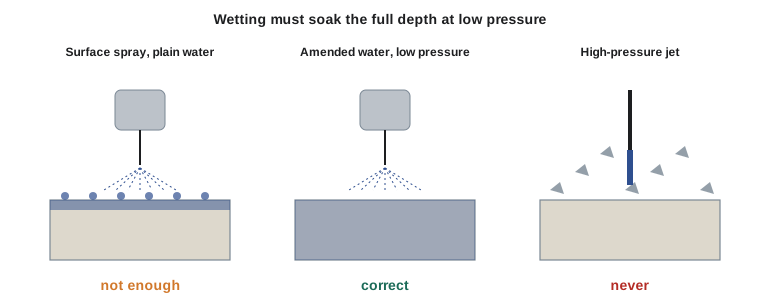
Wetting has limits and side effects that must be managed:
- Electrical hazards. Lock out and isolate electrical circuits in the work area, and use ground-fault circuit interrupters on temporary power. Water and live wiring do not mix.
- Slips and falls. Wet polyethylene sheeting is extremely slippery. Use slip-resistant footwear covers and keep walkways clear.
- Cold weather. Water can freeze outdoors and in unheated buildings. Plan heating or use approved alternatives.
- Hot surfaces. Water on hot pipes or equipment can cause steam burns and thermal shock. Allow equipment to cool, and isolate it.
- Materials that cannot be wetted. Some materials or locations, such as live electrical equipment, cannot be wetted. These need other controls, such as HEPA-collected tools, glove bags or full enclosures, and the decision must be made by a competent person.
Removing materials intact
Breaking a material releases far more fibers than removing it whole. For non-friable materials this is often the single most important practice. Floor tiles can often be lifted whole with a flat scraper after the adhesive is softened. Asbestos-cement siding and roofing can be removed by drawing nails or cutting fasteners rather than breaking the sheets. Ceiling tiles can be lowered whole. Removed pieces should be lowered, not dropped or thrown, and should be wrapped or bagged promptly.
Choosing tools
Tools that cut, abrade or grind at high speed release the most fibers. Sanders, grinders, abrasive cutting wheels, high-speed saws and rotary hammers can raise fiber concentrations by orders of magnitude.
| Tool or method | Fiber release | Typical rule |
|---|---|---|
| Hand tools on wetted material (scraper, hand saw, nibbler) | Low | Preferred where practicable |
| Hand tools on dry material | Moderate | Higher risk level; avoid where wetting is possible |
| Power tools with shroud and HEPA dust collection | Moderate, controlled at the source | Acceptable with the precautions for the risk level |
| Power tools without dust collection | High | Prohibited for many tasks unless controlled; avoid |
| Sanding, grinding or abrasive blasting | Very high | Do not use on asbestos-containing material except under full high-risk controls |
| Compressed air for cleaning | Very high | Never use on asbestos dust or debris |
| Dry sweeping or ordinary vacuums | High | Never use; use wet methods or a HEPA vacuum |
Where power tools must be used, choose tools designed with a shroud connected to a vacuum with a HEPA filter, and keep the shroud in contact with the surface. Many drill manufacturers offer dust extraction accessories. A HEPA vacuum is a vacuum with a filter that captures at least 99.97 percent of particles of 0.3 micrometers, the most penetrating size; ordinary shop vacuums blow fine fibers straight through and out the exhaust.
Glove bags and mini-enclosures
For small jobs on pipe insulation, a glove bag isolates the work from the room. A glove bag is a heavy plastic bag with built-in gloves and a tool pouch, sealed around a section of pipe. The worker reaches through the gloves to wet and strip the insulation inside the bag, wets the bare pipe and the waste, seals the ends of the remaining insulation, and then collapses and seals the bag for disposal. Glove bags only work on pipes of a size and temperature the bag is designed for, on straight runs or fittings that the bag fits around, and when they are not overfilled; they are not suitable for large or hot pipes or for long runs. A mini-enclosure, a small plastic tent with a single entry and HEPA-filtered exhaust, is another way to isolate a small job such as repairing a section of sprayed ceiling.
Under OSHA, glove bags are a required or permitted control for many Class I and Class III tasks on TSI. The standard sets specific requirements: the bag must be seamless at the bottom, of at least 6-mil plastic, used only once, not used on surfaces hotter than the bag can tolerate, and smoke-tested before use; the bag must be collapsed with a HEPA vacuum before removal from the pipe.
Controlling the work area
Fibers that escape the immediate work area can expose other trades, occupants and the public. Basic work area controls apply even to lower-risk tasks:
- Restrict access. Only workers doing the asbestos work should be in the area. Post signs and use barriers or tape.
- Shut down air handling. Turn off and seal air supply and return openings serving the work area so fibers are not spread through the building.
- Protect surfaces. Lay polyethylene drop sheets below and around the work and cover objects that cannot be removed.
- Keep waste contained. Have waste bags or containers ready and bag waste as it is generated.
- No eating, drinking, smoking or chewing in the work area.
- Plan the sequence. Schedule asbestos work when the area is unoccupied, before other trades arrive, or behind barriers.
Clean-up
Clean-up is part of the job, not an afterthought. Debris and settled dust left behind will be disturbed later by other people who do not know it is there. Use these methods:
- Pick up larger debris while it is still wet and place it directly in waste bags.
- Clean surfaces with a HEPA vacuum or with damp cloths or mops, working from top to bottom.
- Fold drop sheets inward on themselves to trap dust, then bag them as asbestos waste.
- Clean tools with damp wipes or a HEPA vacuum before they leave the work area.
- Never use compressed air, dry sweeping or ordinary vacuums.
How controls combine
Like any controls, asbestos controls work together. Each control removes a fraction of what is left by the one before it, so the fractions remaining multiply. The numbers below are illustrative, but they show why no single control is relied on alone for higher-risk work.
uncontrolled = 20.0   # f/cc, illustrative dry scraping of friable material

controls = [
    ("thorough wetting with amended water", 0.95),
    ("hand tools instead of power tools",    0.50),
    ("intact removal, lowered not dropped",  0.40),
]
remaining = uncontrolled
for name, reduction in controls:
    remaining *= (1 - reduction)
    print(f"after {name:38s} {remaining:6.3f} f/cc")
print(f"overall reduction {1 - remaining / uncontrolled:.2%}")

for apf, resp in ((10, "half-facepiece, APF 10"), (50, "full-facepiece APR, APF 50")):
    print(f"inside {resp}: about {remaining / apf:.4f} f/cc if worn and fitted correctly")

# Amended water: surfactant concentrate needed for a sprayer tank (label ratio, illustrative)
tank_litres = 8
ratio = 1 / 200        # 1 part concentrate to 200 parts water, from the product label
print(f"concentrate for an {tank_litres} L tank: {tank_litres * ratio * 1000:.0f} mL")after thorough wetting with amended water 1.000 f/cc after hand tools instead of power tools 0.500 f/cc after intact removal, lowered not dropped 0.300 f/cc overall reduction 98.50% inside half-facepiece, APF 10: about 0.0300 f/cc if worn and fitted correctly inside full-facepiece APR, APF 50: about 0.0060 f/cc if worn and fitted correctly concentrate for an 8 L tank: 40 mL
In this example, wetting does most of the work, but the combination reduces exposure by about 98.5 percent. Even so, the remaining concentration during the task is above the 0.1 f/cc limit, which is why higher-risk work also needs enclosures and respirators. The surfactant ratio in the last lines is illustrative; always follow the product label.
Worked problem
Planning a small removal
A maintenance crew must remove about 0.4 square meters (about 4 square feet) of asbestos pipe insulation from a straight run of cold-water pipe in a basement to replace a valve. What source controls should the plan include?
Show solution
- Confirm the pipe is cold and isolated, and lock out nearby electrical circuits that could get wet.
- Shut down and seal any air supply or return openings in the basement, restrict access and post signs.
- Use a glove bag sized for the pipe, smoke-tested for leaks, with amended water to soak the insulation fully inside the bag.
- Strip the insulation with hand tools inside the bag, wet the bare pipe and seal the cut ends of the remaining insulation with encapsulant.
- Collapse the bag with a HEPA vacuum, seal it, place it in a labeled waste bag, and clean the area with damp wipes and a HEPA vacuum.
Answer: Glove bag removal with amended water, area controls and HEPA clean-up controls the release. Under OSHA this is Class III repair work using local isolation, with a competent person, trained workers and respirators unless a negative exposure assessment exists.
Common mistakes
MistakeSpraying the surface lightly and starting to scrape.
InsteadSoak the material through its full depth with amended water before disturbing it.
MistakeUsing a high-pressure washer to wet material.
InsteadUse a low-pressure fine spray; high pressure breaks material apart.
MistakeCleaning up with a shop vacuum.
InsteadUse a HEPA vacuum or wet methods; ordinary vacuums exhaust fine fibers.
MistakeThrowing removed sheets into a bin from height.
InsteadLower materials intact and bag or wrap them promptly.
MistakeLeaving the building ventilation running.
InsteadShut down and seal air handling serving the work area.
Summary and key terms
- Source controls that stop fibers from becoming airborne prevent the most exposure.
- The first question is whether the work needs to disturb asbestos at all.
- Wet materials thoroughly with amended water applied at low pressure, and manage electrical, slip and cold hazards.
- Remove materials intact wherever possible, and lower rather than drop them.
- Prefer hand tools; use power tools only with shrouds and HEPA dust collection; never sand, grind, dry sweep or use compressed air.
- Glove bags and mini-enclosures isolate small jobs; work area controls protect others.
- Clean up with HEPA vacuums and damp methods, and remember that controls combine by multiplying the fractions remaining.
- Amended water
- Water with a wetting agent added so that it penetrates asbestos materials.
- Surfactant
- A chemical that reduces the surface tension of water, helping it soak into materials.
- HEPA vacuum
- A vacuum with a filter capturing at least 99.97 percent of particles at 0.3 micrometers.
- Shroud
- A cover on a power tool connected to a dust collector to capture dust at the source.
- Glove bag
- A sealed plastic bag with built-in gloves used to remove small amounts of pipe insulation.
- Mini-enclosure
- A small enclosure with HEPA-filtered exhaust for isolating a small job.
- Intact removal
- Removing a material whole, without breaking it, to minimize fiber release.
- Encapsulant
- A coating that binds asbestos fibers and seals the surface of a material.
- Drop sheet
- Polyethylene sheeting laid under and around work to catch debris.
- Ground-fault circuit interrupter (GFCI)
- A device that cuts power quickly when current leaks to ground, protecting workers in wet areas.
Practice problems
Work each problem on paper first, then reveal the answer to check.
Why is amended water used instead of plain water?
Show answer
It penetrates asbestos materials better because the surfactant lowers surface tension.
Why should water never be applied at high pressure?
Show answer
High pressure breaks material apart and scatters fibers.
Name three hazards created by wetting.
Show answer
Electrical hazards, slippery surfaces, freezing, and steam burns on hot surfaces.
What is the advantage of removing floor tiles intact?
Show answer
Breaking the tiles releases far more fibers.
What does a HEPA filter capture?
Show answer
At least 99.97 percent of particles at 0.3 micrometers.
Name three methods that must never be used on asbestos dust.
Show answer
Compressed air, dry sweeping and ordinary vacuums.
When is a glove bag not suitable?
Show answer
On pipes too large or hot for the bag, on long runs, or when it would be overfilled.
Three controls remove 90, 50 and 50 percent in turn. What is the overall reduction?
Show answer
1 − (0.1 × 0.5 × 0.5) = 97.5 percent.
Why must air handling serving the work area be shut down?
Show answer
To prevent fibers from spreading through the building.
How should drop sheets be removed?
Show answer
Fold them inward to trap dust and bag them as asbestos waste.
Lesson quiz · 5 questions
Score 60% or more to complete this lesson.
Create a free account to save your progress, take quizzes and earn a certificate.