
HSE-246 · Lesson 6 of 12 · 25 min
OSHA work classes I to IV
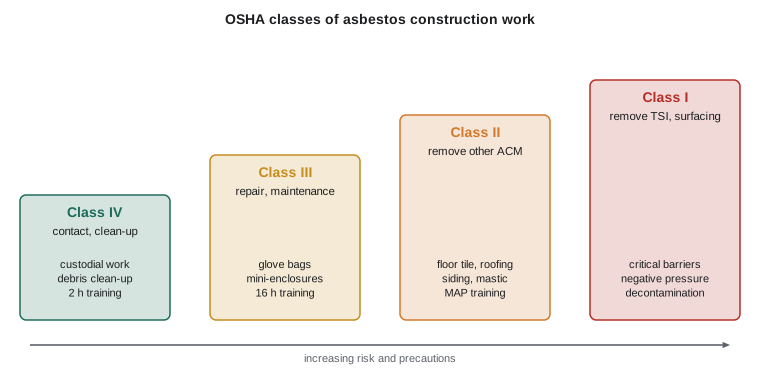
OSHA's construction and shipyard standards do not treat all asbestos work the same. They sort tasks into four classes according to the type of material and the nature of the work, and they set controls, respirators, training and supervision to match. Class I is the highest-risk removal work and Class IV the lowest-risk custodial work. This lesson explains each class, the controls OSHA prescribes, the role of the competent person and the negative exposure assessment, and how to classify a task.
Class I work
Class I work is the removal of thermal system insulation (TSI) and surfacing asbestos-containing material or presumed asbestos-containing material. It includes stripping pipe and boiler insulation and removing sprayed fireproofing and acoustic plaster. Class I work releases the most fibers. OSHA requires it to be supervised by a competent person trained to the EPA Model Accreditation Plan supervisor level, done inside a regulated area with critical barriers or isolation, using wet methods, HEPA vacuums and prompt clean-up, with no high-speed abrasive tools without HEPA collection and no compressed air. For larger jobs, the standard requires one of the listed control methods, commonly a negative pressure enclosure, and ventilation that moves contaminated air through HEPA filtration.
Class II work
Class II work is the removal of asbestos-containing material that is not TSI or surfacing material. Examples are removing vinyl and asphalt floor tiles, sheet flooring, ceiling tiles, asbestos-cement siding and roofing, roofing felts, mastics and construction mastics. OSHA prescribes specific work practices for common Class II tasks. For flooring, that means wet methods, no sanding of tiles or backing, removing tiles intact where possible and using wet methods or approved chemical methods for mastic. For roofing, it means wet or intact methods, no high-speed abrasive saws without dust collection, and lowering material to the ground rather than dropping it. For cement siding and panels, it means removing them intact and not cutting, abrading or breaking them unless necessary. A competent person trained to the supervisor level must supervise, and workers must have MAP-equivalent worker training.
Class III work
Class III work is repair and maintenance in which ACM or PACM, including TSI and surfacing material, is likely to be disturbed. Examples are cutting out a section of pipe insulation to repair a valve, drilling through a sprayed ceiling to hang a support, or removing a small area of drywall with asbestos joint compound to reach a wire. OSHA requires wet methods, local isolation such as glove bags or mini-enclosures when TSI or surfacing material is disturbed by cutting, abrading or breaking, and impermeable drop cloths and barriers. Class III workers need training equivalent to the EPA 16-hour operations and maintenance course.
Class IV work
Class IV work is maintenance and custodial activity in which employees contact but do not disturb ACM or PACM, and activities to clean up dust, waste and debris resulting from Class I, II and III work. Examples are cleaning floors in a building with asbestos floor tile, picking up debris left from a removal, or entering a ceiling space with asbestos fireproofing to change a light without touching the fireproofing. OSHA requires wet methods, HEPA vacuums, prompt clean-up and disposal of debris in leak-tight containers, and at least 2 hours of awareness training. Workers in areas with damaged or deteriorating ACM must be protected as if doing Class III work.
| Feature | Class I | Class II | Class III | Class IV |
|---|---|---|---|---|
| Work | Remove TSI and surfacing ACM | Remove other ACM | Repair and maintenance disturbing ACM | Contact without disturbance; clean-up |
| Supervision | Competent person, MAP supervisor level | Competent person, MAP supervisor level | Competent person | Competent person |
| Training | MAP worker (32 h) | MAP worker or task-specific equivalent | 16 h operations and maintenance | 2 h awareness |
| Isolation | Critical barriers, often negative pressure enclosure | Barriers and specific work practices | Glove bags, mini-enclosures, drop cloths | HEPA vacuum and wet methods |
| Respirator without NEA | Required; supplied air for larger jobs | Required | Required for TSI or surfacing material | As exposure requires |
The negative exposure assessment
Several OSHA requirements, including respirators and some daily monitoring, can be relaxed if the employer has a negative exposure assessment (NEA) showing that employee exposure will be below the PEL and excursion limit during the specific operation. An NEA can be based on objective data showing the task cannot exceed the limits, on exposure monitoring from the past 12 months for the same task under similar conditions by equally trained workers, or on initial monitoring at the start of the job. For Class I work, an NEA can only be based on monitoring from comparable jobs, and some controls are required regardless. Until an NEA exists, the employer must assume the work could exceed the limits and protect workers accordingly.
Classifying a task
Classification is the job of a competent person who knows the regulation, the material and the method. A simple decision function shows the logic, but real classification must follow the full regulation, including the special cases this sketch leaves out.
# Simplified sketch of OSHA class logic (not a substitute for 29 CFR 1926.1101)
def osha_class(activity, material):
    tsi_or_surfacing = material in ("TSI", "surfacing")
    if activity == "remove":
        return "Class I" if tsi_or_surfacing else "Class II"
    if activity == "repair":       # repair or maintenance likely to disturb ACM
        return "Class III"
    if activity in ("contact", "cleanup"):
        return "Class IV"
    return "assess"

tasks = [
    ("strip pipe lagging in a boiler room",   "remove", "TSI"),
    ("remove sprayed fireproofing",           "remove", "surfacing"),
    ("remove vinyl floor tile and mastic",    "remove", "flooring"),
    ("remove cement siding",                  "remove", "cement"),
    ("cut out lagging to repair a valve",     "repair", "TSI"),
    ("drill through a sprayed ceiling",       "repair", "surfacing"),
    ("wet-mop floors with asbestos tile",     "contact", "flooring"),
    ("clean up debris after a removal",       "cleanup", "debris"),
]
for name, act, mat in tasks:
print(f"{name:38s} {osha_class(act, mat)}")strip pipe lagging in a boiler room Class I remove sprayed fireproofing Class I remove vinyl floor tile and mastic Class II remove cement siding Class II cut out lagging to repair a valve Class III drill through a sprayed ceiling Class III wet-mop floors with asbestos tile Class IV clean up debris after a removal Class IV
The output shows that the class depends on both the activity and the material. Removing pipe lagging is Class I, while cutting out a small section of the same lagging to repair a valve is Class III. Small-scale work can still be dangerous, so Class III work on TSI must use glove bags or mini-enclosures, and the competent person must decide whether the job is truly small-scale repair or a removal that belongs in Class I.
The role of the competent person and supervisor
OSHA requires a competent person for all asbestos construction work. For Class I and II, the competent person must have MAP supervisor-level training; for Class III and IV, operations and maintenance training. The competent person classifies the work, sets up regulated areas, checks controls, ensures monitoring and inspects the work: at least once per shift for Class I, and often enough to detect changes for Classes II and III. Reclassification is needed whenever the method, material or quantity changes, for example when a planned intact removal starts breaking the material.
Worked problem
Choosing a method to lower the risk
An electrician must run new cable through a washroom wall lined with asbestos-cement board. The plan calls for three 2-inch holes. What are the options, and how do they affect the class of work?
Show solution
- Drilling holes in ACM to run cable is repair and maintenance that disturbs ACM, so it is Class III work regardless of the tool.
- Class III requires wet methods and local isolation; a drill with a shroud connected to a HEPA vacuum, plus wetting and a drop cloth, controls the release at the source.
- If no negative exposure assessment exists, the electrician must wear a respirator, and the area must be marked and controlled.
- In every case, clean up with a HEPA vacuum or damp wipes and dispose of debris as asbestos waste.
Answer: The job is Class III. Using a shrouded HEPA drill with wetting, a drop cloth, a respirator and HEPA clean-up meets the requirements and keeps exposure low.
Common classification questions
Can a removal be split into small repairs? No. The competent person must look at the whole job. Repeated small cuts into TSI that together amount to removal are Class I work, and For TSI and surfacing material, OSHA limits a Class III disturbance to the amount of material that can be contained in one standard-sized glove bag or waste bag; anything more is not Class III.
What if the material is presumed rather than tested? PACM is treated as asbestos-containing, and the work is classified accordingly. Testing can rebut the presumption, using the sampling and analysis procedures in the standard, and the results must be kept as long as they are relied on.
Who decides when the answer is unclear? The competent person, often advised by an accredited consultant. When in doubt, choose the higher class until the question is resolved.
Class II work practices in more detail
OSHA's construction standard sets out specific work practices for the most common Class II tasks. For vinyl and asphalt flooring, it prohibits sanding of flooring or its backing, requires wet methods when removing resilient sheeting, prohibits dry sweeping, requires mechanical chipping to be done in a negative pressure enclosure unless an NEA exists, and requires tiles to be removed intact where possible. For roofing, it requires roofing material to be removed in an intact state where feasible, wet methods where feasible and safe, HEPA dust collection on power cutters, prompt bagging or wrapping of material, and lowering rather than dropping material from the roof. For cement siding, shingles and transite panels, it requires removal intact where possible, wetting, and avoiding cutting, abrading or breaking. Gaskets must be removed intact or wetted and placed promptly in a disposal bag. When these practices cannot be followed, the employer must use other controls approved in the standard and, in many cases, treat the work with Class I controls.
Project specifications often add to these practices, for example requiring negative pressure enclosures for all floor tile removal or setting monitoring triggers. The contractor must meet both the standard and the specification, and supervisors should read the specification before work starts. Specifications also define who has authority to stop the work and what happens when results exceed a trigger, and many name an independent consultant or project monitor who represents the owner on site. Knowing these rules before the job starts avoids arguments in the middle of an abatement, and it makes clear that the competent person's duty to stop unsafe work is never overridden by the schedule.
Common mistakes
MistakeCalling a removal small-scale repair to avoid Class I controls.
InsteadRemoval of TSI or surfacing material is Class I regardless of how it is described.
MistakeKeeping the original classification when the method changes.
InsteadReclassify whenever the method, material or quantity changes.
MistakeUsing untrained workers for Class II removal.
InsteadClass II work requires MAP-equivalent training and a trained competent person.
MistakeAssuming low-risk work needs no precautions.
InsteadEven the lowest level requires wetting, controlled methods and proper clean-up.
MistakeRelying on a contractor from another province to know local rules.
InsteadCheck the classification and precautions of the jurisdiction where the work is done.
Summary and key terms
- OSHA classifies asbestos construction work as Class I, II, III or IV.
- Class I is removal of thermal system insulation and surfacing material, the highest-risk work.
- Class II is removal of other ACM, such as flooring, roofing, siding and mastic, with prescribed work practices.
- Class III is repair and maintenance that disturbs ACM, using wet methods and local isolation.
- Class IV is contact without disturbance and clean-up of debris, with at least 2 hours of training.
- A negative exposure assessment can relax some requirements, but only when properly supported.
- A competent or qualified person must classify work before it starts and reclassify when conditions change.
- Class I work
- Removal of thermal system insulation and surfacing ACM or PACM.
- Class II work
- Removal of ACM that is not TSI or surfacing material.
- Class III work
- Repair and maintenance in which ACM or PACM is likely to be disturbed.
- Class IV work
- Maintenance and custodial contact with ACM without disturbing it, and clean-up of debris.
- Regulated area
- An area where asbestos work is done, with access limited to authorized, protected persons.
- Critical barrier
- Plastic sheeting sealing openings so that fibers cannot leave the work area.
- Negative exposure assessment (NEA)
- A demonstration that exposure during a task will be below the PEL and excursion limit.
- Glove bag
- A plastic bag with built-in gloves sealed around a pipe to remove small amounts of insulation.
- Mini-enclosure
- A small enclosure built around a small work area to contain fibers.
- Competent person
- A person trained to identify asbestos hazards and authorized to take corrective action.
Practice problems
Work each problem on paper first, then reveal the answer to check.
Give two examples of Class I work.
Show answer
Stripping pipe or boiler insulation; removing sprayed fireproofing or acoustic plaster.
Give two examples of Class II work.
Show answer
Removing floor tile and mastic; removing asbestos-cement siding or roofing.
Give two examples of Class III work.
Show answer
Cutting out lagging to repair a valve; drilling through a sprayed ceiling to hang a support.
What training is required for Class IV work?
Show answer
At least 2 hours of awareness training.
What is a negative exposure assessment?
Show answer
A demonstration, from objective data, recent comparable monitoring or initial monitoring, that exposure will be below the PEL and excursion limit.
How can the choice of method reduce the risk level?
Show answer
Controls such as wet methods and HEPA collection reduce exposure and may support a negative exposure assessment.
When must a task be reclassified?
Show answer
When its method, material or quantity changes.
How often must the competent person inspect Class I work?
Show answer
At least once per shift.
Which classes require MAP supervisor-level training for the competent person?
Show answer
Class I and Class II.
Why must even low-risk work use controls?
Show answer
Any disturbance releases some fibers and asbestos has no known safe level.
Lesson quiz · 5 questions
Score 60% or more to complete this lesson.
Create a free account to save your progress, take quizzes and earn a certificate.